Atal Setu Effect: How the Mumbai Trans Harbour Link Is Reshaping Navi Mumbai Flat Prices (2026 Investor Map)

Atal Setu Effect: How the Mumbai Trans Harbour Link Is Reshaping Navi Mumbai Flat Prices (2026 Investor Map)
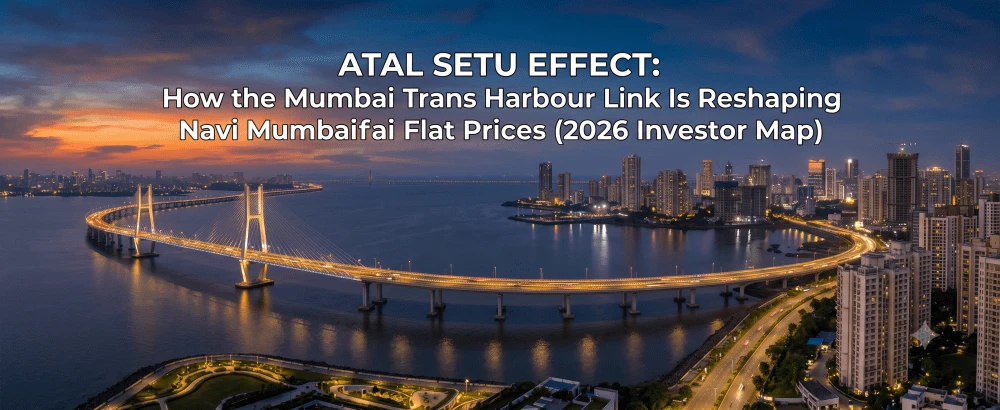
Infrastructure rarely moves property prices in a straight line - but every so often a single project redraws the map. In Mumbai, that project is Atal Setu. The 21.8-kilometre sea bridge, officially named the Atal Bihari Vajpayee Sewri–Nhava Sheva Atal Setu, and formally the Mumbai Trans Harbour Link (MTHL), has done something no metro line or flyover could: it has collapsed the distance between South Mumbai and the Navi Mumbai mainland from a two-hour crawl to a 20-minute drive. For flat buyers, that is not a commuting story - it is an appreciation story.
This is a forward-looking investor's map of the Atal Setu effect: what the bridge is, how it has already moved Navi Mumbai flat prices, and - most importantly - which micro-markets are positioned to grow next as the corridor around it matures. If you are buying a flat in the Mumbai Metropolitan Region in 2026 with a three-to-five-year horizon, this is the infrastructure story you cannot afford to ignore.
What Is Atal Setu (MTHL)?
Atal Setu is India's longest sea bridge - a six-lane, 21.8-kilometre elevated corridor running from Sewri on the Mumbai island to Chirle near Nhava Sheva on the Navi Mumbai mainland. Operational since early 2024, the bridge is the physical spine of a much larger connectivity vision that ties together South Mumbai, Navi Mumbai, the new airport, and the Mumbai–Pune Expressway.
The headline number tells the story: travel time between South Mumbai and the Navi Mumbai–Panvel belt has dropped from roughly two hours to about 20–25 minutes. Overnight, neighbourhoods that felt like distant satellite towns became a short drive from the city's financial core. When a bridge does that, it does not just save commuters time - it rewrites the value equation of every flat within reach of its landing points.
Crucially, Atal Setu does not operate in isolation. It plugs directly into the Navi Mumbai International Airport (NMIA), operational since December 2025, and connects onward to the Mumbai–Pune Expressway and the emerging Coastal Road network. The combined effect is a Navi Mumbai that is now genuinely central rather than peripheral - and the property market is repricing accordingly.
The Atal Setu Effect on Navi Mumbai Property Rates So Far
The re-rating has already begun. Since the bridge opened, improved access has driven a measurable jump in demand, with several Navi Mumbai micro-markets seeing rates climb by ₹600–₹1,200 per square foot. More importantly, the bridge has changed buyer psychology: what once felt like a compromise location now reads as a practical, well-connected home base with a direct line to South Mumbai's job centres.
The effect has rippled unevenly, which is exactly what creates opportunity. The nodes closest to the bridge's landing and to the new airport - Ulwe, Dronagiri, and Panvel - have seen the sharpest interest, while established nodes like Kharghar, Vashi, Kopar Khairane, and Airoli have benefited from the broader demand wave and improved onward connectivity. For a buyer, the key is to read where the re-rating is early versus where it is already substantially priced in. The rest of this guide is that map.
The Investor Map: Which Micro-Markets Grow Next
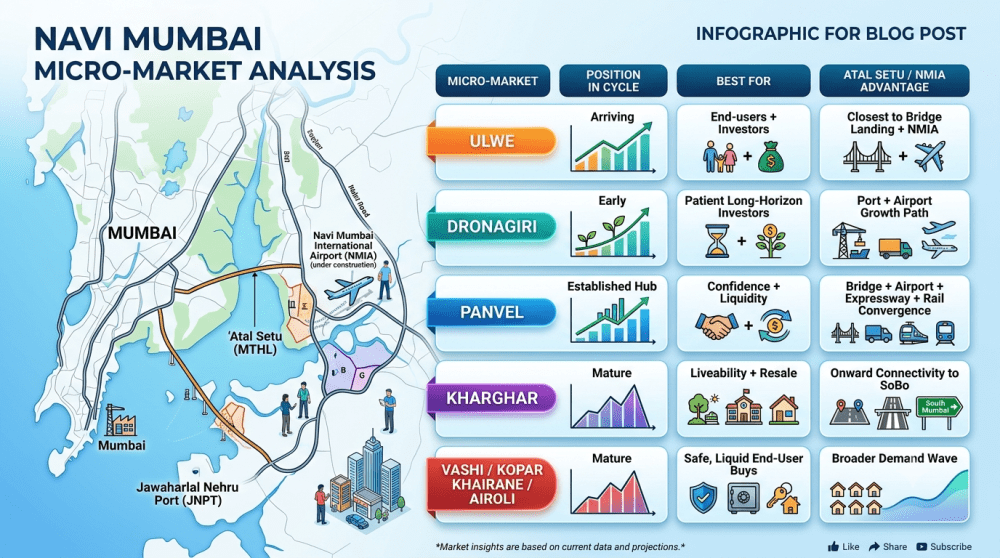
- Ulwe - The Bridgehead Beneficiary: Ulwe sits closest to the Atal Setu landing and the NMIA, and it has been the single biggest beneficiary of the corridor. Built on a planned sector grid, Ulwe offers organised infrastructure and a spread of 1, 2, and 3 BHK flats. With the bridge live and the airport operational, Ulwe has moved from "emerging" to "arriving" - and while part of the premium is now in the price, the node still trades below the mature Vashi–Kharghar belt, leaving room as social infrastructure catches up. It is the clearest end-user-plus-investor play on the map.
- Dronagiri - The Early-Cycle Bet: Dronagiri is Ulwe's less-developed neighbour, closer to the JNPT/Nhava Sheva port and the Sewri–Nhava Sheva landing. It is earlier in its cycle - lower entry prices, thinner social infrastructure today, but directly in the path of port-led and airport-led growth. For a patient investor with a longer horizon and an appetite for a developing node, Dronagiri offers the largest potential upside on the corridor, provided you buy a well-built, MahaRERA-registered project and are comfortable holding through the infrastructure maturing.
- Panvel - The Connectivity Convergence Point: Panvel is where everything converges: Atal Setu, the NMIA, the Mumbai–Pune Expressway, and the suburban rail network all meet here. That makes Panvel the most connectivity-rich node in the entire southern MMR, and it supports a deep, liquid flat market across budget and mid-premium segments. For buyers who want the confidence of an established, multi-modal hub rather than a still-developing sector, Panvel is the anchor choice - and its liquidity makes resale easier than in earlier-cycle nodes.
- The Established Belt - Kharghar, Vashi, Kopar Khairane, Airoli: The mature Navi Mumbai nodes - Kharghar, Vashi, Kopar Khairane, and Airoli - are not the sharpest appreciation plays anymore, but they remain the safest. They offer the fullest social infrastructure, the deepest rental and resale demand, and the least execution risk. Atal Setu strengthens their onward connectivity to South Mumbai, sustaining demand. These are the choices for a buyer who prioritises liveability and liquidity over maximum upside.
Atal Setu Micro-Market Map at a Glance
How to Play the Atal Setu Corridor: A Buyer's Framework
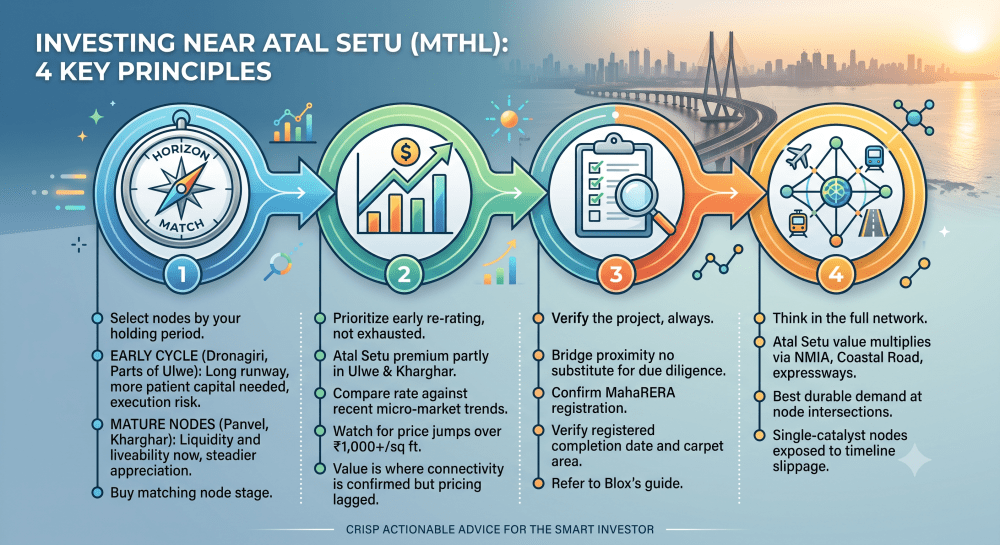
- Match the node to your horizon. The early-cycle nodes (Dronagiri, parts of Ulwe) offer the biggest runway but need patience and carry more execution risk. The mature nodes (Panvel, Kharghar) offer liquidity and liveability now, with steadier appreciation. Buy the node whose stage matches how long you intend to hold.
- Prioritise nodes where the re-rating is early, not exhausted. Part of the Atal Setu premium has already arrived in Ulwe and Kharghar. Compare a flat's rate against its micro-market's own recent trend - if it has already jumped ₹1,000+/sq ft purely on the bridge story, much of the near-term upside may be spent. The value sits where connectivity is confirmed but pricing has lagged.
- Verify the project, always. A game-changing bridge nearby is no substitute for due diligence. Confirm the project's MahaRERA registration, the registered completion date, and the carpet area before booking. Infrastructure is the tailwind; a clean, registered, well-built flat is the boat. (See Blox's MahaRERA project-search guide for the ten-minute routine.)
- Think in the full network, not one bridge. Atal Setu's value multiplies because it connects to NMIA, the Coastal Road, and the expressway. Nodes that sit at the intersection of two or more of these - Panvel above all - carry the most durable demand. Single-catalyst nodes are more exposed to timeline slippage.
The Wider Corridor: Why Atal Setu Is More Than a Bridge
The reason the Atal Setu story has legs is that the bridge is one piece of a converging infrastructure grid, not a standalone project. On the Navi Mumbai side, it feeds directly into the Navi Mumbai International Airport, operational since December 2025, which is itself a demand magnet for the surrounding nodes. It connects onward to the Mumbai–Pune Expressway, opening up the Panvel–Khopoli axis, and ties into the emerging Coastal Road network on the Mumbai side, which improves the onward journey once you cross the bridge. Planned enhancements like the Nerul–Uran suburban line and proposed water-transport links add further layers.
For a flat buyer, this convergence matters because it makes the demand durable rather than a one-off spike. A single-catalyst location can stall if its one project slips; a node sitting at the intersection of a bridge, an airport, and an expressway has multiple independent reasons for demand to keep building. That is why Panvel and Ulwe - which benefit from several of these at once - sit at the top of the investor map, while nodes riding a single catalyst carry more timeline risk.
Risks and What Could Slow the Story
No infrastructure thesis is risk-free, and honest buyers price the downside. The social-infrastructure lag is the biggest near-term caveat in the newer nodes - Dronagiri and parts of Ulwe still need schools, hospitals, and retail to fully mature, and until they do, everyday liveability trails the connectivity. Supply overhang is another: when a corridor gets hot, developers launch aggressively, and an oversupplied micro-market can see prices plateau even with strong infrastructure. Toll costs and usage patterns on the bridge also shape how much of the promised commute benefit actually accrues to daily commuters. None of these negates the Atal Setu thesis, but they argue for buying quality projects in nodes with genuine end-user demand, rather than chasing the cheapest unit on the map.
The Bottom Line for MMR Flat Buyers
Atal Setu is the rare piece of infrastructure that has genuinely redrawn a city's property map. By turning a two-hour journey into a 20-minute drive and plugging Navi Mumbai directly into South Mumbai, the new airport, and the expressway network, it has re-rated an entire belt of flat micro-markets - and the process is far from over. Ulwe is the arriving beneficiary, Dronagiri the early-cycle bet, Panvel the connectivity anchor, and the mature Kharghar–Vashi belt the safe liquid choice.
The winning move is to match the node to your horizon, target where the re-rating is early rather than exhausted, and verify every project's MahaRERA registration before you commit. Explore MahaRERA-registered flats across the Atal Setu and NMIA corridor on blox.xyz, and read our Flats Near Navi Mumbai International Airport guide alongside this investor map to see the full connectivity picture before you buy.
Frequently Asked Questions
How has Atal Setu affected Navi Mumbai property prices?

Which Navi Mumbai locality is the best buy after Atal Setu?
Is it too late to benefit from the Atal Setu property boom?

Get in Touch
Let our experts help you answer your questions

 +91
+91


Get in Touch
Let our experts help you answer your questions
+91