Baner Real Estate 2026: Property Prices, Metro Line 3 Connectivity & Complete Flat Buyer's Guide

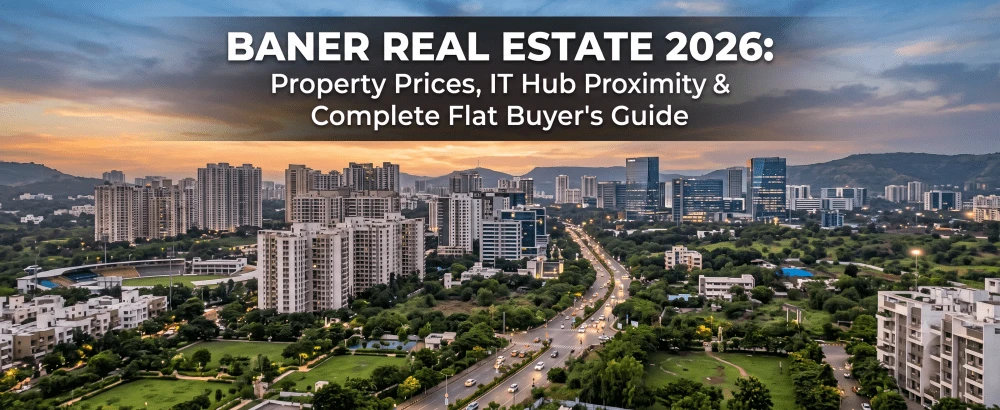
If you've been researching Baner Pune as a place to buy your next flat, 2026 is turning out to be the year this micro-market finally gets the recognition it deserves. Sitting between Pune's established core and the Hinjewadi IT corridor, Baner has quietly delivered some of the strongest capital appreciation numbers in the city while the Pune Metro Line 3 construction has moved from promise to reality. For anyone comparing a flat in Pune, Baner now sits at the intersection of connectivity, IT-hub proximity, and price headroom that's becoming harder to find in neighbouring Aundh or Pashan.
This guide breaks down everything a flat buyer needs before shortlisting Baner: current price bands, the Metro Line 3 timeline and its measurable effect on property values, a locality-by-locality comparison, the flat configurations delivering the best return, and the documentation checklist you'll need before you sign. This is written specifically for buyers purchasing flats and apartments for end-use or investment - not for anyone exploring plots, land, or rental yield plays, since those follow entirely different rules and risks.
Why Baner Is Pune's Fastest-Appreciating Micro-Market in 2026
Baner's investment case rests on a simple structural fact: it is the last relatively affordable, well-developed micro-market before prices cross into Aundh and Pashan territory, where rates have already pushed past ₹15,000 per sq ft for comparable inventory. That positioning - a genuine "next in line" locality with an established social infrastructure - is exactly what has driven Baner's price trajectory over the past three years.
Independent market trackers report that flat rates in Baner have risen by roughly 8.3% over the last year, 32.2% over three years, and close to 55% over five years - an annualized appreciation rate of 8-12%, comfortably ahead of Pune's citywide average. Two forces are compounding this: the Pune Metro Line 3 corridor construction, which runs directly through the Baner-Balewadi stretch, and Baner's continuing pull as a residential base for IT and consulting professionals who work in Hinjewadi but want a more established, amenity-rich neighbourhood to live in.
For a buy flat in Pune decision in 2026, that combination of transit-driven appreciation and IT-hub proximity is difficult to replicate elsewhere in the city at Baner's current price point.
Baner Property Prices 2026: Complete Area-Wise Breakdown
Baner is not a single price band - it spans budget resale stock, mid-range ready-to-move inventory, and a genuine premium segment around Baner Hill and the low-density pockets closer to the Mula-Mutha riverfront. Here's how the market breaks down as of mid-2026:
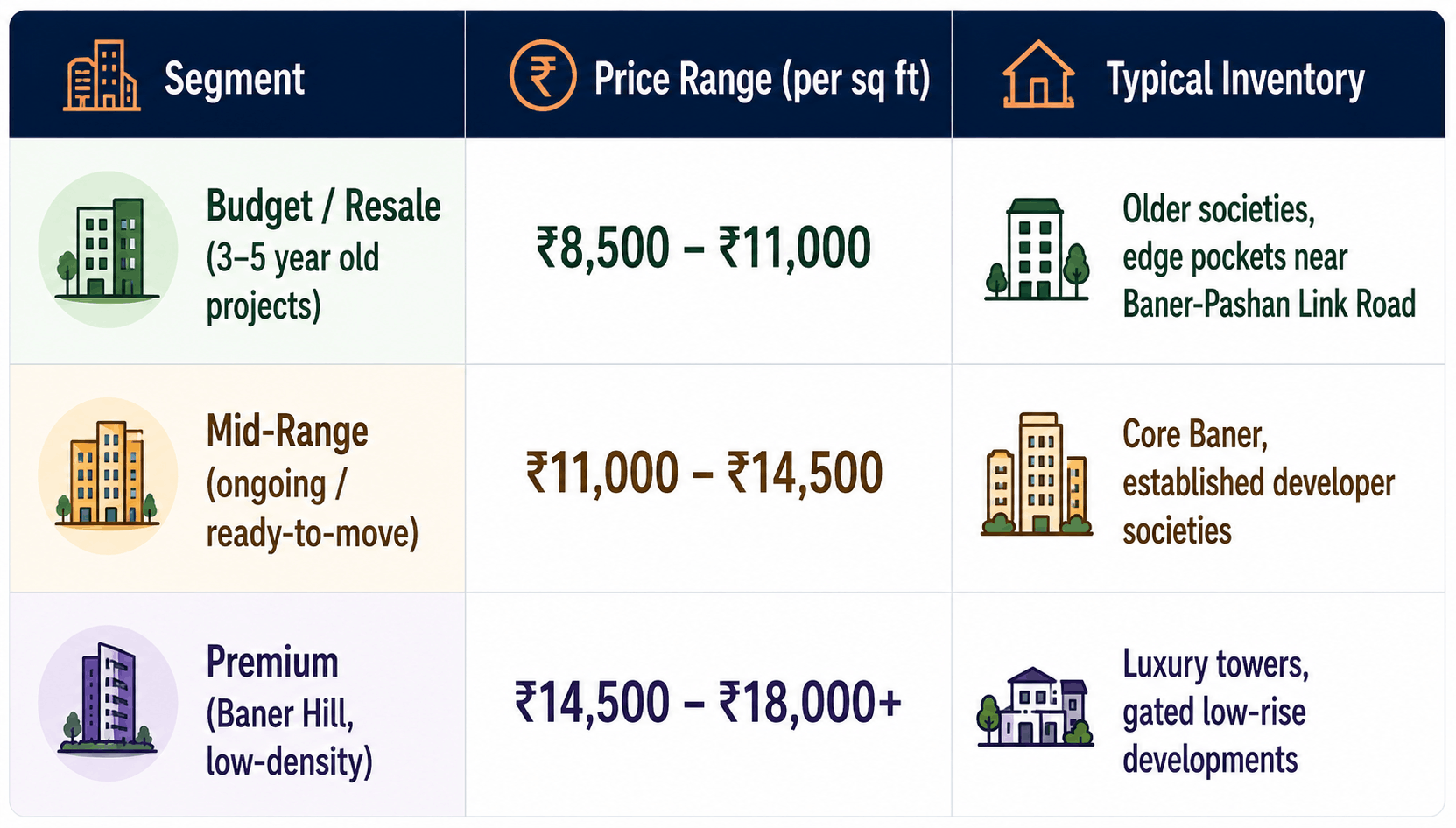
A realistic transaction-level view for 2026 looks like this: ₹9,500–₹11,500 per sq ft for select resale in edge pockets, ₹11,500-₹13,500 per sq ft for core Baner in strong, well-maintained societies, and ₹13,500-₹16,000+ per sq ft for premium micro-locations and low-density projects. For a typical 2BHK flat in Baner (900-1,050 sq ft carpet-plus-loading), this translates to a total ticket size roughly between ₹1.05 crore and ₹1.5 crore depending on the project and floor.
Compare this to Pune's citywide average pune flat price, and Baner sits meaningfully above budget micro-markets like Hadapsar or Pimpri Chinchwad, but still well below Koregaon Park or Kalyani Nagar - occupying exactly the mid-premium slot that appeals to upgrading IT professionals and NRI buyers who want quality without paying Aundh-level rates.
Pune Metro Line 3 and Baner: How Rapid Transit Is Reshaping Flat Demand
The single biggest catalyst for Baner's 2026 price story is Pune Metro Line 3 - the Hinjewadi-Civil Court corridor that runs directly through Baner and Balewadi. This is not a distant, speculative project anymore. The Hinjewadi-to-Baner section, roughly 11.4 km across 12 stations, has moved through advanced testing, with public operations for this section expected between December 2025 and January 2026, and full commercial operations across the entire corridor targeted for May 2026.
For flat buyers, the practical impact is straightforward: once operational, a Baner-to-Hinjewadi commute that currently eats up 25-40 minutes in peak traffic could shrink to under 10 minutes by metro. That is a transformational change for the roughly 350,000-plus IT professionals who work out of Hinjewadi's Rajiv Gandhi IT Park - home to Infosys, Wipro, TCS, Cognizant, and dozens of other technology employers - and who currently either live in Hinjewadi itself (denser, more traffic-choked) or commute in from Baner and beyond.
Market data already reflects this: Baner and neighbouring Balewadi have recorded a 15-20% increase in property prices since the metro project's announcement alone, well before trains have started running commercially. Buyers who purchase before the May 2026 full commissioning are, in effect, buying ahead of a connectivity re-rating that has historically pushed metro-adjacent Indian residential markets up by another 10-15% in the 12-18 months after a line goes fully live.
Supporting this, the PMRDA-targeted Savitribai Phule Pune University Square flyover is also on track for 2026 completion, improving surface connectivity between Shivajinagar and the Baner-Balewadi corridor - a second, complementary infrastructure tailwind alongside the metro.
Baner vs Aundh vs Pashan vs Balewadi: Where Should You Buy a Flat?
Baner doesn't exist in isolation - it's part of a connected cluster of west Pune localities that buyers routinely cross-shop. Here's how they compare for a flat buyer in 2026:
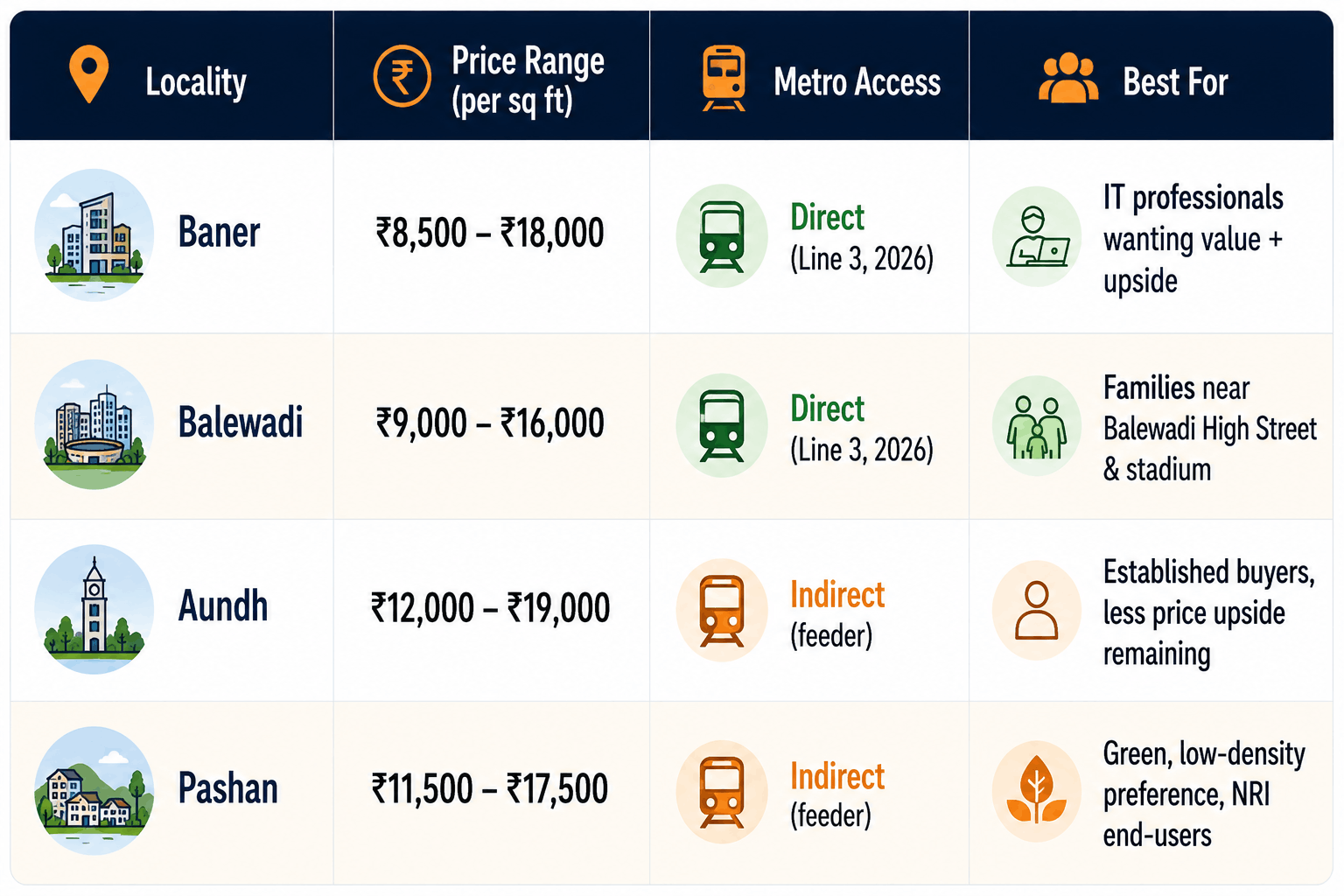
The takeaway for most buyers: Aundh and Pashan are mature markets where much of the appreciation has already been captured. Baner and Balewadi, still mid-cycle on their metro-driven re-rating, offer more room to run - which is exactly why search interest and transaction volumes in Baner have been climbing faster than its established neighbours through 2025 and into 2026.
Best Flat Configurations for ROI in Baner
Not every configuration in Baner delivers the same return profile. Based on current absorption trends and resale liquidity:
1BHK flats (450-650 sq ft) are the most liquid resale category, driven by young IT professionals and first-time buyers seeking a 1bhk flat for sale in Pune close to Hinjewadi. These typically range from ₹45 lakh to ₹70 lakh and see the fastest resale turnover, though absolute capital appreciation per unit is naturally lower than larger configurations.
2BHK flats (850-1,100 sq ft) represent the sweet spot for both end-users and investors in Baner. Priced roughly ₹1.05 crore to ₹1.5 crore, this configuration benefits from the widest buyer pool -small families, dual-income couples, and NRI investors all compete for the same inventory, which supports stronger long-term appreciation and easier resale.
3BHK flats (1,250-1,600 sq ft) in Baner's premium pockets, priced from ₹1.8 crore upward, cater to established families and senior professionals who value space and are less price-sensitive. Appreciation here tracks the broader market but with lower liquidity - expect a longer resale timeline if you need to exit quickly.
Top Residential Projects and Developers in Baner
Baner's project pipeline in 2026 spans the full spectrum from young, ready-to-move mid-range societies to newer premium low-density developments. When shortlisting, buyers should prioritise projects with active RERA registration, established developer track records in the Pune-Pimpri Chinchwad Metropolitan Region, and clear possession timelines - particularly for under-construction inventory, where Baner still has a meaningful share of new launches responding to metro-driven demand.
Given the pace of new project announcements following the Metro Line 3 progress, it's worth cross-checking any shortlisted project's RERA registration number directly on the MahaRERA portal before booking - a step covered in detail in Blox's for Maharashtra flat buyers.
Baner's Social Infrastructure: Schools, Healthcare & Retail
One reason Baner commands a premium over pure IT-hub localities like core Hinjewadi is the depth of social infrastructure it has built up over the past decade - a factor that matters as much as price or connectivity for families evaluating a long-term flat purchase.
On education, Baner sits within easy reach of established schools such as Vibgyor High, Podar International, and Euro School, along with several CBSE and ICSE-affiliated institutions along the Baner-Pashan Link Road - a meaningful consideration for family buyers who might otherwise have to commute their children into Aundh or the central city.
Healthcare access is another differentiator. Baner is home to established multi-specialty facilities including Manipal Hospital and Jupiter Hospital, both of which draw patients from across west Pune - a factor that keeps search volumes for these two hospital brands consistently high alongside general Baner locality searches, and one that buyers researching the area for elderly parents or young families should weigh alongside price data.
On retail and lifestyle, Baner's stretch along the Baner-Pashan Link Road has developed into one of Pune's more active high-street corridors, with a mix of national F&B chains, boutique retail, and co-working spaces that cater directly to the IT and consulting workforce living in the area. This is a meaningfully different lifestyle proposition than the more work-focused, still-maturing retail landscape in core Hinjewadi - another reason many professionals choose to live in Baner and commute to Hinjewadi rather than the reverse.
Home Loan and Financing Considerations for Baner Flat Buyers
Financing a flat in Baner works within the same lending framework as the rest of Pune, but a few points are specific to this micro-market. Because Baner spans both older resale stock and active under-construction projects, the loan process differs meaningfully depending on which category you're buying into.
For ready-to-move flats in Pune, most nationalised and private banks disburse the full loan amount upfront against the registered sale agreement, provided the society is formed and the Occupancy Certificate is on file. Loan-to-value ratios typically run 75–80% of the agreement value for flats priced above ₹75 lakh, which covers the bulk of Baner's mid-range and premium inventory.
For under-construction projects in Pune, lenders disburse in construction-linked tranches tied to the developer's RERA-filed milestone schedule - another reason confirming RERA registration matters before booking. Buyers should also factor in that under-construction financing usually carries a "pre-EMI" phase (interest-only payments on the disbursed amount) until possession, which can meaningfully affect monthly cash flow planning for a ₹1.2–1.8 crore Baner 2BHK or 3BHK purchase.
NRI buyers financing a Baner flat through an NRE/NRO account should also budget for TDS implications on resale purchases and confirm their chosen bank's NRI home loan desk has an active branch presence in Pune, since document verification for NRI applicants often takes longer than for resident Indian buyers. Blox's dedicated [NRI flat buyer's guide](https://blox.xyz/blog) walks through the account structuring, power-of-attorney, and repatriation rules that apply specifically to NRI purchases in Maharashtra.
Documentation & RERA Checklist Before You Buy in Baner
Buying a flat in Baner follows the same Maharashtra-wide legal framework as any Pune or Mumbai purchase, but a few checks are especially relevant for this corridor given the volume of both resale and under-construction inventory:
- MahaRERA registration - confirm the project's RERA number and cross-check the promised possession date against the RERA-filed timeline, not just the developer's marketing brochure.
- Society formation status - for older resale flats (pre-2021 possession), verify whether a cooperative housing society has been formed and whether outstanding maintenance dues exist.
- Title and encumbrance check - obtain a 30-year title search report, particularly important in the Baner-Pashan belt where agricultural-to-residential land conversion history varies project to project.
- Stamp duty and registration - Maharashtra's current stamp duty applies uniformly; budget roughly 6-7% of the agreement value for stamp duty plus registration charges.
- Occupancy Certificate (OC) - for ready-to-move flats, always confirm OC has been issued before final payment; possession without OC can complicate home loan disbursement and resale later.
Frequently Asked Questions
Is Baner a good locality to buy a flat for long-term investment in 2026?

What is the average pune flat price in Baner compared to Hinjewadi?
How much does a 2BHK flat in Baner cost in 2026, and what should first-time buyers budget for beyond the sale price?
Buying a Flat in Baner? Start With Blox

Get in Touch
Let our experts help you answer your questions

 +91
+91


Get in Touch
Let our experts help you answer your questions
+91