Byculla Real Estate 2026: Property Prices, Heritage Redevelopment & Complete Flat Buyer's Guide to Central Mumbai's Most Underrated Locality

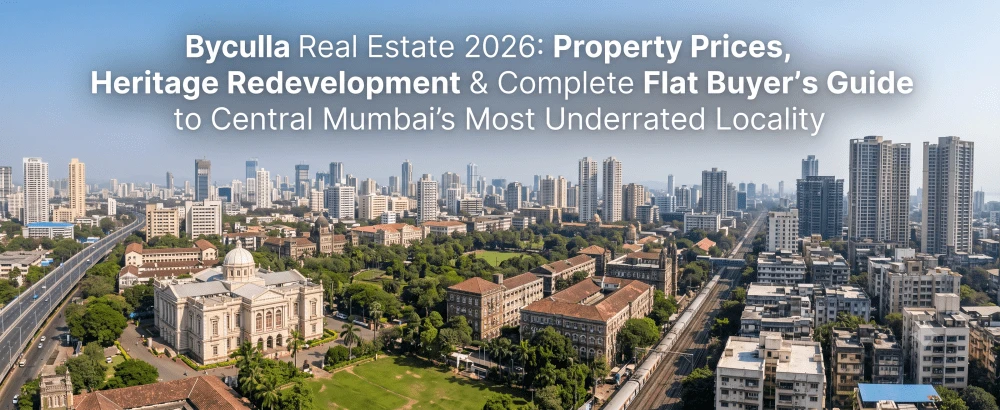
Byculla in 2026: Central Mumbai's Heritage Redevelopment Opportunity
Byculla sits at the geographic heart of Mumbai - seven minutes from CST by Central Railway, eight minutes from Dadar, and within a 15-minute cab of Lower Parel's mill-district commercial corridor. In any other city, this location at this price point would not exist. In Mumbai, it does - because Byculla's stock is dominated by pre-1940 cessed buildings, tenanted chawls, and industrial-era structures that have suppressed new supply for decades.
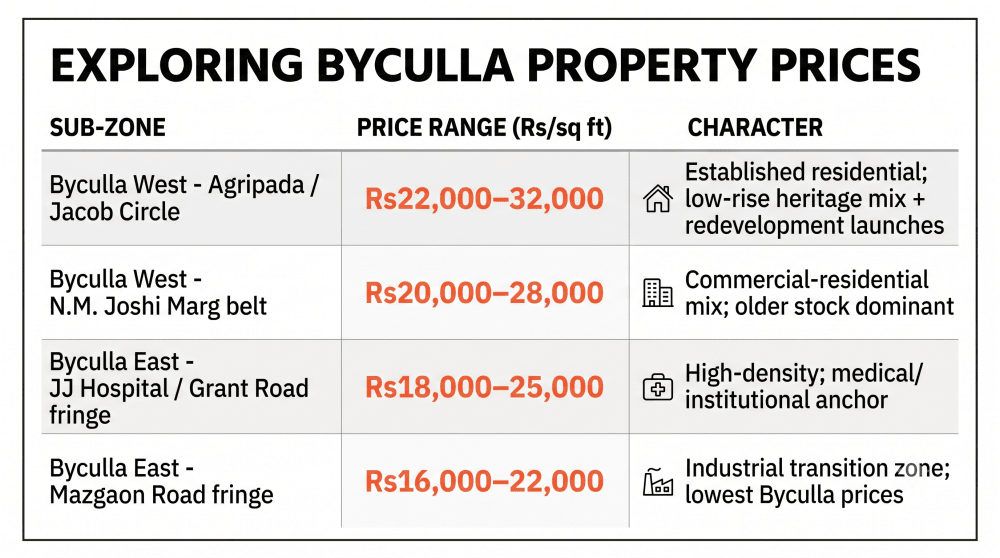
In 2026, that supply constraint is starting to release. DCR 33(7) and 33(9) old-building redevelopment - the same mechanism that powers Dadar and Matunga's flat market - is transforming pockets of Byculla West and Byculla East into modern residential towers. The buyers entering today are purchasing ahead of that transformation: at Rs18,000–28,000 per sq ft, Byculla is 30–40% cheaper than Dadar West (Rs38,000–55,000/sq ft) and 20–30% cheaper than Prabhadevi - with identical Central Railway connectivity.
The locality divides cleanly into two belts: Byculla West (Agripada, Jacob Circle, N.M. Joshi Marg - the more premium, quieter residential belt) and Byculla East (JJ Hospital fringe, industrial pockets - higher commercial density, more affordable, slower appreciation). Both are served by Byculla Central Railway station.
Byculla Property Prices in 2026
Flat Prices by Configuration (2026)
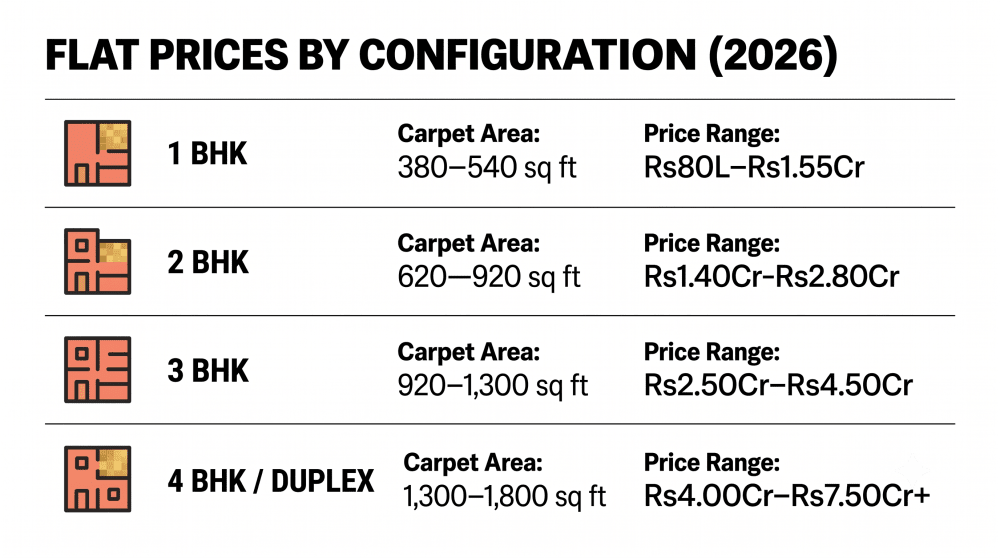
At these prices, Byculla delivers Central Railway access (CST 7–10 min; Dadar 8 min; Thane 32–36 min) at a 30–40% discount to the comparable Dadar East belt. For buyers who need central Mumbai connectivity but are priced out of Dadar or Lower Parel, Byculla is the structural alternative.
Rail & Road Connectivity
Central Railway - Byculla Station:
- CST (South Mumbai): 7–10 min
- Dadar: 8–10 min
- Kurla: 20–22 min
- Thane: 32–36 min
- Pune (long-distance services from CST/Dadar - Byculla is one stop from CST)
Road Access:
- Dr. Ambedkar Road / Byculla Bridge: connects to South Mumbai (Marine Lines, Churchgate) and north toward Lower Parel via S.K. Bole Marg
- Eastern Freeway onramp via Mazgaon: BKC 20–25 min, Chembur 15–18 min
- JJ Flyover/Nagpada junction: connects to the Bhendi Bazar–CST corridor
Future Rail Upgrade:
Metro Line 3 (Aqua Line) - the nearest station is Grant Road (approx. 1.5–2 km from Byculla West). For Byculla West residents, an auto/cab to Grant Road Metro gives BKC access in 22–26 min total - a meaningful improvement for BFSI professionals post-Metro 3 operational expansion.
The Heritage Redevelopment Thesis
Byculla's defining real estate dynamic in 2026 is the old-building redevelopment pipeline. The locality has one of Mumbai's highest concentrations of MHADA-cessed buildings (pre-1940 structures under rent control) - and the DCR 33(7)/33(9) redevelopment mechanism is converting these, slowly but systematically, into new residential towers.
How this creates a buyer opportunity:
- Below-market new launches: Developers redeveloping cessed buildings are constrained by rehabilitation obligations (tenant floors) and plot FSI - so they price competitively relative to Dadar or Lower Parel at similar stages
- Heritage density premium: Once a building is redeveloped, the locality's character improves - each new tower makes the next one marginally easier to sell, creating a compounding liveability improvement
- Appreciation inflection: Byculla has historically lagged Dadar and Lower Parel by 5–10 years on appreciation. That lag is now closing, driven by the redevelopment pipeline and South Mumbai buyers priced out of Worli/Prabhadevi
Buyer checklist for redevelopment projects:
- Verify MHADA/BMC cessed-building status of the original structure - confirm it is not subject to lingering litigation
- Confirm IOD (Intimation of Disapproval) / CC (Commencement Certificate) from BMC
- Check MahaRERA registration: maharerait.mahaonline.gov.in - confirm RERA-registered possession date
- For SRA component buildings: verify MahaRERA SRA registration separately; confirm title is freehold post-project completion, not leasehold
- Structural audit of adjacent buildings if purchasing in an older redevelopment cluster
Byculla's Neighbourhood Context: The Liveability Assets
- Jijamata Udyan (Byculla Zoo): One of Mumbai's oldest public parks and zoo complexes - a 2,500+ sq ft green anchor in an otherwise dense urban belt. Park-adjacent addresses in Byculla West command a 5–10% premium for proximity.
- JJ Hospital: One of Maharashtra's largest government hospitals - an employment anchor for the medical and pharmaceutical sector in Byculla East. Drives consistent rental demand from medical staff and students.
- Bhendi Bazar SRA Cluster Redevelopment: The large-scale SRA redevelopment of Bhendi Bazar (immediately adjacent to Byculla's western edge) is approaching completion phases. As this project adds new modern residential stock adjacent to Byculla, it raises the baseline liveability and infrastructure quality of the entire belt.
- Cultural density: Byculla has a distinctive old-Mumbai cultural character - the Byculla market (wholesale fish and vegetable), the Crawford Market corridor, the Bohri Mohalla food lane. For buyers who want central Mumbai lived experience (not just a dormitory), Byculla delivers it at a discount to Dadar or Lower Parel.
Byculla vs Comparable Central Mumbai Micro-Markets
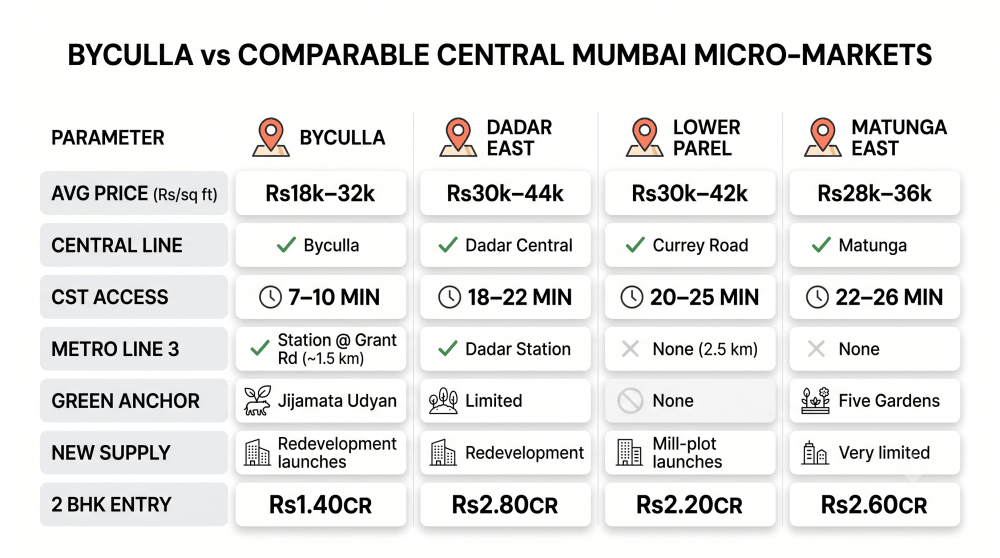
Byculla's price-to-connectivity ratio is the strongest in central Mumbai. The 2 BHK entry at Rs1.40Cr vs Rs2.80Cr in Dadar East, for near-identical Central Railway travel times to CST and Dadar, is the clearest statement of the Byculla value proposition.
Who Is Buying in Byculla?
- Profile 1 - South Mumbai proximity buyer (Rs1.40Cr–Rs3.00Cr): A buyer who works at CST-area offices (banking, trading, law, government), is priced out of Worli, Dadar, and Lower Parel, and wants to minimise commute. Byculla delivers CST in 7–10 min at the lowest price point in that travel time radius.
- Profile 2 - Redevelopment investor (Rs80L–Rs1.55Cr): Buying a 1 BHK in a new launch during early stages of project completion, targeting 25–35% appreciation by possession + 2 years as the redevelopment cycle completes in the locality.
- Profile 3 - Yield investor: Rental yield in Byculla: 3.2–4.5%. Byculla East (JJ Hospital fringe) achieves higher yields (4.0–4.5%) due to medical sector rental demand; Byculla West lower (3.2–3.8%) because of the price base. Yields are among the highest for Central Mumbai at this price point.
Investment Outlook: 2026–2031
The Byculla thesis is heritage redevelopment + South Mumbai proximity + supply unlock.
The 5-year appreciation story hinges on three compounding factors:
- Redevelopment pipeline completions (2026–2030): Each project that completes in Byculla raises the price floor and makes the next launch easier. The compounding effect is most visible in the first 3 years post-launch.
- Bhendi Bazar SRA completion: The large-scale adjacent project improves the entire western fringe's liveability - directly affects Byculla West's pricing ceiling.
- Dadar-Prabhadevi repricing: As Dadar West approaches Rs55,000–62,000/sq ft by 2028 and Prabhadevi approaches Rs52,000–60,000/sq ft, Byculla's discount becomes unsustainable - gap-closure appreciation follows.
5-year appreciation estimate: 28–38% blended.
- Byculla West (Agripada/Jacob Circle): 30–38% (proximity to Bhendi Bazar SRA uplift + Dadar gap-closure)
- Byculla West (N.M. Joshi Marg belt): 26–34%
- Byculla East (JJ Hospital fringe): 22–30% (yield play; slower capital appreciation)
- Byculla East (Mazgaon fringe): 18–26% (industrial transition; longest timeline)
Rental yield: 3.2–4.5%. Top yield sub-zone is Byculla East near JJ Hospital. Capital appreciation play is concentrated in Byculla West near Agripada and Jacob Circle.
Frequently Asked Questions
What are property prices in Byculla in 2026?

How far is Byculla from CST and Dadar?
Is Byculla safe for residential investment in 2026?
What is the Bhendi Bazar SRA project and how does it affect Byculla?
Is Byculla a good investment compared to Dadar or Lower Parel?
What types of new flats are available in Byculla?
How does Byculla compare to Matunga East for flat buyers?

Get in Touch
Let our experts help you answer your questions

 +91
+91


Get in Touch
Let our experts help you answer your questions
+91