CBD Belapur Real Estate 2026: Complete Guide to Property Prices, Investment & Living in Navi Mumbai's Business Hub

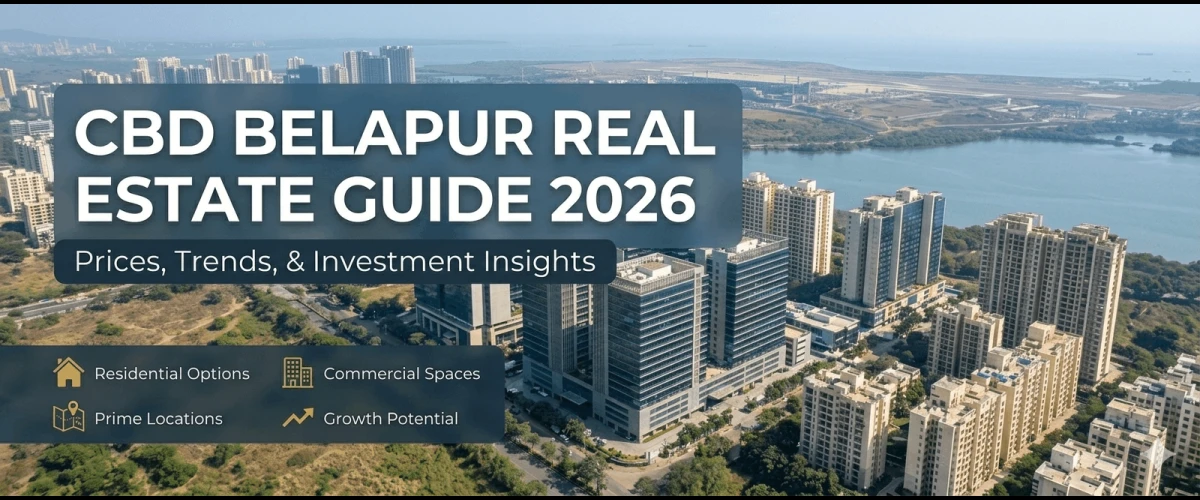
If you've been tracking Navi Mumbai's property market, you already know that the action has historically centred on Kharghar, Panvel, and Ulwe. But there's one node that serious investors and end-users keep circling back to — CBD Belapur. It's Navi Mumbai's administrative and commercial spine, home to government offices, corporate parks, reputed schools, and a railway station that connects you to CST in under an hour. In 2026, with the Navi Mumbai International Airport (NMIA) now operational and the Navi Mumbai Metro expanding, CBD Belapur is entering a new phase of growth.
This guide covers everything you need to know: sector-by-sector price data, rental yields, top projects, investment case, and practical advice for buyers and investors.
What Is CBD Belapur? A Quick Orientation
CBD stands for Central Business District — and Belapur was planned and developed by CIDCO (City and Industrial Development Corporation) as Navi Mumbai's administrative nerve centre. It is one of the 14 nodes of Navi Mumbai, located along the Harbour Line of the Central Railway between Seawoods-Darave and Kharghar.
The node spans sectors 1 through 25, covering a mix of government quarters, residential societies, commercial offices, and educational institutions. The Belapur CBD Railway Station is a key transit hub and now also serves as the terminus for Navi Mumbai Metro Line 1, giving the node exceptional multi-modal connectivity.
Key facts about CBD Belapur in 2026:
• Distance from CST (Church Gate): ~35 km, approximately 50–55 minutes by fast train
• Distance from NMIA (Navi Mumbai International Airport): ~18–20 km
• Distance from Bandra-Kurla Complex (BKC): ~30 km via Sion-Panvel Highway
• Municipal authority: Navi Mumbai Municipal Corporation (NMMC)
• CIDCO node: Yes — planned township with clear sector demarcations
CBD Belapur Property Prices in 2026: Sector-Wise Breakdown
One of the most important things buyers miss when evaluating CBD Belapur is the price variation across sectors. Sectors closer to the railway station and commercial zones command a premium, while interior residential sectors offer more value.
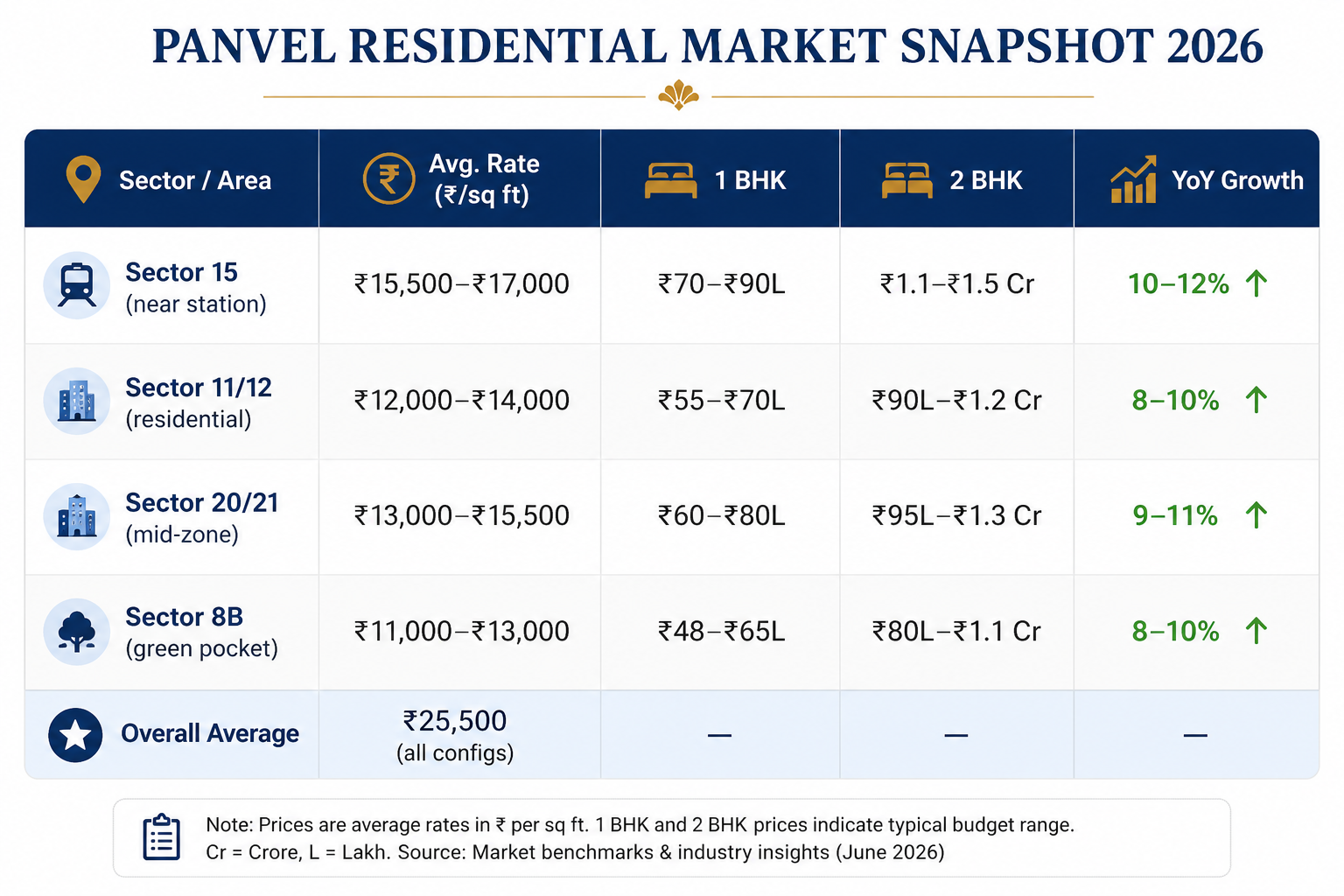
Note:- The overall average of ₹25,500/sq ft reflects a blend including premium 3BHK and luxury units. Standard 1–2 BHK residential units trade in the ₹11,000–₹17,000/sq ft range
Year-on-year price growth of 11.6% outpaces most of the Mumbai Metropolitan Region (MMR) average for 2025–26, making Belapur one of the better-performing nodes in Navi Mumbai.
Why CBD Belapur Is a Strong Real Estate Market in 2026
1. The NMIA Effect
The Navi Mumbai International Airport became operational on 8 October 2025 — a milestone that has reshaped investor sentiment across the entire Navi Mumbai corridor. CBD Belapur sits approximately 18–20 km from the airport, making it well-positioned to capture the growing ecosystem of airport-adjacent businesses, logistics companies, and airline employees who need housing near the airport but prefer an established residential neighbourhood.
Post-NMIA, property consultants have noted a 15–20% uptick in inquiries for Navi Mumbai nodes including Belapur, Kharghar, and Nerul. The airport's Phase 1 handles 20 million passengers per year — setting the stage for sustained demand over the next decade.
2. Navi Mumbai Metro Line 1 Terminus
Belapur CBD is the southern terminus of the Navi Mumbai Metro Line 1, which runs 23.4 km from Belapur to Pendhar. This fully elevated metro makes Belapur a direct high-frequency, air-conditioned transit hub connecting:
• Seawoods
• Kharghar
• Taloja
• Pendhar
For residents, this means a seamless commute to multiple employment zones without depending solely on the Harbour Line train. Properties near the Belapur Metro Station command a 5–8% premium over equivalent units further from the station.
3. Established Commercial & Office Market
CBD Belapur lives up to its name. The commercial market here is mature — hosting government departments, PSU offices, IT parks, and co-working hubs. Major occupiers in the area include NRI Complex, MIDC zones, and several mid-size IT companies that have set up operations to leverage lower office rents compared to BKC or Andheri.
This employment concentration generates sustained rental demand for residential properties — a key reason why Belapur achieves rental yields ahead of many Mumbai micro-markets.
4. Social Infrastructure: A True Live-Work-Play Node
Belapur scores high on the livability index thanks to its planned CIDCO layout. Key social infrastructure includes:
• Schools: DPS Nerul (10 min), Bharatiya Vidya Bhavan, Orchids International
• Hospitals: Apollo Clinic, MGM Hospital (~5 km), Medicover Hospitals
• Shopping: Inorbit Mall (Vashi, ~12 km), Seawoods Grand Central (15 min drive), Glomax Mall in Kharghar
• Parks & Recreation: Belapur Fort, CIDCO Exhibition Centre, multiple CIDCO-developed gardens
For families prioritising schools and healthcare, Belapur offers a compelling package at lower price points than comparable South Mumbai or Bandra addresses.
Rental Market in CBD Belapur: Yields and What to Expect
For investors, rental yield is often the deciding metric. Here's how Belapur's rental market looks in 2026:
Unit Type | Monthly Rent | Capital Value | Gross Yield |
1 BHK (450–550 sq ft) | ₹18,000–₹28,000 | ₹55–₹85L | 3.5–4.5% |
2 BHK (700–900 sq ft) | ₹30,000–₹50,000 | ₹90L–₹1.4 Cr | 3.8–4.8% |
3 BHK (1,000–1,400 sq ft) | ₹55,000–₹85,000 | ₹1.4–₹2.2 Cr | 3.9–5.0% |
Commercial Unit | ₹45,000–₹1.2L | ₹1–₹3 Cr | 4.5–6.0% |
Demand profile of CBD Belapur renters:
• Corporate employees posted to Navi Mumbai offices
• MIDC workers and IT professionals
• Families seeking good schools at affordable rents compared to Mumbai
• Government employees in the NRI Complex and CIDCO quarters
Vacancy rates for well-maintained 2 BHK units in Belapur remain low — typically under 4 weeks to find a tenant, according to local brokers. The post-NMIA boom has further tightened supply in the ₹30,000–₹50,000 rental bracket.
Top Sectors to Buy In: A Micro-Market Guide
Sector 15 — The Station Zone
The area immediately surrounding the Belapur railway and metro station. Higher prices but maximum liquidity — easiest to rent out and resell. Best for investors who want quick tenancy and strong capital appreciation.
Sector 11 & 12 — Family Residential
Quieter, greener sectors with well-established housing societies. Many CIDCO-built buildings here are older but structurally sound and offer larger carpet areas at lower per-sqft rates.Best for end-users with families.
Sector 20 / 21 — The Mid-Market Sweet Spot
Balanced location — not too close to the station bustle, not too far for convenience. Newer residential projects have come up here with modern amenities.Best for first-time buyers seeking a balance of price and quality.
Sector 8B — The Green Pocket
A relatively quieter, tree-lined sector at the edge of the Belapur node. Lower density and good open space. Best for buyers who prioritise peace and greenery over transit proximity.
Buyer's Guide: Common Mistakes to Avoid in CBD Belapur
Purchasing in a CIDCO-planned township like Belapur has its own set of nuances. Here are the most common mistakes buyers make — and how to avoid them:
Not checking MahaRERA registration Always verify the project's MahaRERA registration number at the official portal (maharera.mahaonline.gov.in). All new developments in Belapur must be registered, and you can track project timelines, approvals, and complaints through this portal.
Confusing carpet area with built-up / super built-up area Post-RERA, developers must quote and sell on carpet area. But some older resale transactions are still quoted in super built-up area, which inflates the apparent price per sqft. Always ask for the carpet area.
Ignoring CIDCO NOC for resale Older CIDCO-allotted properties may have restrictions on resale or transfer without obtaining a CIDCO No Objection Certificate (NOC). Verify with a property lawyer before finalising any resale transaction.
Overlooking floor level and direction In older buildings without lifts, upper floors can be problematic. In newer buildings, higher floors command a premium. East-facing units get morning sun; west-facing units can be uncomfortably warm in summer. Ask your broker about the specific floor and orientation.
Not budgeting for stamp duty and registration In Maharashtra, stamp duty is 5% (men) or 4% (women) for residential property, plus 1% registration charge. On a ₹1 crore flat in Belapur, that's ₹5–₹6 lakh in additional costs — factor this into your budget.
Navi Mumbai vs. CBD Belapur: How Does It Compare?
Node | Avg. Rate (₹/sqft) | Yield | Distance from CST | Key Advantage |
CBD Belapur | ₹11,000–₹17,000 | 4–5% | 50–55 min | Commercial hub, metro terminus |
Kharghar | ₹8,500–₹13,000 | 3.5–4.5% | 60–65 min | Golf course, hill views |
Panvel | ₹6,500–₹10,000 | 3.5–4% | 65–75 min | NMIA proximity |
Nerul | ₹12,000–₹16,000 | 4–4.5% | 45–50 min | Established, lake views |
Ulwe | ₹5,000–₹8,000 | 3–3.5% | 70–80 min | Cheapest, high growth potential |
CBD Belapur positions itself as the premium end of the mid-market in Navi Mumbai — more expensive than Kharghar or Panvel but cheaper than Nerul or Vashi, with a stronger commercial ecosystem that supports both rentals and resale.
Who Should Buy in CBD Belapur in 2026?
Investors: CBD Belapur is a solid buy-and-hold play. Rental yields of 4–5% beat fixed deposits for many investors, capital appreciation is running at 10–12% annually, and NMIA has created a structural tailwind that should persist for the next 5–8 years.
End-Users (working in Navi Mumbai): If your workplace is anywhere in the Navi Mumbai corridor — Vashi, Nerul, Turbhe, Belapur itself — this is an ideal home base. The metro + Harbour Line combination gives you direct access to most employment zones.
Families with children: The combination of good schools, planned green spaces, and a quieter township feel makes Belapur appealing to families who want a Mumbai address without the chaos of the western suburbs.
Upgraders from Kharghar or Panvel: Buyers who entered Navi Mumbai at lower price points 3–5 years ago and have seen their property appreciate may find Belapur's higher-quality infrastructure worth the premium.
Investment Outlook: 2026–2030 Price Forecast
CBD Belapur's price trajectory for the next 5 years looks positive for three compounding reasons:
1. NMIA is fully operational and Phase 2 expansion (targeting 60 million passengers) is already being planned — this guarantees continued infrastructure investment in the entire Navi Mumbai corridor.
2. Navi Mumbai Metro expansion — additional lines connecting Belapur to Thane and further nodes are in planning stages, which will further strengthen connectivity and property values.
3. Office market recovery and expansion — post-pandemic, Navi Mumbai's office market has absorbed significant new supply and demand from IT/ITeS companies looking for more affordable alternatives to BKC. Belapur is a primary beneficiary.
Property consultants project CBD Belapur values to appreciate 40–55% by 2030 from current levels, translating to a compound annual growth rate (CAGR) of roughly 7–9%. Combined with rental income, the total return profile compares favourably with many equity investments.
How to Buy Property in CBD Belapur: A Step-by-Step Checklist
1. Define your budget — Include not just the property price but stamp duty (5%), registration (1%), brokerage (1–2%), and GST on under-construction properties (5% for regular, 1% for affordable).
2. Shortlist sectors based on your use case (investor vs. end-user, connectivity vs. quiet).
3. Verify MahaRERA registration for any under-construction project at maharera.mahaonline.gov.in.
4. Check CIDCO allotment status for older resale properties — some older buildings are still under CIDCO lease.
5. Arrange home loan pre-approval — HDFC, SBI, ICICI, and Axis all have active operations in the Navi Mumbai market and offer competitive rates for properties in NMMC jurisdiction.
6. Conduct physical site inspection — check for construction quality, water supply (NMMC vs. private tanker), parking allocation, and society maintenance.
7. Engage a property lawyer for title verification and to review the sale agreement.
8. Register the property at the Sub-Registrar's Office, Belapur — bring Aadhaar, PAN, and two witnesses.
Final Thoughts: CBD Belapur Is Navi Mumbai's Most Mature Investment
Of all the Navi Mumbai nodes, CBD Belapur represents the best blend of established infrastructure, commercial demand, and forward-looking growth catalysts. It doesn't have the raw land plays of Ulwe or the scenic appeal of Kharghar — but it has something more valuable for serious investors: depth of market, rental demand, and liquidity.
If you're building a property portfolio in Navi Mumbai, or looking for a family home with the best infrastructure in the corridor, CBD Belapur should be on your shortlist in 2026.

Get in Touch
Let our experts help you answer your questions

 +91
+91


Get in Touch
Let our experts help you answer your questions
+91