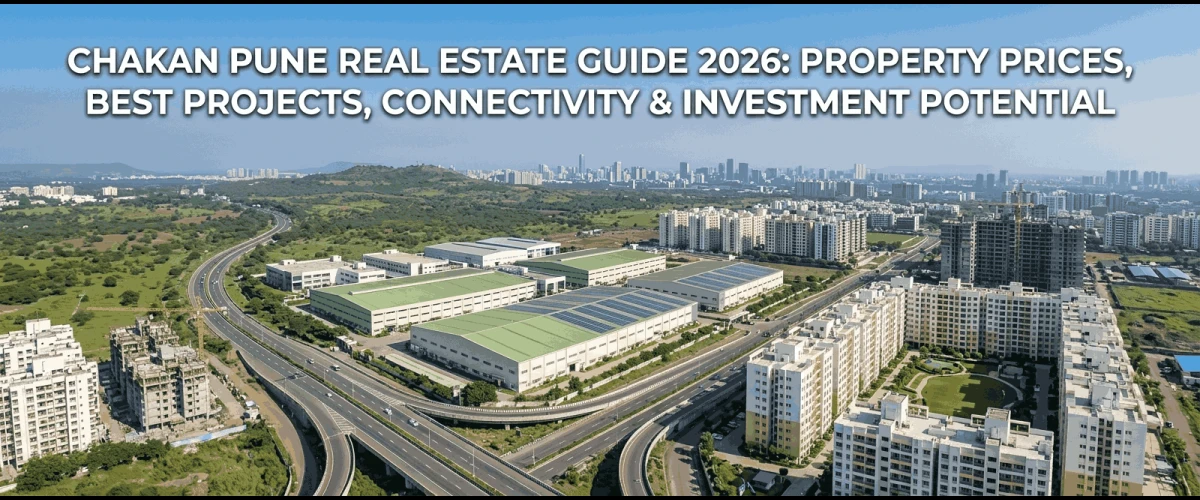
Chakan is, by almost any industrial measure, one of the most important places in western India. More than 150 large enterprises and roughly 3,000 ancillary units operate out of its MIDC estate. Mercedes-Benz, Volkswagen, Bajaj Auto, Mahindra & Mahindra and Hyundai all build vehicles here, and several lakh people draw a salary within a fifteen-kilometre radius. India calls this the country's automobile hub, and that is not a brochure line.
And yet flats changed price by just 2.6% over the past year, and 14.3% over five, while Alandi appreciated far faster and Bhosari posted double-digit growth. World-class employment, third-tier price performance - that gap is the most interesting thing about this market, and any guide that skips it is not being straight with you.
The explanation is oversupply of land-led housing against a workforce that overwhelmingly rents rather than buys, in a town that until recently had no rail connectivity on the horizon. A metro corridor, an elevated highway upgrade and the Pune Ring Road are now changing that. This guide covers what a flat costs in 2026 and which buyers Chakan rewards.
Why Buy Property in Chakan
The first of three concrete pillars is entry price. At roughly ₹4,000 per sq ft, Chakan is among the cheapest formal housing markets in the Pune metropolitan zone. A 2 BHK lands around ₹36 lakh; the equivalent in Moshi costs close to ₹67 lakh and in Baner or Kharadi it crosses ₹1 crore. For a buyer on a ₹40-lakh budget, few places in the district let a loan-funded purchase leave room to breathe.
The second is employment density. Manufacturing jobs are sticky in a way IT jobs are not - a Volkswagen paint shop cannot be shifted to work-from-home or offshored on a cost review - which makes the tenant base structurally durable.
The third is the infrastructure pipeline, which after years of talk has moved into tendering - a shift from "proposed" to "awarded" that is the 2026 story.
Location Snapshot
Chakan sits about 30 km north of central Pune on the Pune–Nashik Highway (NH-60), where it meets the Talegaon-Shikrapur corridor (NH-548D). It falls under the Chakan Municipal Council - not PCMC, not PMC - a detail with real consequences for property tax, water and building approvals.
The distances define the market. Central Pune and the airport both sit around 30 km away, Nigdi 18 km, Hinjewadi IT Park 28 km and Talegaon MIDC 20 km. The nearest railhead is Pune Junction at roughly 32 km. Average rates run about ₹4,000 per sq ft, and stock is dominated by 1 and 2 BHK units.
Read those numbers as a distance problem, not an advantage. Nothing here is close to Pune's white-collar employment or its social anchors; Chakan is close to factories, and that is the whole proposition. Treat it as a self-contained industrial town, and the pricing turns rational.
Property Price Insights
Formal apartment supply trades in a narrow band of ₹3,300 to ₹4,900 per sq ft, averaging roughly ₹4,000. Residential land, the segment that has genuinely performed, runs ₹700-1,700.
The ready-to-move premium of roughly ₹700–900 per sq ft is wider than in mainstream Pune, and that spread is telling: it reflects real wariness about delivery risk in a market where several plotted townships took years to finish promised amenities. With around 218 ready apartments available, an end user can sidestep construction risk entirely.
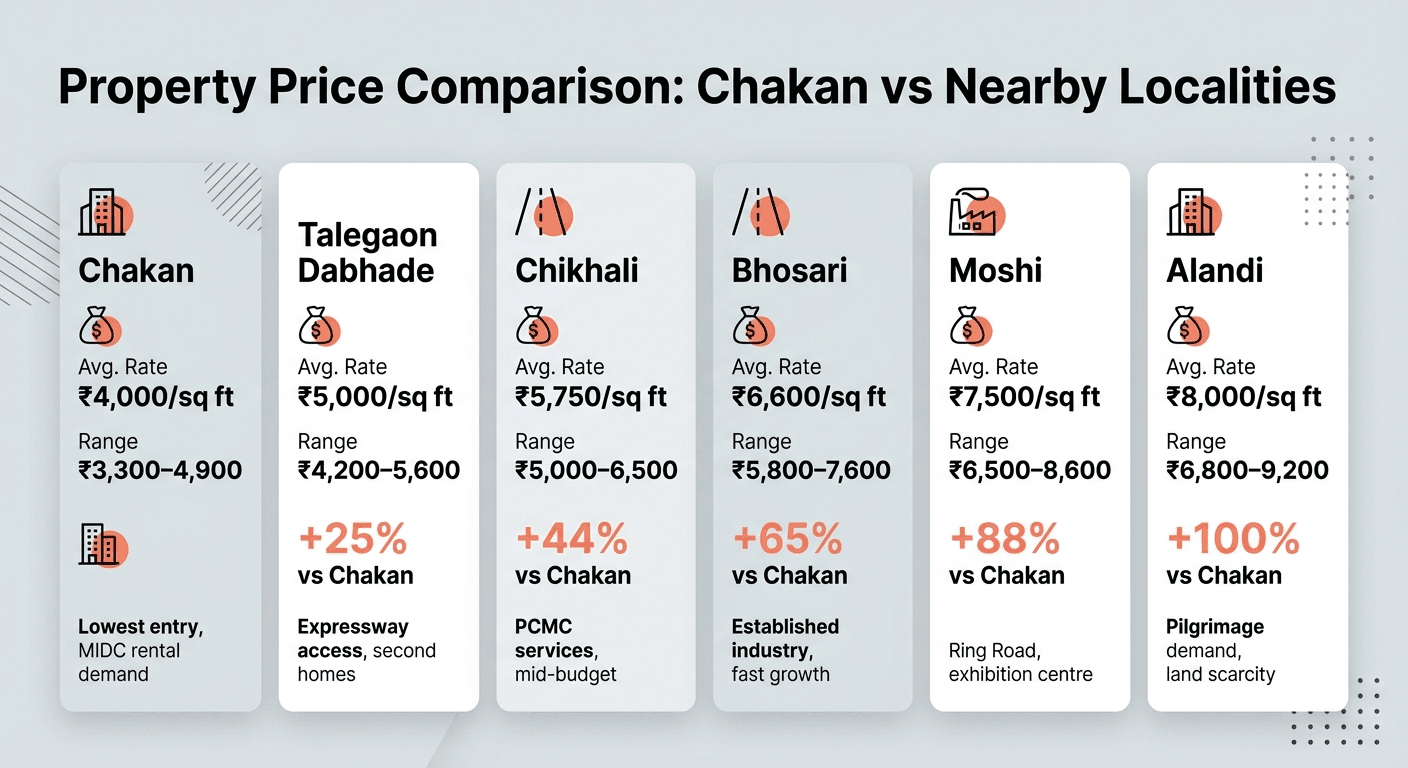
The ladder is unambiguous: you pay a 44% to 100% premium the moment you step into PCMC jurisdiction, and some of that buys real municipal services. But Chikhali, the closest comparator, grew only 2.7% last year - the whole affordable northern belt is digesting supply, so framing Chakan's flatness as a locality-specific failure would be dishonest.
On the trend: flats moved 2.6% over one year, 5.3% over three, 14.3% over five and 31.1% over ten - meaning the five-year figure is roughly flat in real terms and the three-year figure negative. Land tells the opposite story, up 3.6% in a year and 52.6% over three, because developers have bid up raw land while finished apartments compete against a large inventory overhang. Rentals are healthy: a 1 BHK fetches ₹6,000-8,500 a month, yielding 3.5-4% against the 2.5-3% typical of premium Pune.
For a projection, take a ₹36-lakh 2 BHK: at 5% CAGR it reaches ₹46 lakh in five years and ₹59 lakh in ten; at 7%, ₹50.5 lakh and ₹70.8 lakh; at 9%, ₹55.4 lakh and ₹85.2 lakh. The trailing record is closer to 2.7% annualised, so treat 5% as the base case and anything above as contingent on infrastructure arriving.
Connectivity
Road access is the strength. NH-60 runs into Nashik Phata and onward to central Pune, NH-548D carries east–west industrial traffic between Talegaon and Shikrapur, and PMPML buses reach Nigdi, Bhosari and Pune Station. The weakness is plain: no rail, and congestion that turns a 30-km journey into an hour-long crawl at shift change.
Three projects will change that. The Nigdi–Chakan metro - a 40.926-km Purple Line extension with 31 proposed stations, six inside Chakan Municipal Council limits - carries a ₹10,383.89-crore estimate. The Talegaon-Chakan-Shikrapur corridor is further along: MSIDC is delivering 53.2 km on a build-operate-transfer basis, four-lane elevated from Talegaon and six-lane at-grade onward, against a ₹3,123.92-crore tender. The Pune Ring Road's eastern arc links the belt to the Solapur corridor.
Travel times tell the honest story. Talegaon MIDC, 20 km out, takes 25 minutes off-peak and 40-50 at peak; Bhosari at 15 km runs 25 against 45-55; Nigdi at 18 km, 30 against 55-70. The longer runs punish hardest: the airport at 30 km takes 50 minutes off-peak and 75-90 at peak, Pune Junction 55 against 80-95, and Hinjewadi Phase 1 - nominally 28 km - stretches from 45 minutes to a brutal 80-100.
Those peak figures should drive your decision. Someone working inside the MIDC estate has a ten-minute commute and outstanding quality of life for the money; someone commuting to Hinjewadi faces three hours a day, which no price discount compensates. Treat the metro as upside, not an assumption - extensions of this length typically run six to nine years from approval to service.
Social Infrastructure
Day-to-day needs are met locally; specialist needs are not. Podar International School runs two CBSE campuses, at Ambethan and Rohkal, both within 4–6 km of the town centre, alongside Gladiolus English Medium, Global Achievers and Priyadarshani schools. Degree students commute 18–20 km to the Pimpri-Chinchwad and Akurdi college cluster (PCCOE, DY Patil).
Healthcare follows the pattern. Chakan Criticare, Unicare, Surya Multispeciality, Karnika and Dr Joshi Hospital handle routine and emergency care within 2–5 km, but serious cases travel to Aditya Birla Memorial Hospital in Thergaon, 22 km and an hour away.
Retail is functional rather than aspirational: Vishal Center, Vedant Sankul, The Grand Central and Mega Center cover groceries, apparel and banking, with SBI, HDFC and Bank of Maharashtra on the main road. For multiplexes and malls, residents drive 20 km to Elpro City Square in Chinchwad. Open space is the compensation: the Bhama riverfront and surrounding farmland.
Investment Potential
Judge this market on yield first and appreciation second, because that is the order in which it delivers. A ₹36-lakh 2 BHK renting at ₹11,000-13,000 a month grosses roughly 3.7-4.3% before costs - strong where 2.5-3% is normal - and vacancy risk is low. Financed at 8.5%, the rent covers a meaningful share of the EMI, which it does not in Baner or Kharadi.
The appreciation case is a re-rating bet. Land up 52.6% over three years against 5.3% for flats means the input cost of future supply has risen sharply; once inventory clears, replacement-cost economics should pull prices up. The metro is the accelerant, historically re-rating peripheral industrial towns by 20-35% within two years of opening - but a realistic window is 2032–2034.
Pros & Cons
What works. Entry prices are the lowest in the district's formal market, putting ownership within reach on one middle-income salary. Rental yields of 3.5-4% and near-zero vacancy rest on several lakh manufacturing workers who cannot be automated away or shifted to remote work. Road connectivity via NH-60 and NH-548D is good and improving. And the environment - river, open land, low density - is a genuine quality-of-life advantage.
What doesn't. Flat appreciation of 2.6% in a year and 14.3% over five is poor, and negative in real terms over three. The inventory overhang will suppress prices for years. Chakan Municipal Council services lag PCMC standards on water, drainage and roads. There is no rail before roughly 2032, resale liquidity is thin, pollution from industry and highway freight is a daily reality, and commuting to Pune's IT corridors is impractical.
Who Should Buy Here
MIDC and industrial professionals are the natural buyers: a ten-to-thirty-minute commute plus a ₹36-lakh 2 BHK is a combination Pune cannot match.
Yield-focused investors with a 5–10 year horizon should look seriously, provided they underwrite the rent and treat appreciation as optionality rather than the thesis.
First-time buyers priced out of PCMC get a genuine path to ownership, but should prefer ready-to-move stock from a delivered developer over a plotted launch.
NRIs should be selective: MahaRERA compliance is checkable remotely, but thin liquidity means exit can take six to twelve months.
Avoid if you commute daily to Hinjewadi, need an exit within three years, or require tertiary healthcare nearby.
Final Verdict
Chakan rewards clear thinking and punishes wishful thinking. The employment base is world-class, the entry price is the lowest of any formal Pune-district market, and the rental yield is among Maharashtra's best - enough to justify a purchase for the right buyer. But the appreciation record of 2.6% in a year is equally factual, and it says inventory overhang and the absence of rail have stopped industrial strength converting into price growth. The metro and the Talegaon-Chakan-Shikrapur upgrade will eventually change that. Eventually is doing a lot of work in that sentence.




 +91
+91