Colaba Real Estate 2026: South Mumbai's Heritage Peninsula - Prices, Projects & Why India's Most Historic Suburb Defies Market Cycles

Introduction
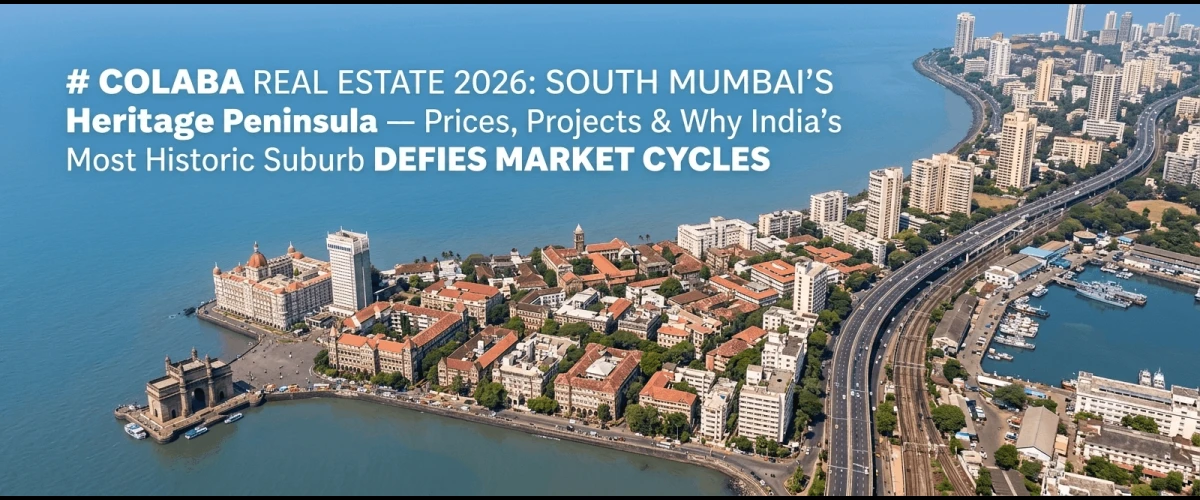
Colaba is not a suburb in any conventional sense. It is a peninsula - Mumbai's southernmost residential tip - where the Gateway of India stands at the waterfront, the Taj Mahal Palace Hotel has defined South Mumbai luxury since 1903, and residential buildings from three different centuries stand within walking distance of each other. The area's address carries a weight that no marketing campaign can manufacture: Colaba is where colonial Bombay was built, and where modern Mumbai's most prestigious residential enclave has remained.
In 2026, Colaba's residential market operates on fundamentally different economics from the rest of Mumbai. New supply is structurally constrained - most of the peninsula's land is developed, with significant portions under heritage protection, naval establishment control, or government ownership. What little new residential inventory exists commands ₹55,000–90,000/sq ft at launch, with ultra-luxury completions reaching ₹1,00,000-1,40,000/sq ft for sea-facing or Taj-adjacent addresses.
For buyers who can afford it, Colaba offers something no other Mumbai suburb can replicate: a self-contained peninsula with South Mumbai's best walking infrastructure, Metro Line 3 (Aqua Line) connectivity to BKC and the airport, and an address that has never lost its premium in a century of Mumbai's urban evolution.
Colaba at a Glance (2026)
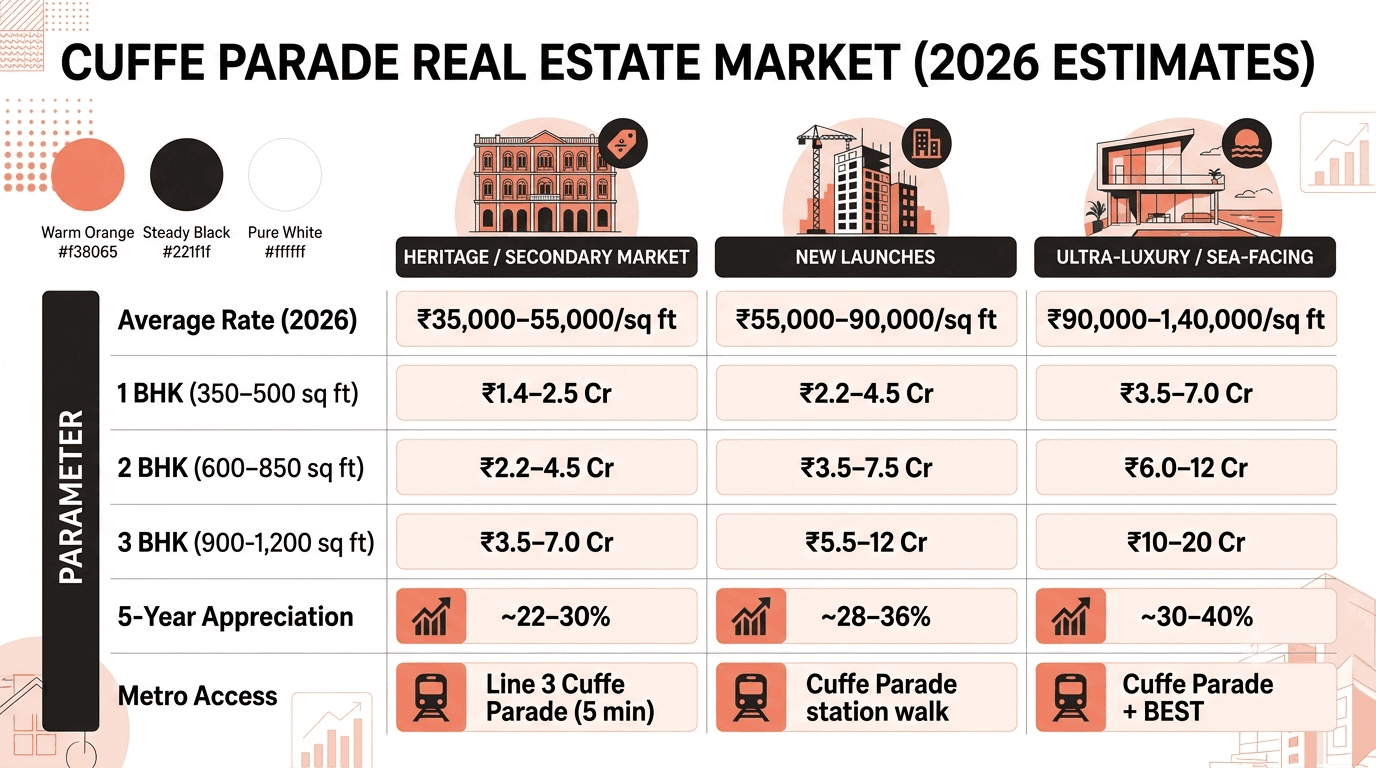
Why Colaba in 2026
Structural Supply Scarcity - The Permanent Premium Engine
Colaba's land constraint is fundamental. The peninsula is bounded by the Arabian Sea on three sides. A significant portion of its land is under the Indian Navy's jurisdiction (INS Angre, INS Trata, Naval Dockyard), the Archaeological Survey of India's heritage protection, or government/institutional ownership. BMC development regulations further constrain height and FSI on heritage-proximate plots.
The practical consequence: there have been fewer than a dozen significant new residential launches in Colaba in the past decade. This scarcity means that every new project sells at a structural premium over the secondary market, and the secondary market itself holds firm because there is no risk of large new supply competing it down. Colaba's per-square-foot floor has never fallen meaningfully in Mumbai's recorded property history.
Metro Line 3 (Aqua Line) - Cuffe Parade Station
- Churchgate - 5 min (by road/metro, already close)
- BKC - 22 min (Metro Line 3, no change required)
- Andheri - 38 min (Metro Line 3 to SEEPZ junction)
- Airport - 45 min (Metro Line 3 to CSIA T2)
The Taj-Gateway Institutional Anchor
The presence of the Taj Mahal Palace Hotel and the Gateway of India within a 5-minute walk of Colaba's residential core does something that academic urban economics struggles to quantify: it creates a permanent gravitational field around an address. Heads of state, global CEOs, and institutional events anchor at the Taj. The social infrastructure that surrounds this institutional anchor - Leopold Cafe, Mondegar, Indigo, the Colaba Causeway retail strip, multiple art galleries, and the Jehangir Art Gallery on MG Road 10 minutes away - has been established for decades and is irreplaceable.
No developer in Mumbai can build a comparable context from scratch. Colaba's social infrastructure is a moat.
Backbay Reclamation and Nariman Point Proximity
Nariman Point - Mumbai's original CBD and still a significant financial district anchor - is 15 minutes from Colaba by road. The Marine Drive–Nariman Point-Colaba axis is functionally one precinct. This means Colaba residents have South Mumbai's premier office district within a short commute, alongside the social and retail infrastructure of Colaba Causeway, without competing with the denser congestion of Fort or the CST area.
Micro-Zones in Colaba
Colaba Causeway Belt
Cusrow Baug / Electric House Area
Navy Nagar / Badhwar Park
Cuffe Parade (North Colaba)
Active Projects in Colaba
Project | Developer | Zone | Type | Price (Blox) | Possession |
|---|---|---|---|---|---|
Radius Harbour Heights | Radius Developers | Colaba Waterfront | 1, 2, 3 BHK | ₹1.9–3.0 Cr | Dec 2026 |
Lodha Group | Grant Road West | 3, 5 BHK | ₹12–35 Cr | Under Construction | |
Verain Group | Tardeo | 1, 2, 3, 4 BHK | ₹2.5–12 Cr | Under Construction | |
World Crest | Lodha | Cuffe Parade | 3, 4, 5 BHK | ₹18–45 Cr | Ready to Move |
Raheja Classique | Raheja | Colaba-adjacent | 2, 3 BHK | ₹4.0–9.5 Cr | Dec 2027 |
Price Appreciation: Colaba vs South Mumbai Peers
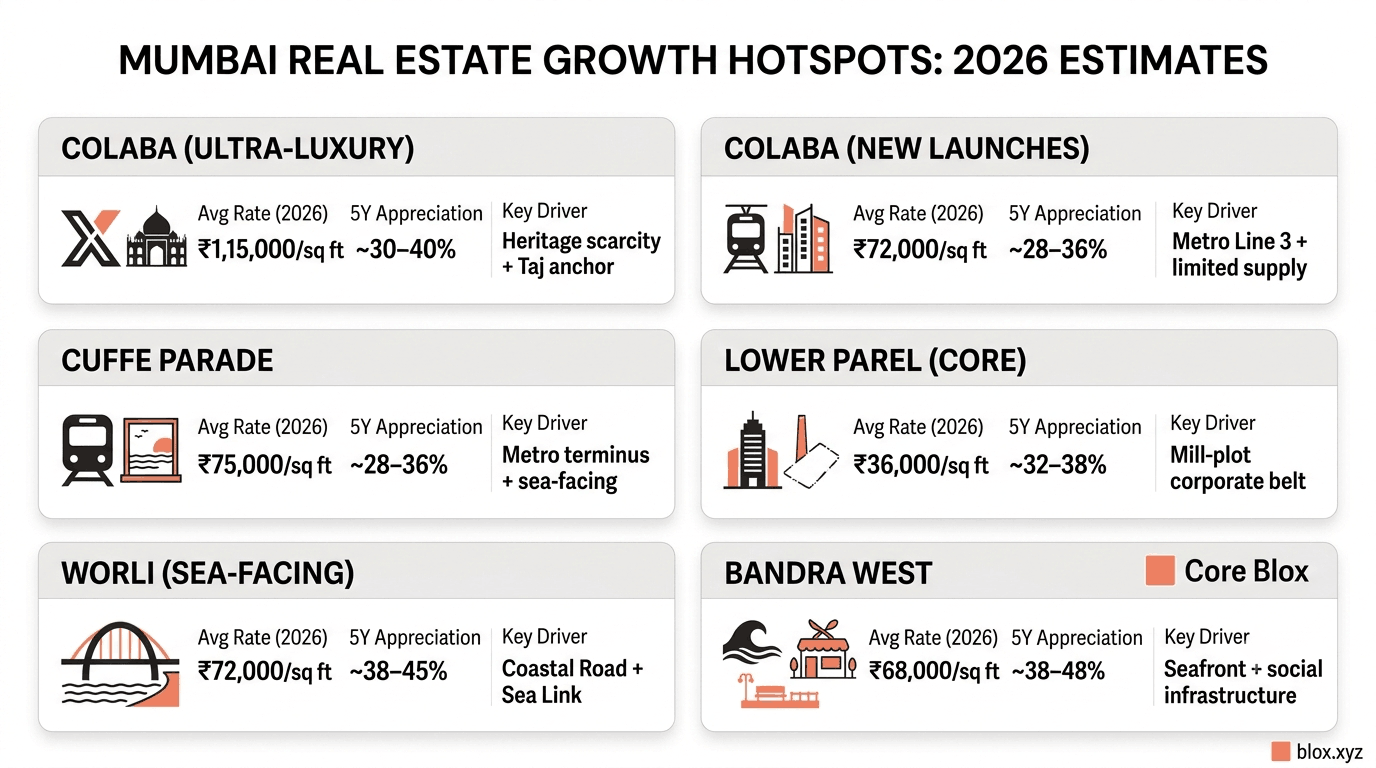
Colaba's appreciation rates are lower than Worli or Bandra partly because it is already the most expensive residential micro-market in Mumbai - percentage appreciation compresses at the absolute top of the market. The wealth preservation and scarcity argument, however, is Colaba's strongest: it has never significantly depreciated.
Social Infrastructure
Retail: Colaba Causeway - Mumbai's most famous street market (antiques, fashion, handicrafts). Palladium Mall (Lower Parel, 15 min) - luxury retail anchor. Linking Road Bandra (30 min) - premium fashion retail.
Dining & Culture: Leopold Cafe (Mumbai's most storied colonial-era restaurant). Indigo Restaurant (Mandlik Road). The Taj Mahal Palace Hotel's restaurants and bars. Multiple art galleries: Chatterjee & Lal, Project 88, Gallery Maskara (Colaba / Fort precinct, 10 min).
Healthcare: Breach Candy Hospital (Breach Candy, 15 min) - premier private hospital for South Mumbai's upper-income residents. Jaslok Hospital (Peddar Road, 12 min). Bombay Hospital (Marine Lines, 15 min).
Education: Cathedral & John Connon School (Fort, 10 min) - Mumbai's most prestigious day school. Campion School (Cooperage, 5 min). For international curriculum, Dhirubhai Ambani International School (BKC, 30 min via Metro Line 3).
Recreation: Gateway of India waterfront (5 min walk). Badhwar Park (10 min walk, sea-facing). Marine Drive promenade (15 min). Oval Maidan (10 min) - one of Mumbai's heritage cricket grounds.
MahaRERA Buyer Checklist for Colaba
- Heritage Property Status - Many older buildings in Colaba are Grade I, II, or III heritage-listed by the Mumbai Heritage Conservation Committee. Confirm the building's heritage status before purchasing - heritage-listed buildings have restrictions on modification, extension, and redevelopment that affect resale value and renovation scope.
- Naval Land Boundary - Some plots near Navy Nagar and Badhwar Park are subject to defence-related land use restrictions. Confirm the specific plot's land-use classification and any Navy/Ministry of Defence encumbrances via the RERA title report.
- CRZ Compliance (Sea-Facing Units) - Colaba is surrounded by water on three sides. Any unit within 500m of the high-tide line (which covers much of the peninsula) requires CRZ clearance. Verify environmental clearance in the RERA registration.
- RERA QPRs for Under-Construction Projects - For Raheja Classique (Dec 2027) and Verain Iora (under construction), verify last 4 QPRs to confirm on-pace construction.
- OC + Society for Ready Units - For Radius Harbour Heights (Dec 2026 possession) and World Crest (RTM), confirm OC, society formation, and maintenance handover are fully complete.
Is Colaba Right for You?
Buy if: Budget ₹2.5 Cr+ (secondary market) or ₹6 Cr+ (new launches); you work in Nariman Point, BKC (Metro Line 3), or South Mumbai's financial and diplomatic precinct; you want a permanent wealth-preservation asset in Mumbai's most historically stable market; or you're targeting the expat/diplomatic rental demand for strong lease income.
Wait if: You need a larger flat (3+ BHK) at an accessible budget - Colaba's floor prices for 3 BHKs start around ₹5.5 Cr in secondary market and ₹10+ Cr for new launches. Western suburbs like Bandra or Worli offer comparable South Mumbai prestige at a lower per-sq-ft entry for equivalent configurations.
Avoid if: You depend on suburban railway access - there is no Western or Central Line station in Colaba. Access is via Metro Line 3 (Cuffe Parade station, 10 min walk for most addresses), BEST buses, or personal vehicle. For buyers who commute daily by local train, Colaba's road/metro-only connectivity is a practical constraint.
Final Word
Frequently Asked Questions
What is the average flat price in Colaba in 2026?

How is Colaba connected to the rest of Mumbai?
Is Colaba a good investment in 2026?
What are the key differences between Colaba and Cuffe Parade?
What heritage regulations affect buying in Colaba?
What MahaRERA checks are specific to Colaba?

Get in Touch
Let our experts help you answer your questions

 +91
+91


Get in Touch
Let our experts help you answer your questions
+91