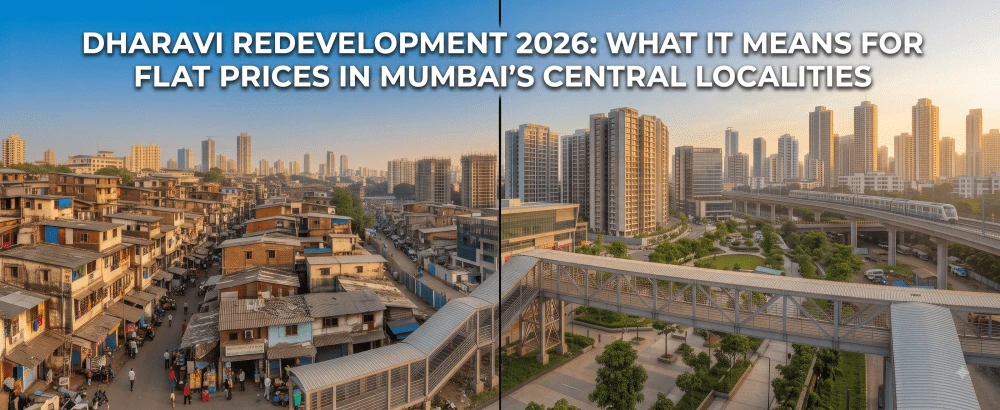
Dharavi Redevelopment 2026: What It Means for Flat Prices in Mumbai's Central Localities

Introduction: The Biggest Urban Bet in Mumbai's History
When people talk about Mumbai 3.0 - the next wave of the city's transformation - one name keeps coming up: Dharavi.
The Dharavi redevelopment project isn't just a slum upgrade. It's the single largest government-backed urban regeneration initiative in India's history. Over 590 acres in the geographic heart of Mumbai - with an additional 240+ acres of Railway Ministry land - are being converted into a world-class township, mixed-use commercial zone, and planned residential precinct under a ₹95,790 crore project.
For flat buyers in central Mumbai, this raises an obvious and important question: what does all of this mean for flat prices in the surrounding localities?
Areas like Mahim, Matunga, Sion, and Dadar West sit 1–3 km from the Dharavi boundary. They're already among Mumbai's most densely populated and expensive residential pockets. And they're about to change - faster than most buyers realise.
This guide breaks down exactly what's happening with the Dharavi redevelopment in 2026, when things are expected to move, and what it means if you're thinking of buying a flat in the surrounding areas.
What Is the Dharavi Redevelopment Project? A 2026 Primer
The Scale of the Project:
Dharavi occupies roughly 590 acres in central Mumbai - bordered by the Mithi River to the north, Sion to the east, Mahim to the west, and the Bandra Kurla Complex (BKC) to the northwest. It's also intersected by the Central and Western Railway lines, giving it unmatched rail connectivity that has never been fully monetised.
The project is being executed by Navbharat Mega Developers Pvt Ltd (NMDPL) - a special purpose vehicle that is 80% owned by the Adani Group and 20% by the Government of Maharashtra. NMDPL won the bid in November 2022, committing ₹5,069 crore as the upfront capital. The total project outlay is ₹95,790 crore across a 17-year development horizon, with the rehabilitation component due to complete by January 2032.
The 2026 Status Update:
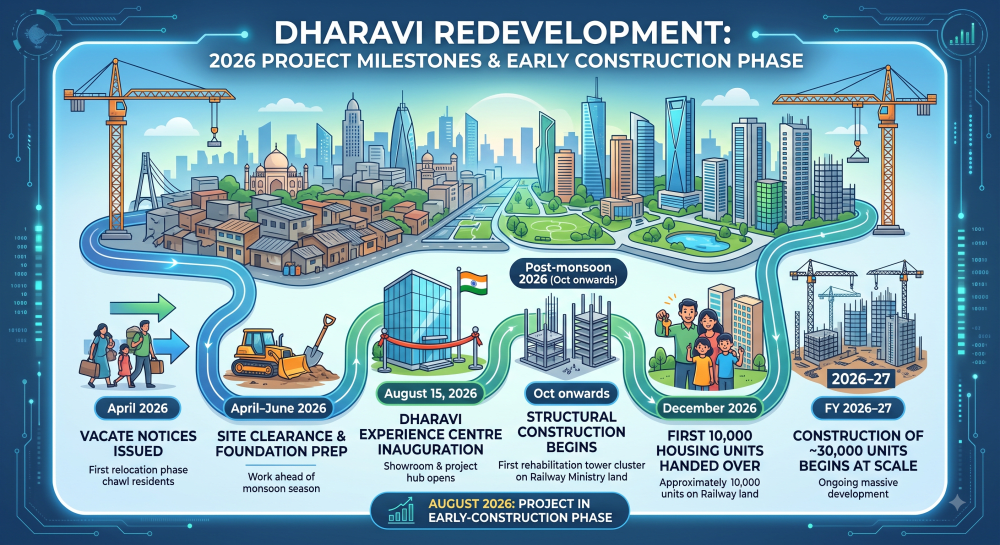
As of August 2026, the Dharavi project is firmly in its early-construction phase:
- April 2026: Vacate notices issued to chawl residents in the first relocation phase
- April–June 2026: Site clearance and foundation preparation ahead of monsoon
- August 15, 2026: Dharavi Experience Centre (showroom and project hub) to be inaugurated
- Post-monsoon 2026 (October onwards): Structural construction to begin on the first rehabilitation tower cluster on Railway Ministry land
- December 2026: First handover of approximately 10,000 rehabilitated housing units on Railway land
- FY 2026–27: Construction of ~30,000 units to begin at scale
For residents being rehabilitated, the new units will be 500–754 sq ft - significantly larger than the earlier SRA standard of 300–405 sq ft, and a direct result of negotiations between the Maharashtra government, resident associations, and NMDPL.
The overall project will deliver housing for approximately 1 million+ residents across 1.25 lakh homes, while freeing up prime land for commercial development, parks, schools, and infrastructure.
Why This Matters for Flat Buyers in Surrounding Localities
Here's the key insight for flat buyers: you can't buy a flat in Dharavi as a market entrant. The redeveloped homes will go to existing Dharavi residents under the rehabilitation scheme. The commercial and residential projects on the freed-up land are years away from market availability.
But what you can do is buy a flat in the localities that will directly benefit from Dharavi's transformation. And 2026 is arguably the best window to do that - before appreciation fully prices in the infrastructure and urban upgrade spillover that's coming.
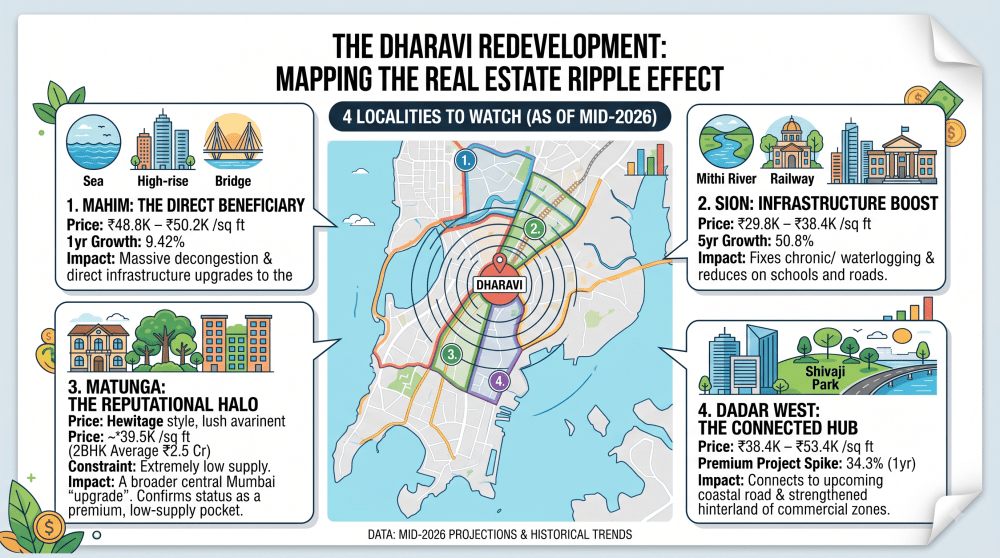
The four localities most directly in the impact zone are:
1. Mahim - ₹48,350–50,250 per sq ft: Mahim sits on Dharavi's western edge and is arguably its closest established residential neighbour. It's already one of central Mumbai's most sought-after addresses, with excellent connectivity to BKC via the Sea Link extension corridor, and to Dadar via the Mahim Causeway.
As of mid-2026, flats in Mahim are averaging ₹48,350–50,250 per sq ft, with a 9.42% appreciation in the past year and 7.7% over five years. 1BHK flats in Mahim are priced between ₹1.6–2.58 crore; 2BHKs typically start from ₹2.5 crore and go up to ₹5 crore.
What changes with Dharavi's redevelopment: The cleared and developed land will dramatically reduce the congestion, drainage, and utility pressure that currently makes the Dharavi–Mahim junction one of Mumbai's most congested corridors. Infrastructure upgrades - road widening, improved drainage, upgraded electricity grids - typically ripple outward into adjacent localities. Mahim stands to be a direct beneficiary.
2. Sion - ₹29,850–38,450 per sq ft: Sion borders Dharavi on its eastern flank and straddles the Central Railway main line. It's a mixed residential and commercial locality that offers more accessible entry prices than Mahim or Dadar, while still commanding excellent connectivity.
Current flat prices in Sion average ₹38,450 per sq ft (Sion West/Central), with Sion East at a lower ₹29,850 per sq ft but showing the fastest appreciation - 8.56% recently, and a remarkable 50.8% over the past five years. 1BHK flats in Sion are typically available from ₹80 lakh to ₹1.5 crore.
The Dharavi factor for Sion is twofold: first, the infrastructure upgrades to the Dharavi–Sion junction (particularly around the Mithi River corridor and eastern rail land) will reduce the chronic flooding and waterlogging that currently affects Sion during monsoons. Second, the redevelopment will decongest the dense Dharavi population that currently adds pressure to Sion's civic infrastructure, roads, and schools.
3. Matunga - ~₹39,581 per sq ft: Matunga - both East and West - is a tightly held, low-supply residential pocket that benefits from superb rail connectivity (Central and Harbour Lines) and a reputation for excellent social infrastructure. It's technically set back 1.5–2 km from the Dharavi boundary, but the urban upgrade ripple will be felt here too.
2BHK flats in Matunga are currently averaging ₹2.5 crore at rates around ₹39,581 per sq ft. Supply is extremely constrained - which is both why prices are this high and why appreciation has been consistent.
Matunga's indirect benefit from Dharavi is reputational and infrastructural: as the broader central Mumbai belt upgrades, localities like Matunga - already premium - will see a further consolidation of their status. Redevelopment projects within Matunga itself will also become more viable as Dharavi's transformation raises the neighbourhood's overall profile.
4. Dadar West - ₹38,497–53,400 per sq ft: Dadar is Mumbai's geographic centre - and Dadar West is its most premium residential pocket. Western Railway connectivity, Shivaji Park proximity, and the upcoming coastal road extension make Dadar West one of Mumbai's most resilient real estate markets.
Flat prices in Dadar West range from ₹38,497 to ₹53,400 per sq ft depending on the building and tier. 2BHK flats start from ₹1.4 crore and go up to ₹5.8 crore. 5-year appreciation has been 11.3%, with some premium projects like Kohinoor Altissimo recording 34.3% appreciation in just the last year.
Dharavi's redevelopment connects to Dadar West through the coastal road and the Mahim–Dadar corridor. As Dharavi's railway land becomes a commercial and mixed-use zone, Dadar West - already home to major corporate offices and retail - will see its hinterland strengthen.
Supply Dynamics Argument: Why Dharavi Buyers Don't Go to These Localities
One concern sometimes raised about large-scale redevelopment projects is whether they flood the market with supply, suppressing prices in surrounding areas.
For Dharavi, this concern doesn't apply to Mahim, Sion, Matunga, or Dadar West - for a critical reason.
The 1 lakh+ rehabilitated housing units will be allocated to existing Dharavi residents, not sold on the open market. These residents don't become buyers in Mahim or Dadar. They move from informal shanties to formal rehabilitated flats within the same precinct.
Meanwhile, the commercial development on freed-up land will bring new office workers, retail consumers, and professionals into the Dharavi precinct - many of whom will seek residential accommodation in nearby formal localities. This creates *demand* for flats in Mahim, Sion, and Dadar, not competing supply.
In short: Dharavi's redevelopment shrinks supply pressure on surrounding localities while increasing demand. A positive double effect for flat buyers in adjacent areas.
Infrastructure Upgrades: The Invisible Price Driver
Beyond the direct Dharavi story, central Mumbai's infrastructure is getting a multi-layer upgrade that directly impacts all four localities discussed above.
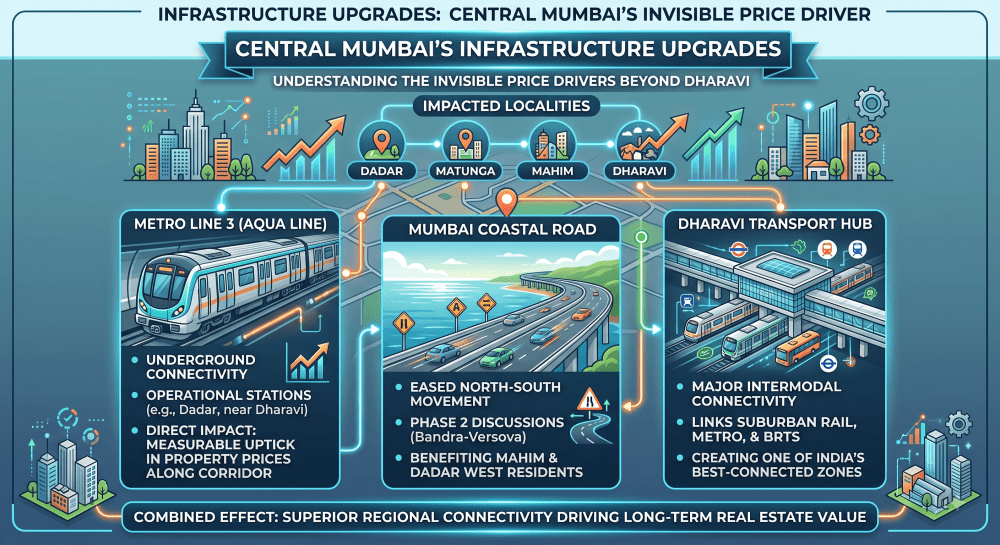
Metro Line 3 (Aqua Line) - Already Operational for Dadar and Matunga: Mumbai Metro Line 3 runs underground from Aarey Colony to Cuffe Parade, with stations at Dadar, Dharavi (planned future extension), and several central Mumbai nodes. The operational stretches have already driven a measurable uptick in flat prices along the corridor.
Mumbai Coastal Road - Phase 2 Discussions: The coastal road (Bandra–Versova section discussions in 2026) will ease north-south movement along Mumbai's west coast, benefiting Mahim and Dadar West residents most directly.
Dharavi Transport Hub: One of the project's stated components is converting the Dharavi–Sion–Matunga railway junction zone into a major intermodal transport hub connecting suburban rail, metro, and bus rapid transit. When operational, this will make the central Mumbai belt one of the best-connected zones in the country.
Should You Buy a Flat in These Localities in 2026?
Here's the straightforward case for each:
- Mahim: If you can stretch to ₹48,000–50,000 per sq ft, Mahim offers the best combination of proximity to BKC jobs, the Sea Link, and the western suburb connectivity. Flat inventory is limited - it's a buy-whenever-you-find-the-right-unit market.
- Sion: For buyers at a more accessible budget, Sion East offers entry points around ₹29,850 per sq ft - with arguably the highest appreciation runway ahead as the Dharavi eastern corridor transforms. 1BHK buyers who can't afford Mahim or Dadar should look very seriously at Sion.
- Matunga: Premium and supply-constrained. If you find a good flat in Matunga, the hold value is exceptional. Not the easiest market to enter at scale.
- Dadar West: The high-conviction, long-hold bet. ₹38,000–53,000 per sq ft is a wide range - the lower end reflects older building stock with less amenity. New or recently redeveloped projects in Dadar West command premium pricing but offer excellent appreciation prospects.
Key Risks to Watch
No investment view comes without its caveats, and the Dharavi story is no exception.
- Construction delays: The project has a 17-year horizon and has already faced legal and administrative challenges since the 2022 award. While the 2026 milestones (Experience Centre, December handover on railway land) represent real progress, delays to the broader transformation timeline are possible.
- Resettlement complexity: Moving 1 million+ residents is a logistical challenge without precedent in Indian urban history. Political friction and legal challenges from resident groups could slow certain phases.
- Market cycle: Mumbai's premium residential market ran hard in 2024–2025. Some moderation in velocity is expected in 2026 even as prices remain supported. Buyers entering at the top of a cycle should hold for 5+ years to fully capture the Dharavi appreciation uplift.
The Bottom Line for Flat Buyers
Dharavi's redevelopment is the most consequential infrastructure and urban transformation event in central Mumbai in a generation. It's already in motion - with the first residential handovers targeted for December 2026 and construction on 30,000 units ramping up in FY27.
For flat buyers, the opportunity is not in Dharavi itself - it's in the 1–3 km belt of established localities that will directly benefit: Mahim for BKC connectivity, Sion for affordable entry with strong appreciation, Matunga for premium hold value, and Dadar West for the highest-conviction long-term bet in central Mumbai.
The window to buy before these localities fully price in the Dharavi transformation is narrowing. If central Mumbai is your target market, 2026 is the year to move.
Looking to buy a flat in Mahim, Sion, Matunga, or Dadar West? Explore verified listings and connect with experts on Blox.

Get in Touch
Let our experts help you answer your questions

 +91
+91


Get in Touch
Let our experts help you answer your questions
+91