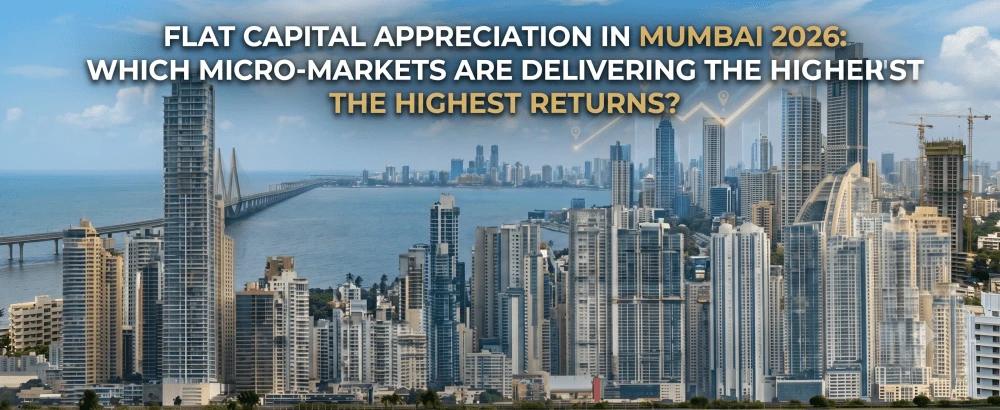
Flat Capital Appreciation in Mumbai 2026: Which Micro-Markets Are Delivering the Highest Returns?

Why Capital Appreciation Is the Primary ROI Story for Mumbai Flat Investors in 2026
Mumbai flat investors have traditionally spoken in two currencies: rental yield and capital appreciation. In 2026, only one of those conversations dominates serious investor rooms. It is capital appreciation.
The arithmetic is blunt. A typical 2BHK flat in Mumbai priced at ₹1.5 crore generates a rental income of approximately ₹25,000–₹35,000 per month, which translates to a gross rental yield of 2–2.8%. After maintenance, property tax, and vacancy gaps, the net yield often falls below 2%. Compare this to a bank fixed deposit yielding 6.5–7% with zero management friction, and rental yield as a standalone strategy looks mediocre.
Capital appreciation is where residential flats in Mumbai truly outperform. The best-performing Mumbai micro-markets have delivered 30–105% appreciation over three years (2023–2026), in specific localities. Even the broader market average has delivered approximately 20–22% over three years, equivalent to roughly 7% per annum compounded - competitive with equity markets but without the volatility, and with the added leverage of a home loan amplifying equity returns.
This guide is built for the flat investor who is asking the right question: not "what will this flat rent for?" but "where in Mumbai will my flat be worth the most in five years?"
We have mapped the data by micro-market, analysed the infrastructure drivers, and built a framework for selecting flats that maximise capital appreciation probability.
Understanding Capital Appreciation vs Rental Yield: Why the Distinction Matters
Before diving into the data, a conceptual frame that serious investors use when evaluating Mumbai flats:
- Capital appreciation is the increase in the sale price of your flat over time. If you buy at ₹1.5 Cr and sell three years later for ₹2 Cr, you have made ₹50 lakh in capital appreciation - a 33% return on the asset.
- Rental yield is the annual rent expressed as a percentage of the property's value. At ₹30,000/month rent on a ₹1.5 Cr flat, the gross yield is 2.4%.
For a leveraged investor (buying with a home loan), capital appreciation has a multiplier effect on equity returns. If you have put ₹30 lakh as down payment on a ₹1.5 Cr flat and the flat appreciates to ₹2 Cr, your equity has grown from ₹30 lakh to ₹80 lakh - an appreciation of 167% on equity deployed, even though the asset itself only grew by 33%.
This leverage-amplified return is the reason experienced Mumbai flat investors focus intensely on choosing the right micro-market. A 5% difference in annual appreciation between two localities translates into dramatically different wealth outcomes over a seven-to-ten-year hold.
Mumbai Flat Market Overview: The 2026 Appreciation Cycle
Mumbai's residential flat market entered 2026 in what analysts characterise as a "fundamentals-driven appreciation cycle" - meaningfully different from the speculative runs of 2010–2013 or the COVID-recovery spike of 2021–2022.
Current market snapshot (June 2026):
- Average property price across Mumbai: ₹38,600 per sq ft (up from ₹37,850 in June 2025)
- YoY appreciation (Mumbai average): approximately 5–6%
- Three-year appreciation (Mumbai average): approximately 20–22%
- Analyst consensus (Reuters poll, early 2026): 5–7% annual appreciation over next three years
The market is not uniformly appreciating. The wide range of outcomes - from 4% in some fully-priced micro-markets to 15%+ in infrastructure-adjacent localities - means micro-market selection is where the investment game is won or lost.
What is driving appreciation in 2026?
Three macro forces are at work simultaneously:
- First, infrastructure delivery. Multiple long-pending projects - the Trans Harbour Link (operational since 2024), Metro Line 3, the GMLR Phase 1 (May 2026), and the approaching completion of the Navi Mumbai International Airport - are creating concentric rings of appreciation around their access points.
- Second, supply-demand dynamics. Mumbai's net new flat supply has lagged demand for four consecutive years, driven by project approval delays, rising construction costs, and the natural constraints of an island city. This creates a structural floor under prices across the city.
- Third, buyer quality upgrade. The buyer pool in Mumbai has shifted upmarket - the median ticket size for a Mumbai flat purchase in Q1 2026 crossed ₹1.5 crore for the first time. This is bringing better-quality inventory from Tier-1 developers, which itself creates a pricing benchmark that resale stock tracks upward.
Top Performing Localities: The 2026 Capital Appreciation Champions
Navi Mumbai: Where Infrastructure Has Already Delivered
Navi Mumbai is 2026's most dramatic capital appreciation story, and the data reflects it.
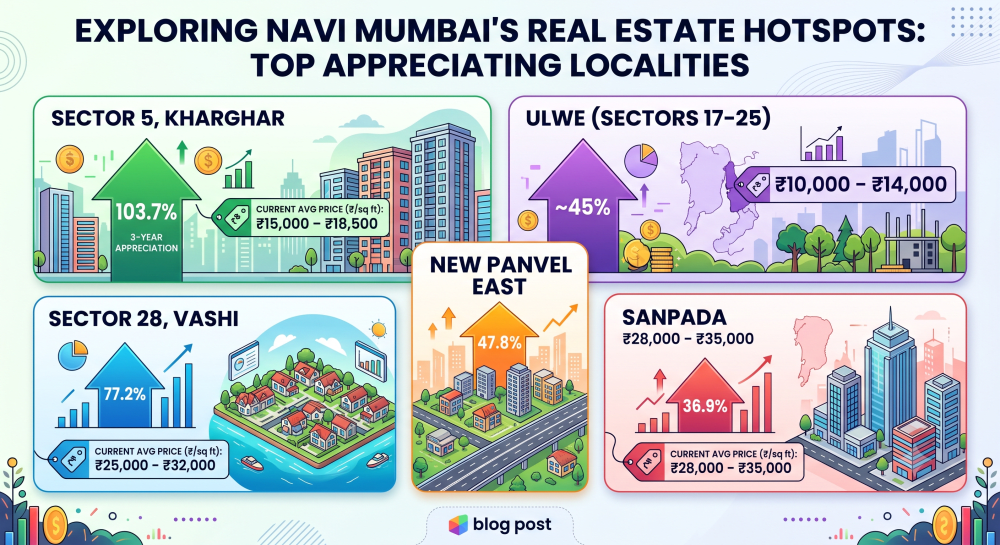
The engine behind Navi Mumbai's appreciation has been the Navi Mumbai International Airport (NMIA) - one of the largest greenfield airport projects in India, located at Ulwe. As the airport has moved from planning to construction to approaching completion, the appreciation wave has swept outward from the NMIA site: first Dronagiri and Ulwe (earliest appreciators), then Panvel and Kharghar (mid-wave), and now being priced into Sanpada and Vashi as the infrastructure premium broadens.
For flat investors who entered Kharghar in 2023, the 103.7% three-year appreciation means their ₹70 lakh 1BHK (a realistic entry point then) is now valued at approximately ₹1.43 crore. This is the kind of outcome that has made Navi Mumbai the most-discussed investment market in Mumbai's real estate community in 2026.
Where the opportunity still exists: New Panvel East and specific sectors in Ulwe remain below ₹12,000/sq ft. For investors comfortable with a four-to-seven-year horizon tied to the NMIA thesis, these are still considered pre-premium-pricing territory by several analyst teams.
Western Suburbs: Infrastructure-Driven Pockets Leading the Market
Mumbai's western suburbs are broadly at high price points, with less room for dramatic appreciation in already-mature micro-markets like Bandra West or Juhu. However, infrastructure-adjacent pockets within the western suburbs are delivering above-average appreciation.
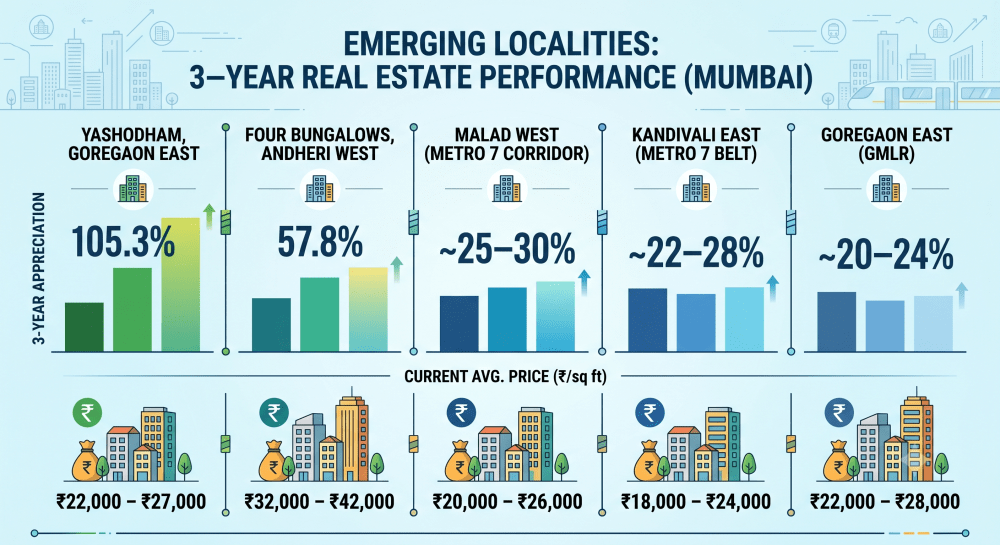
Yashodham in Goregaon East deserves particular attention. The 105.3% three-year appreciation is the highest in the western suburbs and reflects the convergence of two infrastructure catalysts: Metro Line 7 (already operational through Goregaon) and the upcoming GMLR, which will connect Goregaon to Mulund. Yashodham's relatively compact geography, established social infrastructure, and proximity to the Oberoi complex commercial zone have created a premium micro-market within Goregaon.
Four Bungalows in Andheri West at 57.8% appreciation over three years reflects the sustained demand for established, transit-rich western suburb addresses within a perceived "safe" distance from the city.
For investors: At current price points (₹32,000–₹42,000/sq ft in Four Bungalows; ₹22,000–₹27,000 in Yashodham), entry costs are high and appreciation headroom has compressed. The better infrastructure opportunity in the western belt now sits in Kandivali and Malad East, where Metro Line 7 has created appreciating micro-markets at lower absolute prices.
Eastern Suburbs: Chembur and the BKC Adjacency Play
Chembur has emerged as one of 2026's most compelling eastern suburb stories, driven by a geography that no infrastructure project needed to create: its natural adjacency to BKC.
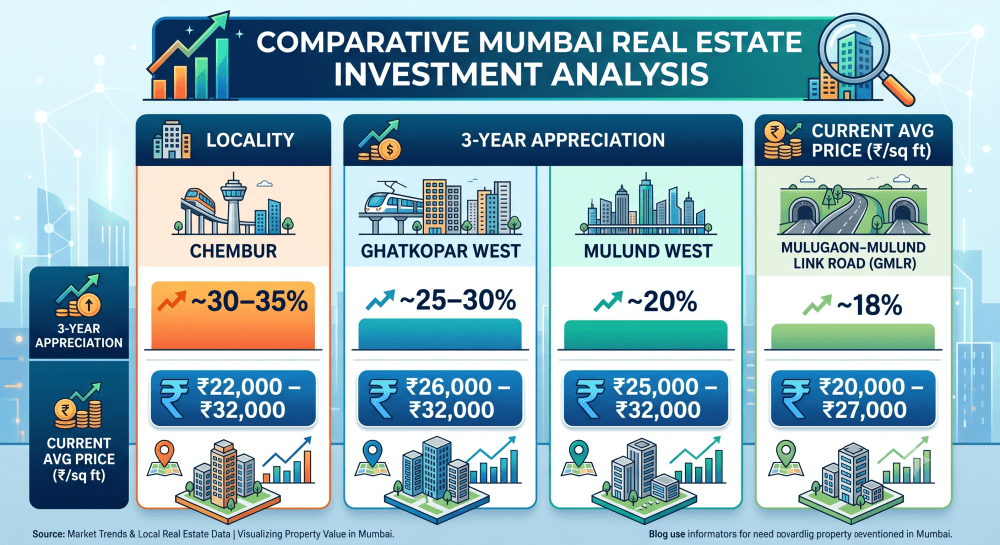
Chembur's appreciation is driven by three vectors simultaneously. First, it is the closest suburban neighbourhood to BKC on the eastern side, accessible via the Eastern Freeway in under 25 minutes. Second, it benefits from the Mumbai Trans Harbour Link, which now makes commuting to Navi Mumbai from Chembur materially faster. Third, a concentration of large redevelopment projects from Tier-1 developers (many converting old mill and commercial land into residential towers) has introduced fresh, premium inventory that has reset pricing benchmarks.
Ghatkopar, as the Metro Line 1 hub connecting eastern suburbs to Andheri and beyond, has maintained strong appreciation on the back of metro-driven demand from buyers seeking cross-city connectivity.
Thane: The Three-Year Outperformer With Questions About What Comes Next
Thane is the single most dramatic appreciation story in the broader Mumbai Metropolitan Region over the past three years, with the market as a whole averaging approximately 46% over that period.
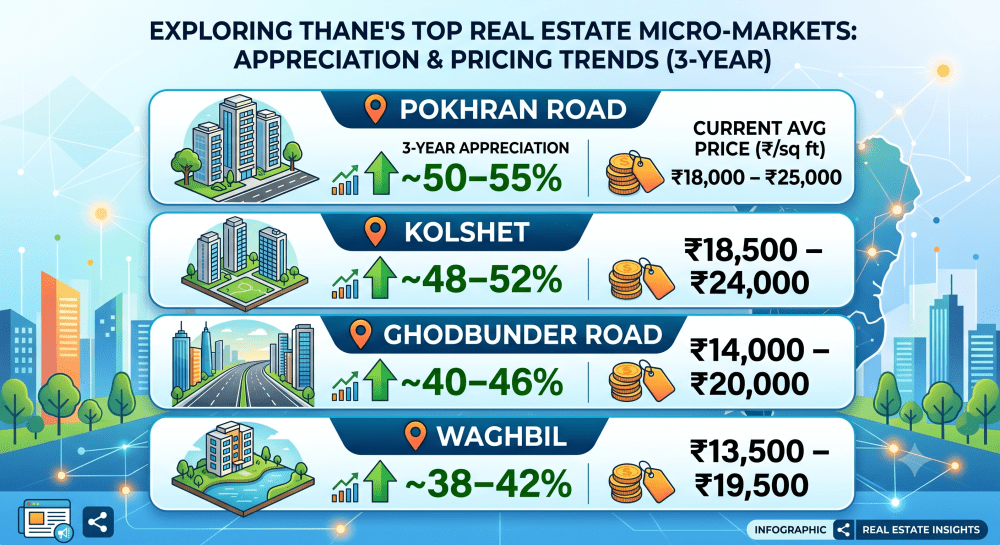
The Thane story has been driven by a perfect storm of catalysts: the Trans Harbour Link (bringing Thane within 25 minutes of Navi Mumbai), multiple metro lines under construction (Lines 4, 5, and eventually 7), a massive supply of quality projects from Lodha, Godrej, Hiranandani, and Piramal, and a buyer profile upgrade as professionals migrated from Mumbai proper to Thane for larger homes at lower prices.
The question for 2026 investors: At 46% appreciation over three years, and with premium pockets at ₹19,000–₹25,000/sq ft, is the best of the Thane appreciation already banked? Several analysts suggest the highest-conviction gains are behind us in Thane's established nodes, but micro-markets like Waghbil and peripheral Ghodbunder road still offer meaningful upside at lower absolute price points.
Infrastructure Catalysts: The Appreciation Map for 2026–2030
Understanding which infrastructure projects are operational vs upcoming - and mapping your flat purchase to the right stage of that cycle - is the analytical core of capital appreciation investing in Mumbai.
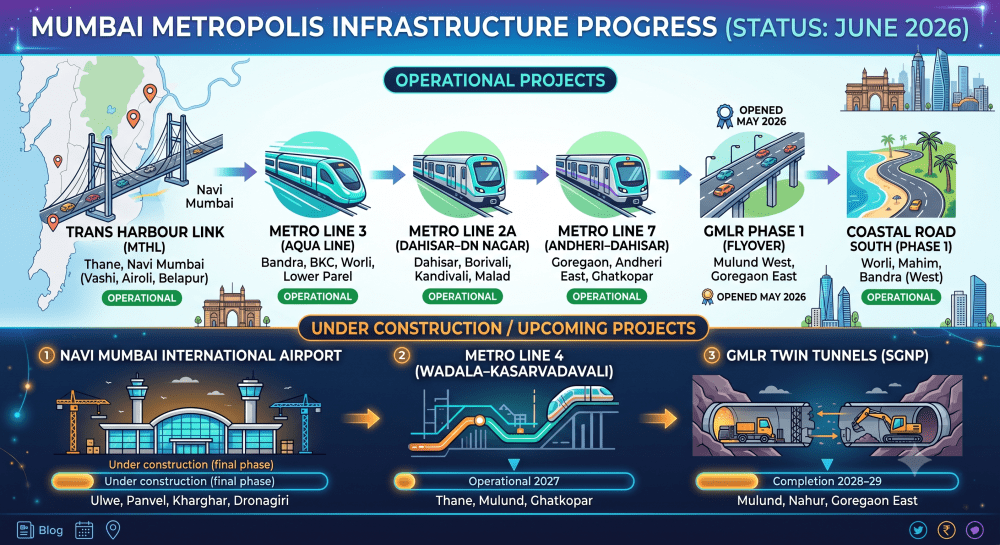
The investor framework: The highest appreciation typically occurs in localities that are in the "early-to-mid infrastructure delivery" window - where the project is confirmed, underway, and approaching completion but the full price benefit has not yet been factored in by the broader market.
Localities where infrastructure is fully priced in (like Vashi or Bandra West) still appreciate, but at the market average. Localities where infrastructure is in construction phase (like Mulund with GMLR tunnels, or Ulwe with NMIA final phase) are where the outsized gains still lie.
Configuration Analysis: Which Flat Type Appreciates Fastest in Mumbai?
One of the most data-rich conversations in Mumbai real estate concerns flat configuration - does a 1BHK, 2BHK, or 3BHK appreciate fastest?
The 2BHK Sweet Spot
Across most Mumbai micro-markets, the 2BHK has historically shown the most consistent and liquid appreciation. The reasons are structural:
- It is the most demanded configuration in the market (largest buyer pool = easiest resale = tighter bid-ask spread)
- Banks are most comfortable financing 2BHKs (mainstream loan eligibility for salaried middle-income buyers)
- It sits in the ticket size (₹1.2 Cr–₹2.5 Cr across most suburbs) that represents the deepest liquidity pool
When 1BHKs Outperform
In certain micro-markets and scenarios, 1BHKs can outperform on appreciation:
- In emerging, infrastructure-adjacent localities where a ₹50–₹70 lakh 1BHK represents the lowest liquid entry point (e.g., New Panvel, Taloja, outer belt locations)
- In high-supply areas where 2BHK inventory is excess but 1BHK is scarce
- In localities with high rental absorption (near employment zones), where 1BHK rental yield near 3–3.5% makes the investment more "self-funding"
When 3BHKs and 4BHKs Outperform
Large-configuration luxury flats in micro-markets like BKC, Worli, and South Mumbai have seen the most dramatic absolute value appreciation because their buyer pool - HNI and ultra-HNI - is insulated from interest rate cycles and buys on aspiration. However, liquidity is thin in these segments. A 3BHK in Worli that appreciates from ₹8 Cr to ₹11 Cr over three years is a 37.5% gain - but you need a buyer who can absorb ₹11 Cr, which creates a longer selling cycle.
The practical investor conclusion: Buy the 2BHK in an infrastructure-adjacent micro-market for the optimal combination of appreciation rate and liquidity.
Common Mistakes Flat Investors Make When Chasing Capital Appreciation in Mumbai
- Buying fully-priced infrastructure: A flat priced already reflecting the full metro or road benefit (because the project is now operational) will appreciate only at the market average going forward. The return is banked by whoever bought before completion.
- Focusing on yield instead of location: Investors who optimise for rental yield often end up with flats in high-supply, lower-appreciation locations. A 3.5% yielding 1BHK in a peripheral location may underperform a 1.8% yielding 2BHK in Mulund or Chembur on total return over five years.
- Ignoring builder quality in appreciation markets: In appreciation-focused markets, the brand of the developer matters for resale. A Tier-1 developer project (Lodha, Godrej, Piramal, Kalpataru) commands a 5–15% premium at resale over comparable Tier-3 projects in the same building. This premium has been consistent and widens over time.
- Concentration in one micro-market: Smart investors spread across two or three micro-markets at different stages of the infrastructure cycle, rather than doubling down on the highest-appreciation market (which has already moved the most).
- Holding too long after appreciation has plateaued: The right exit in appreciation investing is as important as the right entry. Selling after 3–5 years in a locality that has reached full infrastructure pricing - and redeploying into the next pre-infrastructure window - is how compounding works in property investment.
Investor Action Plan: Building a Mumbai Flat Capital Appreciation Portfolio in 2026
If you are a flat investor seeking to maximise capital appreciation over a five-year horizon, here is the framework:
- Step 1 - Map the infrastructure cycle: Use the table in this article to identify micro-markets in the "under construction, approaching completion" window. As of June 2026, these include Mulund (GMLR tunnels), Ulwe and New Panvel (NMIA), and the Metro Line 4 corridor.
- Step 2 - Set your ticket size and leverage correctly: The optimal leverage for appreciation investing is approximately 65–70% home loan (LTV), leaving equity deployed at a level where monthly EMIs are serviceable even with no rental income. Over-levering creates forced-sale risk if appreciation takes longer than expected.
- Step 3 - Shortlist projects from Tier-1 developers only: In appreciation markets, developer quality matters at resale. Use MahaRERA to verify the developer's track record: on-time project completions, no complaint history, and strong unit absorption in previous projects.
- Step 4 - Buy 2BHK as your primary configuration: Unless you have a specific thesis for 1BHK (yield-supplemented, entry-point play) or 3BHK (luxury, long hold), the 2BHK optimises for both appreciation and liquidity.
- Step 5 - Verify the title and RERA documents thoroughly: Appreciation gains mean nothing if the property has a title defect. Before signing the agreement, have a real estate lawyer conduct a 30-year title search and verify all RERA-filed documents.
- Step 6 - Plan your exit horizon before you buy: Define upfront whether you are holding for 3 years, 5 years, or 7 years. This determines which stage of the infrastructure cycle you should buy in. A 3-year horizon favors micro-markets with 12–18 months of infrastructure to deliver; a 7-year horizon can afford to buy earlier in the development cycle.
Explore verified, RERA-registered flat projects across all Mumbai micro-markets on blox.xyz - with transparent pricing, detailed project information, and no brokerage, it is the most efficient way to build your shortlist and take the next step toward a capital appreciation-optimised flat investment.
The 2026–2030 Appreciation Opportunity Map: Where to Focus
Synthesising all the data and infrastructure timelines, here is a summary framework for capital appreciation investing across Mumbai's micro-markets in 2026:
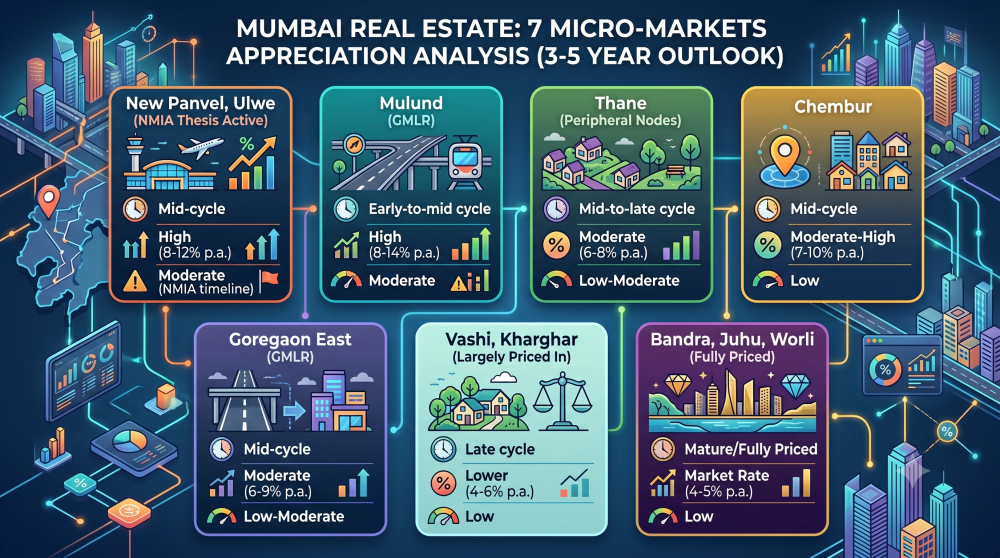
The most compelling risk-reward opportunities as of June 2026 are in the mid-cycle markets where significant infrastructure is operational but not fully priced, specifically Mulund, Chembur, and New Panvel/Ulwe. These are the locations where disciplined flat investors are most likely to outperform the 5–6% market average appreciation over the coming three to five years.
All price and appreciation data referenced in this article are sourced from publicly available market reports as of June 2026. Capital appreciation in real estate depends on numerous factors including market conditions, infrastructure delivery timelines, and individual asset characteristics. Investors should conduct independent due diligence and consult a qualified financial adviser before making purchase decisions.

Get in Touch
Let our experts help you answer your questions

 +91
+91


Get in Touch
Let our experts help you answer your questions
+91