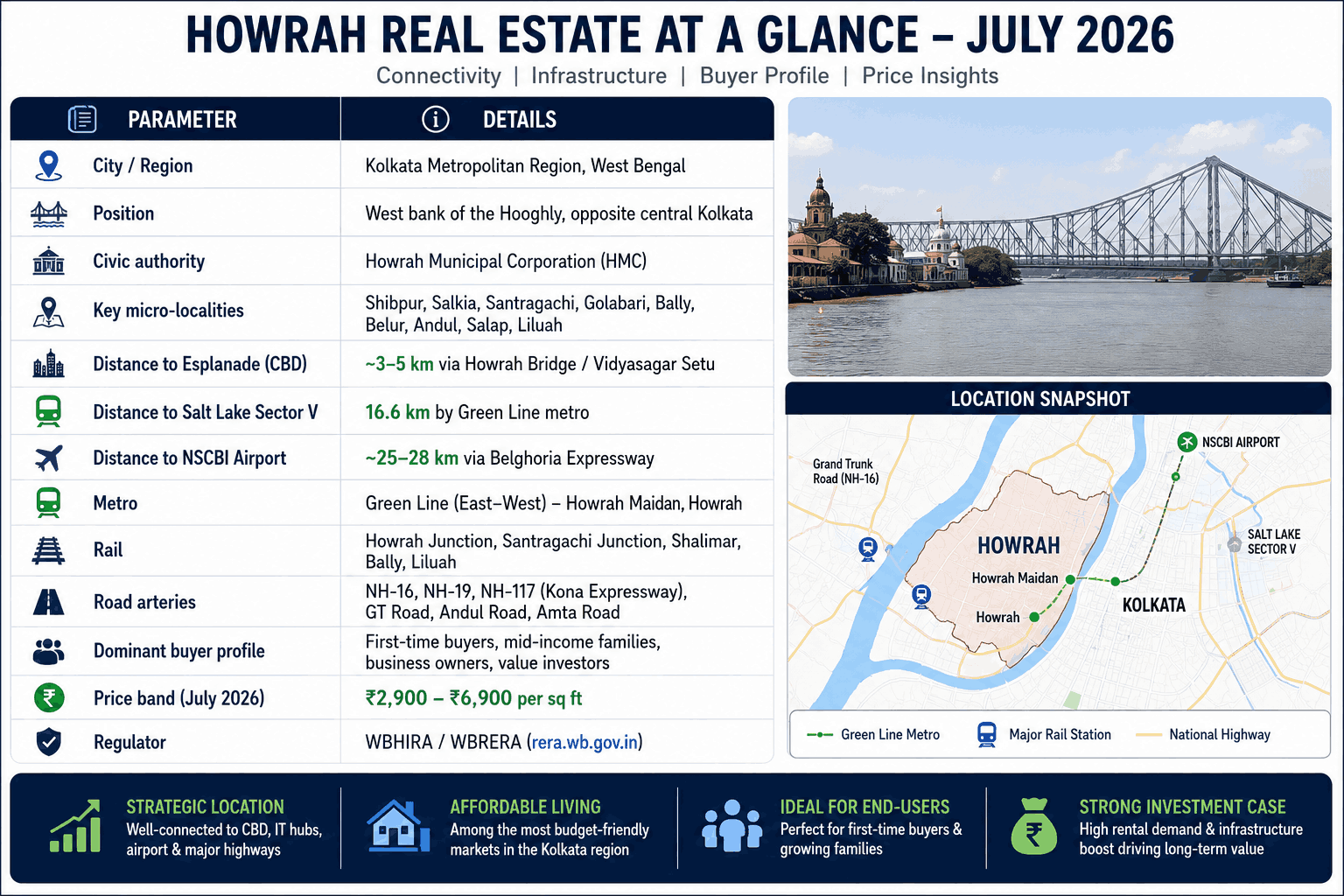
For decades, Howrah was the address Kolkata buyers drove through rather than moved into - a working river-bank district known for its railway terminus, its jute mills and its traffic. That framing is now out of date. On 6 March 2024, trains began running beneath the Hooghly for the first time in Indian history, and by August 2025 the Green Line was a continuous 16.6 km corridor linking Howrah Maidan directly to the Salt Lake Sector V IT hub. A commute that once meant an hour of bridge traffic now takes roughly 35 minutes underground. That single change quietly rewrote the Howrah real estate story.
The numbers are starting to reflect it. Shibpur has recorded roughly 24% year-on-year growth in asking rates. Santragachi has appreciated close to 40% over five years. Bally added nearly 13% in a year. Yet entry prices across most of the district still sit well below the Kolkata average of about ₹6,400 per sq ft - and that gap is where the opportunity lives.
This guide is written for four readers: the first-time buyer priced out of South Kolkata, the investor hunting a corridor before it reprices, the NRI who wants a Grade-A developer and a clean WBHIRA title, and the family working in Sector V who has just realised the metro made the west bank viable.
Why Buy Property in Howrah
The Howrah real estate case rests on one structural fact: it is the only major Kolkata suburb across the river that is now closer, by time, to the city's primary employment centre than several South Kolkata addresses. Geography that was a penalty became an advantage the moment a tunnel was dug under it.
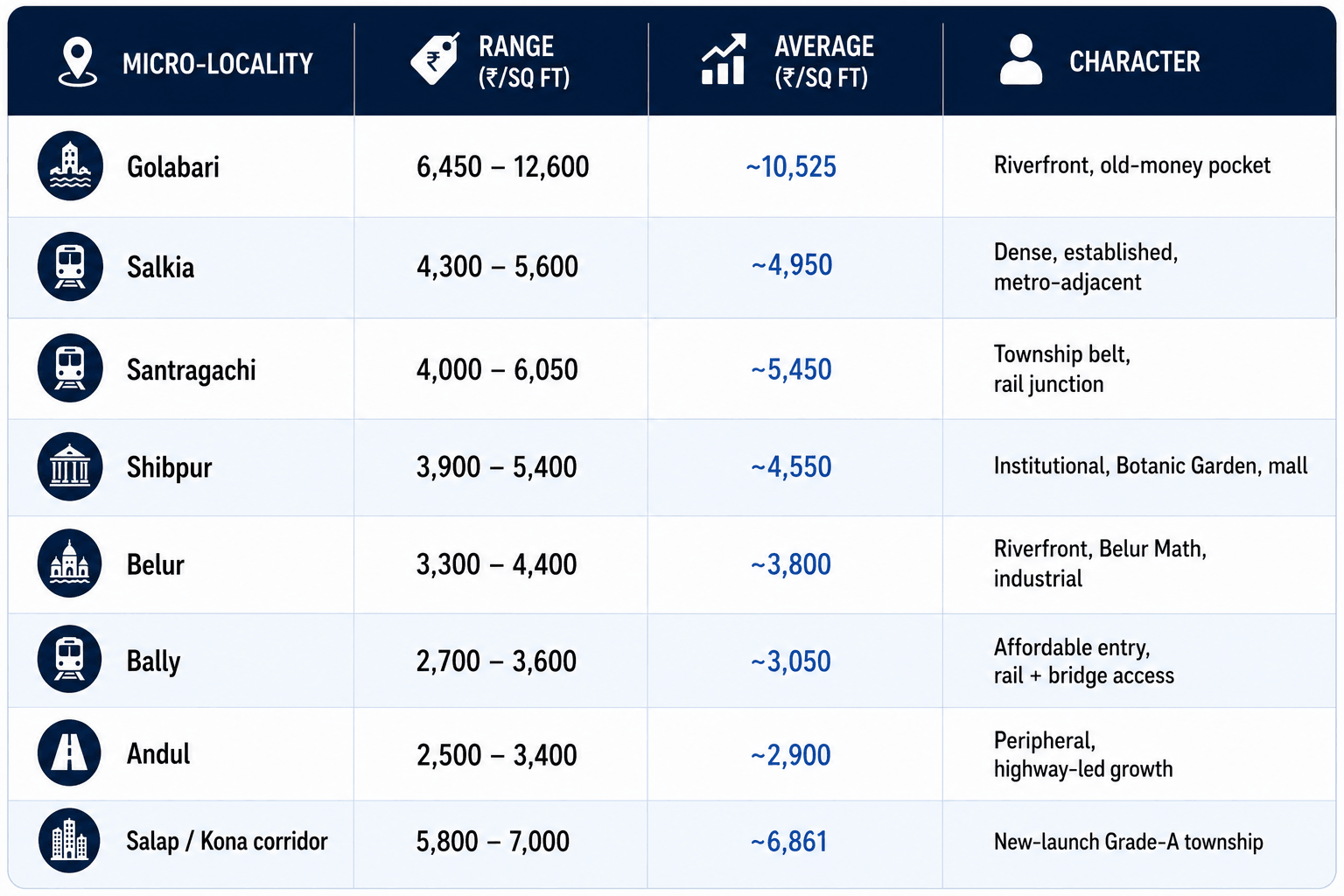
Start with price arbitrage. Kolkata averages roughly ₹6,400 per sq ft. Andul trades near ₹2,900, Bally ₹3,050, Belur ₹3,800, Shibpur ₹4,550, Salkia ₹4,950. A ₹55–60 lakh budget that buys a compact 2 BHK in Behala or Garia buys a larger, newer township 2 BHK here.
Supply quality also changed. Howrah's older stock was overwhelmingly small-builder walk-ups. Shapoorji Pallonji's Joyville township near Santragachi - 30 acres, 75% open space, 800-plus families resident - set a Grade-A benchmark the market lacked.
The infrastructure pipeline is unusually dense: India's deepest metro station, its longest cable-stayed bridge, eastern India's busiest railway terminus, and a highway being six-laned. Employment runs both ways too - Dankuni's industrial belt and the Salap cluster hire locally, while the metro imports Sector V's white-collar jobs. That two-sided demand holds Howrah real estate occupancy steady.
Howrah is not one locality but a district on the Hooghly's west bank, opposite central Kolkata. Its internal geography matters: pricing varies more than 2x across a 12 km stretch.
Howrah effectively sells two products. The city-side pockets - Shibpur, Salkia, Golabari - are dense, walkable, metro-adjacent and priced higher for resale. The western belt - Santragachi, Salap, Andul, Bally - holds the gated townships at lower rates with better amenities but greater car dependence. Decide which you want before discussing budget.
Property Price Insights
Read this as a ladder, not a list. The spread from Andul's ₹2,900 to Golabari's quotes above ₹12,000 shows a stratified market where a single "Howrah average" is close to meaningless. Golabari's reported average sits suspiciously near the top of its own range - usually a thin sample of premium listings pulling the number up. The mid-market band for most buyers is ₹3,000-₹5,500.
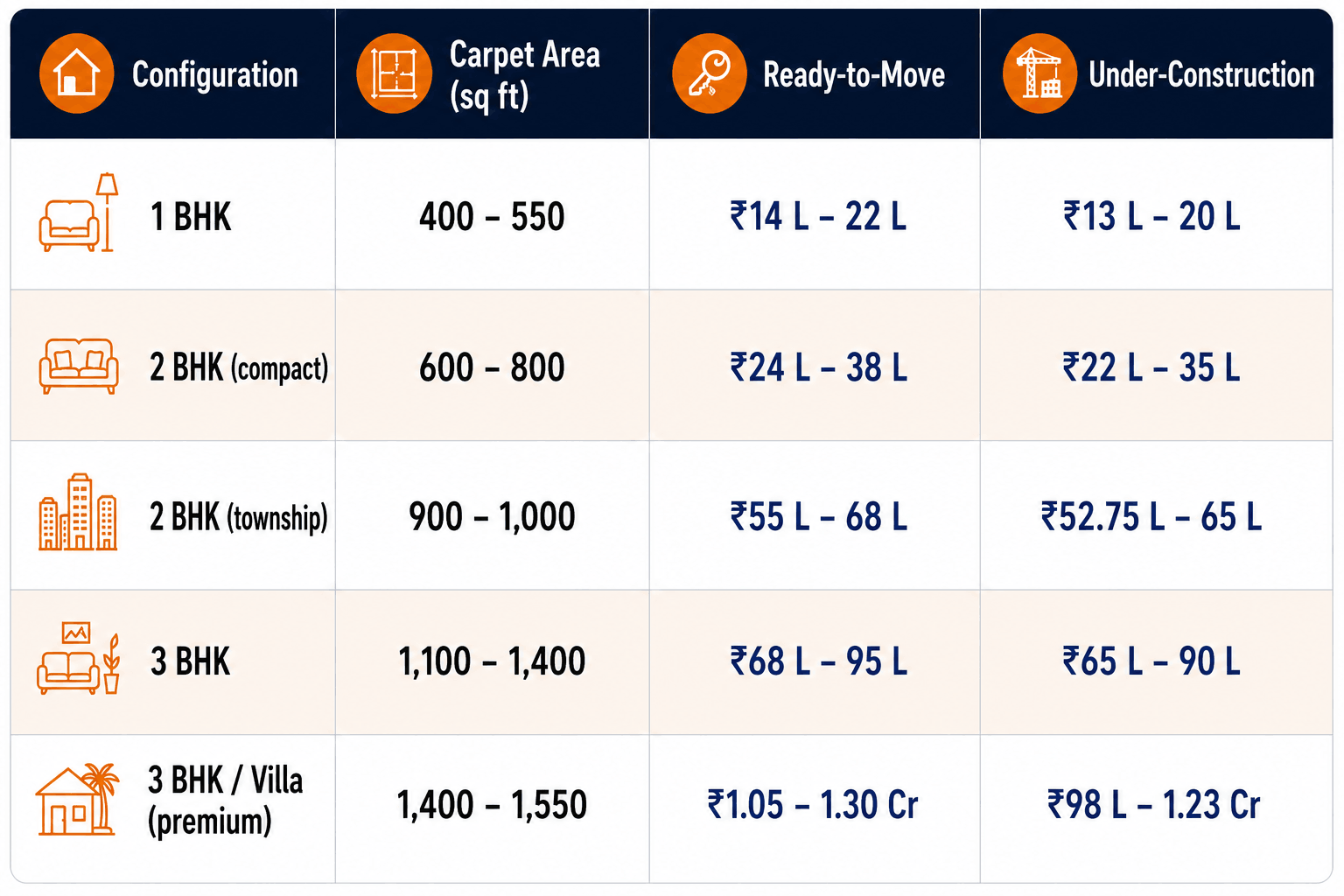
Prices by Configuration and Construction Status
The ready-versus-under-construction gap here is 5-8%, against 12-15% in Rajarhat. That narrowness signals low perceived execution risk, because the dominant new supply comes from a developer with an occupied phase already standing on site. Only accept a 2028 possession date if the unit, floor or view is genuinely better.
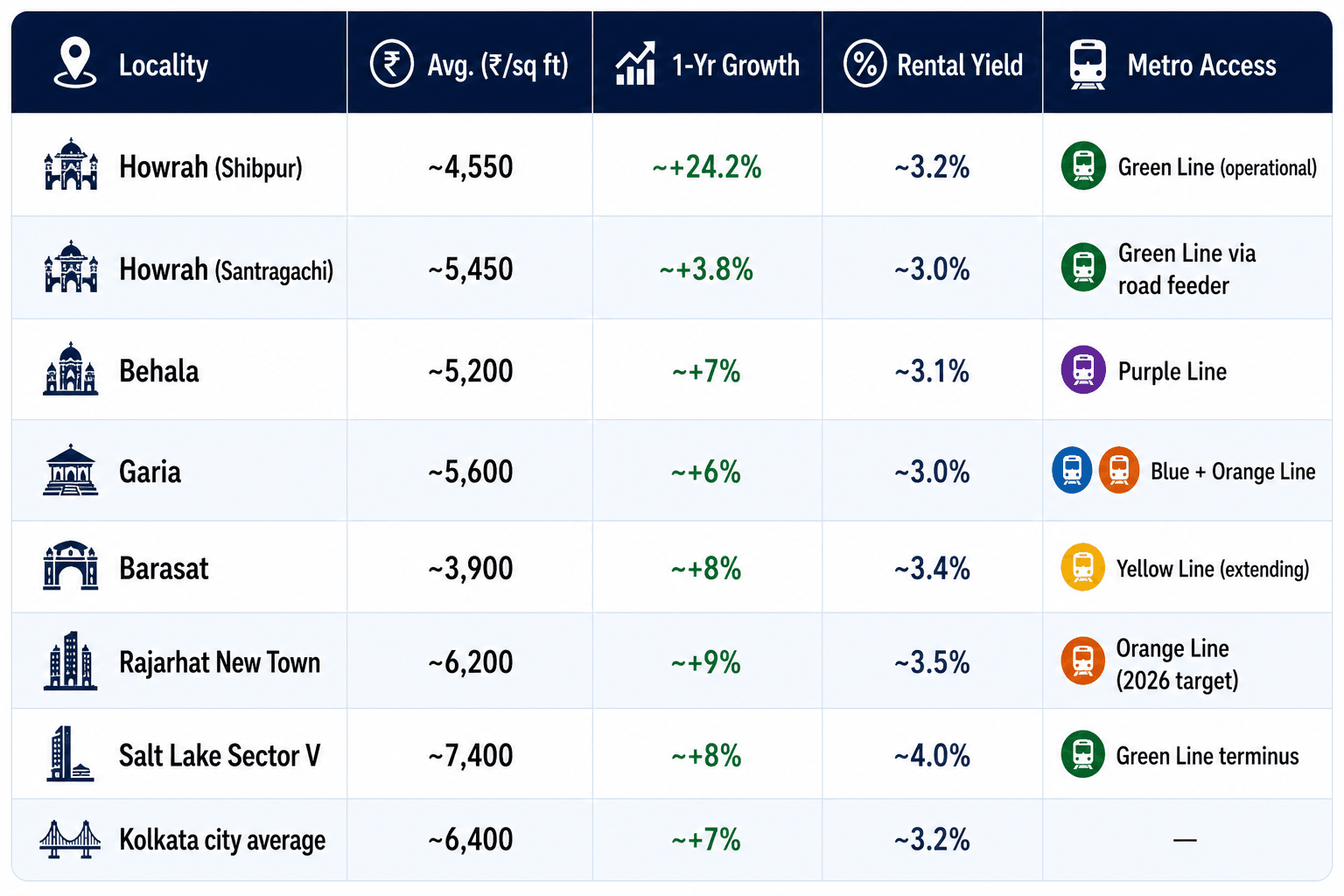
Comparison with Nearby and Competing Localities
Side by side, the pitch gets specific. Howrah is not the highest-yielding market - Sector V wins there - nor fastest-growing on a three-year view, where Rajarhat is stronger. What it offers is the widest gap between current price and achieved connectivity: an operational metro to the city's largest IT hub while trading 15-30% below average.
Connectivity
Connectivity is the strongest pillar here. Separate what is running from what is promised.
Metro (operational). The Green Line, or East–West Metro, runs 16.6 km from Howrah Maidan to Salt Lake Sector V. The under-river Howrah Maidan–Esplanade section opened on 6 March 2024 - India's first under-river metro - and the corridor became continuous on 22 August 2025. Howrah station, roughly 33 m deep, integrates with Howrah Junction; Esplanade offers Blue Line interchange. A 5.5 km extension toward Teghoria targets 2026.
Rail. Howrah Junction is eastern India's busiest terminal. Santragachi Junction, the region's third-largest station, is the suburban node for the township belt. Shalimar is now an originating terminal; Bally, Liluah and Belur serve the north.
Road. Kona Expressway (NH-117) runs 14.17 km from Kona to Vidyasagar Setu, the spine of the western township belt. Its six-laning began in August 2025 and targets early 2026, executed by the West Bengal PWD with Howrah Municipal Corporation. Vidyasagar Setu, India's longest cable-stayed bridge, carries that traffic into the city.
Airport. NSCBI Airport is 25-28 km away via Nivedita Setu and the Belghoria Expressway - road-only, and unreliable at peak hours.
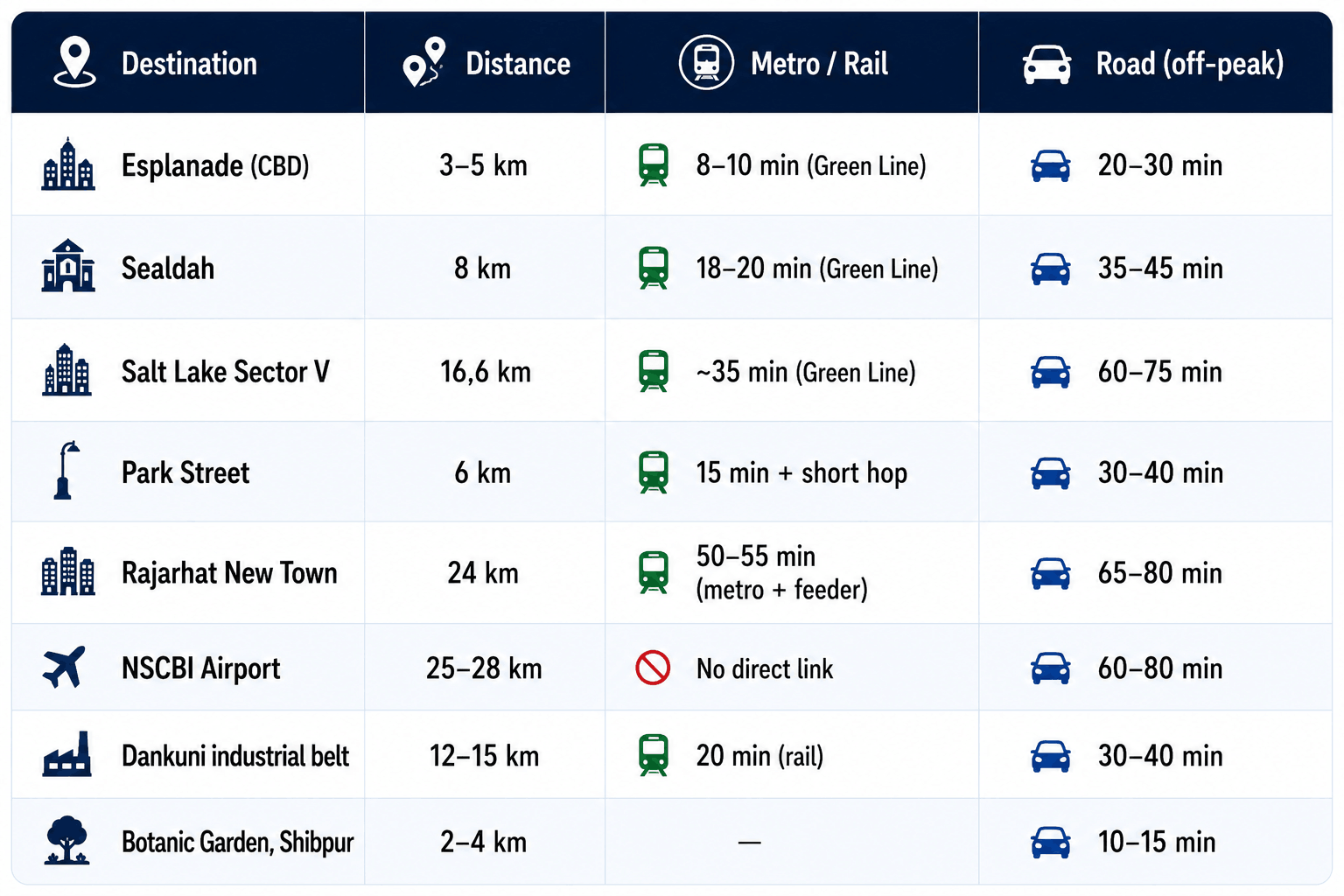
This table is the whole thesis. Howrah beats almost every Kolkata suburb on time-to-CBD and time-to-Sector V, and loses decisively on time-to-airport. If your daily journey is Esplanade, Sealdah or Sector V, this is the best-value address in the region. If you fly weekly, it is not.
Investment Potential
The Howrah real estate investment case is a falsifiable claim: the infrastructure has been delivered but the price has not fully repriced, and closing that gap is the return.
Three things support it. The Green Line is operational, not promised - the execution risk normally embedded in a metro thesis has been discharged. The price gap is measurable: ₹3,000-₹5,500 against a city average near ₹6,400 and Sector V near ₹7,400, despite a 35-minute link. And the catalysts are dated - Kona Expressway six-laning and the Teghoria metro extension, both 2026.
Three argue for caution. Shibpur's ~24% year means the easiest money has likely been made. Santragachi shows township supply can cap growth for years. And yields of 2.8-3.6% are modest absolutely - capital appreciation with rental support, not income.
Expect 6-9% annual appreciation over five years for well-located stock, the upper half contingent on those 2026 deliveries landing near schedule. The fitting strategy is a five-to-seven-year hold, financed conservatively, treating rent as carrying cost. A leveraged short flip does not fit: at roughly 7% each way, brief holds in Howrah real estate lose to a fixed deposit.
Who Should Buy in Howrah
First-time buyers get the region's strongest deal: a ₹55–60 lakh budget that buys a compact 2 BHK in an ageing South Kolkata building buys a 911 sq ft carpet township 2 BHK here, with clubhouse and gated security. Target Santragachi, Salap or Bally.
Investors should be selective. The compact 1-2 BHK within 1.5 km of a metro station is the highest-conviction play — an appreciation hold, not an income asset.
NRIs should prioritise Grade-A township stock over local resale; documentation quality matters more than saving ₹400 per sq ft.
Sector V and CBD professionals are the most obvious beneficiaries and the slowest to act - a shorter metro commute than most of South Kolkata, at a lower price.
Families with school-age children should do the shortlist first - the genuine weak point. Who should not buy: frequent flyers, buyers needing tertiary care within 20 minutes, and short-horizon speculators.
Conclusion:
Howrah in 2026 is a market where the hardest part of the thesis has already happened. The tunnel is dug, the trains are running, and 190,000 people a day use a corridor that did not exist three years ago. What has not happened is full repricing: a district connected to Kolkata's largest IT hub in 35 minutes and to the CBD in under ten still trades 15–30% below the city average.
The honest version is narrower than the headline. Shibpur's ~24% year has priced in much of the metro premium, Santragachi shows township supply can hold prices flat for years, and the airport and school-density gaps are real.
What remains, for the right buyer, is compelling: 6–9% expected annual appreciation over five to seven years, a national-developer township you can walk through before buying, two dated 2026 catalysts, and an entry price that lets a first-time buyer own a 911 sq ft carpet home with a clubhouse for what a compact resale flat costs across the river. For Sector V and CBD commuters, Howrah real estate is the most under-exploited address in the region.
Ready to see it for yourself? Blox lists RERA-verified Howrah real estate including — transparent pricing, verified WBHIRA numbers, real floor plans and an EMI calculator. Browse Properties in Howrah on Blox and book a visit before the Kona Expressway upgrade and the Green Line extension close the price gap.





 +91
+91