Kamothe Real Estate 2026: Property Prices by Sector, Metro Connectivity & Why This Navi Mumbai Locality Is an Investor's Sweet Spot

Introduction
Kamothe sits at an interesting crossroads in Navi Mumbai's property story. It is not as loud as Panvel, not as premium as Kharghar, and not as headline-grabbing as Ulwe - but for buyers who know how to read infrastructure signals, Kamothe in 2026 may well be the smartest satellite town buy in the entire Navi Mumbai belt.
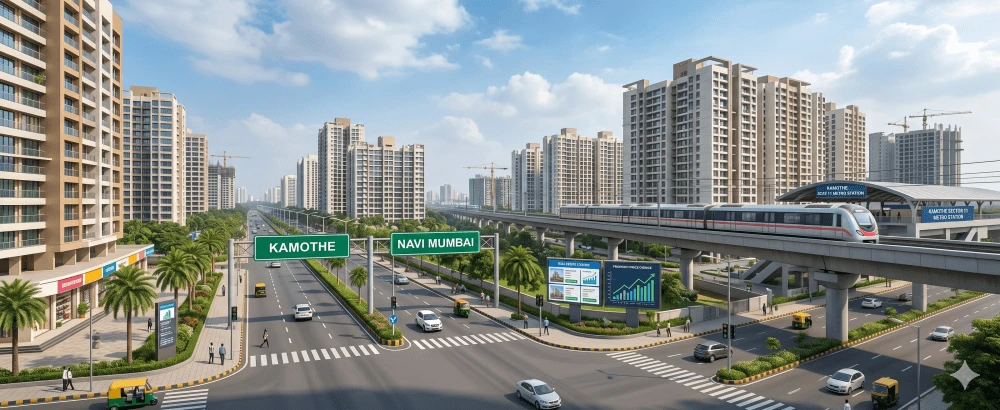
Strategically located between Kharghar and Panvel, Kamothe is divided into numbered sectors, well-served by the Khandeshwar railway station on the Harbour Line, and increasingly in focus because of the upcoming Navi Mumbai Metro Line 1, which will pass directly through the locality on its way to the Navi Mumbai International Airport (NMIA). Add to this CIDCO's continuing urban development push, a registered property rate still below ₹12,000 per sq ft despite robust transaction volumes, and a township character that attracts genuine end-users - and you have a locality that is maturing rather than overheating.
This guide covers everything a home buyer or investor needs to know about Kamothe real estate in 2026: price ranges by sector, property types, infrastructure pipeline, pros and cons, and a straight answer on whether buying here makes sense today.
Kamothe at a Glance: Location, Layout and Why It Matters
Kamothe is a planned node of CIDCO, spread across roughly 22 sectors in the Panvel taluka of Raigad district. It borders Kharghar to the north, Kalamboli to the west, and Panvel to the south-east. The Harbour Line suburban train runs through Khandeshwar station, which is Kamothe's primary rail lifeline. The Mumbai-Pune Expressway entry and Sion-Panvel Highway are both within easy reach, making road connectivity to both Mumbai and Pune strong.
The node was CIDCO-planned, which means the sector layout is orderly, public spaces were factored in at design stage, and the locality does not have the haphazard growth patterns common in non-planned Mumbai suburbs. Wide internal roads, a mix of residential, commercial, and institutional zones, and an established social infrastructure of schools, hospitals, and markets give Kamothe the feel of a mature township.
For 2026, the single biggest location advantage Kamothe carries is the Navi Mumbai Metro Line 1 corridor. The 23.4-km metro route connects CBD Belapur through Kharghar, Taloja, Kalamboli, Kamothe, and Khandeshwar before terminating at NMIA. CIDCO has allocated ₹690 crore to metro expansion in its recent budget, with the Kamothe-area stretch among the priority segments.
Kamothe Property Prices in 2026: Sector-by-Sector Breakdown
Understanding Kamothe's pricing requires looking at the distinction between CIDCO-plotted older sectors and newer high-rise micro-markets. Here is the current price landscape:

Overall market averages (2026):
- Asking rate (residential): ₹14,375/sq ft
- Registered rate: ₹11,884/sq ft
- Transaction volume (last 12 months): 1,497 deals; gross value ₹754 crore
- Year-on-year appreciation: approximately 0.93% (apartments); market stabilising after 2024 correction
1BHK flats: ₹52 lakh–₹68 lakh (carpet area 380–500 sq ft)
2BHK flats: ₹85 lakh–₹1.15 crore (carpet area 650–850 sq ft)
3BHK flats: ₹1.20 crore–₹1.75 crore (carpet area 950–1,200 sq ft)
The gap between the asking rate and the registered rate (roughly ₹2,491/sq ft) reflects a market where negotiation headroom exists - useful for buyers who do their homework. Sector 36 commands the highest premiums due to newer construction, better amenities, and greater metro proximity, while Sectors 7–12 offer affordable entry-level options for first-time buyers.
Navi Mumbai Metro Line 1: The Game-Changer for Kamothe
The Navi Mumbai Metro Line 1 is arguably the most important infrastructure development for Kamothe real estate in 2026. The proposed 23.4-km corridor runs:
CBD Belapur → Sectors 4, 9, 16 → Kharghar → Taloja → Taloja MIDC → Kalamboli → Kamothe → Khandeshwar → NMIA
CIDCO has earmarked ₹690 crore for metro expansion and the line includes a 4.17-km extension into the NMIA terminal complex. Once operational, this will make Kamothe the last major residential node before the airport - a position analogous to how Andheri benefited from being near the domestic airport in the 1990s.
For property owners and investors, the metro trajectory follows a predictable pattern: pre-announcement prices are modest, construction-phase prices see moderate uplift, and post-commissioning prices see the sharpest gains. Kamothe in mid-2026 is firmly in the construction-phase window - which historically offers the best risk-adjusted entry point.
CIDCO has also planned two additional metro routes to enhance NAINA (Navi Mumbai Airport Influence Notified Area) and NMIA connectivity, with Kamothe positioned as a key node in that expanded grid.
NMIA Impact on Kamothe Property
The Navi Mumbai International Airport is already active as Mumbai's second international airport, NMIA will serve as a major employment and economic anchor for the entire south Navi Mumbai belt - and Kamothe, situated just north of Panvel, is within the direct catchment zone.
Historical precedents from other Indian airport-adjacent real estate markets (Hyderabad's Shamshabad corridor, Bengaluru's Devanahalli) suggest appreciation of 18–28% in the 5-year window post-airport activation. Kamothe's pricing, still below ₹15,000/sq ft asking rate, leaves meaningful headroom compared to already-corrected micro-markets like Ulwe (₹9,000–₹12,000/sq ft for inland sectors) or Dronagiri (₹8,500–₹11,000/sq ft but higher infrastructure risk).
The employment multiplier effect is especially important. NMIA is expected to generate over 1.5 lakh direct and indirect jobs in the region, creating sustained rental demand for 1BHK and 2BHK units in Kamothe - which currently offers much better value-to-amenity ratios than Panvel or Kharghar for tenants.
Connectivity Snapshot: Commuting from Kamothe in 2026
One of Kamothe's underappreciated strengths is its multi-modal connectivity profile:
Rail:
- Khandeshwar Station (Harbour Line): direct connection to CST in approximately 65–70 minutes; Vashi in 25 minutes; Belapur in 15 minutes
- Panvel Station (junction): 15-minute drive; connections to Konkan Railway, Central Line, and upcoming speed rail projects
Road:
- Sion-Panvel Highway: direct access; connects to Eastern Freeway and Mumbai
- Mumbai-Pune Expressway: Kalamboli interchange approximately 10 minutes away
- Palm Beach Road: scenic coastal connector to Vashi, Belapur and beyond
Upcoming Metro (Phase 1):
- Kamothe Metro Station on Line 1: cuts travel time to Belapur to under 15 minutes; Kharghar to 10 minutes; NMIA to 8 minutes
For IT professionals working in Airoli, Mahape, or Belapur - all of which have substantial tech campuses - Kamothe offers a commute time of 20–35 minutes with train or planned metro, at price points that are 25–35% lower than those localities. That arbitrage is a primary driver of end-user demand.
Top Builders and Active Projects in Kamothe 2026
Several reputed developers are active in Kamothe, and all projects must be RERA-registered with MahaRERA before sales commence. Buyers should verify registration at maharera.mahaonline.gov.in before signing any agreement.
Key developer profiles active in Kamothe:
- CIDCO residential schemes: Original plotted development; resale market well-established
- Arihant Group: Multiple mid-segment towers across Sectors 20 and 36; known for reliable delivery
- Rustomjee / Lodha associates: Looking at land parcels near the metro alignment
- Local RERA-registered developers: Various Sector 12–15 projects in the ₹55L–₹90L range
What to verify for any project:
- MahaRERA registration number (format: P52000XXXXX)
- Completion certificate timeline
- Carpet area vs. built-up area ratio (carpet should be ≥70% of RERA-stated super built-up)
- Escrow account compliance (70% of collections must go to project account)
- Builder's track record on past possession timelines
Pros and Cons of Buying in Kamothe in 2026
✅ Advantages
- Metro alignment confirmation: Kamothe is a mapped station on Line 1 - not speculative
- Airport adjacency without airport pricing: NMIA benefit without Ulwe/Panvel premiums
- CIDCO-planned township: Orderly layout, good public spaces, reliable civic amenities
- Established social infrastructure: Schools (Ryan International, DY Patil), hospitals, malls
- Harbour Line connectivity: Existing, functional - not dependent on future projects
- Price headroom: At ₹11,884/sq ft registered rate, still affordable vs. many MMR markets
⚠️ Watch-outs
- Metro timeline risk: Indian infrastructure projects frequently face delays; metro benefit is not immediate
- Modest short-term appreciation: 0.93% YoY is below inflation; not for quick-flip investors
- Competition from Kharghar and Panvel: Better-known localities with more developer activity
- Resale liquidity: Certain older sectors may be slower to sell vs. new launches
- Negotiation needed: The asking-to-registered rate gap requires buyers to bargain actively
Investment Case: Who Should Buy in Kamothe in 2026?
Best for:
- End-users working in Belapur, Kharghar, Panvel, or the emerging NMIA economic zone
- Long-term investors (5–10 year horizon) comfortable with infrastructure-led appreciation
- First-time buyers seeking a CIDCO-planned township with sub-₹70 lakh 1BHK options
- Rental investors: current gross rental yields in Kamothe average 3.5–4.0%, which compares favourably with Mumbai city (2–2.5%)
Not ideal for:
- Buyers needing immediate price uplift or quick liquidity
- Those who want the premium lifestyle of Kharghar's hillside sectors or Belapur's corporate buzz
5-year scenario (conservative):
- Current price (registered): ₹11,884/sq ft
- Conservative appreciation (8% CAGR, metro + airport boost): ₹17,450/sq ft by 2031
- A 2BHK bought at ₹90 lakh today could be worth ₹1.32 crore by 2031 - purely on capital appreciation, before rental income
Rental Market in Kamothe: What to Expect in 2026
Kamothe has a growing rental ecosystem driven by IT workers, airport-adjacent professionals, and families priced out of Kharghar and Belapur. Current rental benchmarks:

Gross rental yield on a 2BHK purchased at ₹90 lakh and rented at ₹18,000/month works out to approximately 2.4% annually. However, with appreciation factored in, total returns over 5–7 years become compelling. The rental market should tighten as NMIA-related employment accelerates and metro connectivity arrives.
Common Mistakes Buyers Make in Kamothe
- Buying on word-of-mouth without RERA verification. Always cross-check the project's MahaRERA registration, builder's fund escrow, and completion timeline on maharera.mahaonline.gov.in.
- Ignoring sector micro-market differences. Sector 36 and Sector 20 have a fundamentally different price, quality, and tenant profile compared to Sector 7 or Sector 10. Treat each sector as its own micro-market.
- Overweighting metro timelines. The metro will benefit Kamothe, but no buyer should count on a specific operational date. Plan your finances without the metro; treat it as an upside.
- Not checking stamp duty and registration costs. Maharashtra stamp duty is 5% (male buyer), 4% (female buyer), plus 1% registration charge + GST on new properties. Budget 6–7% over and above the property value for transaction costs.
- Skipping a site visit. Photos online and virtual tours can be misleading. Physical site visits reveal floor-to-floor noise insulation, view quality, access road condition, and construction quality.
- Negotiating on price alone. In Kamothe's current market, smart negotiation also includes free car parking, furnishing packages, or waiver of maintenance deposits - all of which can add ₹3–5 lakh to effective value.
Blox Verdict: Should You Buy in Kamothe in 2026?
Kamothe earns a cautious Buy for end-users and patient investors. The fundamentals are sound: CIDCO-planned township with established civic amenities, Harbour Line access today, metro confirmation for tomorrow, and an airport adjacency that is no longer speculative. Pricing has not run away - registered rates are still below ₹12,000/sq ft - which means you are buying infrastructure optionality at a reasonable cost.
The locality is not a quick-return play. If you need 30% gains in two years, look elsewhere. But for a 5–10-year hold - whether for end-use or rent - Kamothe checks more boxes than its low profile might suggest.
Ready to explore verified, RERA-registered properties in Kamothe and across Navi Mumbai? Browse listings, compare prices by sector, and connect with experts at blox.xyz. Find your next home or investment - smarter, faster.
Frequently Asked Questions
Is Kamothe part of NMIA's airport influence zone?

What is the best sector to buy in Kamothe?
How far is Kamothe from the Navi Mumbai International Airport?
Is Kamothe a good locality to live in with family?
What rental returns can I expect?

Get in Touch
Let our experts help you answer your questions

 +91
+91


Get in Touch
Let our experts help you answer your questions
+91