Navi Mumbai International Airport has been flying commercial since 25 December 2025 and was running 78 daily departures by April 2026. Karanjade sits about 12.6 kilometres from it - closer than most of the nodes that spent 2024 and 2025 selling themselves on airport proximity.
Karanjade's property prices moved roughly 0.5% last year.
Not 15%. Not 6%. Half a percent, against Panvel's 6.9% and New Panvel's 6.5% over the same window. The airport opened, the trains kept running, and this node sat still.
That is either the most obvious mispricing in the Panvel belt or an accurate verdict the market has already reached. This guide is an attempt to work out which - because Karanjade real estate is one of the last places in the Navi Mumbai region where a 1 BHK still starts under ₹40 lakh, and that fact deserves a straight answer rather than a brochure.
Why Buy Property in Karanjade
Most airport-corridor nodes sell you a future. Ulwe sells the coastal road. Pushpak Nagar sells the terminal across the field. Taloja sells a metro extension that keeps getting redrawn.
Karanjade sells something duller and more useful: a price you can actually clear.
Sixty-two per cent of buyers searching here want something under ₹50 lakh, and unusually, the market supplies it. Eighty-four per cent of demand is for 1 BHK - and 83% of supply is 1 BHK. Demand and supply are almost perfectly matched, which is rare and tells you exactly what this node is. It is not a lifestyle destination. It is where people who work across the Panvel–JNPT belt buy their first home.
The second argument is geography that doesn't depend on anything being built. Panvel railway station is 3.5 km away - Harbour line, Central line, and long-distance services out of one interchange. The Sion-Panvel Expressway and the old Mumbai–Pune Highway are minutes off. JNPT Road runs past.
Be honest about the trade, though. No metro station, sanctioned or otherwise. No large mall inside the node. Residents complain - consistently, in review after review - about water distribution, road maintenance, thin public transport and peak-hour congestion on the approach roads. You are buying floor area and a postcode near a highway, not a finished suburb.
Location Snapshot
So where exactly is this? South-east of the Navi Mumbai core, on the Panvel side of the Sion–Panvel Expressway, in Panvel taluka of Raigad district - administered from Panvel, whose municipal corporation was formed in October 2016 out of the old council and 29 revenue villages.
The PIN code is 410206. The node covers roughly 2.91 square kilometres with a population near 30,500, which makes it dense for its footprint and small enough to walk across.
The reference points that matter: Panvel railway station 3.5 km, Navi Mumbai International Airport 12.6 km, Kamothe and Kalamboli immediately north, Old Panvel and New Panvel to the east. Roads are JNPT Road, Uran-Panvel Road, the Sion-Panvel Expressway and the Mumbai–Pune Highway. There is no metro station and none is under construction.
Stamp duty is 6% plus 1% registration, dropping to 5% for a sole female buyer.
Two numbers frame what follows. Asking rates sit roughly in the ₹11,000–13,000 per sq ft band as of August 2026 - with portals disagreeing sharply, of which more below. And the node's five-year appreciation is +14.4%, against Panvel's +32.7% and New Panvel's +39%. Karanjade has been the slow one on its own street for years, not just last year.
Property Price Insights
Before the tables, a warning that matters more here than in most nodes: the portals do not agree on what Karanjade costs, and the gap is not small.
One platform reports ₹5,600 to ₹10,750 per sq ft. Another puts the average at ₹9,680. A third shows ₹11,000-13,000. A fourth quotes ₹12,250. That is a spread of more than 100% for the same locality in the same quarter, driven by carpet-versus-built-up methodology, by the mix of old village-side stock against new towers, and by the sheer number of small projects with inconsistent listing discipline. Treat every single number below as a range-finder, and treat registered transaction values from the Maharashtra registration records as the only figure you actually transact on.
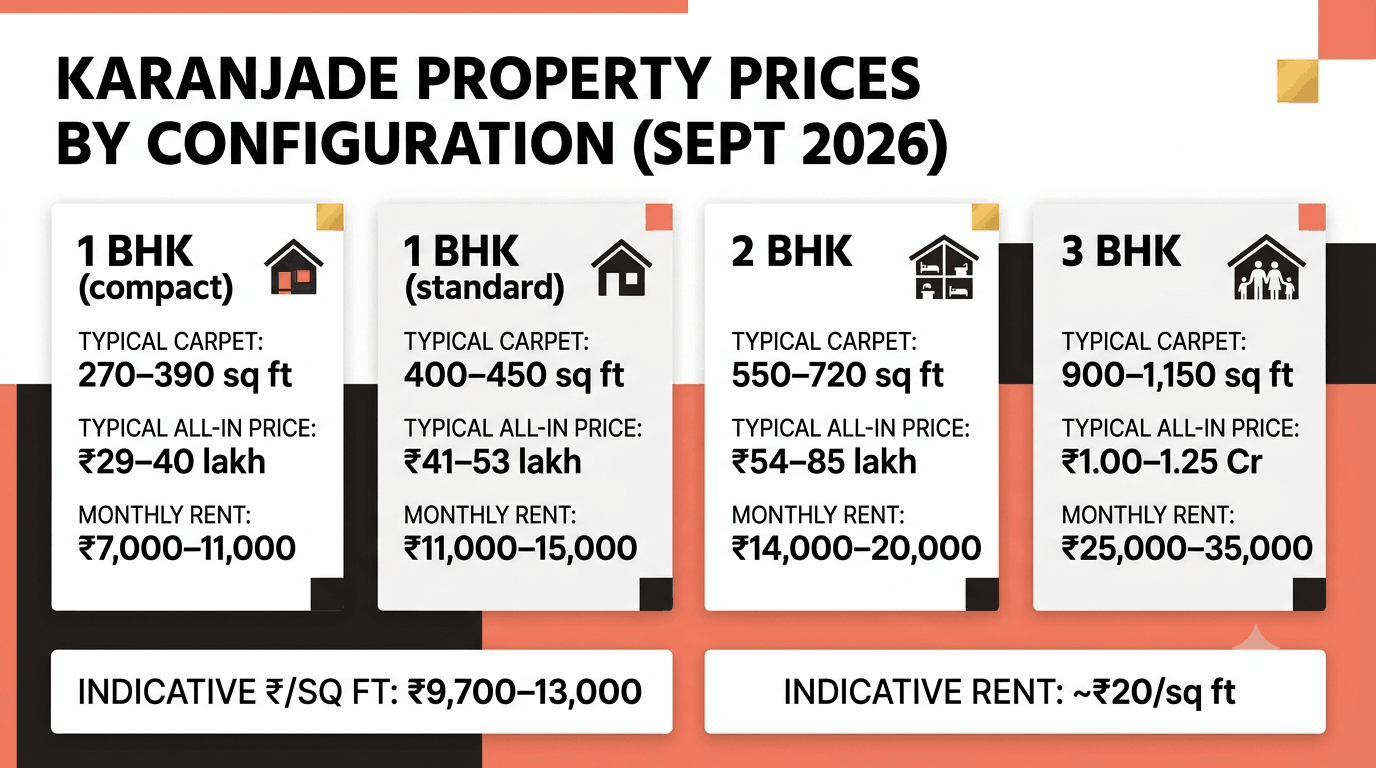
Look at the top row. Compact 1 BHKs of 270 to 390 sq ft carpet, selling from about ₹29 lakh. That is close to the cheapest formal, RERA-registered housing available anywhere within 15 km of a functioning international airport in India. It is also, plainly, a very small flat - and the resale market for 270 sq ft units is thinner than for 450 sq ft ones. Cheap and liquid are not the same thing.
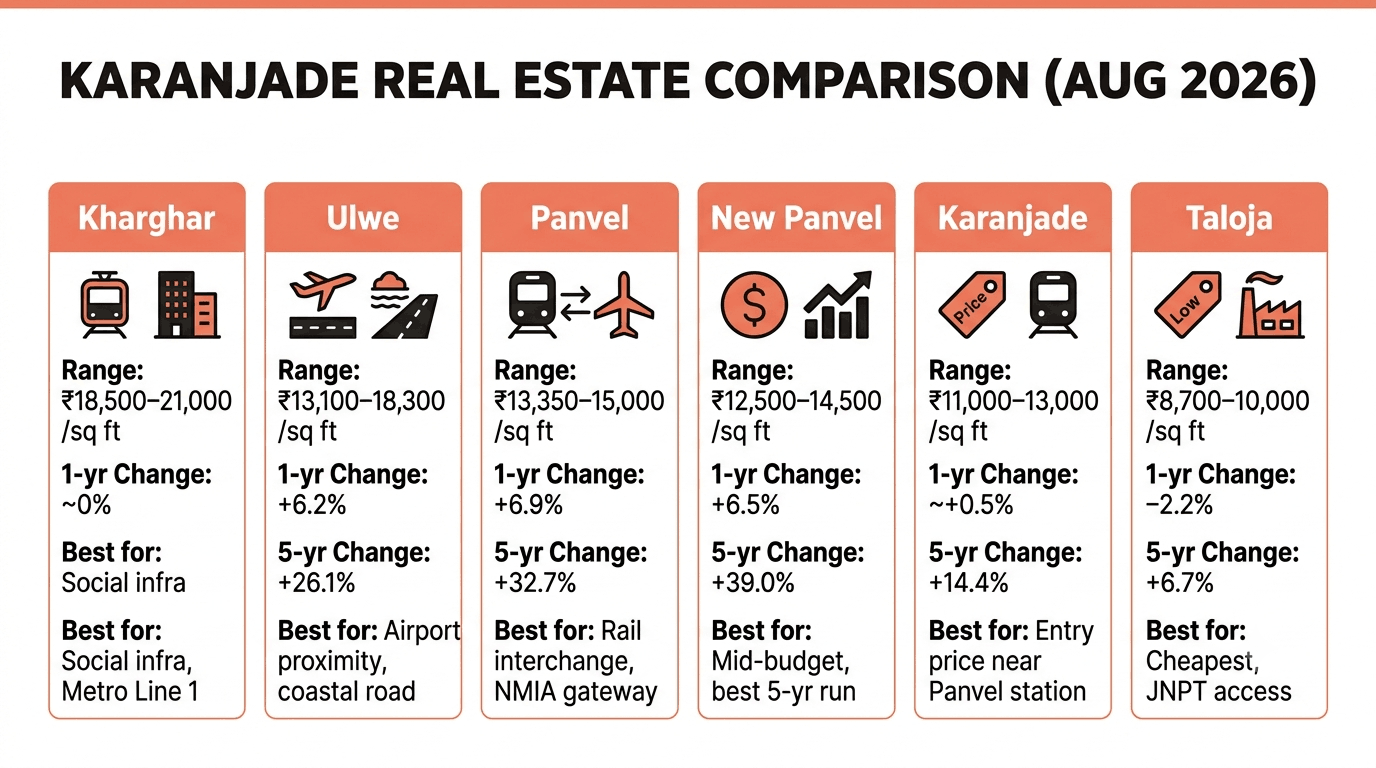
Read the 5-year column, not the 1-year one. New Panvel put on 39% while Karanjade managed 14.4%. Over five years, on a ₹50 lakh flat, that difference is about ₹12 lakh of forgone appreciation - considerably more than the entry-price saving that brought most buyers here in the first place.
Rental economics are the node's genuine strength, and they rarely get mentioned. Gross yield runs near 3.9% - higher than Koparkhairane's 3.0-3.2%, higher than Ulwe's 3.0-3.5%, and among the better figures in the region. Low capital values with functional rents do that. Registered transaction activity is real too: roughly 290 transactions worth about ₹99 crore in the year to August 2026, which works out to an average deal size near ₹34 lakh. That is a 1 BHK market transacting like a 1 BHK market.
Connectivity to Karanjade
Which raises the obvious question. If Karanjade is this close to the airport and this close to Panvel station, why hasn't it repriced? Connectivity gives an uncomfortable answer: the node is near a great deal of infrastructure and on almost none of it.
Start with what works. Panvel station at 3.5 km is a genuinely strong asset - Harbour line services to Mumbai, Central line to Karjat and beyond, and outstation trains from one of the busiest junctions on the network. From Karanjade that is a ten to fifteen minute auto or bus ride, longer when the approach roads snarl.
Road access is similarly good in principle. The Sion-Panvel Expressway, the Mumbai-Pune Highway, JNPT Road and Uran-Panvel Road all pass within easy reach, which is why the freight and port workforce lives here. Atal Setu, open since January 2024, puts South Mumbai within roughly an hour by car - budget ₹250 each way for the toll, on a 50% concession currently set to expire on 31 December 2026, with EVs exempt.
Now the gaps, which are the reason for the price.
There is no railway station in Karanjade and no metro. Navi Mumbai Metro Line 1 runs CBD Belapur to Pendhar and has since November 2023. Its approved extensions - MIDC Taloja to Khandeshwar (7.12 km, eight stations) and Khandeshwar to the airport (4.17 km) - would pass to the north of here without serving the node, and neither has an announced construction timeline. Mumbai Metro Line 8, the 34.9 km CSMIA–NMIA corridor approved on 24 February 2026 at ₹22,862 crore, is genuinely significant for the region, with construction slated to start in June 2026 and a May 2031 target. It terminates at the airport, not here.
And the airport itself, at 12.6 km, is a twenty-five to thirty-five minute drive depending on the Uran-Panvel Road. Close enough to be useful for a traveller. Not close enough, evidently, to reprice the land.
Social Infrastructure
The commute is what you are buying. The amenity picture is what you are accepting, and here it deserves precision rather than a padded list.
Schools are adequate and improving. SGT International School, Mother Mary International, St. Wilfred's, Akshar Global School, Rising Star's Public School and New English School operate in and around the node, covering the mainstream boards. For anything more specialised, Kharghar and New Panvel are the realistic catchment.
Healthcare inside the node runs to smaller multi-speciality and nursing-home-scale facilities - Lifeline, Panacea, Paramount, Yash, Aadhar and similar. The serious hospital for this belt is MGM in Kamothe, a short drive north, with Kharghar's larger facilities further out. This is the single biggest gap between Karanjade and a node like Kharghar, and worth weighing if you have elderly parents in the household.
Retail is functional rather than aspirational. Excellanzaa Shopping Plaza and a Reliance SMART cover daily needs inside the node; Orion Mall, K-Mall and Little World Mall in Kharghar handle the rest. There is no large public park of consequence, and residents say so.
The honest summary: everything essential exists, nothing is excellent, and the things people complain about - water supply consistency, road surfaces, public transport frequency - are exactly the things that separate a ₹11,000 node from an ₹18,500 one.
Employment & Commercial Hubs in Karanjade
So who fills these flats? Not, mostly, people who work in Karanjade.
The node's employment base is the wider Panvel-Uran-JNPT belt: port and logistics operations at Jawaharlal Nehru Port, the industrial estates along the Taloja and Panvel corridors, the commercial and government establishment around Panvel city, and increasingly the airport's own ecosystem - ground handling, cargo, hospitality and the services that cluster around a 24×7 terminal.
That last piece is the most interesting and the least proven. The airport scaled from 22 daily departures at launch to 78 by April 2026 across 46 domestic destinations, and opened its first international route - Air India Express to Abu Dhabi - on 15 July 2026, with Phase 1 rated for 20 million passengers a year. An airport of that scale eventually generates thousands of shift-based jobs in exactly the income band that buys ₹35-50 lakh flats. Karanjade is well placed for that tenant. Whether the jobs arrive in the numbers optimists expect is, as of September 2026, still an assumption rather than a fact - and no credible published headcount exists for the airport's indirect employment. Treat any specific number you are quoted with suspicion.
Investment Potential
So: opportunity or trap? The honest answer is that Karanjade is a decent income asset wearing the costume of a growth story, and most people buy it for the costume.
The bull case is real enough. This is the cheapest formal housing within striking distance of a working international airport, at a yield near 3.9% that beats every premium node in Navi Mumbai. The regional infrastructure pipeline is genuinely heavy - Metro Line 8 approved in February 2026, Metro Line 1's airport extension on the books, the Panvel-Karjat corridor nearing completion, Atal Setu already operational. The Panvel belt as a whole put on 6–7% last year and 30–39% over five.
The bear case is the scoreboard, and it is unambiguous. Karanjade did 0.5% while its neighbours did 6–7%. Over five years it did 14.4% while New Panvel did 39%. None of the approved metro alignments stop here. There is no station in the node and no plan for one. The supply pipeline is large, fragmented and continuously replenished, which caps price recovery - when demand rises in a node with 394 projects and unlimited small-builder capacity, you get more flats, not higher prices.
That last point is the one most buyers miss. Scarcity is what makes a node rerate. Karanjade has none.
So the defensible trade is narrow: buy a well-built 1 or 2 BHK near the Panvel-side approach, from a builder with completed projects you can inspect, and hold it for rent at a realistic 3.5-4%. Underwrite capital growth at 3–5% a year, not 10%. Anyone selling you an airport-driven doubling should be asked why the last twelve months produced half a per cent.
Pros & Cons
What works. The entry price is the lowest in the Panvel belt outside Taloja, with formal, RERA-registered 1 BHKs starting near ₹29 lakh and standard ones under ₹50 lakh. Rental yield near 3.9% is among the region's best. Panvel station is 3.5 km away with Harbour, Central and outstation services. The airport is 12.6 km. Road access to the Expressway, the Mumbai–Pune Highway and Atal Setu is good. Supply of small configurations exactly matches demand for them, which keeps the market liquid at the entry level.
What doesn't. Prices moved about 0.5% in a year and 14.4% over five, both the weakest in the belt. There is no railway station and no metro in the node, and none of the approved extensions serve it. Serious healthcare is a drive away in Kamothe. Water supply, road maintenance, parks and public transport all draw consistent resident complaints. Supply is fragmented across small builders with wide quality variance and thin brand accountability. And the enormous project pipeline means any demand surge is likely to be absorbed by new stock rather than by prices.
Who Should Buy in Karanjade
Buy here if you are a first-time buyer working across the Panvel, JNPT, Uran or airport belt who needs a formal, registered home under ₹50 lakh and cannot clear Panvel or Ulwe pricing. Buy if you are a yield-focused investor who genuinely wants 3.9% gross and is content compounding capital at single digits. Buy if you value the Panvel interchange - for a household that uses outstation trains regularly, 3.5 km from that junction is worth real money.
Look elsewhere if capital appreciation is the point: New Panvel and Panvel have delivered two to three times Karanjade's five-year return for a manageable premium. Look elsewhere if you want metro access, in which case Kharghar or the Taloja corridor are the honest answers. Look elsewhere if social infrastructure matters most, where Kharghar is simply a better-built place. And if you are chasing the airport trade specifically, Ulwe and Pushpak Nagar have the coastal road and the proximity that actually moved prices.
We started with a contradiction: an international airport twelve kilometres away, and a price that moved half a per cent.
The contradiction resolves once you stop thinking in kilometres and start thinking in connections. Karanjade is near a great deal — a major rail junction, an expressway, a port belt, a new airport — and on almost none of it. No station. No metro. No approved alignment that stops here. In a region where every rerating of the last five years followed a piece of transit infrastructure, that is not a small detail. It is the whole explanation.
What is left, once you remove the growth story, is still worth something. This is the most affordable formal, registered housing in the Panvel belt, with the best rental yield in Navi Mumbai, 3.5 km from one of the network's busiest junctions, in a node where demand and supply are almost perfectly matched at the 1 BHK level. For a first-time buyer on a real budget, or an investor who genuinely wants income rather than a story, that is a defensible purchase.
Just buy it for what it is. Karanjade real estate is an income asset with an entry price that makes sense - not an airport play that is about to catch up. The last twelve months made that argument more clearly than any guide could.
Blox can take it from here. Compare verified, MahaRERA-registered
Karanjade projects, work from registered transaction values rather than asking rates, and talk to an advisor who will tell you plainly when a small-builder project isn't worth the discount.




 +91
+91