For a decade, Katraj was the place Pune drove through rather than the place Pune bought into. It was the zoo, the ghat, the tunnel on the Bengaluru highway, and a long queue of trucks. That framing is now out of date, and the reason is boring but decisive: five underground metro stations are being built between Swargate and Katraj, and the southern arc of the Pune Ring Road is taking shape a few kilometres away.
Katraj sits at a junction most Pune micro-markets would envy. The old Pune-Satara Road runs through its centre. The Dehu Road-Katraj Bypass loops around its western edge, feeding the Mumbai-Pune corridor without touching city traffic. NH-48 exits south through the New Katraj Tunnel. Add a working social ecosystem - Bharati Vidyapeeth's campus, Rajiv Gandhi Zoological Park, a dense retail strip - and you have a locality that already functions rather than one that promises to.
The honest counterweight: Katraj real estate is not cheap relative to what it delivers today, portal price data disagrees sharply, and the metro will not carry a passenger before 2029. Several appreciation figures circulating online are asking-price artefacts, not registered transactions.
This guide works through the actual 2026 numbers - per-square-foot rates by configuration, one-, three- and five-year appreciation, rental yields, travel times, MahaRERA projects, and a clear-eyed view of who should buy here.
Why Buy Property in Katraj
Three arguments carry weight in Katraj real estate, and one is unusual for a South Pune suburb.
First, confirmed heavy infrastructure. The Swargate-Katraj extension of Pune Metro Line 1 is a 5.463 km underground stretch with five stations, and it terminates in Katraj. This is not a proposal - ground-breaking took place in September 2024, the civil contract is awarded, and segment casting began in 2026.
Second, road optionality. Most Pune suburbs depend on a single artery. Katraj has three: Satara Road into the city core, the Katraj-Dehu Road Bypass to the western IT belt, and NH-48 southward. The Pune Ring Road passes through the Mangdewadi-Wadachiwadi belt just south-east, and the long-stalled Katraj-Kondhwa widening has finally moved, with roughly ₹470 crore committed by PMC to land acquisition.
Third - the differentiator - social infrastructure predates the real estate. Bharati Vidyapeeth's medical, dental and engineering colleges have anchored this belt for decades. Buyers are not gambling on future amenities.
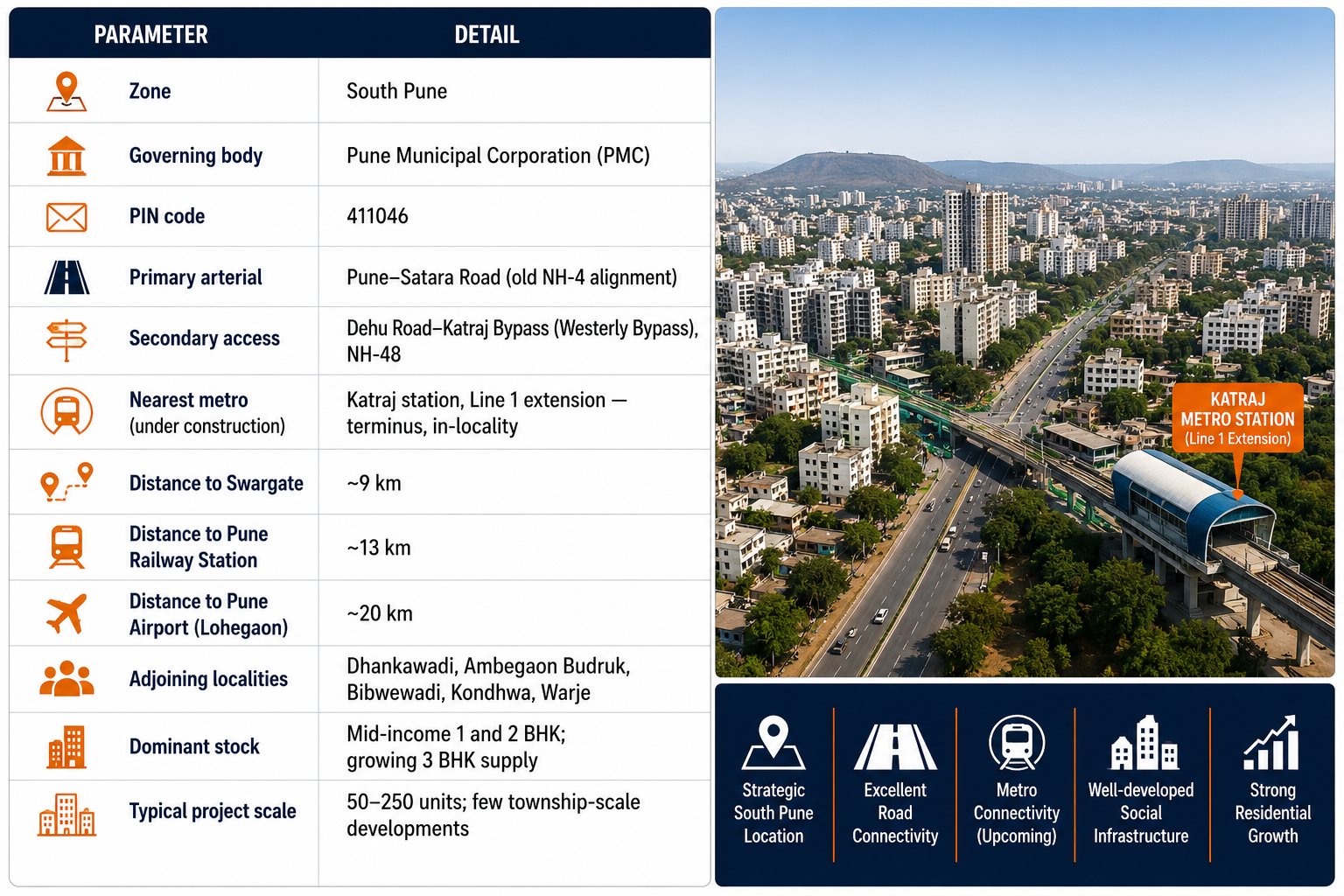
Katraj Location Snapshot
Read that table as a description of a transitional locality. PMC governance matters - water, roads and building approvals sit under municipal jurisdiction rather than a gram panchayat, a real risk reduction versus fringe PMRDA areas. But the "typical project scale" row is the tell: this is a redevelopment-and-infill market, not a master-planned one. You get established neighbourhoods and mature trees; you also get older societies, narrow lanes and inconsistent amenity quality between adjacent buildings. Project-level due diligence matters more here than in Hinjewadi or Punawale.
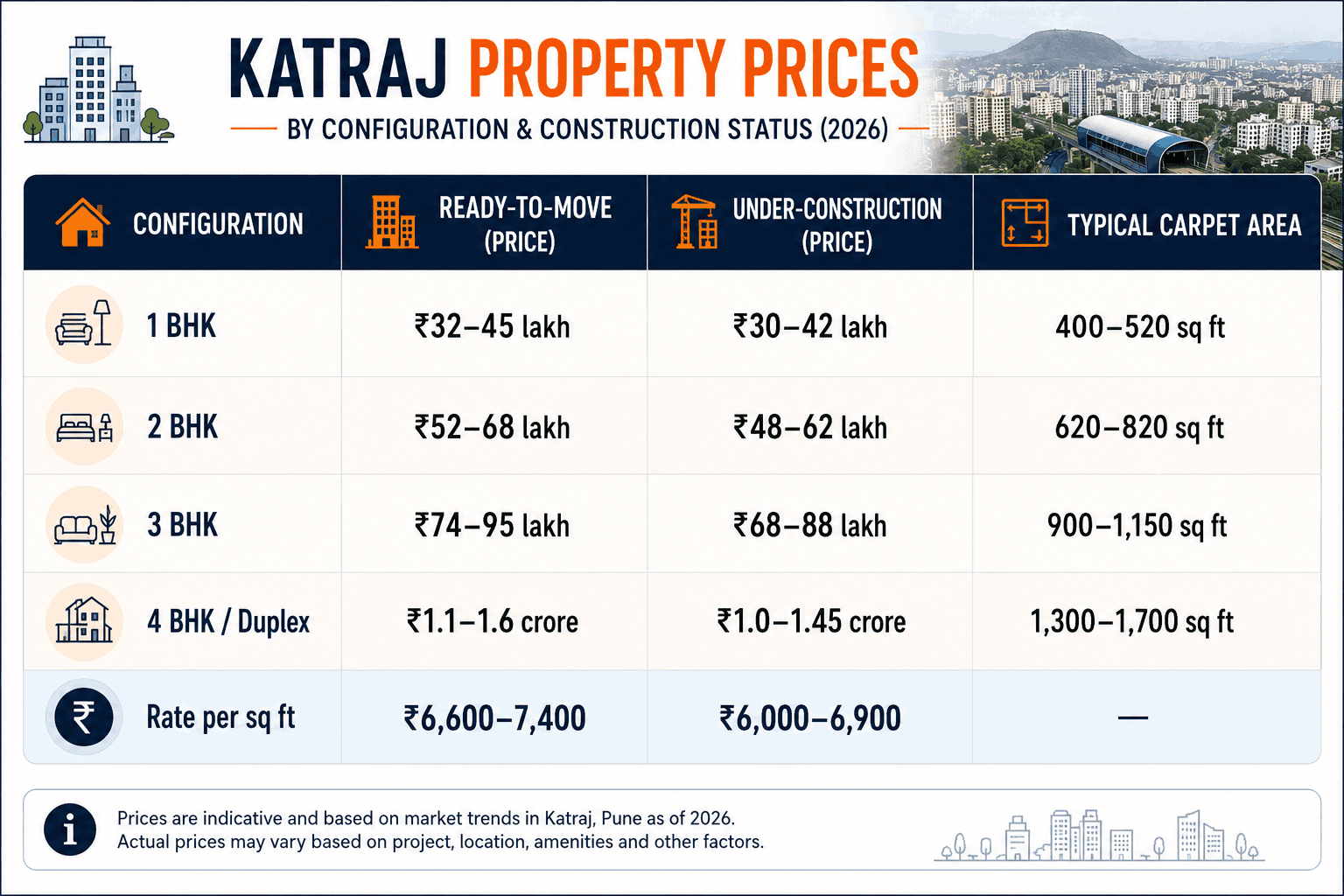
Property Price Insights
The ready-to-move premium of roughly ₹500–700 per sq ft is the most useful number in that table. It is narrower than Pune's western corridor, where the gap often exceeds ₹900 - meaning under-construction Katraj real estate is not being discounted aggressively, because developers are pricing forward against the metro. That removes much of the usual reward for accepting construction risk.
Comparison with Nearby Localities (2026)
Katraj prices in the middle of its own neighbourhood - cheaper than Ambegaon Budruk and Kondhwa, dearer than Dhankawadi and Dhayari. That mid-table position is arguably its strongest investment argument, because it is the only one of the six with a terminus metro station under construction inside its boundary. Ambegaon Budruk's premium buys newer buildings; Katraj's discount to it is the spread an investor is paid to hold through construction.
On appreciation, candour is required. Portal data shows flat rates up roughly 17.5% over one year, 20.5% over three years and 19.5% over five, with the adjoining Katraj-Kondhwa Road pocket steeper at 21.8% over one year. Those figures derive largely from asking prices, and a one-year gain that nearly matches the three- and five-year gains is a warning sign, not a triumph - it means the five-year record was flat-to-weak and almost all movement is recent. The ten-year number, around 6.8%, confirms it: for most of the last decade, Katraj real estate went essentially nowhere. You are underwriting a re-rating that began when the metro contract was awarded, not a compounding history.
Rental economics are similarly mixed. One-bedroom units let for roughly ₹7,000–11,000 a month, two-bedroom units ₹10,000–18,000, three-bedroom units up to about ₹25,000. Against 2026 capital values that is a gross yield of roughly 3.0-3.6% - respectable for Pune, unremarkable in absolute terms, and supported by steady student and hospital-staff demand from the Bharati Vidyapeeth campus.
A ₹56 lakh two-bedroom purchase compounds to about ₹71.5 lakh over five years at 5% CAGR, ₹78.5 lakh at 7%, and ₹86.2 lakh at 9%. The 7% path is the base case if the metro opens close to schedule; 9% needs the Ring Road and metro together; 5% is what to underwrite if either slips two years, which in Pune is not unusual.
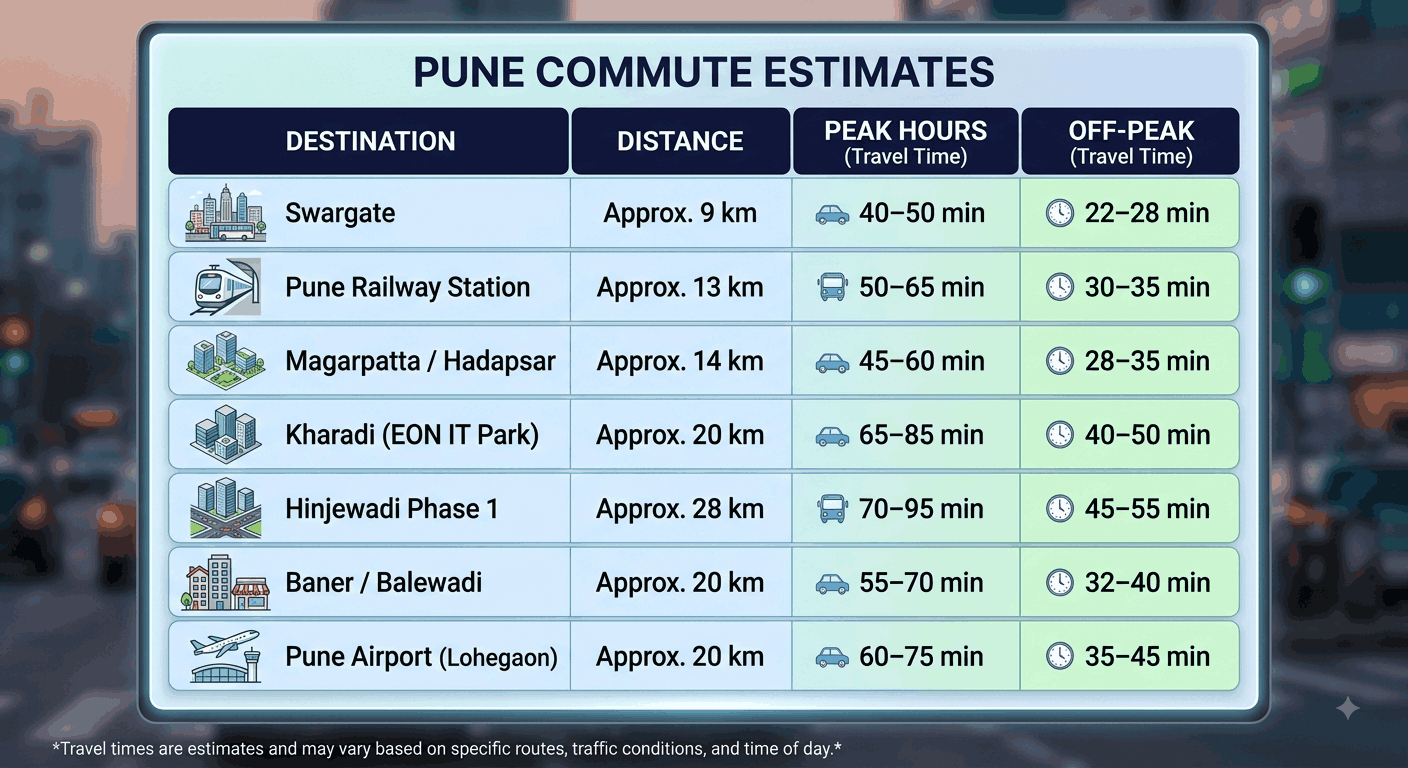
Connectivity
Those peak-hour numbers are the honest case against Katraj real estate today, and they are why the metro matters. Satara Road into Swargate is one of Pune's most congested stretches, and a nine-kilometre trip taking three-quarters of an hour is a real quality-of-life cost. Once the five-station underground line runs, that journey becomes a predictable sub-twenty-minute ride with a Swargate interchange into the network. The bypass also gives Katraj a westward escape route the interior southern suburbs lack.
Employment & Commercial Hubs
Katraj is a commuter locality, not an employment node, and buyers should price that in. The largest in-locality employer is the Bharati Vidyapeeth ecosystem - colleges, hospital and associated services supporting several thousand jobs within 3 km, which underpins genuine local rental demand.
Beyond that, the workforce travels. Magarpatta City and the Hadapsar SEZ belt sit about 14 km east, hosting Amdocs, Accenture, Mphasis and John Deere. Kharadi's EON IT Park - Barclays, Zensar, TCS - is around 20 km, and Hinjewadi's Rajiv Gandhi Infotech Park roughly 28 km via the bypass. The Swargate and Deccan commercial districts, plus Market Yard's wholesale cluster, are 8–11 km and will be directly metro-linked.
Investment Potential
The case rests on a single, dateable catalyst. Pune has run this experiment before: Vanaz-Ramwadi and the PCMC line both delivered visible re-ratings in adjacent stock in the eighteen months bracketing commissioning, even where the locality was unremarkable. Katraj real estate is now at the front of that cycle rather than the back - the difference between buying Wakad in 2019 and in 2025.
What tempers this is that the market has begun pricing it in. The steep one-year move means you are no longer buying at pre-announcement levels, and the compressed under-construction discount means developers capture much of the anticipated upside. A 2029 target carries the usual risk premium; two years of slippage pushes a chunk of the re-rating into the 2030s.
The sensible framing is a five-to-seven-year hold, not a three-year flip. Target stock within walking distance of the Balajinagar or Katraj station sites, avoid interior Katraj-Kondhwa pockets until that widening delivers, and treat the 3.0–3.6% yield as carry rather than return.
What works. Three independent road arteries plus a terminus metro station under construction, rare at this price. Decades-old social infrastructure, so no amenity gamble. PMC jurisdiction rather than fringe panchayat governance. Real green cover - the zoo, lake and ghat slopes are permanent open space, not a rendering. And a mid-table price against Ambegaon Budruk and Kondhwa despite better forward connectivity.
What doesn't. Peak-hour congestion on Satara Road is genuinely bad and stays bad until 2029 at the earliest. A ten-year record near 6.8% shows this market went nowhere for most of the decade, and the recent spike is asking-price-led. Project stock is small-scale and inconsistent, so the locality average tells you little about any specific building. Heavy truck traffic on the highway stretch affects air quality and noise. And employment is entirely elsewhere - a commute-in, commute-out address.
Who Should Buy Here
Katraj real estate suits four profiles. End-user families wanting a genuine 2 or 3 BHK under ₹75 lakh inside PMC limits, with established schools and a teaching hospital within three kilometres, have few better South Pune options. Patient investors on a five-to-seven-year horizon get a dateable catalyst and enough rental carry to hold. First-time buyers priced out of Kondhwa and Ambegaon Budruk get a 4–11% discount without leaving the municipal boundary. NRIs benefit from PMC-governed, MahaRERA-registered stock that is easy to verify remotely.
It suits two poorly: daily commuters to Hinjewadi or Kharadi, who should look at Punawale, Tathawade or Wagholi; and short-horizon investors expecting a two-to-three-year exit, who will find the easy gains already taken.
Katraj is a locality whose story just changed. For a decade it was a highway junction with a zoo attached; from 2029 it becomes the southern terminus of Pune's busiest metro line, with a ring road easing the freight traffic that defined it - a structural shift, at prices roughly 4-11% below Kondhwa and Ambegaon Budruk.
But this is not a market to buy carelessly. The ten-year record is weak, the recent spike is asking-price-led, project quality varies building by building, and the metro is three years away at best. The right buyer is patient, verifies MahaRERA status and registered comparables project by project, and holds through construction collecting a 3.0-3.6% yield. If that describes you, Katraj real estate belongs on your South Pune shortlist alongside Kondhwa and Undri - arguably ahead of both on a five-year view.
Ready to see Katraj for yourself? Browse verified, MahaRERA-registered projects across South Pune on Blox, compare real per-square-foot pricing rather than brochure claims, and book a no-pressure site visit. Blox advisors do not work on developer commissions, so the shortlist fits your budget and commute. Start at blox.xyz.





 +91
+91