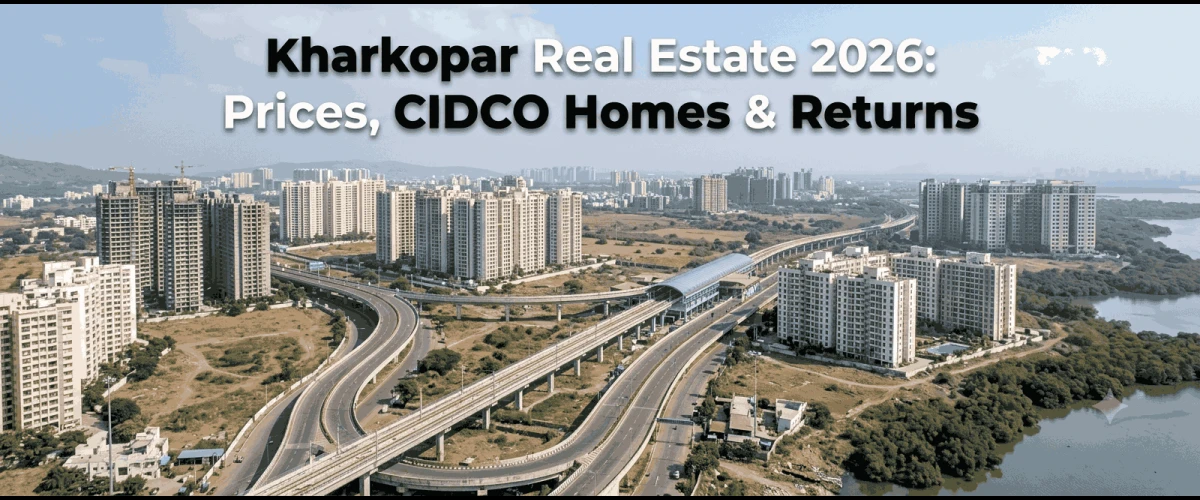
Most suburbs get a railway station. Kharkopar got a railway station and then a suburb.
When the Nerul/Belapur–Uran line opened its first phase on 11 November 2018, Kharkopar was the terminus - a two-platform station on Bandar Road in Gavan, surrounded by very little. Trains ran there because the line had to stop somewhere. For six years, that was the joke about this station: plenty of platform, not many people.
The joke has stopped being funny, in the good way.
The line reached Uran in January 2024. Targhar and Gavan opened in December 2025 - and Targhar, two stops up the line, is now the nearest railway station to the new airport. And CIDCO - not a private developer, CIDCO - is currently building more than 4,000 flats across five phases of a single scheme, most of them within walking distance of that station. Navi Mumbai International Airport, meanwhile, began commercial flights on 25 December 2025 and was running 78 daily departures by April 2026.
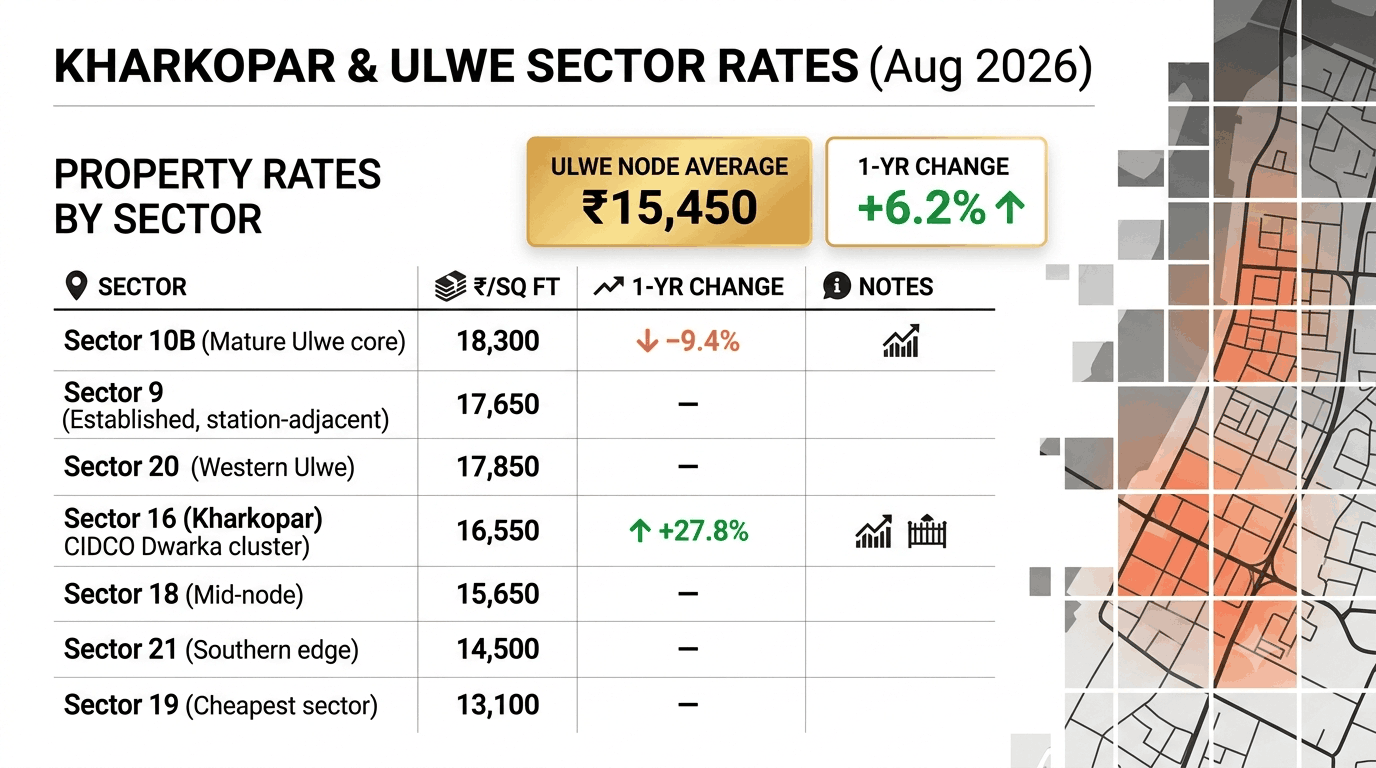
The market has started to notice. Ulwe's Sector 16, which is Kharkopar, posted a 27.8% rise in the twelve months to August 2026 - the fastest-moving sector in a node that itself averaged 6.2%.
This is a guide to what that number means, what it doesn't, and whether a node designed largely for households earning under ₹6 lakh a year is a sensible place to put money.
Why Buy Property in Kharkopar
Almost every Navi Mumbai node grew organically and had infrastructure retrofitted around it. Kharkopar is the reverse: the rail line and the land parcels came first, and the housing is being poured into a plan that already exists.
That has one very practical consequence. You can see what gets built next, because a public agency has published it - phase by phase, sector by sector, with unit counts and completion dates. In a market where most supply forecasting is guesswork, that is unusual and genuinely useful.
The second argument is the station itself. Kharkopar is on the Port line, with services running to Nerul and CBD Belapur in one direction and Uran in the other. From there, Belapur puts you on Metro Line 1 and the Harbour line. It is not a fast commute to Mumbai - nothing on this corridor is - but it is a rail commute, which is more than Karanjade, Pushpak Nagar or most of the NAINA belt can say.
Third: the airport. It is a short drive from here, and Targhar - the station nearest the terminal - is two stops up the same line. The Ulwe Coastal Road, 6.7 km including its dedicated airport link, is designed to land traffic from exactly this direction.
Now the trade, stated plainly. This is not a mature suburb. Social infrastructure inside the node runs to a village school, a small hospital and a mega mart rather than anything you would call a catchment. Train frequency is roughly 25 services a day in each direction, at 30 to 60 minute intervals - not a turn-up-and-go line. And a very large share of what is being built here is one-bedroom EWS and LIG housing, which shapes the tenant pool, the resale market and the character of the place for the next decade.
Location Snapshot
So where exactly is this? On the eastern edge of the Ulwe node, in Raigad district, south of the Navi Mumbai core and just inland from the creek that separates the mainland from the airport site.
Administratively it is part of the Ulwe node, planned and largely built by CIDCO. In listings you will see it as Kharkopar, Khar Kopar or Kharkoper, and the relevant sectors are 16, 16A, 8A and P3 - the last of these sitting directly east of the railway station.
The anchor is Kharkopar station (code KR/KARP), two platforms, on the Port line of the Mumbai Suburban Railway operated by Central Railway. Neighbours are Bamandongri towards Nerul and Belapur, Gavan towards Uran. Targhar and Wahal lie north-west, Ulwe's core sectors west, and Dronagiri and the JNPT belt south.
There is no metro station. A roughly 5 km metro extension towards Ulwe has been proposed but has no confirmed construction start.
Stamp duty is 6% plus 1% registration, dropping to 5% for a sole female buyer.
Two numbers set up everything that follows. Kharkopar's average asking rate sits near ₹11,260 per sq ft on one consistent portal basis, a shade below Ulwe's ₹11,590 on the same basis - so this is Ulwe at a small discount. And on the 99acres basis, which runs higher across the board, Sector 16 quotes ₹16,550 per sq ft, up 27.8% in a year, against the Ulwe node's ₹15,450 and +6.2%. Kharkopar is no longer the cheap corner of Ulwe. It is now quoting above the node average.
Property Price Insights in Kharkopars
Before the tables, the caveat this node needs most: the portals disagree by a wide margin, and here the reason is specific and knowable.
One platform shows Ulwe at ₹13,100–18,300 per sq ft by sector. Another shows Kharkopar at ₹11,260 and Ulwe at ₹11,590. A third reports a Q2 2026 range of ₹6,742–11,118. These are not contradictions so much as different measurements - carpet versus built-up, primary versus resale, CIDCO allotment price versus open-market ask. In a node where a large share of stock is subsidised CIDCO housing sold at a fixed scheme price, that last distinction matters enormously.
Two things jump out. Sector 16 is the only sector in the node posting a rise of that magnitude - more than four times the node average - and it is doing so while Sector 10B, the mature core, actually fell 9.4%. Money is rotating from finished Ulwe into building Kharkopar. That is the single most important line in this guide.
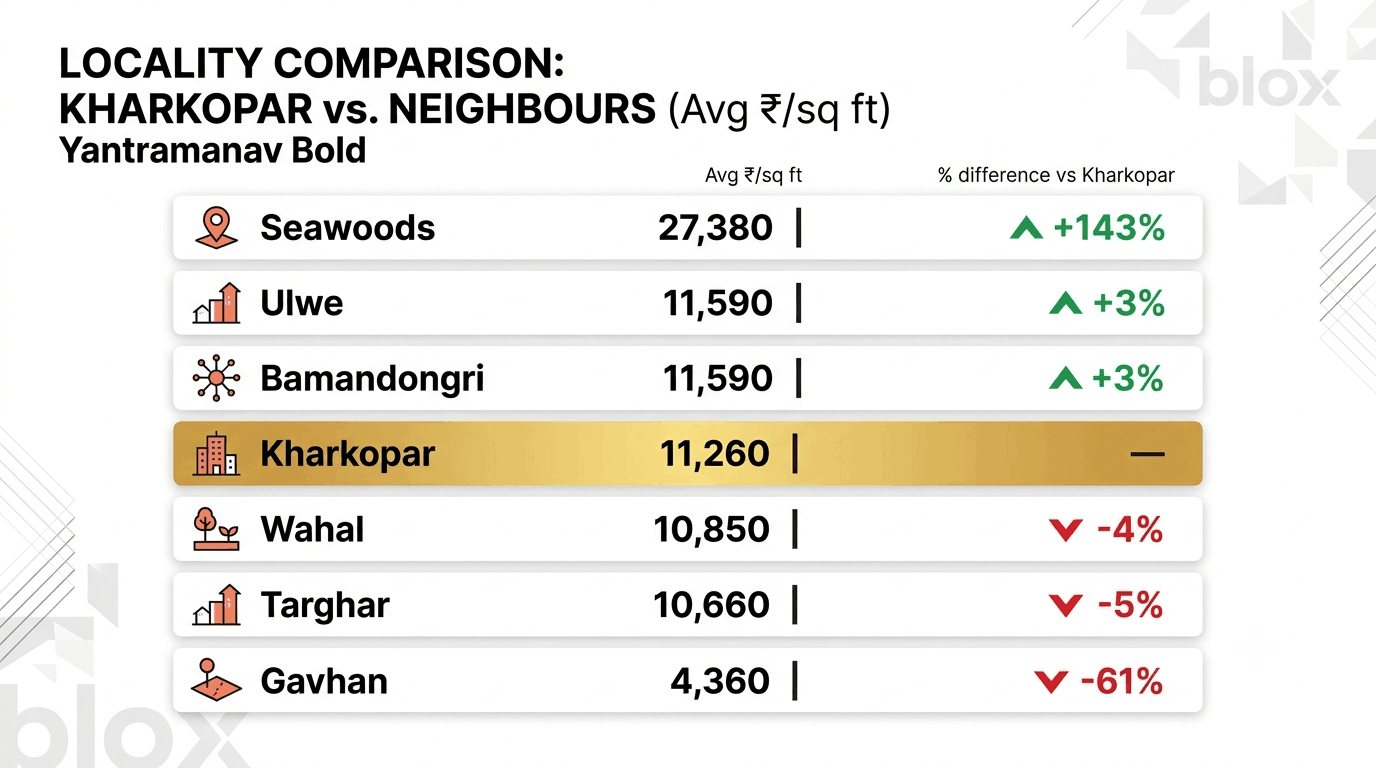
Use this table for the relationships, not the absolute figures - a single consistent methodology is more useful than a mixed-source average. What it shows is that Kharkopar trades level with Ulwe and Bamandongri and above the genuinely early-stage pockets. It is no longer a frontier price.
On rents, the Ulwe node gives the realistic guide: a 1 BHK fetches roughly ₹12,000 to ₹18,000 a month, with gross yields near 3.0-3.5% for one-bedroom units and 3.2-3.8% for larger configurations. Kharkopar sits at the lower end of that band today, because tenant demand near a still-thin node follows amenities as much as stations. Longer-run appreciation for Ulwe runs +26.1% over five years and +78.6% over ten - solid, and notably below the doubling that gets quoted in marketing.
Connectivity
Which raises the fair question: is the infrastructure actually good, or is it just newer than everyone else's? Here the answer is genuinely favourable - with one specific and important gap.
Start with rail, because it is the reason this node exists. Kharkopar sits on the 26.7 km Port line, eleven stations from Nerul and CBD Belapur down to Uran via Bamandongri, Gavan, Shematikhar, Nhava Sheva and Dronagiri. Phase I opened November 2018, the Uran extension was flagged off in January 2024, and Targhar and Gavan became operational on 15 December 2025 - so the corridor is, as of 2026, complete and running end to end.
The honest caveat: roughly 25 services a day in each direction, at 30 to 60 minute headways. That is a timetable you plan around, not a line you turn up for. From Belapur you interchange to Metro Line 1 or the Harbour line for Mumbai, which makes a South Mumbai commute a two-to-three-leg journey. This is a rail-connected node, not a rail-convenient one.
The airport is the bigger story. Navi Mumbai International Airport began commercial operations on 25 December 2025, scaled from 22 daily departures at launch to 78 by April 2026 across 46 domestic destinations, and opened its first international route - Air India Express to Abu Dhabi - on 15 July 2026. Phase 1 is rated for 20 million passengers a year.
Kharkopar's relationship to it is good rather than exceptional, and the distinction is worth getting right. Targhar, two stops up the line, is the railway station closest to the terminal. Kharkopar is a short drive away - near enough to serve airport employment, not near enough to claim the terminal as a neighbour the way Targhar or the western Ulwe sectors can.
Connecting the two is the Ulwe Coastal Road: 6.7 km in total, comprising a 5.8 km main road and a 0.903 km dedicated airport link, running from CBD Belapur's Amra Marg through Seawoods-Darave, Ulwe, Bamandongri and Targhar to the Shivaji Nagar interchange with Atal Setu. Progress reported through 2026 has been in the 60–65% range against a target window later that year. When it opens, published projections put CBD Belapur to the airport at 13-20 minutes against 38-50 today, Nerul at 18-20 minutes, and South Mumbai via Atal Setu at 30-40 minutes against about two hours.
Then the gap: there is no metro here, and none funded. A roughly 5 km extension towards Ulwe has been proposed with no confirmed start date. Mumbai Metro Line 8 - the 34.9 km CSMIA-NMIA corridor approved on 24 February 2026 at ₹22,862 crore, with construction slated from June 2026 and a May 2031 target - terminates at the airport and does not serve this node directly. Treat any listing promising metro connectivity at Kharkopar as unsupported.
Social Infrastructure
The connectivity is what you are buying. The amenity picture is what you are accepting, and it is thin - which is what a node in the middle of being built looks like.
Inside the immediate catchment, everyday needs are covered at village scale: Shri Chhatrapati Shivaji Vidyalaya and a Zila Parishad school within a couple of hundred metres of the station, Lotus Hospital a few hundred metres out, and K Star Mega Mart for groceries. Functional. Not a catchment.
For anything more, the realistic map runs outward. Ulwe's core sectors have the node's better schools and clinics. Seawoods and Nerul, twenty to thirty minutes up the line, hold the serious hospitals, the established CBSE and ICSE schools, and the retail - Seawoods Grand Central being the anchor. Belapur adds the government and medical establishment.
This is the part of the Kharkopar proposition most likely to disappoint a family moving in during 2026 or 2027. The housing is arriving considerably faster than the schools and hospitals that should accompany it. If you are buying to live here with children now, budget for a daily journey out of the node, and treat any promised social infrastructure as arriving on the usual Indian civic timeline rather than the brochure one.
Employment & Commercial Hubs in Kharkopar
The answer is a belt rather than a business district, and it is unusually varied for a node this small.
South of here is the port economy: Jawaharlal Nehru Port, the container terminals, the customs and freight-forwarding ecosystem, and the industrial estates strung along the Uran corridor. The Port line was built to serve exactly this, and Dronagiri and Nhava Sheva stations sit on the same line.
North-west is the airport, and this is the demand story that actually underwrites the housing. A terminal running 78 daily departures and rated for 20 million passengers a year generates a large, shift-based workforce - ground handling, cargo, security, retail, F&B, hospitality, transport - concentrated in precisely the income bands that CIDCO's EWS and LIG housing targets. Kharkopar is a short drive from it, on a rail corridor that runs past it.
There is no white-collar office park in or near this node, and pretending otherwise would be dishonest. The nearest serious commercial catchments are Belapur's CBD and the Nerul–Seawoods corridor, both reachable but both a journey.
Investment Potential
So which is it - the best-planned node in the region or an oversupplied dormitory? Both descriptions are currently true, and the resolution depends on your time horizon.
The bull case has more substance than most. A completed rail corridor. An operational international airport within a short drive. A coastal road with a dedicated airport link at 60–65% completion. Roughly 4,000 funded, under-construction homes from a state agency. And a 27.8% one-year move in Sector 16 showing that the market has begun to price all of it. Ulwe's five-year record of +26.1% and ten-year +78.6% gives the surrounding node a credible base.
The bear case is the supply and the calendar. Four thousand predominantly one-bedroom flats completing between late 2026 and end-2028 will land in a node with one small hospital and a village school. In the year or two after those handovers, rents face real pressure and resale competition will be fierce - every seller will be offering a near-identical 27 sq m unit. Add no funded metro, a 30-to-60-minute train headway, and the fact that Kharkopar has already closed its discount to Ulwe, and the easy money looks like it has been made.
So the defensible trade is specific rather than general. Buy the larger configurations. The 2 BHK stock is scarce here - 1,425 units against roughly 2,600 one-bedroom units in the CIDCO pipeline alone - and scarcity is what appreciates in a market being flooded with a single product. Buy close enough to the station that the walk is genuinely short. Underwrite capital growth at 6-9% a year in line with the node, not 27%, and expect a soft patch around the 2027-28 completion wave.
Pros & Cons
What works. A completed 26.7 km rail corridor with a station in the node, running to Nerul, CBD Belapur and Uran.
Navi Mumbai International Airport a short drive away and commercially operational since December 2025. The Ulwe Coastal Road, with a dedicated airport link, well advanced. Roughly 4,000 CIDCO homes under construction, which is institutional conviction you can verify rather than a developer's promise. Genuine affordability, with EWS and LIG one-bedrooms in the ₹28–36 lakh band. And the node's rate rose 27.8% in the year to August 2026 while mature Ulwe sectors fell.
What doesn't. Social infrastructure is village-scale and lagging the housing badly. Train frequency is roughly 25 services a day at 30–60 minute headways, so this is planned rail, not convenient rail. No metro is funded or under construction. The supply pipeline is heavily skewed to near-identical one-bedroom units completing in a tight 2026–28 window, which will pressure rents and resale. Yields sit near 3.0–3.5%. And the 27.8% move means the entry discount that made this interesting has largely gone.
Who Should Buy Here
Buy here if you work at the airport, at JNPT or across the Uran belt and want a rail-connected home at an entry price that barely exists elsewhere near a functioning terminal - that arithmetic is unusually strong. Buy if you qualify for CIDCO's income-capped schemes, where the allotment price is materially below open-market equivalents and is, on its own terms, among the best value in the region. And buy a 2 BHK if you are investing, because scarce inventory in an oversupplied node is the trade that works.
Look elsewhere if you need schools and hospitals now, where Ulwe's core, Kharghar or the Nerul–Seawoods corridor are the honest answers. Look elsewhere if you commute daily to Mumbai, where the headway and the interchanges make Harbour-line nodes further north better value for your time. Look elsewhere if you want metro access. And if you are buying purely for airport-driven appreciation, note that Kharkopar has already had its repricing year - Ulwe's core and Pushpak Nagar are where the comparison should now be made.
Final Verdict
We started with a station that arrived before its town. That remains the most useful way to think about Kharkopar real estate, because it explains both halves of the picture.
The infrastructure here is not a promise - it is built. The rail corridor runs end to end to Uran. The airport is flying. The coastal road is most of the way there. And
CIDCO has committed roughly four thousand funded homes to these sectors, which is the kind of conviction a private developer's brochure can only imitate. That combination is genuinely rare in the Navi Mumbai region, and the 27.8% move in Sector 16 is the market saying so out loud.
But the town has not caught up with the station yet. One small hospital, a village school, a mega mart and a 30-to-60-minute train headway is what daily life here actually looks like in 2026, and the several thousand one-bedroom flats arriving over the next two years will test the node before they strengthen it.
So the honest position is this. Kharkopar has already had its rerating year, and buying it now on momentum is buying late. Buying it for the right reason - a rail-connected home minutes from a working international airport, at a price that does not exist anywhere comparable, in a configuration the pipeline is not flooding - still makes sense. Just be the buyer who picks the scarce 2 BHK near the platform, not the thousandth identical one-bedroom.
Blox can take it from here. Compare verified,
MahaRERA-registered Kharkopar and
Ulwe projects, work from registered transaction values rather than asking rates, and talk to an advisor who will tell you when a node's best year is already behind it.




 +91
+91