Kolkata Orange Line Metro 2026: The New Garia–Airport Corridor & Flat Micro-Markets Set to Grow

Kolkata Orange Line Metro 2026: The New Garia–Airport Corridor & Flat Micro-Markets Set to Grow
Kolkata's property map is about to be redrawn by a single line on the metro network. The Orange Line metro Kolkata - officially the New Garia–Airport corridor - is the city's most consequential transit project in a generation. As it moves toward full operation, it is set to re-rate a whole belt of flat micro-markets along the eastern and south-eastern edge of the city. For flat buyers, the corridor offers exactly the setup that has historically produced the strongest appreciation: a confirmed, under-construction transit spine linking employment hubs, the airport, and a ring of fast-growing residential nodes.
This guide is a flat buyer's map of the Orange Line metro Kolkata: what it is, where it runs, when it opens, and - most importantly - which micro-markets are positioned to grow as the line comes fully online. If you are buying a flat in Kolkata in 2026 with a medium-term horizon, this is the infrastructure story that should shape your shortlist.
What Is the Kolkata Orange Line?
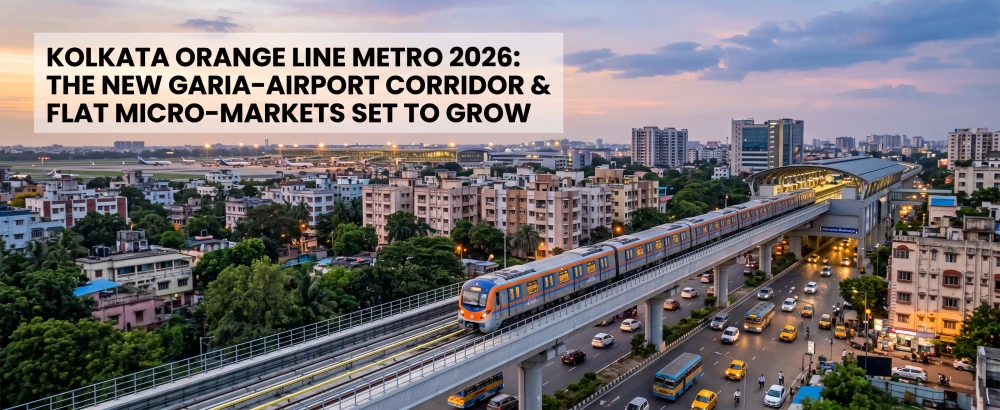
The Orange Line (also called the New Garia–Airport line, and formally Metro Line 6) is a roughly 31-kilometre corridor with 24 stations connecting Kavi Subhash (New Garia) in the south to Netaji Subhas Chandra Bose International Airport in the north-east, passing through the Ruby–EM Bypass belt, Salt Lake, and New Town along the way.
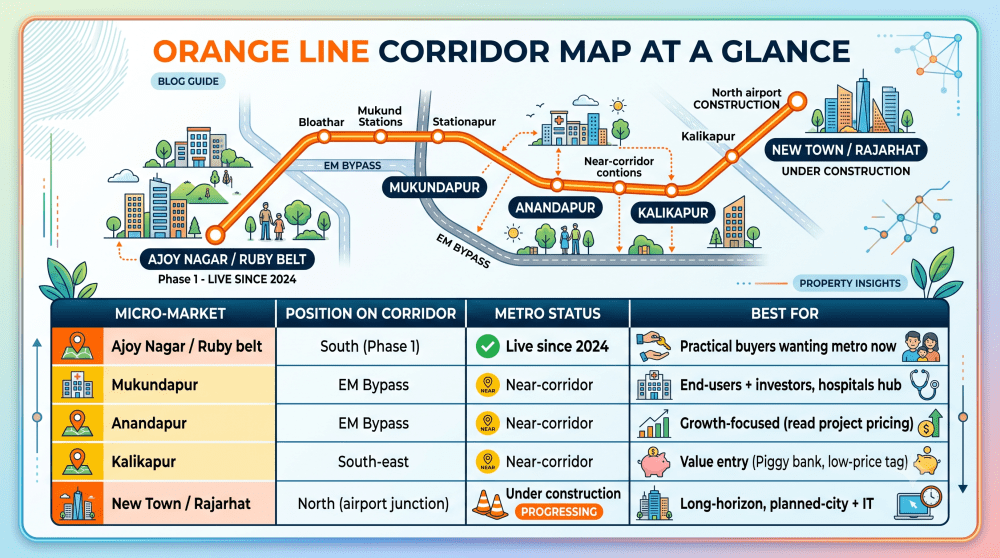
Phase 1 has been operational since March 2024, running between Kavi Subhash (New Garia) and Hemanta Mukhopadhyay (the Ruby area), with five stations already live: Kavi Subhash (New Garia), Satyajit Ray (Hiland Park), Jyotirindra Nandi (Ajoy Nagar), Kavi Sukanta (Abhishikta Crossing), and Hemanta Mukhopadhyay (Ruby). The remainder of the line - pushing north through the EM Bypass corridor, Salt Lake's Sector V IT hub, and New Town to the airport - is under construction, with full operation targeted around the end of 2026.
The single most important feature for buyers is what happens at the northern end: once the Orange Line reaches the airport, the airport becomes a metro junction where the Orange, Yellow (Noapara–airport), and Blue (north–south) lines converge. That transforms the airport from a terminus into an interchange, and it closes what planners describe as a near-continuous transit ring linking south Kolkata, the Sector V IT hub, and the airport.
Why the Orange Line Moves Flat Prices
The Orange Line solves Kolkata's most persistent connectivity problem: the city's south-eastern growth belt - the EM Bypass, Ruby, Mukundapur, and New Town corridors - has attracted enormous residential and commercial development over the past decade, but has depended heavily on congested arterial roads. A rapid-transit spine that links these nodes to each other, to the Sector V employment hub, and to the airport fundamentally changes their commute equations.
As with every infrastructure catalyst, the premium builds in stages: a modest bump when the alignment is confirmed, a larger move as stations take shape and construction becomes visible, and a final step-up when trains actually run. Phase 1 nodes (New Garia to Ruby) are already partway through this curve; the northern nodes toward Salt Lake, New Town, and the airport are earlier. That staggering is precisely what creates the opportunity - different parts of the corridor sit at different points on the appreciation curve.
Several of the corridor's micro-markets already rank among Kolkata's fastest-appreciating localities over the past three years, reflecting how strongly the market rewards infrastructure readiness. Areas connected by metro expansion, arterial roads, and social infrastructure are seeing faster appreciation and clear buyer preference - and the Orange Line is the connective tissue that ties this belt together.
The Corridor Map: Which Flat Micro-Markets Grow Next
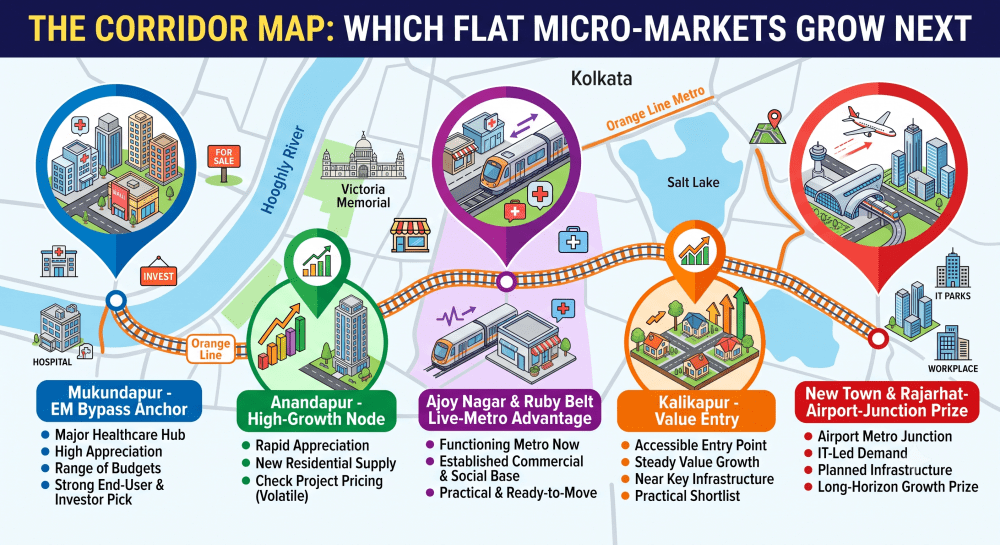
Mukundapur - The EM Bypass Anchor: Mukundapur, on the EM Bypass just off the corridor, has been one of the belt's most active residential markets, powered by a cluster of major hospitals, retail, and a steady pipeline of apartment projects. It offers a genuine spread of budget-to-mid flats and sits among the localities with the highest multi-year price appreciation in the city. With the Orange Line strengthening its connectivity toward Sector V and the airport, Mukundapur is a core end-user-plus-investor pick on the corridor.
Anandapur - The High-Growth Node: Anandapur, adjacent to Mukundapur and the EM Bypass, has been one of Kolkata's standout appreciation stories, driven by new residential supply and its EM Bypass frontage. Pricing here can be volatile as new premium supply enters the market, so buyers should read individual project pricing carefully rather than rely on locality averages - but the underlying demand trajectory, reinforced by Orange Line connectivity, is strong.
Ajoy Nagar & the Ruby Belt - Live-Metro Advantage: Ajoy Nagar (served by Jyotirindra Nandi station) and the **Ruby–Abhishikta belt** (Kavi Sukanta and Hemanta Mukhopadhyay stations) enjoy something rare on the corridor: the metro is already running here. That live-metro advantage, combined with the Ruby area's established retail, healthcare, and commercial base, makes these nodes some of the most practical buys on the line - you get functioning rapid transit today, not a promise for 2027.
Kalikapur - The Value Entry: Kalikapur, tucked between the Ruby belt and Mukundapur, offers a more accessible entry point into the corridor, with prices having risen steadily over the past year. For value-focused buyers who want proximity to the same EM Bypass employment and social infrastructure without the premium of the marquee nodes, Kalikapur is a sensible shortlist entry.
New Town & Rajarhat - The Airport-Junction Prize: At the northern end, New Town and Rajarhat are Kolkata's most prominent planned urban zones - purpose-built residential, commercial, and IT hubs. The Orange Line's completion makes the airport a metro junction on their doorstep, layering rapid transit onto an already-strong planned-city story. For buyers who want organised infrastructure, IT-led demand, and now multi-line metro access, the New Town–Rajarhat belt is the corridor's long-horizon prize.
Orange Line Corridor Map at a Glance
The Airport Junction: Why the Northern End Is the Bigger Story
It is worth dwelling on what happens when the Orange Line reaches the airport, because it is the corridor's most underappreciated feature. Today, Kolkata's metro lines largely run in isolation. Once the Orange Line terminates at the airport alongside the Yellow Line (from Noapara) and, in time, the Blue Line, the airport becomes a genuine multi-line interchange - the kind of node that anchors property demand for decades in mature metro cities. A commuter living in New Town would gain single-interchange access to south Kolkata, the Sector V IT hub, and the airport itself.
For flat buyers, this matters because interchange-adjacent nodes historically outperform single-line nodes over the long run. The New Town–Rajarhat belt already has the planned-city fundamentals - wide roads, organised sectors, IT and commercial demand, and social infrastructure - and the airport junction layers a rare multi-line transit advantage on top. That combination is why the northern end of the corridor, while earlier in its appreciation curve than the live-metro southern nodes, may ultimately be the bigger long-term story. Buyers with patience and a longer horizon should weigh it seriously against the more immediate certainty of the Phase-1 south.
How to Buy Ahead of the Orange Line: A Framework
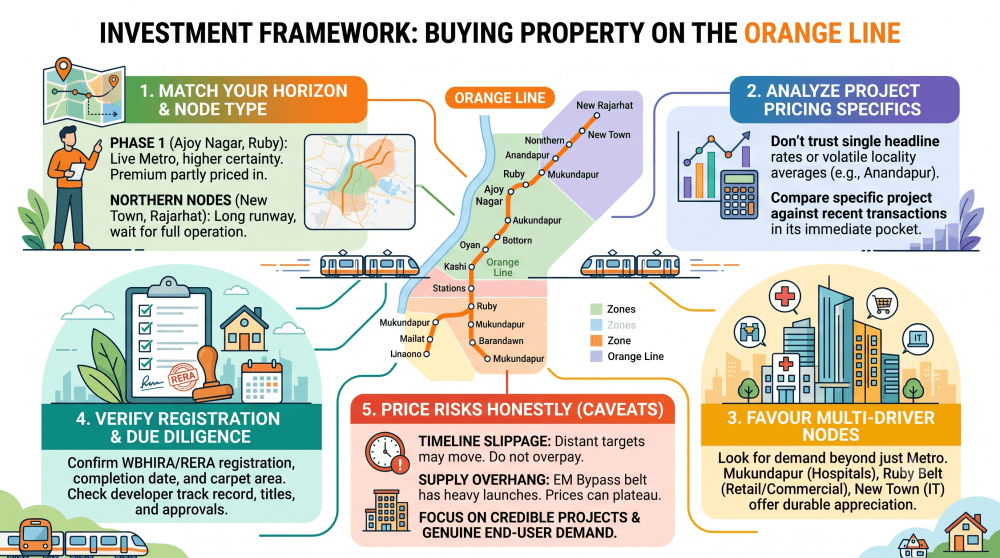
- Match the node to your horizon. The Phase-1 nodes (Ajoy Nagar, Ruby) already have live metro, so their premium is partly in the price - but they offer certainty. The northern nodes (New Town, Rajarhat) toward the airport junction are earlier in the curve, offering a longer runway for buyers willing to wait for full operation.
- Read project pricing, not just locality averages. Some corridor nodes - Anandapur especially - show volatile locality averages because premium new supply skews the numbers. Always compare the specific project against recent transactions in its immediate pocket rather than trusting a single headline rate.
- Favour nodes with more than metro. Mukundapur's hospital cluster, the Ruby belt's retail and commercial base, and New Town's IT demand all give those nodes reasons to appreciate beyond the metro alone. Multi-driver nodes carry more durable demand than single-catalyst ones.
- Verify every project's WBHIRA/RERA registration. A metro line nearby is no substitute for due diligence. Confirm the project's RERA (WBHIRA) registration, the completion date, and the carpet area before you book. Check the developer's track record on delivery, and read the title and approvals carefully.
- Price the risks honestly. Two caveats apply along this corridor. First, timeline slippage - the northern section's end-2026 target is directional, and metro projects of this scale often see phased delays, so do not overpay today for a completion date that may move. Second, supply overhang - the EM Bypass belt has seen aggressive launches, and an oversupplied pocket can see prices plateau even with strong connectivity. Both argue for buying a well-built project from a credible developer in a node with genuine end-user demand, rather than chasing the cheapest unit on the line.
The Bottom Line
The Kolkata Orange Line is the connectivity upgrade most likely to reshape where the city's flat buyers put their money over the next few years. By linking south Kolkata, the EM Bypass growth belt, Sector V, and the airport into a near-continuous transit ring, it re-rates a whole corridor of micro-markets - the live-metro Ruby and Ajoy Nagar nodes in the south, the EM Bypass anchors of Mukundapur and Anandapur, the value entry at Kalikapur, and the planned-city prize of New Town and Rajarhat at the airport junction in the north.
The disciplined play is to match the node to your horizon, read individual project pricing rather than volatile locality averages, favour nodes with demand drivers beyond the metro, and verify every project's WBHIRA registration before you commit. Explore RERA-registered flats along Kolkata's Orange Line corridor on blox.xyz, and pair this guide with our EM Bypass, Garia, and Narendrapur locality guides to map south and south-east Kolkata in full before you buy.
Frequently Asked Questions
When will the Kolkata Orange Line be fully operational?

Which Kolkata localities will benefit most from the Orange Line?
Is it better to buy near the Orange Line before or after it fully opens?

Get in Touch
Let our experts help you answer your questions

 +91
+91


Get in Touch
Let our experts help you answer your questions
+91