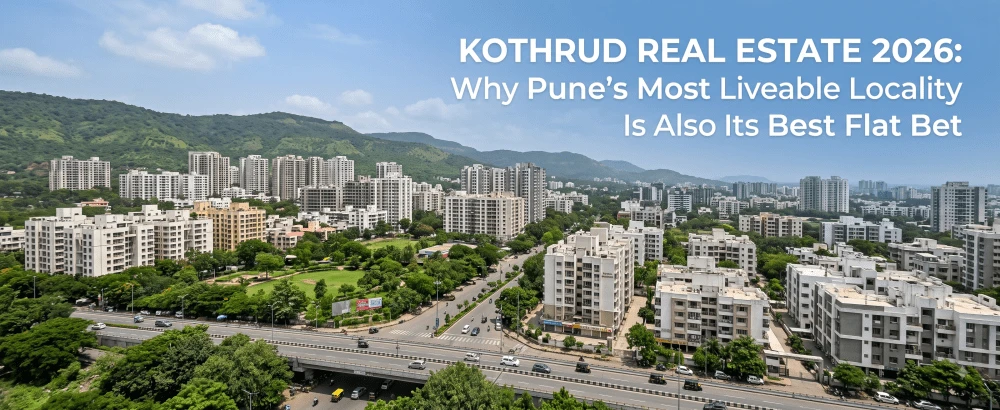
Kothrud Real Estate 2026: Why Pune's Most Liveable Locality Is Also Its Best Flat Bet

Introduction: Kothrud Has Always Been Premium. Metro Changed the Game.
If you ask a Pune resident where they'd most want to live, Kothrud comes up consistently in the top three. It's been that way for over a decade. Established social infrastructure, tree-lined streets, good schools and hospitals, proximity to both central Pune (Deccan, Shivajinagar) and the western IT corridors — Kothrud has long attracted Pune's professional middle class and upper-middle-class families.
What changed in the last two years is connectivity.
The Vanaz Metro Station, the western terminus of Pune's Aqua Line (Metro Line 2), went live and turned Kothrud into one of the most transit-accessible residential pockets in the entire Pune Metropolitan Region. Suddenly, a flat in Kothrud isn't just well-located - it's metro-connected, with a direct ride to Deccan Gymkhana, Garware College, Pune Municipal Corporation (PMC) offices, and all the way east to Yerwada and Ramwadi.
That combination - established livability plus new metro connectivity plus growing flat supply from premium developers - is driving fresh attention to Kothrud in 2026. This guide explains what flat buyers need to know: current prices, what you get at each budget, which projects are active, and why the appreciation story from here is still compelling.
Kothrud at a Glance: Location, Profile, and Why It Holds Value
Where Is Kothrud?
Kothrud is located in western Pune, stretching from Karve Road (its eastern spine) to Paud Road (its western/southern boundary). It's bordered by Erandwane to the east, Bavdhan to the west, Warje to the south, and Shivajinagar to the north.
Its geographic position is one of its strongest assets. It's:
- 2 km from Deccan Gymkhana and FC Road
- 4 km from Shivajinagar (Pune's administrative centre)
- 8–12 km from Hinjewadi IT Park (via Chandani Chowk, 20–30 min by road)
- Metro-connected to the entire Aqua Line via Vanaz station
The Kothrud Buyer Profile
Kothrud has traditionally attracted Pune University faculty, established professionals, and families who prioritise school quality and civic amenities over commute distance to IT parks. In recent years, IT professionals working in Hinjewadi have increasingly been choosing Kothrud over Baner or Wakad - trading a slightly longer road commute for significantly better liveability and flat quality.
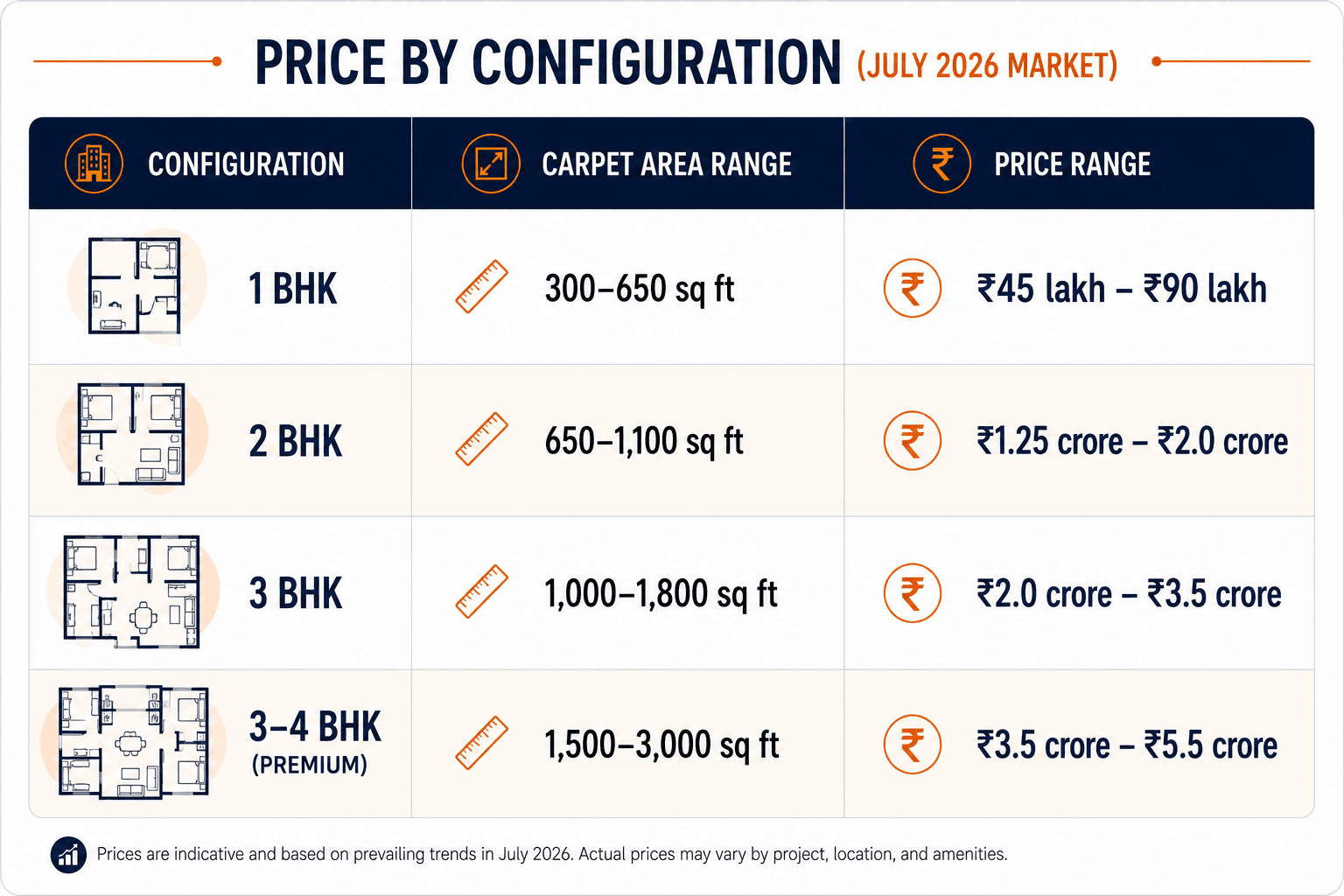
The result: Kothrud's flat market in 2026 is diverse, serving both first-time 2BHK buyers in the ₹1.25-1.6 crore range and premium buyers looking for 3-4BHK homes at ₹3-5 crore.
Vanaz Metro Station: What the Aqua Line Means for Kothrud Buyers
The Aqua Line - Fully Operational
Pune's Aqua Line (Metro Line 2) runs 14.66 km from Vanaz in the west to Ramwadi in the east, with 16 operational stations. It's been running since 2023, but ridership and real estate impact have both continued to build through 2025–26.
Vanaz station is the line's westernmost terminus - meaning every Aqua Line journey starts or ends in Kothrud. From Vanaz, you can reach:
- Garware College - 2 stations (5 minutes)
- Deccan Gymkhana - 3 stations (7 minutes)
- Civil Court - 5 stations (12 minutes)
- PMC Bhavan - 6 stations (14 minutes)
- Pune Railway Station - 9 stations (21 minutes)
- Yerwada -13 stations (31 minutes)
- Ramwadi - 16 stations (38 minutes)
For Kothrud residents, this metro access effectively puts all of central Pune within a 7-15 minute metro ride - without traffic. For a city that has struggled historically with east-west road congestion, that's a significant quality-of-life upgrade.
Metro Line 3 - The Next Catalyst
Beyond the Aqua Line, Pune's Metro Line 3 (Hinjewadi–Shivajinagar corridor, 23.3 km) is under construction and expected to be operational in late 2027 or 2028. Once live, Line 3 will connect Hinjewadi's IT park directly to Shivajinagar - and Kothrud, positioned near Chandani Chowk along this corridor, is expected to benefit from additional metro infrastructure in the Phase 2 expansion, which includes stations in Bavdhan and Chandani Chowk.
For Kothrud flat buyers in 2026, the calculation is: you already have Aqua Line connectivity (live and operational), and you may get a second metro line on your western doorstep by 2028–29.
Kothrud Property Prices 2026: What Does a Flat Cost?
Average Rates
The average flat price in Kothrud in 2026 is ₹13,000-14,000 per sq ft, with year-on-year appreciation of approximately 5%. Premium projects - particularly those on or near Karve Road, with modern amenities and branded developers - command ₹15,000-17,500 per sq ft. Luxury projects (Sobha, Lodha tier) go higher.
For context, this puts Kothrud at a premium over comparable western Pune localities:
- Warje: ₹9,500-11,500/sq ft
- Bavdhan: ₹9,500-12,000/sq ft
- Shivane: ₹8,500-10,500/sq ft
- Baner: ₹12,000-14,000/sq ft (broadly similar to Kothrud)
- Aundh: ₹11,000-14,000/sq ft (slightly lower in some pockets)
Kothrud commands a premium over its western neighbours - justified by its established social infrastructure, better road connectivity, and metro access.
Active Projects in Kothrud - 2026
Sobha Nesara
Lodha Palais
Arham Anantam
Rohan Garden
Kotibhaskar Redevelopment Projects
Kothrud Micro-Pockets: Where to Buy Within the Locality
Karve Road Corridor
Paud Road
Near Vanaz Metro Station
Warje-Kothrud Border
Why Kothrud Is Still Undervalued Relative to Its Peers
Kothrud Appreciation: What the Numbers Show
Practical Buyer Considerations
Documents and RERA
Builder Track Record
Resale vs New Launch
The Bottom Line: Is Kothrud Right for You in 2026?
Metro connectivity: Baner does not have an operational metro station as of 2026. Aundh has no direct metro access. Kothrud (via Vanaz) is the only western Pune locality with a live metro terminus. That connectivity advantage will become more pronounced as Pune's traffic worsens.
Social infrastructure depth: Kothrud has a higher density of schools, hospitals, and markets than either Baner or Aundh at a per-sq-km level. This matters disproportionately to families — and families are the dominant buyer cohort in the ₹1.5–3 crore range.
Heritage and stability: Kothrud's real estate market has been active for 30+ years — older building stock and established societies mean the area has a settlement pattern that provides stability. New projects here enter an established neighbourhood rather than a speculative one.
Lower downside risk: Areas like Wakad, Hinjewadi-adjacent localities, and some new Pune periphery zones carry higher vacancy and rental-yield uncertainty. Kothrud's fundamentals are diversified - it doesn't rely solely on the IT sector.

Get in Touch
Let our experts help you answer your questions

 +91
+91


Get in Touch
Let our experts help you answer your questions
+91