Matunga Real Estate 2026: Property Prices, Dual Rail Access, Heritage Premium & Complete Flat Buyer's Guide to Central Mumbai's Most Liveable Neighbourhood

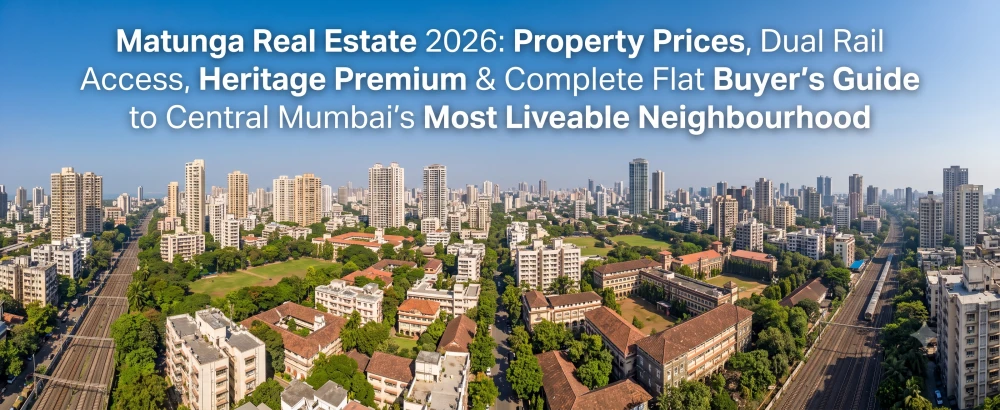
Matunga in 2026: Central Mumbai's Heritage Residential Anchor
Matunga is one of the few Mumbai micro-markets that has no infrastructure story to tell - and doesn't need one. Central Line rail access predates independence. The neighbourhood is built out, walkable, and culturally intact in a way that newer suburbs spend crores trying to replicate. In 2026, it remains one of the most sought-after residential addresses in central Mumbai for buyers who have eliminated compromise from their checklist.
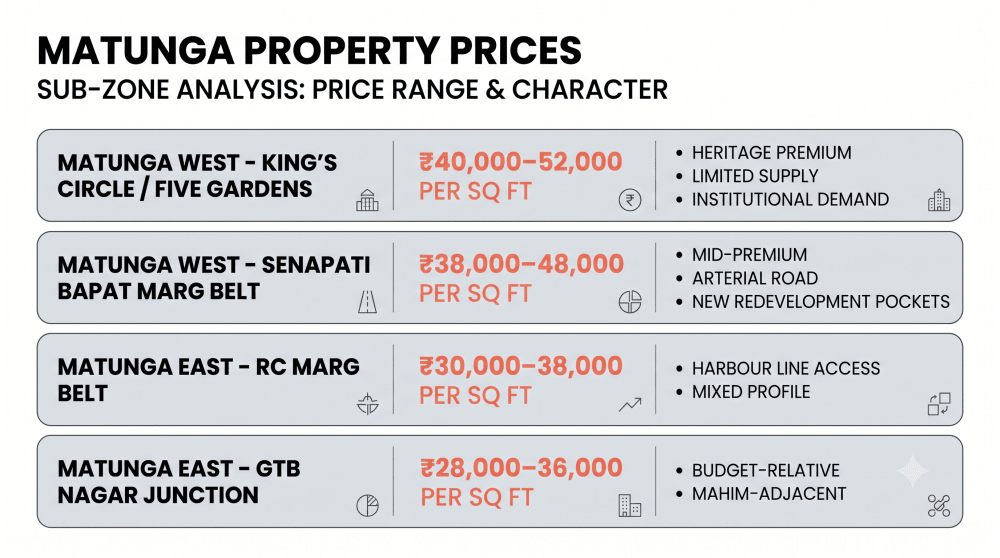
Located between Dadar (south) and Sion (north), Matunga is not a growth-story suburb. It is an established-value, limited-supply, quality-of-life suburb - with flat prices reflecting exactly that. The average rate in Matunga West runs Rs38,000–48,000 per sq ft as of September 2026, and new supply is nearly non-existent. What trades is resale, SRA-redevelopment projects, and the occasional new launch on a redeveloped plot.
The two belts of Matunga are distinct:
- Matunga West (King's Circle, Five Gardens, Senapati Bapat Marg): The premium belt. South Indian cultural hub of Mumbai - home to iconic Udupi restaurants (Café Mysore, Ram Ashraya, Café Madras), the five connected Udyan gardens, and a resident profile that skews heavily toward established professional families and inter-generational home owners.
- Matunga East (Harbour Line belt, RC Marg, GTB Nagar junction): Slightly lower prices and higher transactional activity. More mixed residential-commercial character. Better suited for buyers who need quick Central Line + Harbour Line dual access.
Both belts share the same fundamental advantage: central Mumbai location at prices meaningfully below Dadar, Prabhadevi, and Worli - while offering arguably better neighbourhood liveability.
Matunga Property Prices in 2026
Flat Prices by Configuration (2026)
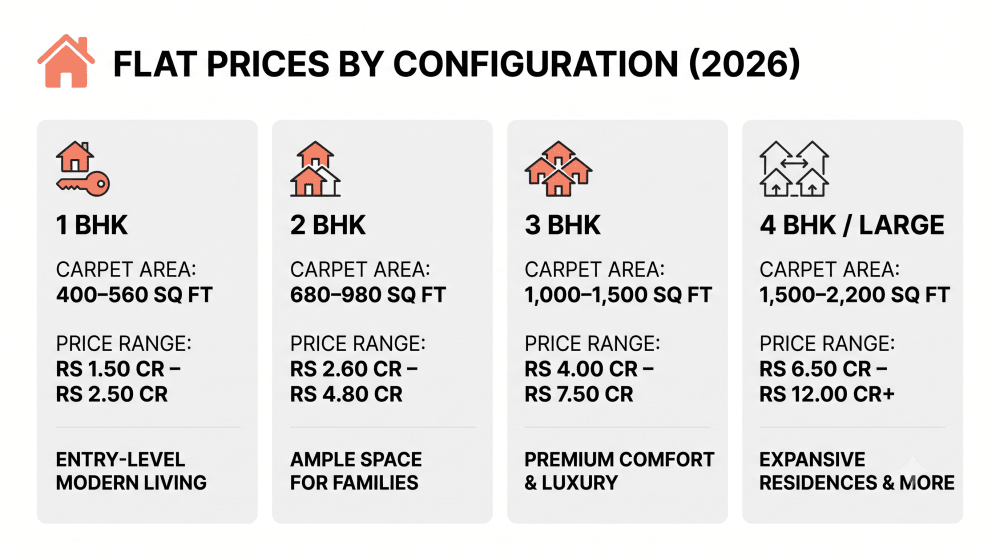
At Rs1.50–2.50Cr for a 1 BHK, Matunga is priced above many western suburbs - but buyers are paying for central Mumbai location, not infrastructure speculation. The comparison is with Dadar West (Rs40,000–55,000/sq ft), Prabhadevi (Rs38,000–52,000/sq ft), or Worli (Rs35,000–55,000/sq ft non-sea-facing) - and Matunga holds up well on the value scale when measured against those benchmarks.
Rail Connectivity: The Dual-Line Advantage
Matunga's rail access is its oldest and most durable structural advantage:
Central Line - Matunga Road Station:
- Dadar: 3 min
- CST (South Mumbai): 20–25 min
- Bandra (via interchange at Dadar): 12 min cab + train
- Thane: 30–35 min
- Kurla: 15–18 min
Harbour Line - Matunga Station:
- CST: 18–22 min
- Wadala: 8–10 min
- Panvel: 55–65 min
- Bandra (via Kurla interchange): 25–30 min
The two stations together give Matunga residents access to two of Mumbai's three major rail lines within walking distance. For families with members commuting in different directions - one toward South Mumbai, one toward eastern suburbs, one toward Navi Mumbai - Matunga's dual-rail access is unmatched outside of Kurla and Dadar.
Metro access: Metro Line 3 (Aqua Line) does not have a station inside Matunga, but the Matunga Road–Dadar belt is within 1–2 km of the Dadar station area. Metro Line 3 at BKC is accessible from Matunga Road in approximately 35–40 minutes by train/cab combination.
The Five Gardens Heritage Premium
The five connected public gardens - Udyan 1 through 5 - are a defining feature of the Matunga West landscape and one of the most under-discussed real estate premiums in central Mumbai. Running along a continuous green belt in the heart of the neighbourhood, they provide:
- Open-air walking and recreation infrastructure that no new suburb replicates within central Mumbai at this density
- A buffer of green and low-rise residential against the commercial intensification of Dadar and Sion
- A permanent constraint on new construction in the garden-facing belt - keeping supply tight and view premiums stable
Properties within 200–500m of the Five Gardens command a 12–18% premium over comparable Matunga West stock. For buyers prioritising long-hold value in central Mumbai, this micro-pocket is the clearest structural underpin in the market.
King's Circle: Neighbourhood Infrastructure That Cannot Be Replicated
The commercial and cultural spine of Matunga West - King's Circle / Matunga Gymkhana / Maheshwari Udyan corridor - has a retail and dining ecosystem that took decades to develop:
- Restaurants and cafes: Café Mysore (est. 1936), Ram Ashraya, Café Madras, and the full Udupi-idli-dosa belt that makes Matunga one of Mumbai's most cherished dining neighbourhoods
- Markets: Matunga market for produce and daily essentials; Portuguese Church area for fresh supplies
- Schools: Matunga has above-average school density for a central Mumbai micro-market - St. Michael's, Balmohan Vidyamandir, and several others within 1 km
- Hospitals: Sion Hospital (KEM Hospital network) 10 min; Hinduja Hospital (Mahim) 12 min; multiple Dadar-area hospitals within the cluster
For buyers who prioritise daily liveability infrastructure over speculative appreciation, Matunga West's King's Circle belt scores higher than any western suburb at any price point.
Supply Dynamics: Why New Flat Supply Is Structurally Scarce
Matunga is almost entirely built out. The remaining mechanisms for new flat supply are:
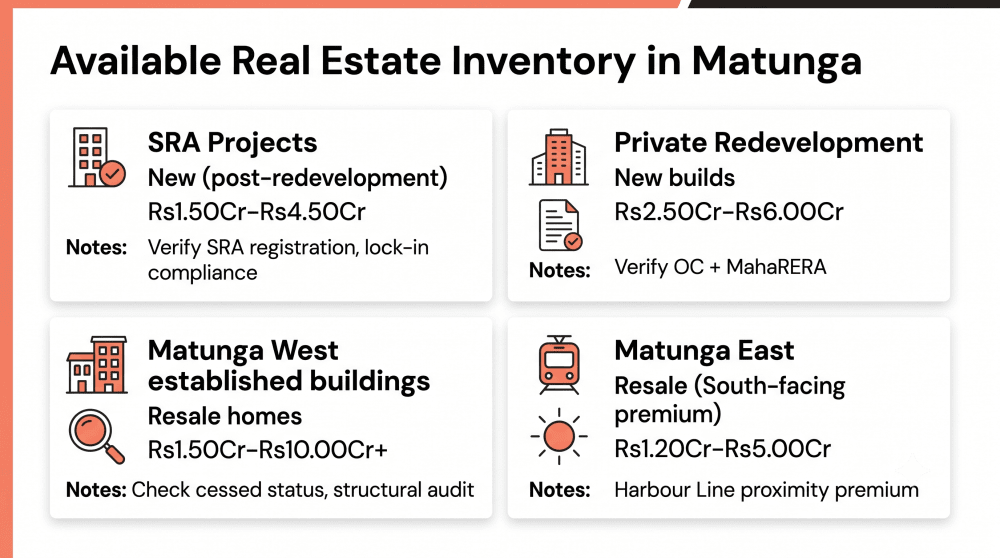
- SRA (Slum Rehabilitation Authority) projects: Redevelopment of chawl-era or slum-occupied plots. Supply is genuine but comes with SRA lock-in requirements and title complexity - buyers should check MahaRERA carefully.
- Old building redevelopment (DCR 33(7) / DCR 33(9)): Owners of aging cessed buildings redevelop under MHADA or BMC schemes. Generates a trickle of new units.
- Plot redevelopment by private developers: Rare; limited available land at prices that make new launches viable at Rs38,000–52,000/sq ft.
The result: Matunga's resale market is the primary channel. New launches are infrequent and typically over-subscribed. This structural supply constraint is the primary driver of the per-sq-ft premium relative to western suburbs with equivalent or better infrastructure scores.
Matunga vs Comparable Central Mumbai Micro-Markets
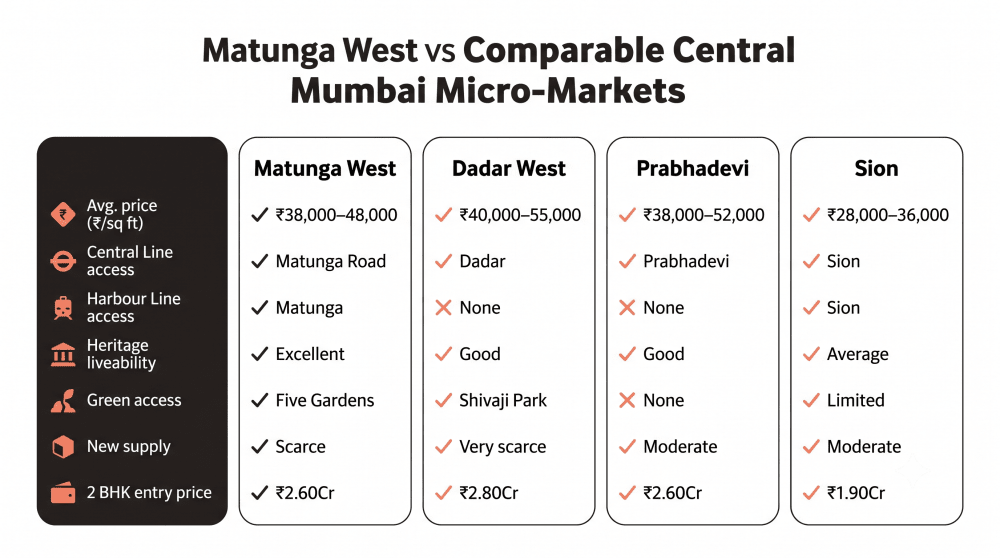
Matunga holds a clear advantage over Dadar and Prabhadevi on the dual-rail point, and over Sion on heritage liveability and supply scarcity. The 10–20% discount to Dadar West is consistent with Matunga's slightly smaller footprint and lower brand recognition outside the south Mumbai buyer profile.
Investment Outlook: 2026–2031
The Matunga thesis is not infrastructure - it is supply scarcity + liveability resilience.
Unlike suburbs where appreciation is catalysed by a Metro line opening or a highway widening, Matunga's appreciation is driven by the long-term demand-supply mismatch. The neighbourhood will not receive material new supply. Demand from established professional families, second-home buyers in the Rs3–8Cr range, and inter-generational inheritance-reinvestment buyers (children of existing Matunga residents upgrading within the neighbourhood) remains structurally sticky.
5-year appreciation estimate: 22–30% blended.
- King's Circle / Five Gardens belt: 25–32% (supply scarcity at its tightest)
- Matunga East (RC Marg): 18–25% (more inventory, less heritage demand)
Rental yield: 2.8–3.5% - lower than suburban yields because the price base is high relative to rental market rates. Matunga is a capital-appreciation play, not a yield play.
Liquidity: Resale transactions in Matunga take longer than suburban markets - typically 60–120 days. Buyers should plan for a longer hold horizon (7–10 years minimum) to maximise appreciation and account for the slower resale cycle.
Active / Available Inventory in Matunga (2026)
Given the scarcity of new launches, buyers have three primary channels:
MahaRERA checklist for Matunga buyers:
- For SRA projects: verify SRA registration separately from MahaRERA; confirm lock-in period and resale restriction window
- Check if the building is on the MHADA or BMC cessed-building list - structural audits are mandatory for pre-1969 buildings
- Confirm BMC property card (7/12 equivalent) for freehold ownership status
- Verify that possession certificate and OC are in order for RTM transactions
- For new launches: confirm the developer's track record of OC delivery in central Mumbai markets
Frequently Asked Questions
What are property prices in Matunga in 2026?

Is Matunga connected by Metro?
What makes Matunga West more expensive than Matunga East?
Is Matunga a good investment in 2026?
What is the difference between buying in Matunga vs Dadar?
What types of flats are available in Matunga?
How does Matunga compare to Sion for flat buyers?

Get in Touch
Let our experts help you answer your questions

 +91
+91


Get in Touch
Let our experts help you answer your questions
+91