Mulund Real Estate 2026: Property Prices, GMLR Impact & Complete Buyer's Guide to Mumbai's Rising Eastern Suburb


Why Mulund Is Mumbai's Most Compelling Real Estate Story in 2026
For decades, Mulund sat in an unusual position in Mumbai's real estate hierarchy - large, leafy, liveable, and yet somehow underpriced relative to what it offered. Flanked by Sanjay Gandhi National Park to its north and Thane Creek to its east, the suburb delivered quality of life that few central Mumbai neighbourhoods could match, all at prices that felt almost unfair compared to Bandra or Powai.
In 2026, the underpricing is ending.
The reason is infrastructure. The ₹14,000 crore Goregaon–Mulund Link Road (GMLR), one of the most ambitious road projects in Mumbai's history, is now actively reshaping how buyers and investors perceive this eastern suburb. The first flyover segment in Mulund West opened in May 2026, and analysts are already projecting 8–15% price appreciation in GMLR-connected micro-markets over the next two to three years.
Add to this Mulund's proximity to Thane, its robust rail connectivity, an established social infrastructure, and a now-maturing inventory of quality projects from Tier-1 developers - and you have the makings of a suburb on the cusp of significant re-rating.
This guide covers everything a flat buyer or investor needs to know about Mulund real estate in 2026: price tables, locality breakdowns, builder profiles, connectivity facts, and a practical action plan to buy here confidently.
Mulund at a Glance: What Makes This Suburb Different
Mulund is a suburb in the central Mumbai suburbs, straddling both the eastern and western sides of the Eastern Express Highway. It borders Thane to the north, Bhandup to the south, and the Sanjay Gandhi National Park (SGNP) forms its entire western boundary - which is both its constraint and its greatest asset.
The park boundary means Mulund cannot sprawl westward the way Andheri or Malad did. Supply is therefore naturally capped. Unlike western suburbs where new housing constantly pushes into agricultural or peripheral land, Mulund's flat supply is finite, driven largely by redevelopment of existing building stock and a handful of larger projects on available pockets.
Key facts about Mulund in 2026:
- Area coverage: Mulund West and Mulund East are the two main zones, separated by the Eastern Express Highway
- Rail connectivity: Western Railway's Central Line - Mulund station serves both East and West; Nahur station (Western Railway) is on the Mulund West side
- Metro connectivity: Metro Line 4 (Wadala-Kasarvadavali) passes through Mulund, though full operationalisation is expected by 2027
- Green cover: One of the highest green-to-concrete ratios in Mumbai, thanks to SGNP
- Resident profile: Predominantly Gujarati and Marwari communities, upper-middle-income families, professionals commuting to Thane, BKC, and CBD Belapur
Mulund Property Prices 2026: East vs West Breakdown
Understanding the price dynamics in Mulund requires separating its two principal zones, as they cater to different buyer segments and have distinct appreciation trajectories.
Mulund West:
Mulund West is the more established, more aspirational side of the suburb. Bordered by SGNP to the west and the Eastern Express Highway to the east, it has a concentration of quality residential projects, better road infrastructure, and a slightly more premium profile.
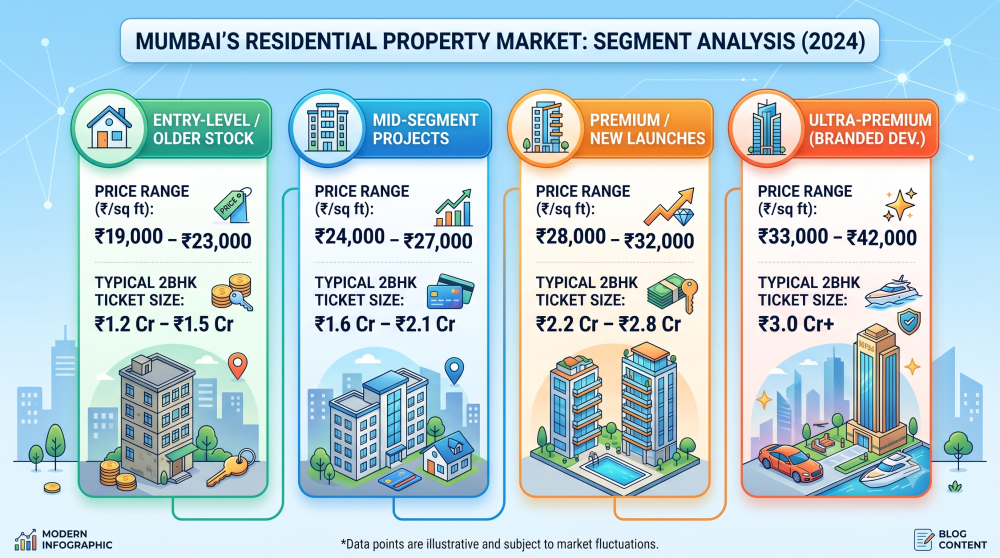
The average asking price in Mulund West reached ₹28,785 per sq ft as of mid-2026, up from approximately ₹24,000 in 2023 - a 20% appreciation over three years. The average registered transaction rate (actual sale prices recorded with the government) stands at approximately ₹19,400 per sq ft, reflecting older stock and resale transactions pulling the average down.
Mulund East
Mulund East, on the other side of the Eastern Express Highway, is more affordable and more transit-oriented. Proximity to Mulund station and the Eastern Freeway makes it attractive for buyers working in BKC, Lower Parel, and South Mumbai.
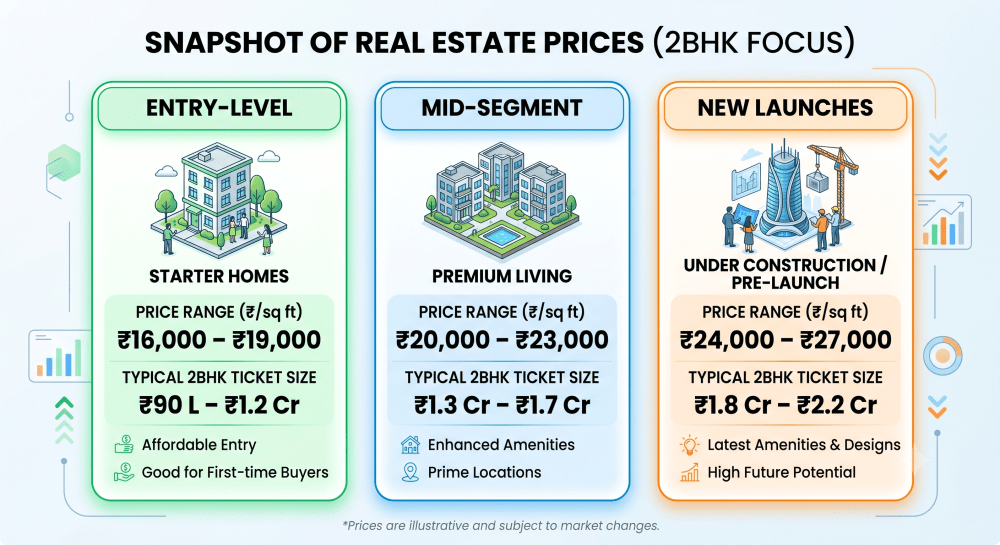
The average asking price in Mulund East sits around ₹25,350 per sq ft, making it approximately 12% more affordable than Mulund West for a comparable configuration.
Nahur: The Emerging Micro-Market
Nahur, a small railway station just south of Mulund West on the Central Line (Harbour Branch), deserves special mention. Largely under the radar until recently, Nahur benefits from both the GMLR alignment and Metro Line 4. Prices currently range from ₹21,000–₹26,000 per sq ft, with several new residential launches positioning it as the value play for buyers priced out of Mulund West.
The GMLR Effect: How the ₹14,000 Crore Link Road Changes Everything for Mulund Flat Buyers
The Goregaon–Mulund Link Road is the single most important infrastructure catalyst in Mulund's 2026 story. Understanding it is essential for any buyer or investor evaluating this suburb.
What the GMLR?
The GMLR is a 12.2-kilometre multi-modal infrastructure corridor that will connect the Western Express Highway at Goregaon (western suburbs) with the Eastern Express Highway at Mulund (eastern suburbs). Currently, driving between Goregaon and Mulund requires navigating through the city, a journey that takes approximately 75 minutes in peak traffic. The GMLR will reduce this to approximately 25 minutes.
The project comprises:
- Flyovers and elevated sections through Mulund West
- A 6.3-kilometre twin-bore tunnel running under Sanjay Gandhi National Park
- Integration points with Metro Line 2A (Goregaon side) and Metro Line 4 (Mulund side)
Total project cost: ₹14,000 crore. Executing agency: Brihanmumbai Municipal Corporation (BMC).
Where the Project Stands in 2026
The 1.89-kilometre flyover in Mulund West - spanning from the Tansa water pipeline to the Nahur railway bridge, incorporating a cable-stayed structure at Dr Hedgewar Chowk - has opened its first phase in May 2026. This is directly accessible to residents in the Guru Gobind Singh Marg corridor of Mulund West.
The twin tunnel bored under SGNP is on track for completion by 2028, with full GMLR operations projected for 2029. When the tunnel opens, the east-west commute transformation will be complete.
Why the GMLR Matters for Flat Buyers
The fundamental impact is connectivity value creation. Real estate analysts project 8–15% property price appreciation in GMLR-connected zones over the next two to three years, even before the tunnel opens. The rationale is straightforward: buyers who previously avoided Mulund because of its perceived "distance" from western suburbs now have a credible, timed commute to BKC (via Eastern Freeway), to Lower Parel, and - post-tunnel - to Goregaon and the western suburbs.
For flat investors, this means Mulund is in the pre-appreciation window - prices have moved, but the full infrastructure benefit has not yet been priced in. The comparison that analysts draw is to what Thane did between 2018 and 2024 as the Trans Harbour Link moved toward completion.
Connectivity Beyond GMLR: How Mulund Plugs into Mumbai
A common concern from buyers unfamiliar with Mulund is that it feels isolated. The data does not support this view.
- Central Line (Railways): Mulund station is on Central Railway's main line - direct trains to Chhatrapati Shivaji Maharaj Terminus (CSMT) take approximately 40–45 minutes. Connecting to Kurla (for BKC access) takes 20–25 minutes. The Harbour Line branch at Nahur extends reach to Vashi and Navi Mumbai without needing to change.
- Eastern Express Highway: The NH-48 passes through Mulund, providing road connectivity to Thane, Nashik, and southward to BKC and South Mumbai via the Eastern Freeway.
- Metro Line 4 (Wadala-Kasarvadavali): This 32.3-kilometre metro corridor passes through Mulund and, when fully operational in 2027, will connect Mulund to Ghatkopar (for Metro Line 1 interchange), Bandra, and Kasarvadavali in Thane. This is a significant future connectivity boost.
- GMLR (Phase 1 operational): Mulund West now has improved east-west connectivity to Goregaon West and Goregaon East, opening access to suburban Mumbai's largest commercial zones.
Top Builders and Projects in Mulund 2026
Mulund has attracted quality developers who recognise its fundamentals. Here are the key builder names with a presence in 2026:
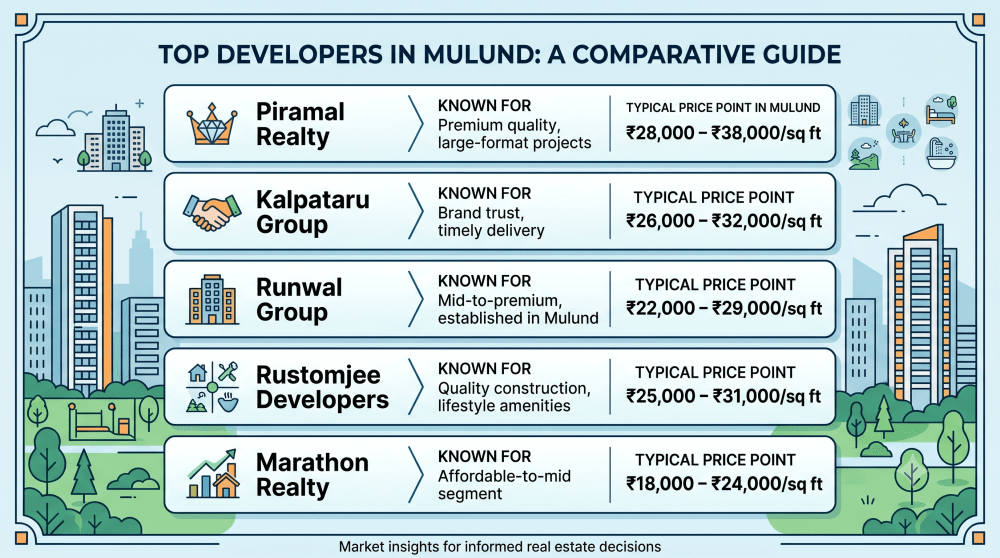
Key projects to track in 2026: Neelkanth Dhara commands one of the highest rates in the market at approximately ₹41,785 per sq ft, positioning itself as Mulund's ultra-premium offering. Runwal projects in the Mulund area offer mid-to-premium configurations in the ₹1.8 Cr – ₹3.5 Cr range.
When evaluating any project, always verify:
- MahaRERA registration number (search at maharera.mahaonline.gov.in)
- Completion date as stated in the RERA filing vs builder's marketing material
- Encumbrance certificate and clear title on land parcel
- Occupancy Certificate status for ready properties
Mulund vs Thane: The Eastern Suburbs Comparison Every Flat Buyer Must See
Buyers often shortlist Mulund and Thane simultaneously. Here is a structured comparison:
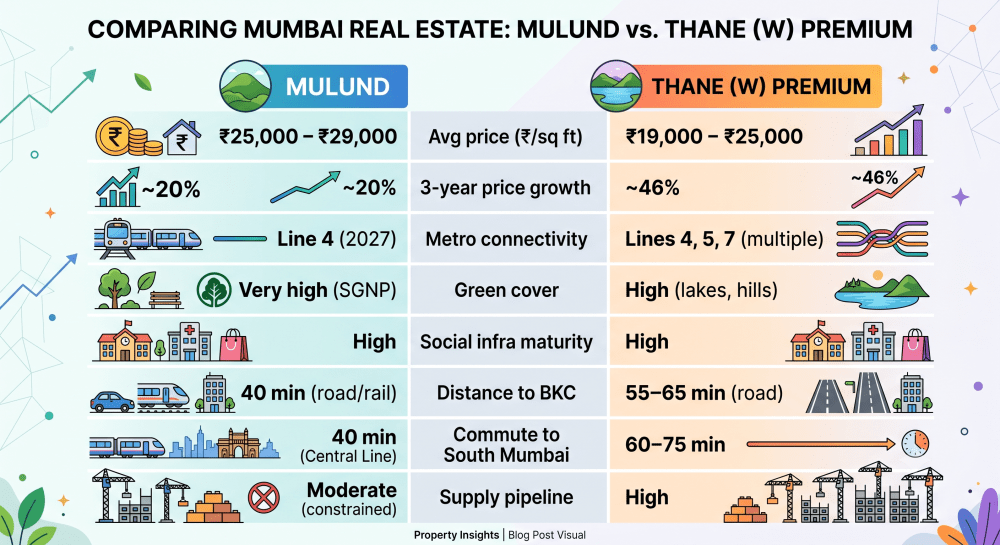
The verdict: Thane has delivered stronger percentage appreciation over the past three years because it started from a lower base and had a larger supply wave. Mulund's appreciation has been steadier and more quality-driven. For end-users who need to commute to South Mumbai or BKC, Mulund's transit connectivity is superior. For pure investors seeking the highest percentage appreciation, Thane still has pockets - particularly in Pokhran Road and Kolshet - that may offer edge. Post-GMLR tunnel completion (2029), the Mulund appreciation thesis becomes significantly stronger.
Who Should Buy a Flat in Mulund in 2026?
Mulund is not a one-size-fits-all suburb. It is best suited to specific buyer profiles:
- The BKC and South Mumbai Commuter: If your office is in BKC, Nariman Point, or Churchgate, Mulund's Central Line and Eastern Freeway access keeps you within 35–45 minutes of your workplace. You get significantly more space per rupee than buying in Kurla, Chembur, or Ghatkopar at similar distances.
- The Navi Mumbai Corridor Professional: Professionals working in Airoli, Vashi, or Belapur often overlook Mulund - but the Nahur railway connection provides Harbour Line access to the entire Navi Mumbai belt. A flat in Nahur or Mulund East gives you both Mumbai and Navi Mumbai access without compromise.
- The Quality-of-Life Upgrader: Mulund's air quality is measurably better than most of Mumbai because of SGNP. Families with children who want access to good schools (Mulund has several well-regarded institutions), open spaces, and a tight-knit community will find Mulund the most liveable large suburb in the city.
- The Pre-Infrastructure Investor: With GMLR Phase 1 live and Metro Line 4 on track for 2027, Mulund sits in an infrastructure appreciation window. Investors buying today are positioned to benefit from the 8–15% analyst-projected appreciation as each infrastructure milestone is delivered.
- Who should not buy in Mulund: If your work is in Andheri, Goregaon, Malad, or other western suburbs, and you need to commute daily, Mulund is currently less optimal. Post-GMLR tunnel (2029), this changes - but the full connectivity benefit is three years away.
Buyer Guide: Documents to Check Before Buying a Flat in Mulund
The standard due diligence process applies in Mulund, with a few locality-specific notes:
- RERA Verification: All new projects must be registered under MahaRERA. Look up the project at the MahaRERA portal and verify the registered carpet area matches what the builder is marketing.
- SGNP Proximity Check: Properties very close to the SGNP boundary should be cross-checked for any eco-sensitive zone (ESZ) notifications that may affect construction legality. This is relevant for projects abutting the park directly.
- Occupation Certificate (OC) for Ready Properties: Mulund has significant older stock (pre-2010 buildings) that may not have OCs. Avoid buying such properties without legal counsel - banks may decline home loans, and Brihanmumbai Municipal Corporation (BMC) may levy fines.
- Society Registration: Confirm the housing society is registered with the Co-operative Housing Society (CHS) registrar. Unregistered societies can create issues in resale.
- Home Loan Eligibility: Major banks including SBI, HDFC, and ICICI offer competitive home loan rates in Mulund. With prevailing rates at approximately 8.5–9.0% (June 2026), for a ₹1.5 crore loan, your EMI would be approximately ₹1.33–₹1.38 lakh per month.
Mulund Real Estate Investment Calculator: What to Expect in 3–5 Years
Using the analyst projections and infrastructure timelines, here is a scenario analysis for a flat buyer investing in Mulund today:
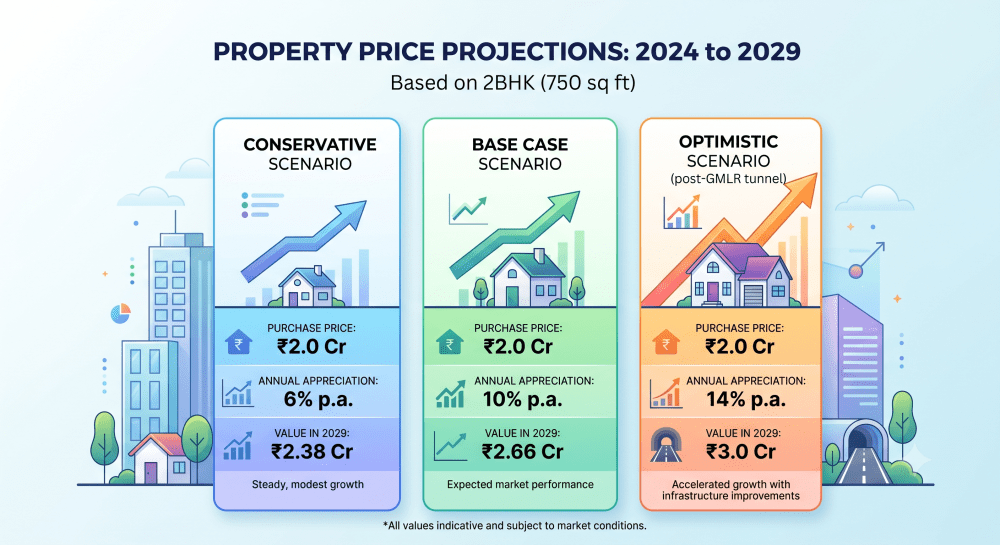
These scenarios assume the infrastructure deliveries proceed on the current timelines. The optimistic scenario assumes GMLR tunnel and Metro Line 4 both become operational, and Mulund undergoes the kind of re-rating that Thane experienced between 2019 and 2022.
Common Mistakes Flat Buyers Make in Mulund
- Buying too far from a metro or rail station: Mulund's strength is its rail access. A flat that is more than 1 km from Mulund station, Nahur station, or a planned Metro Line 4 station will not benefit as strongly from the infrastructure appreciation thesis.
- Ignoring the East vs West price differential: Mulund East buyers sometimes overestimate their resale potential - while East offers better value, the premium commanded by Mulund West buyers at resale is real and consistent.
- Overlooking older redevelopment projects: Some of the best value in Mulund comes from slum rehabilitation authority (SRA) redevelopments or building redevelopments by reputable developers. These projects often trade at a 10–15% discount to comparable new launches while being fully RERA-compliant. Due diligence is essential.
- Not factoring GMLR timeline risk: The GMLR tunnel, while progressing, is a large infrastructure project. Buyers whose entire investment thesis depends on the tunnel opening by 2028 should stress-test their return assumptions against a 2030 completion scenario.
Your Action Plan: How to Buy a Flat in Mulund in 2026
If you are ready to explore Mulund, here is a structured approach:
- Step 1 - Define your use case: Are you buying for end-use or investment? For end-use, proximity to your workplace and school matters most. For investment, prioritise projects near GMLR-corridor streets and Metro Line 4 stations.
- Step 2 - Set your budget: Mulund West in the ₹1.8 Cr–₹3 Cr range gives you access to the best builders and configurations. Mulund East and Nahur open entry-level options from ₹90 lakh.
- Step 3 - RERA-verify your shortlist: Use the MahaRERA portal to verify each project's registration, completion timeline, and any past complaints against the developer.
- Step 4 - Visit projects during GMLR Phase 1: The opened flyover segment is now accessible - physically commute from the project to your workplace using the new road infrastructure to validate the connectivity claim.
- Step 5 - Get pre-approved for a home loan: This strengthens your negotiating position and gives you a clear picture of your actual buying capacity after down payment.
- Step 6 - Use a RERA-registered broker or visit blox.xyz: Blox.xyz lists verified RERA-registered flat projects in Mulund with real inventory, transparent pricing, and no brokerage. You can explore active projects, compare configurations, and connect directly with developers without the traditional intermediary markup.
Final Take: Is Mulund Worth Buying in 2026?
Yes - and the window of opportunity is narrowing.
Mulund in mid-2026 sits in a rare combination of circumstances: prices have appreciated meaningfully from pandemic lows (up ~20% over three years in the West), but the full infrastructure premium from GMLR and Metro Line 4 has not yet been priced in. The tunnel, the most transformative part of the GMLR, is three years away - which means today's buyer is buying infrastructure optionality at current prices.
The suburb's fundamentals - constrained supply (SGNP boundary), strong social infrastructure, superior air quality, multiple rail options, and a large, stable residential community - are durable. They do not require a specific infrastructure bet to hold value.
For end-users, Mulund delivers more liveable square footage per rupee than any comparable eastern suburb at the same commute distance from BKC and South Mumbai. For investors, the 2026–2029 infrastructure delivery window makes it one of the highest-conviction pre-infrastructure plays left in the MMR.
Explore RERA-verified Mulund flat listings on blox.xyz and take the first step toward owning a home in one of Mumbai's most compelling real estate stories in years.
Prices and data referenced in this article are based on publicly available market data as of June 2026. All flat buyers are advised to conduct independent due diligence and verify RERA registrations before purchase.

Get in Touch
Let our experts help you answer your questions

 +91
+91


Get in Touch
Let our experts help you answer your questions
+91