Mumbai Coastal Road 2026: How the Versova–Dahisar–Bhayandar Extension Will Reshape Western-Suburb Flat Prices

Mumbai Coastal Road 2026: How the Versova–Dahisar–Bhayandar Extension Will Reshape Western-Suburb Flat Prices
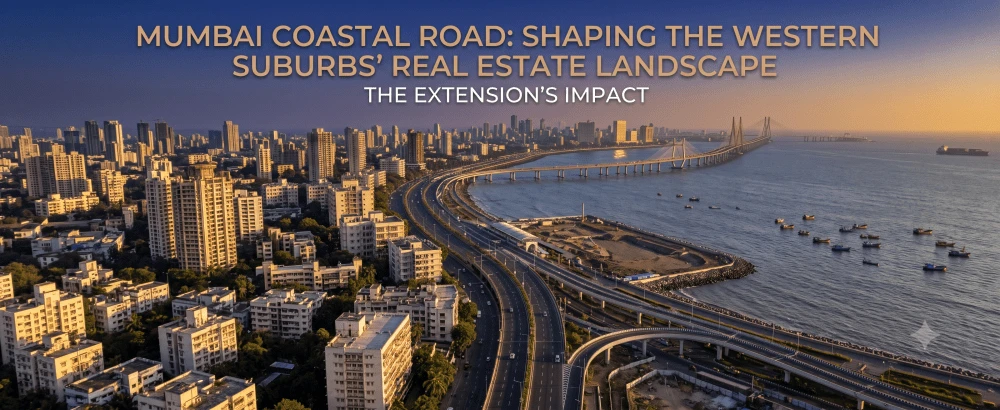
Mumbai's western coastline is being rebuilt into a continuous high-speed corridor - and for flat buyers, that is the single most important connectivity story of the decade. The Coastal Road Mumbai project has already transformed travel along the island city's western edge, and its next phase - the Versova–Dahisar–Bhayandar extension - is set to do the same for the western suburbs, the belt where most of Mumbai's flat buyers actually shop. When a corridor cuts a two-hour commute to forty minutes, it does not just move traffic; it re-rates property.
This is a forward-looking buyer's map of the Coastal Road Mumbai effect on the western suburbs. We will cover what the project is, where the new phase runs, when it opens, and - most importantly - which flat micro-markets are positioned to grow as the corridor comes online. If you are buying a flat in Mumbai's western belt in 2026 with a three-to-five-year horizon, this is the infrastructure story that should reframe your decision math.
What Is the Mumbai Coastal Road?
The Coastal Road Mumbai - officially the Dharamveer Swarajya Rakshak Chhatrapati Sambhaji Maharaj Mumbai Coastal Road - is an eight-lane, grade-separated expressway running along the city's western seafront. Phase 1, inaugurated in March 2024, connects the Marine Lines/Princess Street area in South Mumbai to the Worli end of the Bandra–Worli Sea Link, and it has already compressed south-city travel dramatically while delivering a landmark seafront promenade.
Phase 1 was the island-city story. The bigger prize for the average flat buyer is Phase 2 - the Versova–Bandra–Dahisar–Bhayandar extension - which stitches the entire western sea-facing length of Mumbai into one connected corridor, pushing the coastal expressway north through the heart of the western suburbs. This is where the connectivity upgrade meets the city's largest residential markets.
The Phase 2 Extension: Route, Timeline, and the Headline Number
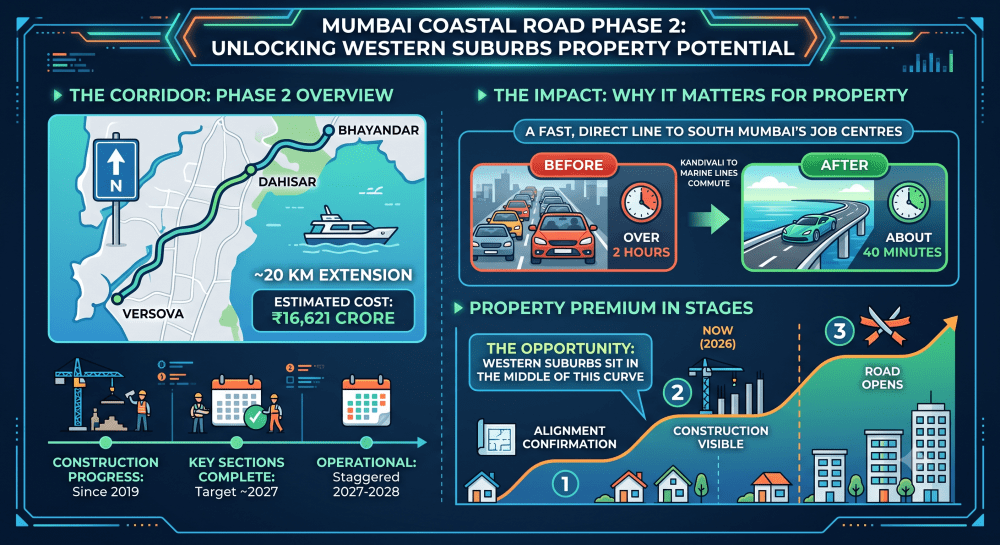
Phase 2 extends the coastal corridor from Versova northward, covering roughly 20 kilometres up to Dahisar and connecting onward toward Bhayandar, at an estimated cost of around ₹16,621 crore. Construction of the Versova–Bandra Sea Link and the onward coastal stretches has been progressing since 2019, with completion of key sections targeted around 2027 and operationalisation staggered through 2027–2028.
The headline number tells you why this matters for property: once the corridor is complete, the commute from Kandivali to Marine Lines is expected to drop from over two hours to about 40 minutes. For a western-suburb flat owner, that is the difference between "far from the action" and "a fast, direct line to South Mumbai's job centres." As with every major infrastructure catalyst, the property premium builds in stages - a bump on alignment confirmation, a larger move as construction becomes visible, and a final step-up when the road opens. In 2026, the western suburbs sit in the middle of that curve, which is precisely where the opportunity is.
Why the Coastal Road Moves Western-Suburb Flat Prices
The western suburbs - Andheri to Dahisar - are among Mumbai's deepest, most liquid residential markets, but they have long been throttled by two congested arteries: the Western Express Highway and the SV Road. The Coastal Road adds a third, high-speed, signal-free spine along the coast, fundamentally changing how quickly residents can reach South Mumbai and the Bandra–Worli business belt.
That connectivity upgrade widens the buyer and tenant pool for every locality along the corridor, and it does something subtler too: it narrows the price gap between the northern suburbs and the more central western neighbourhoods. When Dahisar or Kandivali is suddenly 40 minutes from Marine Lines, its relative affordability becomes a far more compelling value proposition. Historically, that is exactly the dynamic that drives suburban appreciation - and it is why buyers who enter before the corridor opens tend to capture the fullest gains.
The Investor Map: Which Western-Suburb Micro-Markets Grow Next
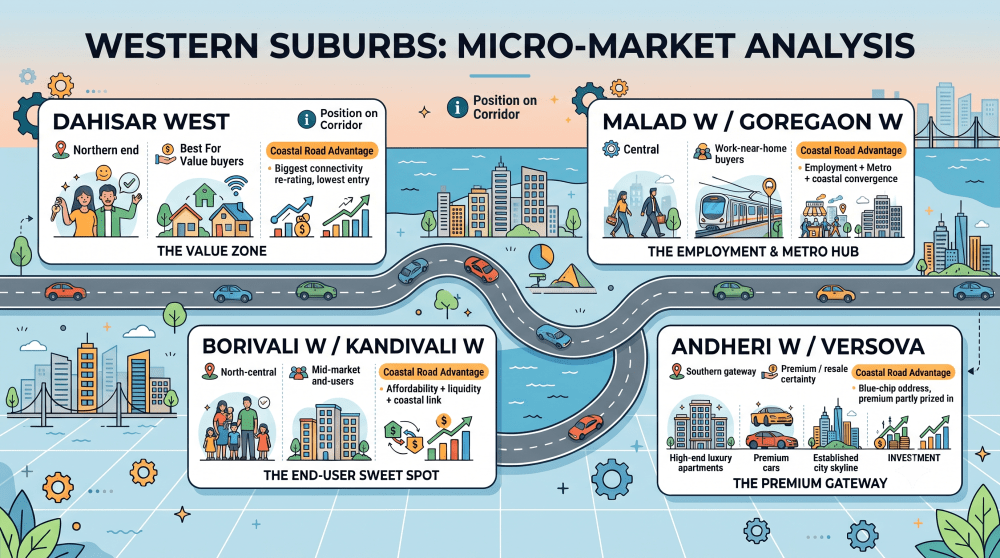
Dahisar West - The Northernmost Value Play: Dahisar West is Phase 2's northernmost residential beneficiary and arguably its clearest value story. Dahisar has traditionally been positioned as an affordable western-suburb entry point; the Coastal Road lifts its connectivity profile substantially, layering a direct coastal link to South Mumbai on top of its existing Metro and rail access. For budget-conscious buyers who want western-suburb addresses without the central-suburb price, Dahisar West is the corridor's headline opportunity.
Borivali West & Kandivali West - Affordability Meets Connectivity: Borivali West and Kandivali West are the belt's established mid-market anchors, offering deep inventory, mature social infrastructure, and strong rail and Metro connectivity. The Coastal Road adds a fast coastal route to the mix, and because these markets are already liquid and liveable, they suit buyers who want appreciation upside without the execution risk of an emerging node. This is the "affordability without compromising connectivity" sweet spot of the corridor.
Malad West & Goregaon West - The Employment-Adjacent Core: Malad West and Goregaon West sit close to major western-suburb employment hubs (the Malad and Goregaon commercial belts), and they benefit from both the Coastal Road and the Metro network converging in the area. For buyers who want to live near work while gaining a fast line to South Mumbai, this stretch offers the strongest multi-driver demand - employment, Metro, and now the coastal corridor all reinforcing each other.
Andheri West & Versova - The Premium Gateway: Andheri West and Versova anchor the southern end of Phase 2, where the extension begins. These are premium, established markets with strong lifestyle appeal and the deepest liquidity in the western suburbs. Part of their Coastal Road premium is already reflected in pricing, so the play here is quality and resale certainty rather than maximum appreciation - the choice for buyers prioritising a blue-chip address with a new connectivity tailwind.
Coastal Road Western-Suburb Map at a Glance
How to Play the Coastal Road Corridor: A Buyer's Framework
Match the node to your horizon. The northern nodes (Dahisar, Kandivali) have the biggest remaining re-rating runway as Phase 2 completes; the southern gateway (Andheri West, Versova) has already priced in much of the story. Buy the node whose stage matches how long you intend to hold.
Favour multi-driver micro-markets. Localities where the Coastal Road overlaps with Metro access and employment - Malad West, Goregaon West - carry the most durable demand. A single-catalyst location is more exposed to timeline slippage; a node with three reasons to appreciate is far steadier.
Don't overpay for a premium already in the price. Compare a flat's rate against its own micro-market's recent trend. If a unit is already priced 15% above the local average purely on the coastal-road story, much of the near-term upside may be spent. The value sits where connectivity is confirmed but pricing has lagged.
Verify the project, always. A coastal expressway nearby is no substitute for due diligence. Confirm the project's MahaRERA registration, the registered completion date, and the carpet area before booking. Infrastructure is the tailwind; a clean, registered, well-built flat is the boat.
Risks and Caveats
A disciplined buyer prices the downside. Timeline slippage is the standard risk - the Versova–Bandra Sea Link and onward stretches have already seen delays, and the 2027–2028 operationalisation is staggered, so do not overpay today for a completion date that may move. Access-point dependency matters too: the corridor's benefit accrues most to localities with convenient on-ramps, so proximity to an interchange matters as much as proximity to the coast. And supply overhang can cap prices in micro-markets where developers have launched aggressively. None of these negates the Coastal Road thesis, but together they argue for buying quality projects in liquid, multi-driver micro-markets rather than chasing the cheapest unit on the map.
The Bigger Picture: Coastal Road as Part of Mumbai's Connectivity Grid
The Coastal Road's impact multiplies because it is one strand of a much larger connectivity grid taking shape across Mumbai at the same time. On the western corridor, the operational Metro Lines 2A (Dahisar–DN Nagar) and 7 (Dahisar East–Andheri East) already serve the same belt, so a flat in Kandivali or Borivali can pair a coastal-road commute south with a metro commute across the suburbs. To the north, the coastal corridor's onward reach toward Bhayandar connects it to the emerging Line 9 (Dahisar–Mira-Bhayandar) catchment, and the broader Virar–Alibaug and freeway networks tie the western seafront into the wider metropolitan region.
For a flat buyer, this convergence is what makes the western-suburb thesis durable rather than a one-off spike. A locality served only by the Coastal Road depends on a single project's timeline; a locality served by the Coastal Road and an operational metro and the rail network has multiple independent reasons for demand to keep building. That is why the multi-driver nodes - Malad West, Goregaon West, and the Borivali–Kandivali belt - sit at the heart of the opportunity, while single-catalyst pockets carry more timing risk. When you read the western-suburb map, look for where the coast, the metro, and the rail all reinforce one another.
The Bottom Line
The Mumbai Coastal Road is the rare infrastructure project that will re-rate an entire belt of the city's most active flat markets. By turning the congested western suburbs into a 40-minute coastal commute to South Mumbai, Phase 2 shifts the value equation for Dahisar, Kandivali, Borivali, Malad, Goregaon, Andheri, and Versova - and the re-rating is still unfolding. The disciplined play is to match the node to your horizon, favour multi-driver micro-markets, avoid overpaying for a premium already in the price, and verify every project's MahaRERA credentials before you commit.
Explore MahaRERA-registered flats across Mumbai's western-suburb Coastal Road corridor on blox.xyz, and read our Atal Setu investor map and Upcoming Metro Lines outlook alongside this guide to see how Mumbai's full connectivity grid - coast, bridge, and metro - is redrawing the property map before you buy.
Frequently Asked Questions
How will the Mumbai Coastal Road affect western-suburb property prices?

When will Coastal Road Phase 2 be complete?
Which western-suburb locality is the best buy on the Coastal Road?

Get in Touch
Let our experts help you answer your questions

 +91
+91


Get in Touch
Let our experts help you answer your questions
+91