Mumbai Metro Yellow Line Corridor: Property Prices, Best Areas to Buy Flats & Investment Guide 2026

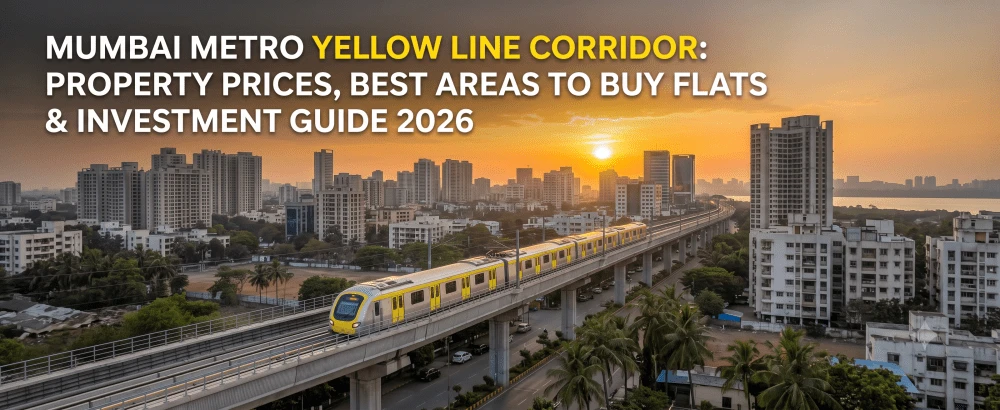
Mumbai's western suburbs have always been a flat buyer's market - dense, well-serviced, and perpetually in demand. But since the Mumbai Metro Yellow Line (Line 2A) became fully operational, something shifted. A 35-minute metro ride now connects Dahisar East to Andheri West. Road congestion that once made certain pockets unliveable suddenly doesn't matter as much. And wherever commute times collapse, property prices follow.
This is not a guide to riding the metro. This is a guide to buying a flat along the yellow line metro route - which areas, at what prices, in which configuration - and understanding exactly what this corridor means for your money in 2026.
Why the Yellow Line Metro Is Mumbai's Most Important Property Corridor Right Now Of the metro lines currently operational in Mumbai, Line 2A punches above its weight as a property investment thesis.
Here's why:
- It solved a real commute problem. The Link Road / Western Express Highway corridor between Dahisar and Andheri was one of Mumbai's worst peak-hour bottlenecks. A 14-km road journey that once took 60–90 minutes by road now takes 30–35 minutes on the metro. That commute compression directly translates to residential demand from professionals who no longer have to choose between affordable Dahisar prices and tolerable Andheri commutes.
- The line is operational - not planned, not under construction. Infrastructure speculation often prices itself in before a single slab is poured. On the Yellow Line, the infrastructure has arrived. Buyers today are purchasing into a live reality, not a promise.
- The pricing gradient along the corridor still has room. Andheri West has always been expensive. Kandivali and Dahisar were historically priced at a discount because connectivity was poor. The Yellow Line has narrowed that connectivity gap significantly - but the price gap has not fully closed. That delta is where the value lies.
- Future connectivity will compound the gains. Metro Line 2B (D.N. Nagar to Mankhurd) is under construction and will eventually extend the Yellow Line corridor eastward to the airport zone and Kurla. The announcement effect on southern Yellow Line stations is still playing out.
How Does Metro Proximity Actually Affect Flat Prices?
The data from previous Mumbai metro launches (Line 1, Navi Mumbai Metro) is consistent: residential properties within 500 metres of an operational metro station command a 10-30% premium over comparable projects further away - and that premium builds over 3-5 years post-launch, not overnight.
On the Yellow Line specifically, here is what has already happened to prices since the line's phased launch:
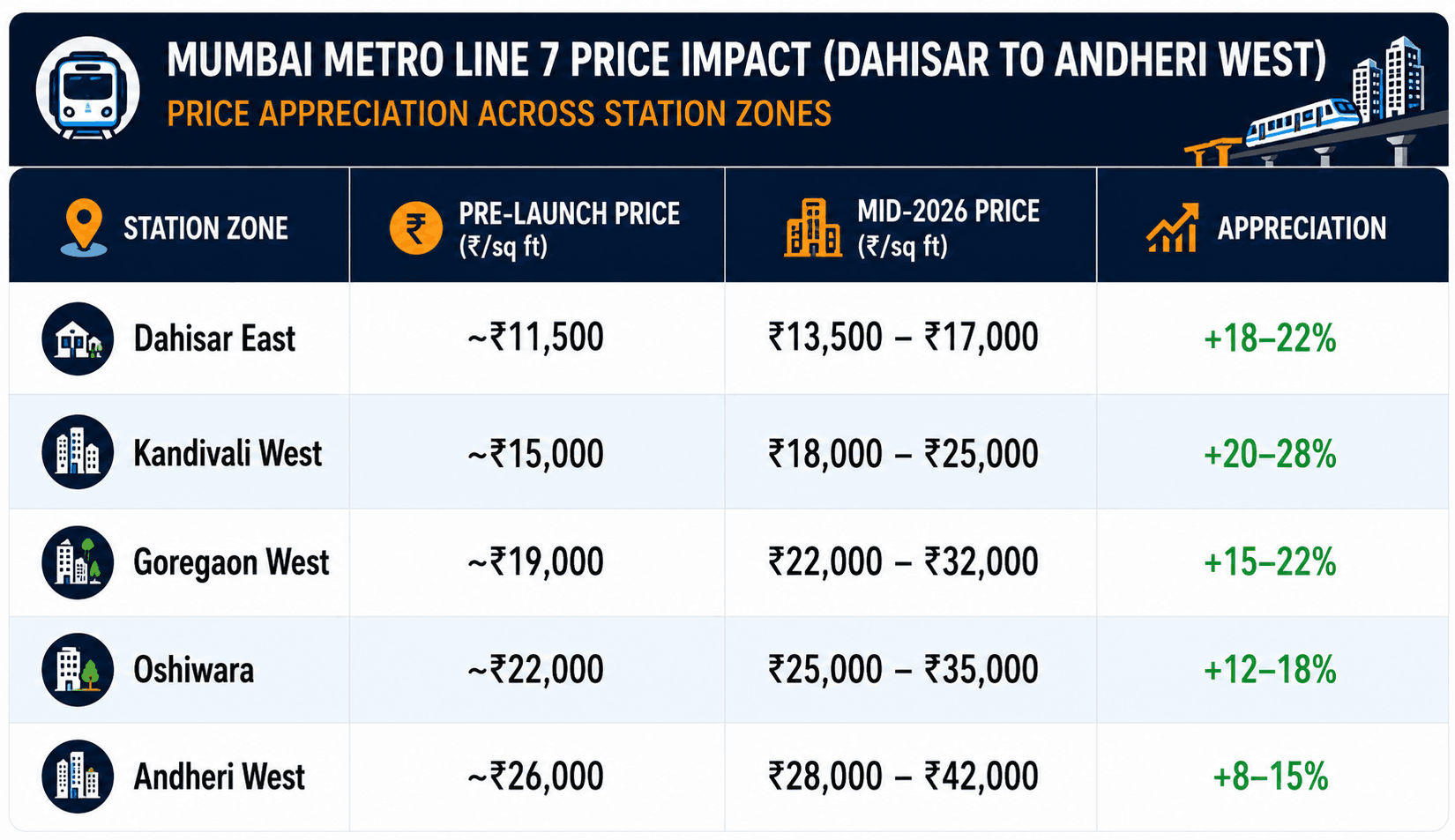
Two things stand out from this data. First, the northern pockets - Dahisar and Kandivali - have seen the highest percentage appreciation because the metro delivered a relatively larger commute improvement to those areas than it did to Andheri, which was already well-connected. Second, Andheri's percentage gain is lower because metro connectivity was partly priced in speculatively before the line launched.
The implication for buyers in 2026: if you want appreciation upside, the northern end of the corridor still has more room to run.
Area-by-Area Flat Price & Buyer Guide: Yellow Line Metro Corridor
Dahisar East - The Affordable Entry Point
- Metro station: Dahisar East (Interchange with Metro Line 7 Red Line)
- Current flat prices: ₹13,500 - ₹17,000 per sq ft
- Target buyer: Budget-conscious buyers, first-time buyers, investors with a long horizon
Dahisar East is the Yellow Line's northern terminus and the corridor's most affordable market in 2026. The station doubles as an interchange with Metro Line 7, meaning residents here have access to both the western and eastern suburban employment belt - a connectivity profile that no amount of road infrastructure could have delivered.
What has changed since the metro: new residential supply has been unlocked in micro-pockets that were previously considered too far from transport. Gated communities with amenity-heavy specifications -clubhouse, gym, children's play zone - have launched here at prices still well below ₹1.5 crore for a decent 1BHK.
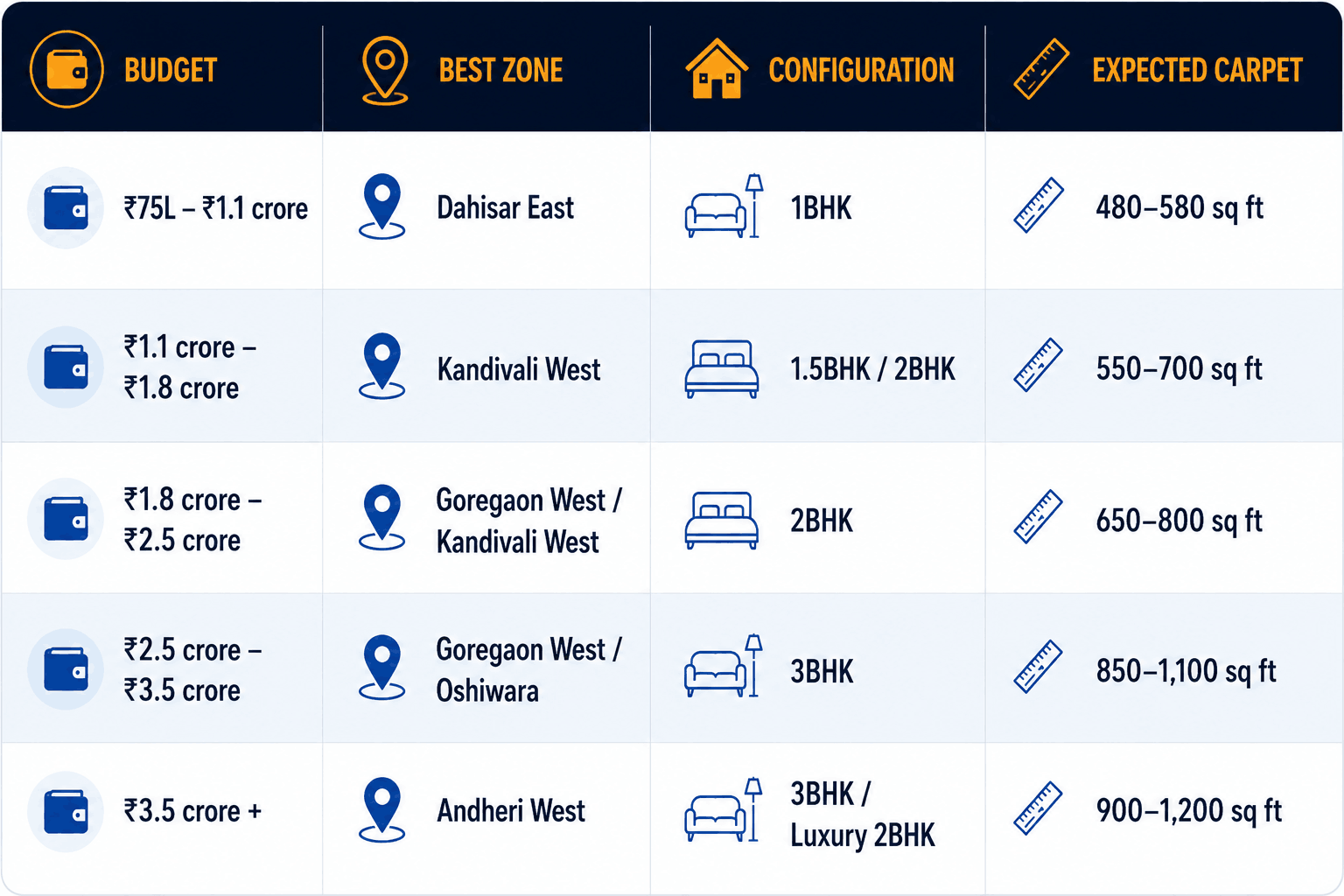
Best configuration: 1BHK (500-600 sq ft carpet) at ₹75 lakh - ₹1.1 crore. Strong rental demand from metro commuters working in Andheri and Kandivali makes it a solid yield play alongside capital appreciation.
What to check on MahaRERA: Dahisar East has seen rapid new launches - verify that your project is registered, that the Q1 2026 update has been filed, and that OC timeline is clearly stated.
Kandivali West - The Corridor's Sweet Spot
- Metro stations: Kandarpada, Dahanukarwadi, Kandivali West, Ekta Nagar
- Current flat prices: ₹18,000 - ₹25,000 per sq ft
- Target buyer: Mid-segment buyers, IT professionals, families upgrading from 1BHK
If there is one area along the Yellow Line that represents the best combination of price, livability, and connectivity in 2026, it is Kandivali West. Four metro stations fall within the Kandivali West micro-market - more station density than any other catchment on the line - and the area has the WR suburban rail at Kandivali Station as a backup.
The Kandivali flat market has historically benefited from its position: close enough to Andheri's employment gravity to matter, far enough from it to be meaningfully cheaper. The Yellow Line has eliminated the last friction point (traffic), and the price premium is still 25-30% below Andheri West comparable stock.
For families, Kandivali West has the best civic infrastructure on the northern corridor: established schools, hospitals, shopping malls (Growel's 101, Infiniti Mall), and social infrastructure built over decades.
Best configuration: 2BHK (650–800 sq ft carpet) at ₹1.2 crore - ₹2 crore. End-user demand is strong from mid-income families, keeping resale liquidity high. 3BHK premium projects near the Kandivali West station are also gaining traction from upgraders.
What to check on MahaRERA: Look for projects that disclose carpet area clearly and have not applied for more than one timeline extension. Several 2023-24 launches in Kandivali West are approaching possession in 2026–27.
Goregaon West - The Employment Hub Play
- Metro stations: Bangur Nagar, Goregaon West
- Current flat prices: ₹22,000 – ₹32,000 per sq ft
- Target buyer: Professionals in media, film, and tech industries; investors targeting rental yield
Goregaon West is the Yellow Line's most interesting employment-residential crossover market. The area hosts Film City, the Goregaon Industrial Estate, and several mid-size tech parks - a combination that generates consistent residential demand from employees who want to walk or take a short metro ride to work.
The Bangur Nagar station in particular has attracted new residential launches targeting the 2BHK and 3BHK segment from professionals in the ₹40,000–₹80,000/month salary range. Rental yields in Goregaon West hover around 3.2–3.8% per annum - not spectacular, but solid for a high-appreciation market.
Goregaon West is also notable for its upcoming supply: several large redevelopment projects from established developers are in the pipeline, with MahaRERA registrations filed in 2025. These projects will add high-specification inventory to a market that has historically had limited new supply.
Best configuration: 2BHK (650–750 sq ft carpet) at ₹1.5 crore - ₹2.4 crore for end-users. 3BHK (900-1,100 sq ft) at ₹2.2 crore - ₹3.5 crore for premium buyers.
Oshiwara / Lower Oshiwara - The Underrated Middle
- Metro stations: Oshiwara, Lower Oshiwara
- Current flat prices: ₹25,000 – ₹35,000 per sq ft
- Target buyer: Andheri-priced-out buyers, Jogeshwari professionals, long-term investors
Oshiwara has long existed in the shadow of Andheri on one side and Goregaon on the other - close to both, but underserved by direct rail connectivity. The Yellow Line changed that. The two Oshiwara stations now give this pocket direct metro access north to Kandivali and south to Andheri West, with interchange connectivity to the Blue and Red lines.
Flat prices in Oshiwara are currently 20–30% below comparable Andheri West stock, but the gap has been narrowing since the metro opened. For buyers who were priced out of Andheri West but want to stay within its gravitational pull - the ad agencies, OTT companies, and financial firms headquartered there - Oshiwara is the immediate alternative.
Best configuration: 2BHK at ₹1.7 crore - ₹2.6 crore. Several integrated township projects with amenity decks are positioned here. Check MahaRERA for OC status on projects launched pre-2023.
Andheri West - The Liquidity Anchor
- Metro station: Andheri West (Interchange with WR Suburban Rail)
- Current flat prices: ₹28,000 - ₹42,000 per sq ft
- Target buyer: Corporate professionals, HNIs, buyers prioritising zero-risk liquidity
Andheri West is the Yellow Line's most valuable node and also its most saturated market. Metro connectivity is fully priced in. What Andheri West offers that no other station on the line can match is liquidity - if you need to sell in two years, you will find a buyer.
For investors buying purely for appreciation, Andheri West is not the play in 2026. For end-users who work in Bandra-Kurla Complex, Lower Parel, or central Mumbai - and want a home they can sell without anxiety at any point - Andheri West remains the gold standard.
Best configuration: 2BHK (700–850 sq ft carpet) at ₹2 crore - ₹3.5 crore. Luxury 3BHK at ₹4 crore+ from branded developers. The market is well-supplied; negotiate hard, especially on under-construction projects where the developer needs to hit sales milesto
Which BHK Makes the Most Sense on the Yellow Line?
Capital Appreciation: What Has Already Happened - And What Comes Next
The Yellow Line's appreciation story has two phases.
Phase 1 (2022-2025): Speculation converts to reality. Buyers who purchased in Kandivali West and Goregaon West pre-launch at ₹14,000-₹19,000/sq ft have seen 20-28% gains. This phase is largely complete for the primary beneficiaries.
Phase 2 (2026 onwards): Maturity appreciation driven by consistent end-user demand, rental yield compression (as capital values rise relative to rents), and eventual announcement effect from Line 2B.
The unlock that could re-energise Yellow Line appreciation: Metro Line 2B (D.N. Nagar to Mankhurd), which when complete will make the D.N. Nagar station a triple-line interchange connecting western suburbs to the airport, Kurla, and eastern Mumbai. D.N. Nagar-adjacent properties in Andheri West have already started pricing in this expectation.
MahaRERA Compliance Checklist Before Booking a Flat Near Yellow Line
Common Mistakes Flat Buyers Make When Chasing Metro Proximity
Paying for a station that's 1.5 km away and calling it "metro-adjacent"
The meaningful radius for metro-linked price premium is 500 metres on foot. At 1 km and beyond, the premium starts eroding. Don't let a builder's brochure sell you a "metro corridor" flat when the nearest station requires an auto-rickshaw ride.
Ignoring floor-rise charges at metro-adjacent projects
Some developers near metro stations charge aggressive floor-rise premiums. Do the per-sq-ft math at each floor and compare against comparable non-metro projects. The metro premium should be in location value, not manufactured as a floor-rise markup.
Booking pre-launch inventory near a metro extension that isn't operational
If the metro connection you're buying for isn't running yet - be careful. Only purchase pre-launch in metro-extension zones if you have a 5+ year horizon and the extension has a confirmed funding and construction contract.
Skipping resale due diligence on secondary sales
Metro-adjacent secondaries are in demand, which means sellers have pricing power. Do not skip checking the original MahaRERA registration, OC status, and outstanding housing society dues before signing a secondary purchase agreement.
Conclusion
Frequently Asked Questions
What is the yellow line metro route in Mumbai?

Which areas near the Yellow Line Metro are best for buying flats in 2026?
What are flat prices near Yellow Line Metro stations in 2026?
Has the Yellow Line Metro increased property prices in Mumbai?
What is the yellow line metro mumbai fare?
What are Yellow Line Metro Mumbai timings?
Which metro lines connect with the Yellow Line?
Is it safe to buy a flat near an under-construction metro station?
How do I check MahaRERA registration for a project near Yellow Line Metro?
What is the expected appreciation near Yellow Line Metro in the next 3 years?

Get in Touch
Let our experts help you answer your questions

 +91
+91


Get in Touch
Let our experts help you answer your questions
+91