Mumbai's Upcoming Metro Lines & 2027–2028 Property Outlook: How Green Line 4, Pink Line 6, Line 9 & Line 5 Will Reshape Flat Prices

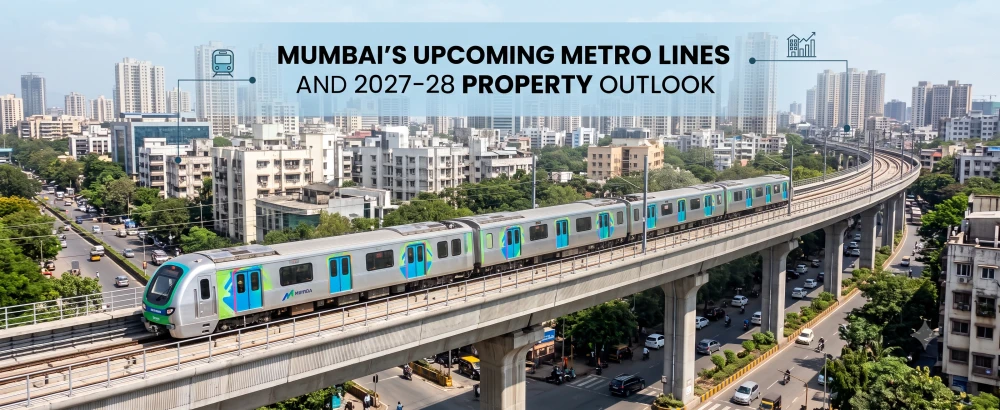
Mumbai's Upcoming Metro Lines & 2027–2028 Property Outlook: How Green Line 4, Pink Line 6, Line 9 & Line 5 Will Reshape Flat Prices
Every flat buyer in Mumbai has heard the advice: "buy near a metro." But by the time a line is operational, the price advantage is usually gone - the smart money moved in while the corridor was still under construction. If you are buying a home in 2026 with a three-to-five-year horizon, the most valuable thing you can study is not today's Mumbai metro map, but tomorrow's.
This is a forward-looking guide to the metro lines that are not yet fully open - the ones that will redraw Mumbai's connectivity, and its property values, between now and 2028. We will walk corridor by corridor through Green Line 4, Pink Line 6, Line 9, and Line 5 (Orange), explain which flat-buying localities each one unlocks, lay out realistic timelines, and give you a framework for buying before the appreciation wave rather than after it. Consider this the property investor's reading of the Mumbai metro map.
Why the Metro Map Is the Most Important Map a Flat Buyer Can Read
Mumbai's geography is unforgiving: a narrow peninsula where north–south road corridors choke daily and east–west links are scarce. The Mumbai Metro network is the single biggest attempt to fix that, and its effect on real estate is measurable rather than theoretical.
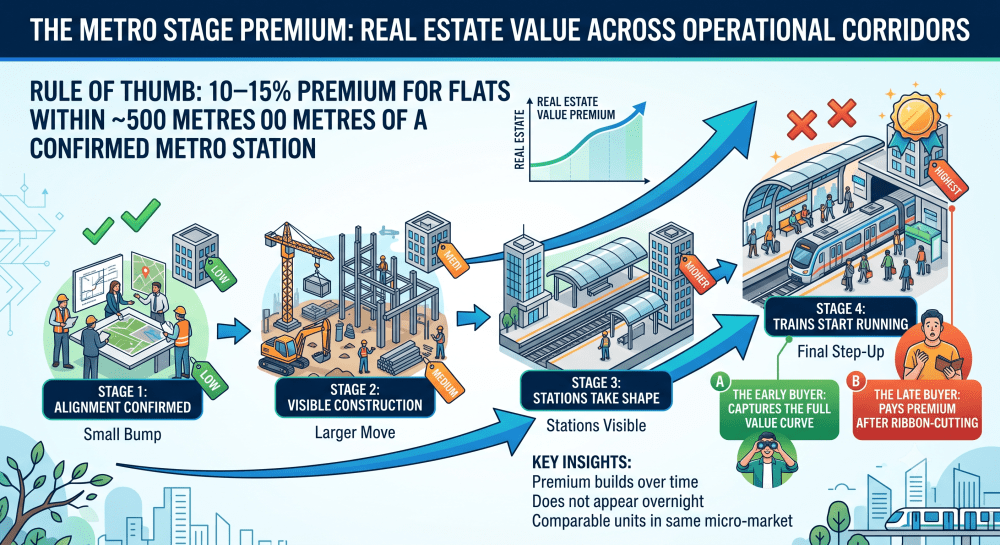
The rule of thumb that has held across every operational corridor is simple: flats within roughly 500 metres of a confirmed metro station command a 10–15% premium over comparable units further away in the same micro-market. That premium does not appear overnight. It builds in stages - a small bump when the alignment is confirmed, a larger move as construction becomes visible and stations take shape, and a final step-up when trains actually start running. The buyer who enters early captures the full curve; the buyer who waits for the ribbon-cutting pays for it.
That is why studying the *upcoming* Mumbai metro map matters more than the current one. The already-operational lines - the Blue Line 1, the Yellow Line 2A and Red Line 7 on the western corridor, and the flagship Aqua Line 3 through the island city - have largely priced in their premium. The opportunity now sits on the lines still under construction.
The State of the Mumbai Metro Map in 2026
Before we look forward, a quick orientation. Several lines are already carrying passengers: the Blue Line (Line 1, Versova–Andheri–Ghatkopar), the Yellow Line (Line 2A, Dahisar–DN Nagar) paired with the Red Line (Line 7, Dahisar East–Andheri East), and the Aqua Line (Line 3, Colaba–BKC–SEEPZ–Aarey), Mumbai's first underground metro, connecting the airport and BKC business district. Blox has dedicated property guides to the Yellow Line 2A and the Aqua Line 3 corridors, and this piece is the natural companion - the map of what comes next.
The lines below are the ones a forward-looking flat buyer should be watching in 2026.
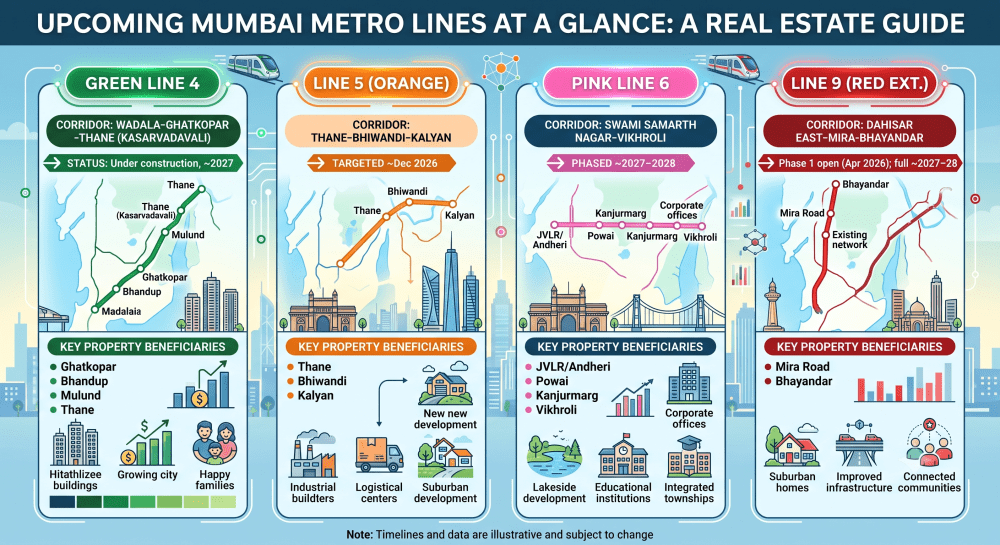
Green Line 4: Wadala–Ghatkopar–Thane–Kasarvadavali (Targeted ~2027)
The Green Line (Metro Line 4), running from Wadala up through Ghatkopar and on to Kasarvadavali in Thane, is arguably the most consequential of the upcoming corridors for the central and eastern suburbs. It stitches together the eastern spine of the city - linking the Wadala–Bhakti Park growth node, the established Ghatkopar interchange, and the fast-growing Thane belt - and connects into other lines to create genuine network effects.
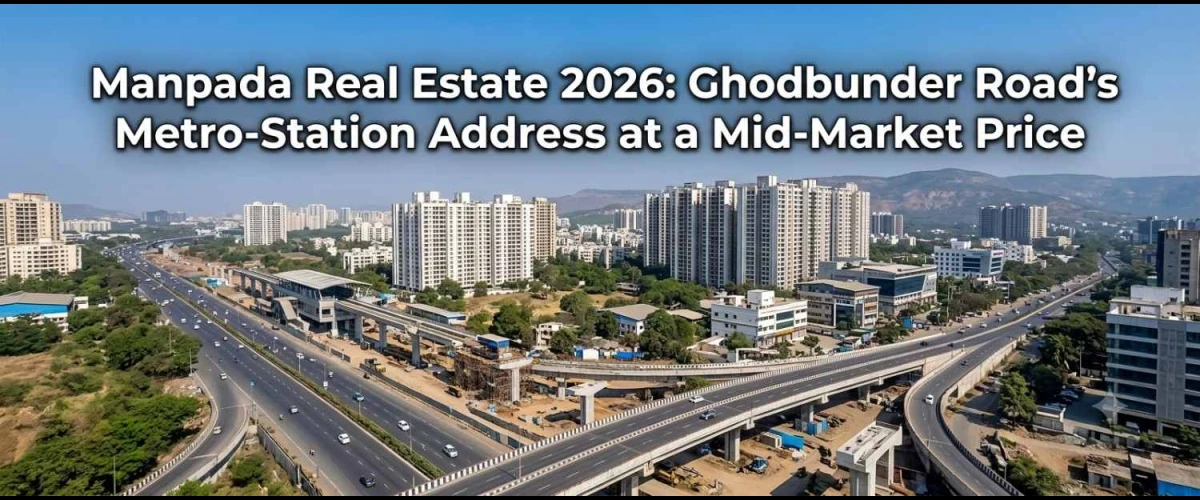
For flat buyers, the Green Line's value is that it serves neighbourhoods that are already residential heavyweights but have been held back by road congestion. Ghatkopar, Bhandup, Mulund, and the Thane corridor all sit on or near this alignment. Mulund and Thane in particular - where Blox buyers already find strong mid-premium inventory - stand to gain from a fast, congestion-free link down the eastern corridor toward Wadala and, via interchanges, to the rest of the network. With a targeted opening around 2027, the window to buy ahead of full operation is open now.
Line 5 (Orange): Thane–Bhiwandi–Kalyan (Targeted ~December 2026)
Line 5, the Orange Line connecting Thane to Kalyan via Bhiwandi, is the nearest-term catalyst on this list, with a targeted opening around the end of 2026. Its significance is that it pushes rapid transit deep into the Thane–Bhiwandi–Kalyan belt - one of the Mumbai Metropolitan Region's largest affordable and mid-budget housing markets.
For a buyer priced out of central Mumbai, this corridor is where value and space still coexist. Kalyan and Bhiwandi offer some of the most accessible ticket sizes in the MMR, and a metro link to Thane - itself a major commercial and residential hub - materially improves their liveability and rental demand. As Line 5 approaches its opening, expect the price gap between these outer nodes and Thane proper to start compressing. Buyers with a longer horizon and a tighter budget should watch this corridor closely.
Pink Line 6: Swami Samarth Nagar–Vikhroli (Phased ~2027–2028)
The Pink Line (Metro Line 6) is the crucial east–west connector the central suburbs have lacked. Running from Swami Samarth Nagar in the west (Lokhandwala/Andheri belt) across to Vikhroli and Kanjurmarg in the east, it will link the western and eastern suburbs without forcing commuters through the overloaded existing corridors. Sections are expected to open in phases between 2027 and 2028.
This line's property story is about the JVLR corridor, Powai, Kanjurmarg, and Vikhroli - micro-markets that are employment-rich (Powai's business district, the Vikhroli–Kanjurmarg office belt) but have been connectivity-constrained. A direct metro that ties these into both the western suburbs and, through interchanges, the Aqua and Green lines, transforms their commute equations. Powai and Kanjurmarg flats, already in demand from professionals, become materially more attractive. Because the Pink Line opens later (2027–2028), it offers the longest runway for early buyers to position ahead of the appreciation curve.
Line 9: Dahisar East–Mira-Bhayandar (Phase 1 Open; Full Line ~2027–2028)
Line 9 extends the western corridor northward from Dahisar East into the densely populated Mira Road–Bhayandar belt. Its first phase - from Dahisar East to Kashigaon - opened in April 2026, and the remaining stretch to Bhayandar is under construction with staggered openings expected through 2027–2028.
Mira Road and Bhayandar are among the western suburbs' most active affordable-to-mid housing markets, home to hundreds of thousands of residents who currently depend on the road corridor and the suburban railway. A metro link that connects them directly into the operational Red Line 7 and the wider western network is a genuine game-changer for commute times. With Phase 1 already live and prices beginning to respond, buyers eyeing this belt should factor the full-line completion into their 2026 decision - the corridor is mid-way through its appreciation cycle rather than at the start or the end.
How to Buy *Ahead* of a Metro Corridor: A Practical Framework
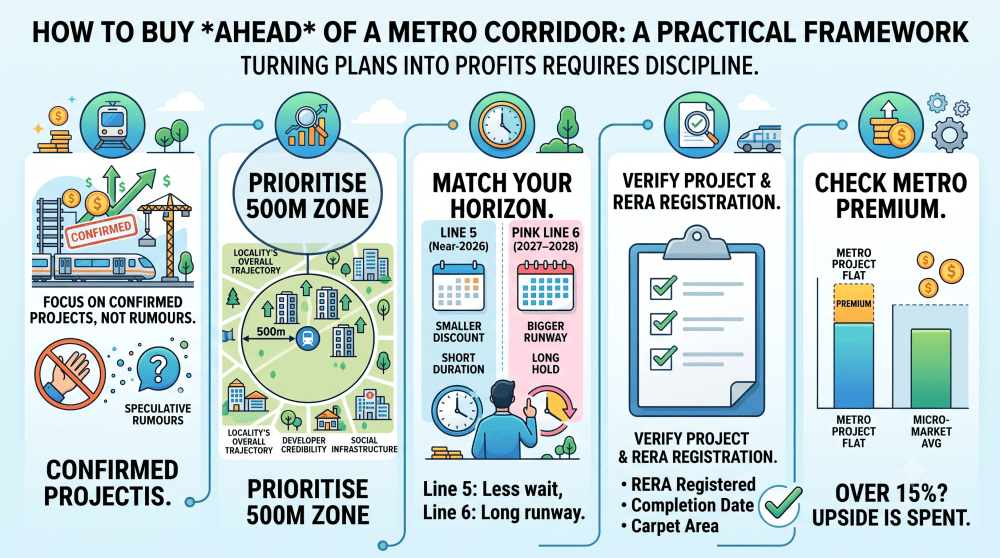
Knowing which lines are coming is only half the job. Turning that into a smart flat purchase requires discipline.
- Anchor on confirmed alignments, not rumours. Premiums accrue to confirmed corridors with visible construction and funded timelines. The four lines above all qualify. Speculative or merely "proposed" extensions carry far more timing risk - treat their upside as a bonus, not the basis of your decision.
- Prioritise the 500-metre band, but weigh the whole micro-market. The strongest premium sits within about 500 metres of a planned station, so a flat's walking distance to its future station matters. But do not buy a weak project just because it is near a station - the locality's overall trajectory, developer credibility, and social infrastructure still decide your outcome.
- Match the timeline to your horizon. Line 5's near-2026 opening means less waiting but a smaller remaining discount. Pink Line 6's 2027–2028 timeline means a longer hold but a bigger potential runway. Buy the corridor whose completion window matches how long you intend to hold.
- Verify the project, always. A metro nearby does not substitute for due diligence. Confirm the project's MahaRERA registration, the registered completion date, and the carpet area before you commit. Infrastructure is the tailwind; a clean, well-built, registered flat is the boat.
- Do not overpay for a premium that is already in the price. On corridors like Line 9's Phase-1 stretch, part of the premium has already arrived. Compare the flat's rate against the surrounding micro-market average - if it is already 15% higher purely on metro proximity, much of the near-term upside may be spent.
What This Means for Each Buyer Profile
The upcoming metro map rewards different buyers differently. For the first-time or budget buyer, Line 5 (Thane–Bhiwandi–Kalyan) and Line 9 (Mira Road–Bhayandar) are the most relevant - they push rapid transit into the MMR's most affordable belts, where a metro link materially lifts both liveability and future resale demand without a central-Mumbai price tag. For the mid-market family buyer, Green Line 4 (Ghatkopar–Mulund–Thane) and Pink Line 6 (Powai–Kanjurmarg–Vikhroli) are the corridors to watch, connecting established residential neighbourhoods to jobs and to the wider network. For the investor, the calculus is about timing the curve: entering a confirmed corridor during construction, targeting the 500-metre station band, and exiting or holding as the premium matures.
A useful mental model is to think in three phases of the premium. Phase one is alignment confirmation, when the corridor is officially funded and mapped - a modest early bump. Phase two is visible construction, when stations and viaducts take shape and buyer confidence rises - the largest single move. Phase three is operation, when trains run and the last step-up arrives. In 2026, Green Line 4 and Line 5 are deep into phase two, Pink Line 6 is earlier in the cycle, and Line 9's first stretch has already reached phase three. Matching your entry to the phase that still has runway left is the essence of buying ahead of the wave.
The Bottom Line for Forward-Looking Flat Buyers
The current Mumbai metro map tells you where the city is connected; the upcoming one tells you where value is about to move. Green Line 4 unlocks the eastern spine from Wadala to Thane, Line 5 pushes affordability-friendly transit into the Kalyan belt, Pink Line 6 finally links Andheri to Powai and Vikhroli, and Line 9 completes the Mira Road–Bhayandar connection. Each opens a window - most acutely between now and 2028 - for buyers to position ahead of the appreciation wave rather than chase it.
The disciplined play is to pick the corridor whose completion timeline matches your horizon, target the 500-metre station band within a genuinely strong micro-market, and verify every project's MahaRERA credentials before you commit. Explore MahaRERA-registered flats along Mumbai's emerging metro corridors on blox.xyz, and read our Yellow Line 2A and Aqua Line 3 property guides alongside this outlook to map the full network - operational and upcoming - before you buy.
Frequently Asked Questions
Which upcoming Mumbai metro line will have the biggest impact on property prices?

Is it better to buy a flat before or after a metro line opens?
How much premium do flats near Mumbai metro stations command?

Get in Touch
Let our experts help you answer your questions

 +91
+91


Get in Touch
Let our experts help you answer your questions
+91