Navi Mumbai Real Estate Investment Guide 2026: NMIA, Atal Setu & the Best Micro-Markets to Buy a Flat

Introduction
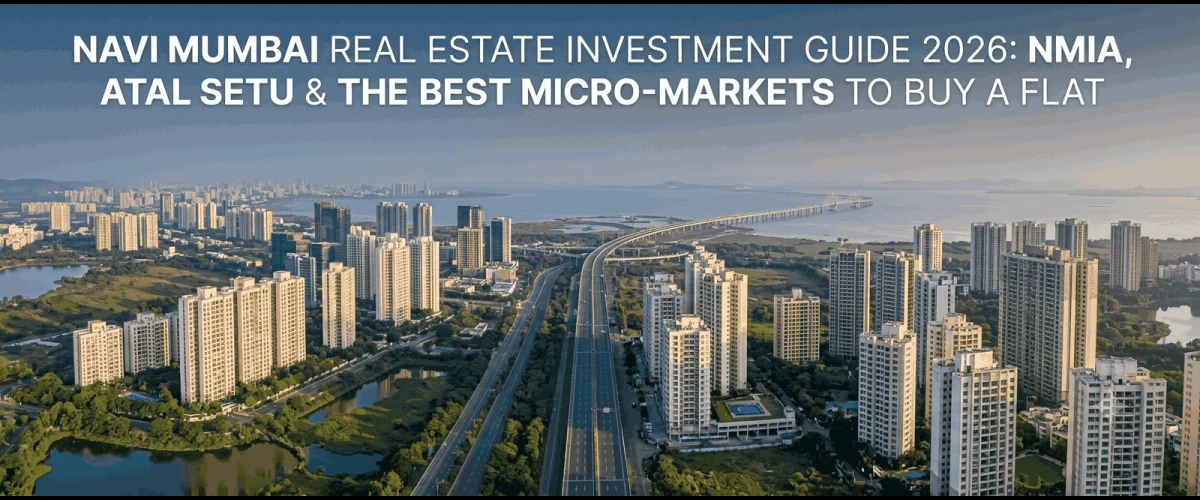
Navi Mumbai is the most event-driven real estate market in India right now. Two structural changes - the opening of Navi Mumbai International Airport (NMIA) Phase 1 in H2 2026 and the Atal Setu (MTHL, already operational) - have transformed the geography of the Mumbai Metropolitan Region. What was once a "value" market offering cheap alternatives to overpriced Mumbai has become a standalone growth story: a planned city with a new international airport, a 22 km sea bridge to the financial capital, and metro connectivity expanding through 2027.
For flat buyers, the question in 2026 is no longer *whether* to buy in Navi Mumbai - but which node to buy in, at what entry price, and before which infrastructure milestone closes the window.
Why Navi Mumbai's Investment Case Is Different in 2026
The NMIA effect is real and measurable. Property prices within a 5 km radius of the NMIA site (Ulwe, Dronagiri) have appreciated by 25–35% over the past two years alone, before the airport even opened. This mirrors the pattern seen at Hyderabad's Rajiv Gandhi International Airport (RGIA) - where localities like Shamshabad and Adibatla saw 3–5x appreciation in the decade following the 2008 opening. NMIA is not Hyderabad's RGIA at scale - it is larger, better connected, and serves India's wealthiest metro.
Atal Setu (MTHL) changed the commute equation. The 22 km sea bridge connects Sewri (south Mumbai) to Nhava Sheva in under 25 minutes. What was a 90-minute drive from South Mumbai to Navi Mumbai is now 35–40 minutes. This has made Navi Mumbai viable for professionals working in the BKC–Nariman Point–Wadala belt for the first time. The bridge has been operational since early 2024 and its commuter impact is now visible in rental demand and buyer interest across Kharghar, Belapur, and Vashi.
The planned city advantage. Unlike Mumbai's organic growth, Navi Mumbai's infrastructure - roads, drainage, open spaces, parking - was designed. CIDCO townships have wider roads, better water supply, and larger flat configurations at lower per-sq-ft rates than comparable Mumbai addresses. This structural advantage is now monetising as NM moves from "affordable alternative" to "preferred destination."
The 5 Micro-Markets to Watch in Navi Mumbai 2026
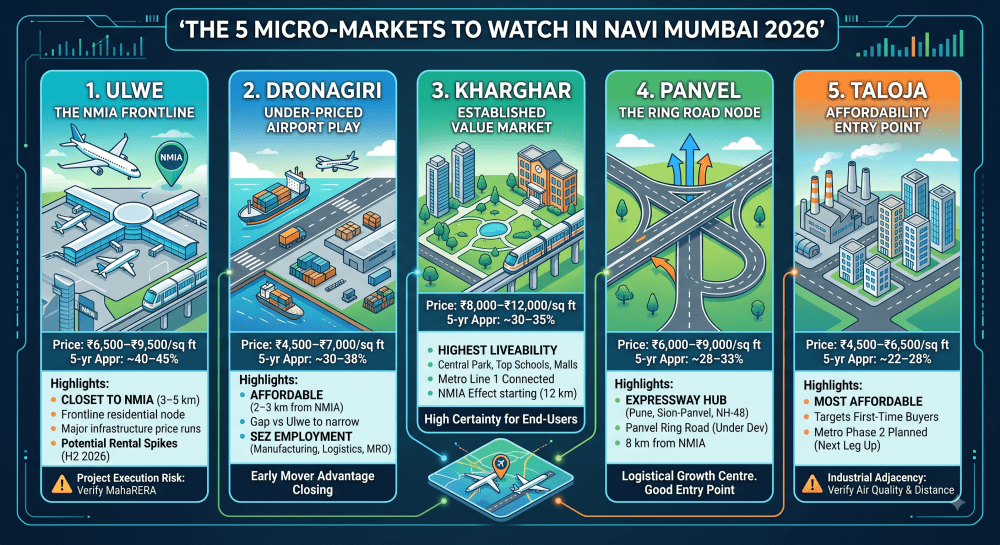
1. Ulwe - The NMIA Frontline
- Price range: ₹6,500–₹9,500/sq ft
- 5-year appreciation: ~40–45%
- Distance to NMIA: 3–5 km (direct road access to terminal approach)
- Metro access: Navi Mumbai Metro Phase 2 (Ulwe node planned)
Ulwe is the closest residential locality to NMIA's terminal. If you draw a 5 km circle around the airport site, Ulwe occupies the densest residential sector within that radius. This is the reason Ulwe prices have run the hardest of any Navi Mumbai node over the past 24 months.
The airport effect on Ulwe will play out in phases:
- Pre-opening (now): Infrastructure-driven price runs already happening
- Opening (H2 2026): Construction and service employment demand for rental accommodation - rental yields may spike to 4.5–5% temporarily
- Post-stabilisation (2027–28): Hotel, logistics, and commercial development around the airport will create secondary appreciation in surrounding residential stock
For flat buyers, the 2 BHK Ulwe entry in the ₹65L–₹90L range offers the cleanest NMIA exposure at a price point that is still accessible.
Caution: Some Ulwe projects are from smaller developers with uncertain delivery timelines. Verify MahaRERA registration and check the builder's past project delivery before booking. The NMIA story is real; individual project execution risk must be assessed separately.
2. Dronagiri - The Under-Priced Airport Play
- Price range: ₹4,500–₹7,000/sq ft
- 5-year appreciation: ~30–38%
- Distance to NMIA: 2–3 km
- Economic driver: JNPA Special Economic Zone, NMIA cargo and maintenance hub
Dronagiri sits between Ulwe and the actual NMIA runway. At ₹4,500–₹7,000/sq ft, it is the most affordable locality within 3 km of the airport - a gap that reflects its current infrastructure deficit (fewer established schools, markets, and social infrastructure than Ulwe) rather than its structural position.
The JNPA (Jawaharlal Nehru Port Authority) Special Economic Zone adjacent to Dronagiri will bring manufacturing, logistics, and MRO (aircraft maintenance) employment once the airport is fully operational. This is an employment driver that Ulwe doesn't have to the same degree - and it creates a distinct buyer profile: salaried professionals in port and airport-linked industries who will rent and eventually buy in Dronagiri.
Investment angle: Dronagiri's price gap vs. Ulwe (₹2,000–₹3,000/sq ft lower) will likely narrow as infrastructure catches up. The early-mover window - buying at ₹5,000–₹6,000/sq ft before airport-phase employment drives rental demand - is closing in 2026.
3. Kharghar - The Established Value Market
- Price range: ₹8,000–₹12,000/sq ft
- 5-year appreciation: ~30–35%
- Distance to NMIA: 12–15 km
- Metro access: NM Metro Line 1 (Belapur–Pendhar), with Kharghar station
Kharghar is Navi Mumbai's most liveable sector: Central Park (one of India's largest urban parks), good schools (DPS Navi Mumbai, etc.), multiple malls, and the best social infrastructure in the city. The Navi Mumbai Metro Line 1 (Belapur–Pendhar) passes through Kharghar, connecting it to Belapur CBD and the TransHarbour suburban rail corridor.
At ₹8,000–₹12,000/sq ft, Kharghar is not cheap - it is priced for what it delivers. But the NMIA effect (12 km away) has begun to percolate via rental demand from airport-related professionals. Kharghar's established infrastructure and metro connectivity make it a natural residential choice for employees at the airport or the SEZ who want quality-of-life alongside investment security.
For whom: End-use buyers who want the Navi Mumbai story + liveability + reasonable appreciation. Not the highest appreciation bet (that's Ulwe/Dronagiri) but the highest certainty.
4. Panvel - The Ring Road Node
- Price range: ₹6,000–₹9,000/sq ft
- 5-year appreciation: ~28–33%
- Distance to NMIA: 8 km
- Key infrastructure: Panvel Ring Road, NMIA 8 km, Expressway hub (Mumbai-Pune, Sion-Panvel, NH-48)
Panvel is the expressway hub of the MMR - the point where Mumbai-Pune Expressway, Sion-Panvel Highway, and the Old NH-48 converge. This makes Panvel the logistical centre of Navi Mumbai's growth corridor. The Panvel Ring Road under development will further strengthen its position as a multi-directional node.
At 8 km from NMIA, Panvel is not in the immediate airport zone - but it benefits from the broader Navi Mumbai growth story. Its price point (₹6,000–₹9,000/sq ft) offers a lower entry point than Kharghar, with similar appreciation potential over a 5–7-year horizon as the Panvel CBD develops and the Ring Road connects to the Virar-Alibaug corridor.
Best configuration: 2 BHK at ₹60L–₹85L in PCNTDA-regulated projects with good connectivity to NH-48.
5. Taloja - The Affordability Entry Point
- Price range: ₹4,500–₹6,500/sq ft
- 5-year appreciation: ~22–28%
- Key infrastructure: Navi Mumbai Metro Phase 2 (Taloja station planned), Industrial belt employment
Taloja is Navi Mumbai's most affordable residential node with reasonable infrastructure. The upcoming Navi Mumbai Metro Phase 2 extension will bring a Taloja station, connecting this industrial-residential hybrid node to the broader NM metro network.
At ₹4,500–₹6,500/sq ft, Taloja targets the genuine first-time buyer - the professional earning ₹40,000–₹70,000/month who wants to buy within 30 km of Navi Mumbai's employment centres. Appreciation has been steady (22–28% over 5 years) rather than dramatic, and the metro connectivity improvement will be the next leg up.
Caution: Taloja's industrial adjacency means air quality and aesthetics lag behind Kharghar or Ulwe. Verify project's distance from industrial plots before booking.
Navi Mumbai: Budget-wise Flat Guide 2026
NMIA Opening: What It Actually Means for Flat Prices
The Navi Mumbai International Airport's Phase 1 (2 runways, ~25 million passengers per year) is expected to open in H2 2026. Here's what the opening means, stage by stage, for residential real estate:
- At opening (2026): An influx of airport construction and service employees will drive rental demand in Ulwe and Dronagiri. Landlords who bought 2 BHK flats in these nodes at ₹55L–₹75L may see monthly rents of ₹18,000–₹25,000 - gross yields of 3.5–4%.
- 12–24 months post-opening: Airport-linked businesses (hotels, cargo handling, MRO, retail) begin operations. A residential absorption cycle begins as permanent employees seek owned housing. Price appreciation accelerates for well-located projects.
- 3–5 years post-opening: Secondary infrastructure (expressway extensions, metro connectivity to airport) becomes operational. The airport zone becomes a sub-city in itself, with a self-sustaining price floor.
- This trajectory is consistent with the RGIA (Hyderabad) precedent. The key difference: NMIA serves a substantially larger and wealthier catchment market.
MahaRERA Verification for Navi Mumbai Buyers
Navi Mumbai flat projects fall under MahaRERA (for private developers) and CIDCO (for CIDCO-developed sectors). Key checks:
- MahaRERA ID: Verify at maharera.mahaonline.gov.in. Confirm registration is active, completion date matches what the builder told you, and the escrow account has funds.
- CIDCO vs. private: CIDCO allotments have a separate transfer process and have historically had fewer delays. Private developer projects in Dronagiri/Ulwe require extra due diligence given the node's relatively recent development.
- Carpet area compliance: MahaRERA mandates disclosure of carpet area. In NM, projects often quote a super built-up area that inflates the apparent size by 25–35%. Always verify carpet area in the registered document.
- Water source: CIDCO supplies water to its designated sectors. Independent projects may rely on MIDC water connection or borewells - check the water connection status before booking.
Blox helps flat buyers find RERA-verified projects across Navi Mumbai. Explore Navi Mumbai investment properties on Blox.
Frequently Asked Questions
Is Navi Mumbai better than Mumbai for investment right now?

Will the NMIA actually open in 2026?
What about the proposed Navi Mumbai Metro to NMIA?

Get in Touch
Let our experts help you answer your questions

 +91
+91


Get in Touch
Let our experts help you answer your questions
+91