Occupancy Certificate vs Completion Certificate in Mumbai 2026: What Every Flat Buyer Must Know Before Taking Possession

Introduction
Of all the documents a Mumbai flat buyer should demand before taking possession, two cause the most confusion and carry the most risk: the Occupancy Certificate (OC) and the Completion Certificate (CC). Builders and brokers sometimes use these terms interchangeably. They are not the same document, they are not issued by the same authority, and the consequences of taking possession without one of them - specifically the OC - are serious enough to derail home loans, attract municipal penalties, and make future resale legally complicated.
In 2026, as MahaRERA has tightened compliance requirements and NMMC, MCGM, and other civic bodies have increased enforcement, every flat buyer in Mumbai and Navi Mumbai needs to understand exactly what these two certificates are, what they prove, who issues them, and what questions to ask before signing any possession letter.
This guide cuts through the confusion with clarity.
What Is a Completion Certificate (CC)?
A Completion Certificate is issued by the local civic authority - MCGM (Brihanmumbai Municipal Corporation) for Mumbai, NMMC for Navi Mumbai, or the relevant municipal body for peripheral areas - to confirm that the building has been constructed in accordance with the approved building plan.
In practical terms, the CC certifies:
- The building's structure matches the sanctioned plan
- Construction complies with local building regulations and bylaws
- Floor heights, setbacks, parking spaces, and common areas match what was approved
- Fire safety provisions are structurally in place
- No unauthorised additional floors or deviations from sanctioned FSI
Who issues the CC?
The relevant local authority / municipal corporation after a physical inspection of the completed building.
When is it issued?
After the construction is fully complete - foundation to terrace - and after the builder applies for inspection.
What it does NOT certify:
The CC does not certify that the building is safe for human habitation or that services (water, electricity, drainage) have been connected. A building can have a CC but still not be fit for occupancy.
What Is an Occupancy Certificate (OC)?
The Occupancy Certificate goes one step further than the CC. It is issued by the local authority after confirming not just that construction matches the plan, but that the building is safe and suitable for people to actually live in.
The OC certifies:
- All structural requirements are met
- Fire safety systems (sprinklers, fire exits, fire NOC from the fire brigade) are operational
- Water supply and sewage connections are in place and functioning
- Electricity connection has been sanctioned
- Lifts are inspected and cleared
- Common areas are complete and accessible
Who issues the OC?
The same local civic authority that issues the CC - MCGM, NMMC, or the relevant body - after a more comprehensive inspection.
When is it issued?
After the CC is obtained and all infrastructure services are connected and verified.
The OC is the last document before a building is legally fit for human habitation. Without it, a flat legally cannot be occupied.
CC vs OC: Side-by-Side Comparison
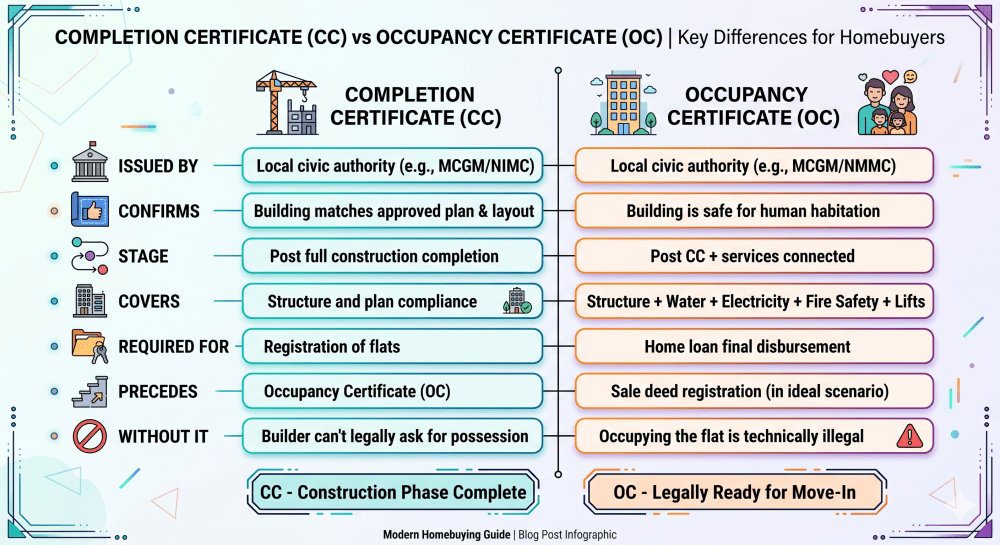
The OC is the more important document for the buyer. The CC is a necessary precursor to the OC, but it is the OC that makes your possession legal.
Why the OC Is the Most Critical Possession Document for Flat Buyers
- Home Loan Disbursement: Banks will not disburse the final tranche of a home loan without an OC. If you are buying an under-construction flat with a home loan, the bank typically disburses in stages. The final disbursement - often 10–20% of the loan amount - is held back until the OC is submitted. Builders who hand over possession without an OC are handing over a flat against which you cannot fully draw your loan.
- Legal Occupancy: Under Maharashtra's building regulations, occupying a flat without an OC is illegal. In theory (and increasingly in practice, as MCGM and NMMC step up enforcement), residents in buildings without OCs can be issued notices and, in extreme cases, evicted. More immediately, you may face difficulty accessing municipal services including water connections and garbage collection.
- Resale: When you sell a flat in the future, the buyer's bank will demand the OC before approving a loan. A flat without an OC will either not sell or will sell at a steep discount - typically 10–20% below market value - to a cash buyer who accepts the legal risk. This directly erodes your investment returns.
- Property Tax: Municipalities levy property tax based on a legally occupied property. Without an OC, you may face issues in getting the property tax account transferred to your name - a bureaucratic problem that compounds over time.
- MahaRERA Compliance: Under MahaRERA, a promoter (builder) is required to disclose the expected OC date on the RERA project page. Delays in obtaining the OC beyond the declared date are treated as project delays and give buyers the right to seek compensation or withdraw from the project. The OC date is therefore not just an administrative milestone - it is a MahaRERA compliance event.
The OC Process in Mumbai: How It Works
Understanding the OC process helps buyers know what to ask builders and when to escalate.
- Stage 1 - Building Completion: The builder completes all floors, common areas, and structural work.
- Stage 2 - Completion Certificate Application: The builder applies for the CC from MCGM or the relevant authority. An inspector visits the site to verify compliance with the sanctioned plan.
- Stage 3 - Fire NOC: The Maharashtra Fire and Emergency Services department inspects the building's fire safety systems - sprinklers, extinguishers, exit routes, fire hydrants - and issues a No Objection Certificate. Without this NOC, the OC cannot be issued.
- Stage 4 - Service Connections:Water supply (from BMC/NMMC/MIDC depending on location), sewage connectivity, and electricity connection (from BEST, Tata Power, Adani Electricity, or MSEDCL depending on location) must be established and verified.
- Stage 5 - Lift Inspection: The Maharashtra Lift Act requires inspection and clearance of all lifts before occupancy. The Lift Inspector's clearance is mandatory for the OC.
- Stage 6 - OC Application and Issuance: With all the above in place, the builder applies for the OC. The civic authority conducts a final inspection and issues the OC.
Typical timeline: The OC process can take 3–12 months after building completion, depending on the builder's preparedness, the queue at the civic authority, and the project's compliance record. Delays at any stage - especially fire NOC and service connections - extend this timeline.
Red Flags: When Builders Delay or Avoid the OC
In Mumbai's real estate market, the OC is one of the most commonly avoided or delayed documents - particularly in older buildings or in projects where deviations from the sanctioned plan exist.
Why builders delay the OC:
- Unauthorised construction: Extra floors, additional flats, or FSI violations that differ from the sanctioned plan. Obtaining the OC would require the authority to inspect and potentially seal the violations.
- Incomplete services: Builder hasn't yet sorted water or electricity connections for the entire project.
- Cost-cutting on fire safety: Fire NOC requirements are sometimes met only partially - upgrading to full compliance to get the NOC adds cost.
- Administrative neglect: Smaller builders sometimes lack the organised documentation to navigate the OC process efficiently.
Red flags to watch for:
- Builder asks you to take possession immediately after construction without mentioning OC status
- Possession letter makes no reference to OC
- Builder says "OC is pending, will come in a few months" - and has been saying this for over a year
- The MahaRERA project page shows an OC status of "pending" well past the declared completion date
- Other residents in the same building are already living there without OC (normalising the violation doesn't make it legal)
What to Do If Your Builder Won't Provide the OC
- Step 1 - Check MahaRERA First: Go to maharera.mahaonline.gov.in, search your project, and check the "Occupancy Certificate" field. If the builder has obtained the OC, it will be uploaded there. If not, you have a documented basis for complaint.
- Step 2 - Written Demand: Send a formal written demand (email + registered post) to the builder requesting the OC before possession. Keep a record - this establishes your due diligence.
- Step 3 - Do Not Sign the Possession Letter Without OC Confirmation: The possession letter is a legal document. Once signed, you have accepted the flat in its current state. Do not sign until OC is confirmed - or at minimum, include a clause in the possession letter acknowledging that OC is pending and obligating the builder to provide it within a specific number of days.
- Step 4 - File a MahaRERA Complaint: If the builder refuses or significantly delays the OC, file a complaint on the MahaRERA portal. MahaRERA can direct the builder to obtain the OC and can impose penalties for non-compliance. The complaint process is online and does not require a lawyer for initial filing.
- Step 5 - Seek Legal Advice: For high-value flats or projects with significant OC delays (beyond 12 months post-declared completion), engage a property lawyer to assess your options - including seeking a refund with interest under Section 18 of the RERA Act.
OC and the Difference Between Ready-to-Move and Under-Construction Flats
- Ready-to-Move Flats: A genuinely ready-to-move flat should have the OC already issued. Before booking, ask the builder or seller directly: "Is the OC issued?" Then verify independently on MahaRERA. If the answer is yes but MahaRERA shows otherwise, treat that as a serious red flag.
- Under-Construction Flats: The OC hasn't been issued yet - the building isn't complete. The builder's RERA registration should disclose the expected OC date. This date becomes your benchmark for monitoring project progress.
- Resale Flats: The OC should exist for any resale flat in a building older than a few years. If the building is more than 5 years old and the seller cannot produce an OC, investigate carefully - it may never have been issued, and you may be inheriting a legally occupied but technically illegal flat.
Specific Mumbai Authorities: Who Issues OC in Different Zones
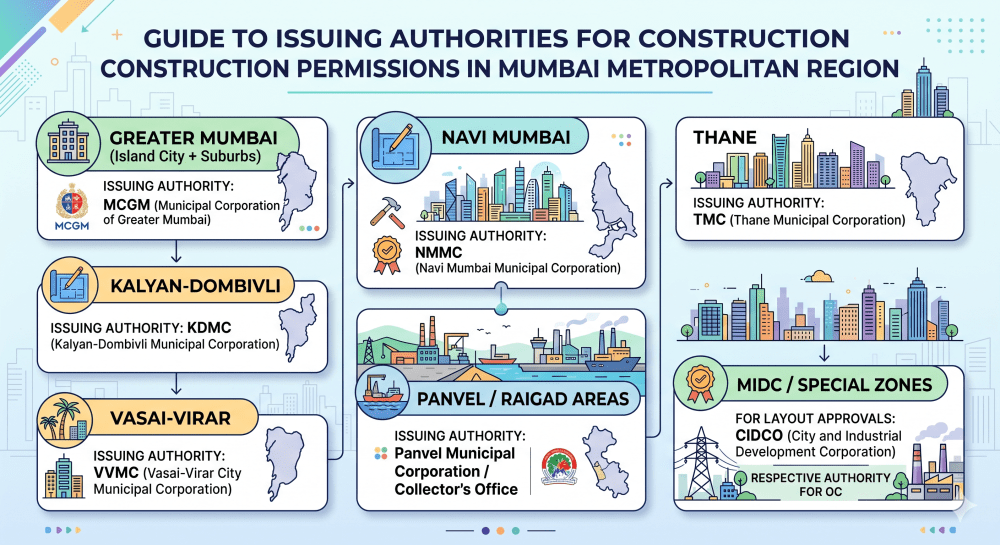
Knowing your issuing authority matters because each has its own portal and complaint mechanism for OC-related issues.
Checklist: OC and CC Verification for Mumbai Flat Buyers (2026)
Use this checklist before accepting possession:
- Ask builder for the OC document (physical copy with authority stamp and date)
- Cross-verify OC on MahaRERA project page (should be uploaded under project documents)
- Check fire NOC from Maharashtra Fire and Emergency Services - ask builder for this separately
- Confirm water connection letter from BMC/NMMC (building-level, not just individual meter)
- Confirm electricity connection sanction from the distribution company
- Check lift clearance certificate (mandatory under Maharashtra Lift Act)
- Review the possession letter - if OC is pending, ensure a binding clause is included with a specific deadline
- Ask your home loan bank whether they require OC before final disbursement (most do)
- If resale: ask the previous owner for the original OC and verify the building year against MCGM/NMMC records
Your Due Diligence, Backed by Blox
Taking possession of a flat in Mumbai without verifying the OC is one of the most avoidable mistakes a buyer can make. The OC is not bureaucratic fine print - it is the document that makes your home legal, your loan complete, and your investment resaleable.
At Blox, every listing is RERA-verified, and our team can help you navigate document verification - including OC status - before you book. Browse verified flat listings across Mumbai and Navi Mumbai at blox.xyz and buy with the confidence that comes from complete documentation.
Blox.xyz is India's first platform for buying flats directly from developers - zero brokerage, verified listings, and full documentation support.
Frequently Asked Questions
Can I legally live in a flat without an OC?

Can a bank give me a home loan without the OC?
Is the OC the same as the Commencement Certificate?
What if my building was built before 2000 and has no OC?
How long does the OC process take in Mumbai?
Can MahaRERA penalise a builder for delaying the OC?

Get in Touch
Let our experts help you answer your questions

 +91
+91


Get in Touch
Let our experts help you answer your questions
+91