Pune Metro Phase 2 (2026): How the Vanaz–Chandani Chowk & Ramwadi–Wagholi Lines Will Grow These Flat Micro-Markets

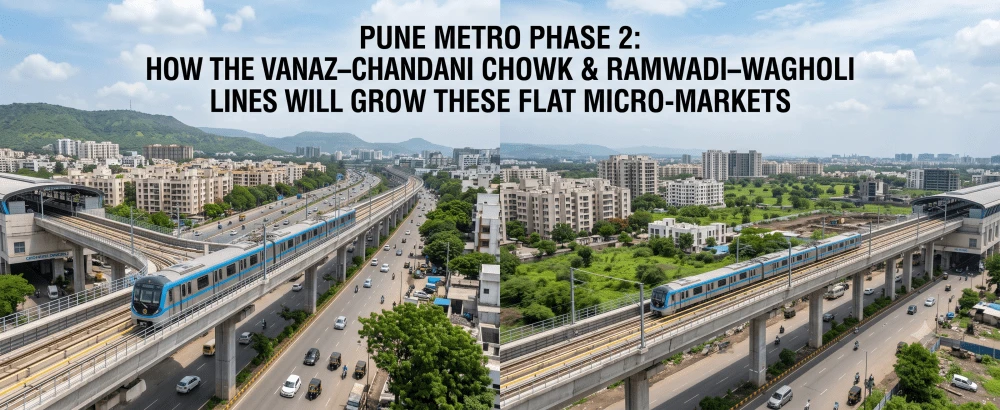
Pune's metro map just got a major upgrade - and for flat buyers, it is a preview of where the city's next wave of appreciation will land. Pune Metro Phase 2 has been cleared by the Union Cabinet, extending the operational Vanaz-Ramwadi corridor at both ends: west toward Chandani Chowk and east toward Wagholi. For anyone buying a flat in Pune with a three-to-five-year horizon, this is exactly the kind of confirmed, funded, forward-looking connectivity story that reshapes micro-market values before the trains ever run.
This guide is a flat buyer's map of Pune Metro Phase 2: what has been approved, where the new corridors run, the timeline, and - most importantly - which residential micro-markets are positioned to grow as a result. Because the smartest infrastructure play is always to read the map before the metro opens, not after.
What Is Pune Metro Phase 2?
Pune Metro Phase 2 is the approved extension of the city's existing Line 2 (the Aqua Line, Vanaz-Ramwadi), which has been operational and is one of Pune's two running metro corridors. The Union Cabinet approved two new elevated extensions:
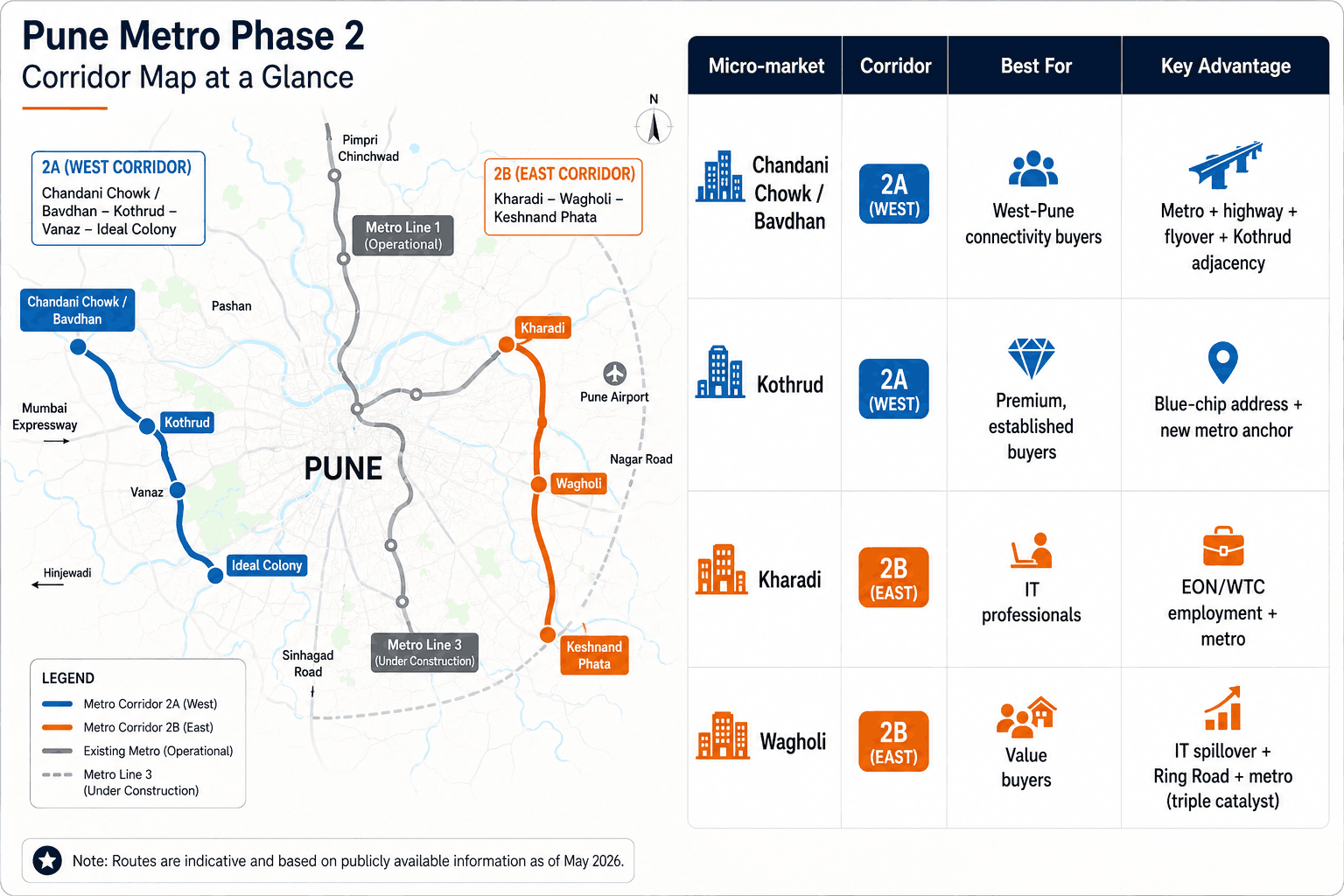
- Corridor 2A - Vanaz to Chandani Chowk: a 1.12 km elevated stretch with two stations (Kothrud Bus Depot and Chandani Chowk), pushing the line west into the fast-growing Kothrud-Bavdhan-Chandani Chowk belt.
- Corridor 2B - Ramwadi to Wagholi/Vitthalwadi: an 11.63 km elevated stretch with 11 stations, extending the line east through Kharadi toward Wagholi.
Together the two corridors add 12.75 km and 13 stations at an estimated cost of about ₹3,626 crore, shared between the central and state governments and external funding agencies. The project is scheduled for completion within roughly four years. Crucially, Phase 2 will connect a string of rapidly developing suburbs - Chandani Chowk, Bavdhan, Kothrud, Kharadi, and Wagholi - directly into Pune's operational metro spine.
Why a Metro Extension Moves Flat Prices
Metro connectivity is one of the most reliable property-value catalysts in any Indian city, and Pune is no exception. When a locality gains a metro station, it gains a fast, congestion-free link to employment hubs and the city core - which widens its buyer and tenant pool, pulls in developers, and lifts prices, especially within walking distance of stations.
The premium builds in predictable stages: a modest bump when the corridor is confirmed and funded (which Phase 2 now is), a larger move as stations take shape and construction becomes visible, and a final step-up when trains start running. Phase 2 sits at the very start of that curve in 2026 - approved and funded, but years from operation - which is precisely the window in which early buyers capture the most upside. The flat buyer who enters a Phase 2 micro-market now is positioning ahead of the appreciation wave rather than chasing it.
The Growth Corridors: Which Flat Micro-Markets Will Grow
Chandani Chowk & Bavdhan - The Western Gateway
Chandani Chowk has long been a critical western Pune junction, and the recently rebuilt Chandani Chowk flyover already eased a notorious bottleneck. Now the metro is coming to it. Together with adjacent Bavdhan, this belt combines proximity to Kothrud's established residential ecosystem, easy access to the Mumbai-Bangalore highway, and - with Corridor 2A - a direct metro link into the city. For buyers who want a west-Pune address with strong connectivity fundamentals and a fresh metro catalyst, Chandani Chowk and Bavdhan are the corridor's western headline.
Kothrud - Established Address, New Catalyst
Kothrud is one of Pune's most sought-after, well-established residential neighbourhoods - and it now gains a Phase 2 station (Kothrud Bus Depot). Kothrud rarely needs help attracting buyers, but a metro upgrade deepens its appeal and supports its premium pricing. For buyers who prioritise a mature, liveable, blue-chip Pune address, the metro extension is a reassuring long-term value anchor rather than a speculative bet.
Kharadi - IT Powerhouse Gets Rapid Transit
Kharadi, home to EON IT Park, the World Trade Center, and a dense multinational office cluster, is one of Pune's biggest employment magnets - and Corridor 2B brings the metro directly to it. For a locality whose demand is driven by tens of thousands of IT professionals, rapid transit is a powerful addition to an already-strong story. Kharadi flats, already in high demand, become materially more attractive with a metro line connecting them to the wider city.
Wagholi - The Eastern Value Beneficiary
Wagholi, the eastern terminus of Corridor 2B, is the belt's clearest value play. Already benefiting from Kharadi IT-corridor spillover and its position on the Pune Ring Road alignment, Wagholi now adds a confirmed metro link to its connectivity stack. That triple catalyst - IT demand, Ring Road, and now Phase 2 metro - is exactly the kind of convergence that drives the strongest re-ratings, and Wagholi still trades well below Kharadi, leaving room to grow.
How Phase 2 Fits Pune's Wider Connectivity Picture
Who Should Buy Along Phase 2 - and Who Shouldn't
How to Buy Ahead of Pune Metro Phase 2: A Framework
Frequently Asked Questions
What are the routes of Pune Metro Phase 2?

Which Pune localities will benefit most from Metro Phase 2?
Should I buy a flat before or after Pune Metro Phase 2 opens?

Get in Touch
Let our experts help you answer your questions

 +91
+91


Get in Touch
Let our experts help you answer your questions
+91