Pune Ring Road 2026: The New Growth Corridors & Which Flat Micro-Markets Will Boom

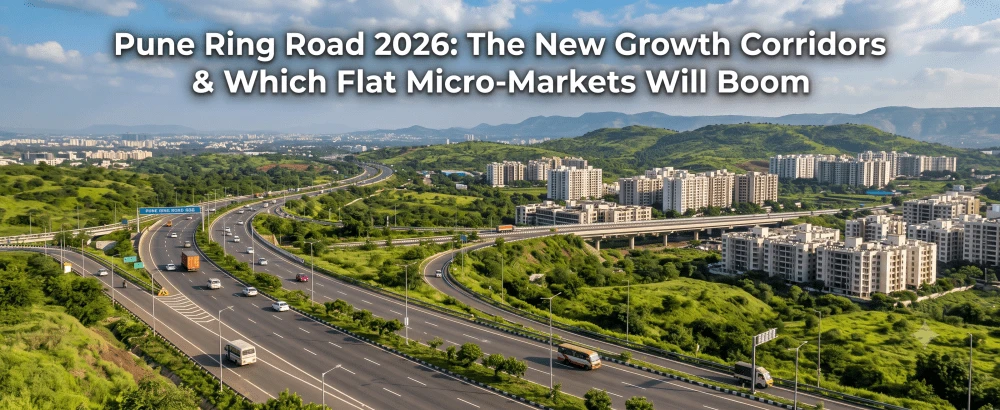
Pune is on the verge of its biggest connectivity upgrade in a generation - and for flat buyers, it is the single most important map to study before making a 2026 decision. The Pune Ring Road is a mega orbital expressway designed to loop traffic around the city's periphery, and as it moves from "under construction" to "operational" over the next two years, it will unlock a new ring of residential growth corridors. History is clear on what happens next: the flat micro-markets that sit on or near a new orbital corridor tend to re-rate sharply once it opens.
This guide breaks down the Pune Ring Road for the flat buyer: what it is, where it runs, when it opens, and - most importantly - which residential micro-markets are positioned to boom as a result. If you are buying a flat in Pune with a three-to-five-year horizon, this is the infrastructure story that should shape your shortlist.
What Is the Pune Ring Road?
The Pune Ring Road is an MSRDC-led orbital expressway - a roughly 138-kilometre, six-lane, access-controlled corridor connecting six national highways around Pune at an estimated cost of about ₹42,711 crore. Its purpose is simple but transformative: pull long-distance and inter-regional traffic out of the congested city core and onto a high-speed ring, decongesting Pune's radial arteries and the Mumbai-Pune Expressway approach.
Formal construction began in December 2024. The western section is targeted for completion around mid-2027, with the eastern section following around 2028. Alongside the main outer ring, the Pune Metropolitan Region Development Authority (PMRDA) is advancing an Internal Ring Road - a 65-metre-wide access-controlled corridor featuring 12.62 km of tunnels, 17 major bridges, and nine interchanges - for which ₹55.03 crore was allocated in the 2026-27 budget. Together, these projects are expected to cut inner-city traffic by close to 40%.
For a flat buyer, the takeaway is this: the ring is no longer a line on a planning map. It is being built, funded, and phased - which is precisely the stage at which locality re-ratings begin.
Why a Ring Road Moves Flat Prices
Orbital corridors change the economics of the suburbs they touch. Before a ring road, a peripheral locality's value is capped by how painfully long it takes to reach the city's job centres through congested radial roads. After the ring opens, that same locality gains fast, congestion-free access not just to the core but to *other* growth quadrants - IT hubs, the airport axis, the expressway - without funnelling through the centre.
That connectivity upgrade widens the buyer and tenant pool, pulls in developers, and compresses the price gap with more central areas. As with every infrastructure catalyst, the premium builds in stages: a modest bump when the alignment is confirmed, a larger move as construction becomes visible, and a final step-up when the corridor actually opens. The flat buyer who enters while the ring is still under construction captures the full curve; the one who waits for it to open pays for it.
A note specific to the Ring Road belt: much of the land along the alignment is agricultural or plotted, and that is not the Blox play. This guide is about residential flat micro-markets and organised townships along or near the corridor - not land or plot speculation. Focus on established and emerging apartment nodes where the ring improves an already-real housing market.
The Growth Corridors: Which Flat Micro-Markets Will Boom
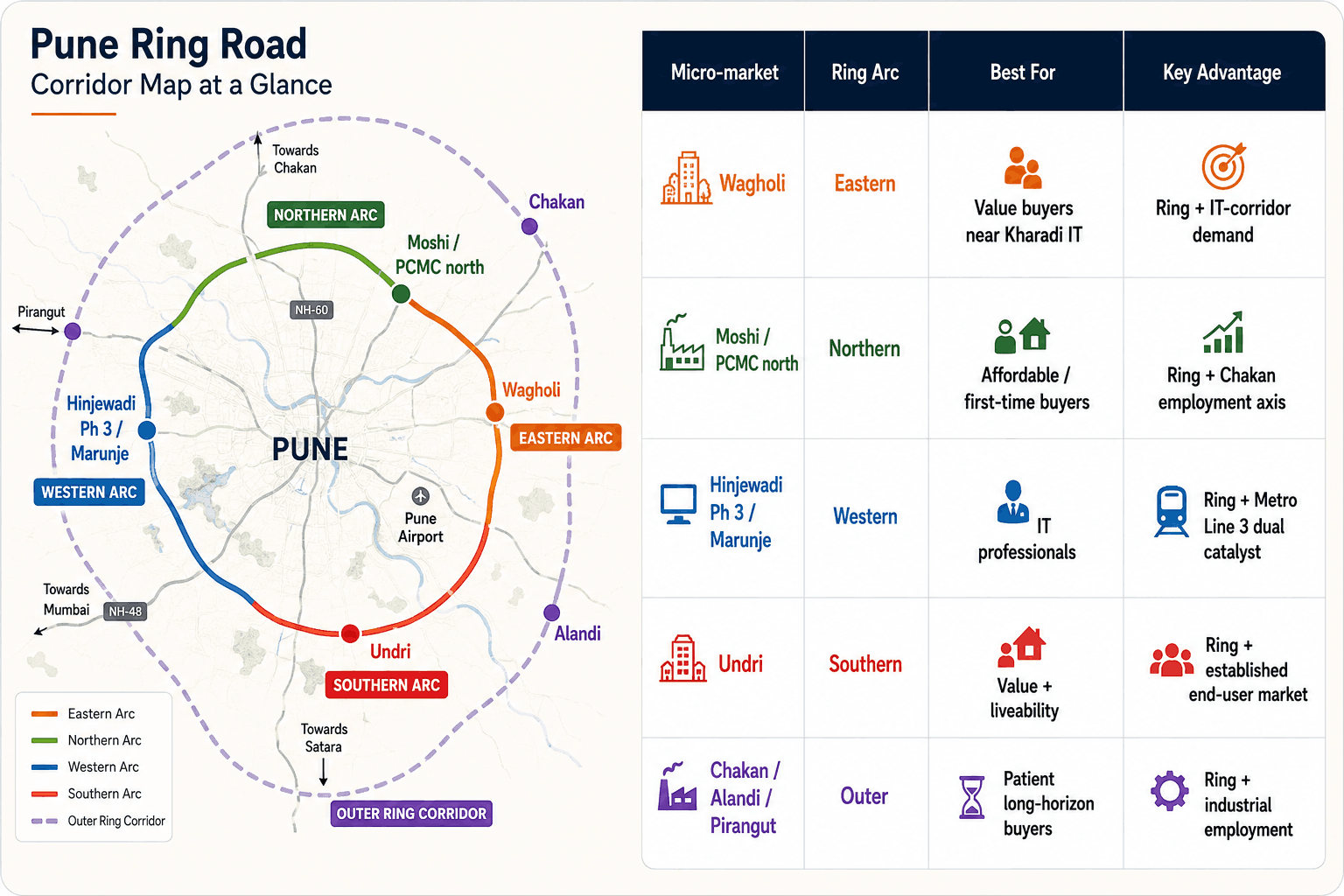
Wagholi - The Eastern Ring Beneficiary
Wagholi, on Pune's eastern edge along the Nagar highway, sits directly in the Ring Road's proximity zone and already has a deep, active flat market thanks to its adjacency to the Kharadi IT corridor. The ring adds orbital access on top of that existing IT-led demand - a powerful combination. With township-scale inventory and a price point well below Kharadi, Wagholi is one of the clearest flat plays on the eastern arc of the ring.
Moshi & the Northern PCMC Belt - Affordable Growth
The northern belt around Moshi and PCMC stands to gain from ring connectivity toward Chakan's industrial-and-employment axis and the broader metropolitan region. This is Pune's affordable-to-mid growth frontier, where township developers are active and ticket sizes remain accessible. For budget-conscious buyers, the northern ring corridor offers space and amenities at prices the established western suburbs can no longer match.
Hinjewadi Phase 3 & Marunje - IT Meets Orbital
Hinjewadi Phase 3 and Marunje sit at the intersection of two catalysts: the ring road and Pune Metro Line 3 (Hinjewadi-Shivajinagar), which is nearing completion. This dual-catalyst overlap - India's largest IT cluster plus rapid transit plus orbital road access - is exactly the kind of convergence that drives the strongest re-ratings. Flats here serve a vast, ready IT tenant and buyer base, and the connectivity stack keeps deepening.
Undri & the Southern Corridor - Value with a Catalyst
Undri and the southern belt sit on the ring alignment and are attracting early-stage buyer interest as a value corridor. Undri already offers end-user liveability - schools, hospitals, township living - at a discount to the East Pune IT nodes, and the ring adds a connectivity catalyst to an already-functioning residential market. It is a sensible entry point for value buyers who want an established neighbourhood plus an infrastructure tailwind.
Chakan, Alandi & Pirangut - The Longer-Horizon Arc
Chakan (a major industrial and automotive hub), Alandi, and Pirangut sit further out on the ring and are earlier in their residential cycle. Chakan in particular benefits from ring connectivity to its large employment base. These nodes suit patient, longer-horizon buyers willing to trade today's thinner social infrastructure for a bigger potential runway - always within organised, MahaRERA-registered flat projects rather than raw land.
How to Buy Ahead of the Ring Road: A Framework
The Metro Overlap: Where the Ring Road Meets Rapid Transit
Risks and Caveats for Ring Road Buyers
The Bottom Line
Frequently Asked Questions
When will the Pune Ring Road be completed?

Which Pune localities will benefit most from the Ring Road?
Should I buy a flat before or after the Ring Road opens?

Get in Touch
Let our experts help you answer your questions

 +91
+91


Get in Touch
Let our experts help you answer your questions
+91