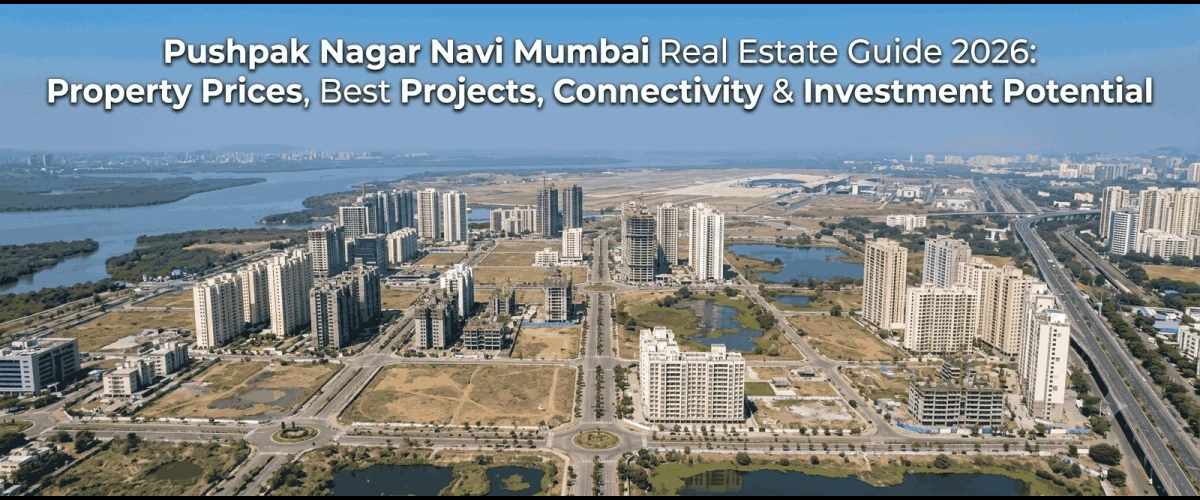
Pushpak Nagar is the closest residential node to Navi Mumbai's new airport, and the widest gap in the region between what sellers ask and what buyers actually pay. There is a number in Pushpak Nagar that does more work than any other, and it is not the price.
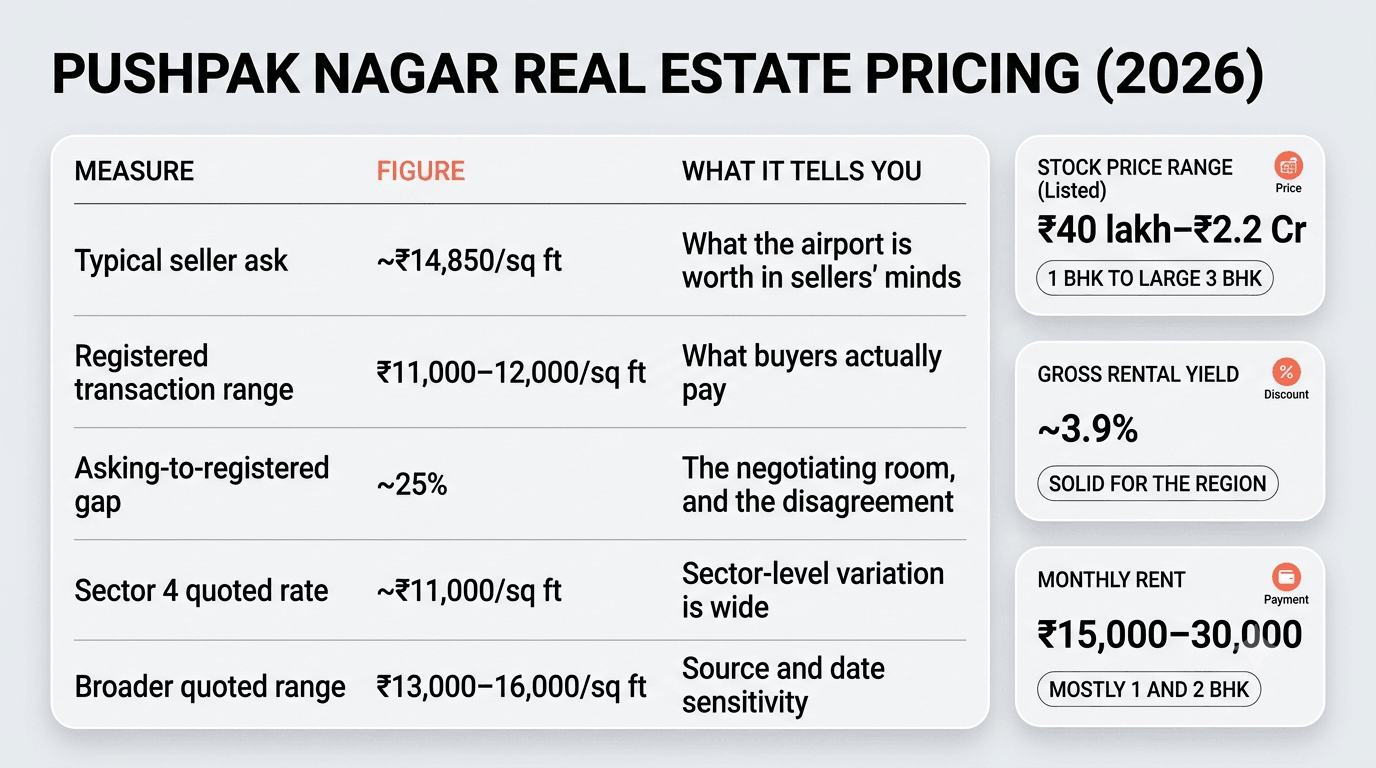
It is the gap. Sellers here quote around ₹14,850 per sq ft. Registered transactions close nearer ₹11,000 to ₹12,000. That is roughly a 25% spread between asking and closing - among the widest anywhere in the Navi Mumbai region, and a far more revealing statistic than either figure on its own.
Because a 25% gap is a market having an argument with itself. Sellers are pricing the airport, which is genuinely minutes away and genuinely transformative. Buyers are pricing the node they actually have to live in - which ranks #629 out of 744 Navi Mumbai localities on livability, scores 3.3 out of 5 on lifestyle, and where residents' most common complaint is that public transport barely exists.
Both sides have a point. This guide is about where, between ₹11,000 and ₹14,850, the truth sits - and what that means if you are about to sign something.
Why Buy Property in Pushpak Nagar
Nothing is closer to the terminal. Navi Mumbai International Airport began commercial operations on 25 December 2025 and was running 78 daily departures across 46 domestic destinations by April 2026, with its first international route to Abu Dhabi from 15 July 2026 and Phase 1 rated for 20 million passengers a year. Published travel times from Pushpak Nagar to the airport are 5 to 10 minutes. No other residential node in the region can say that.
The node was planned, not accreted. This is CIDCO's work, laid out around the airport with 30 to 60 metre road widths, landscaped medians and engineered drainage. Drive through it and the difference from an organically grown locality is obvious - the bones are good, even where the flesh has not arrived.
And the price is still, arguably, reasonable. At ₹11,000-12,000 registered, Pushpak Nagar transacts at roughly the same level as Ulwe and below Kharghar's ₹15,000-16,000, while sitting closer to the terminal than either.
Now the trade, and it is a real one. Social infrastructure is thin and arriving slowly - the locality's own residents rate education and healthcare 3.4 out of 5 and flag "limited public transport" as the headline problem. There is no railway station and no metro, which for a node built beside an airport is a genuine structural gap. Panvel station is 6.9 km away. And the market is described, by more than one independent assessment in 2026, as over-supplied.
Location Snapshot of Pushpak Nagar
So where is this? Immediately north and east of the airport site, in the Panvel–Ulwe belt of Raigad district, on land CIDCO planned as the airport's residential neighbour.
The PIN code is 410206, shared with Ulwe and Karanjade. The node runs in numbered sectors, with Sector 4 among the more active.
Reference points, and they need care: published distances to the airport range from about 1.5 km to the airport boundary to roughly 7.5 km to the terminal building, depending on what is being measured - which is why travel time (5 to 10 minutes) is the more honest metric. Panvel railway station is 6.9 km, Ulwe 6.6 km, CBD Belapur 12.9 km.
There is no railway station in the node and no metro. The NAINA metro corridor is proposed for roughly 2028–2030 and is not built. Mumbai Metro Line 8, the 34.9 km CSMIA–NMIA line approved on 24 February 2026 at ₹22,862 crore with construction from June 2026 and a May 2031 target, terminates at the airport.
Stamp duty is 6% plus 1% registration, dropping to 5% for a sole female buyer.
Property Price Insights
Read the first three rows together. If you walk into Pushpak Nagar and pay the asking price, you have paid roughly a quarter more than the market's own recorded clearing level. That is not a rounding error - on a ₹80 lakh flat it is about ₹20 lakh. In no other node in this series is the diligence-to-savings ratio this favourable.
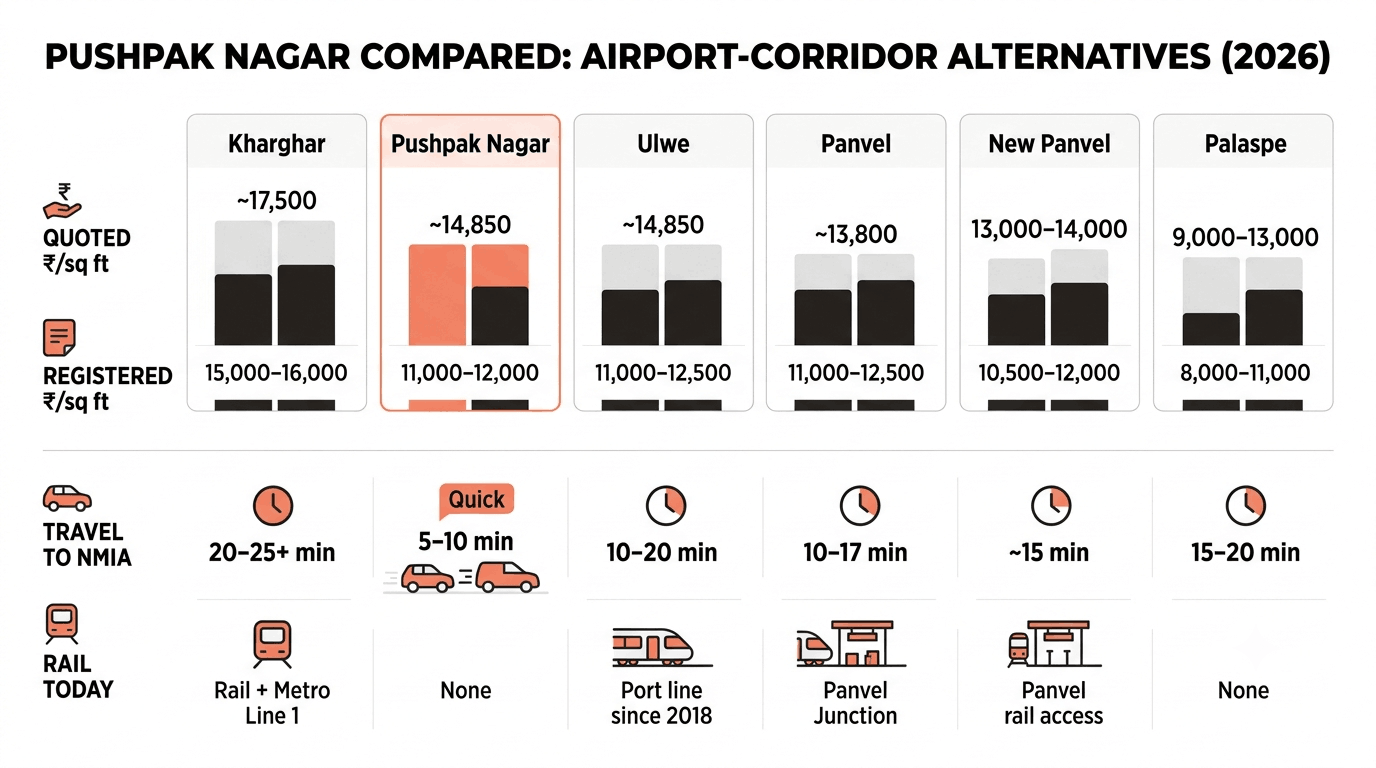
This is the table that decides the purchase. Look at Pushpak Nagar and Ulwe side by side: identical quoted rates, near-identical registered rates, and Ulwe throws in a railway line that has been running since 2018. Pushpak Nagar's compensation for having no rail is five to ten minutes less to the terminal.
Whether that trade is worth it depends entirely on whether your life revolves around the airport or around everything else.
On appreciation, an earlier 2026 assessment put Pushpak Nagar's five-year run at around +35.8% - the strongest in the Panvel belt, against Panvel's +32.7% and Ulwe's +26.1%. That is a real track record and the node's best argument. It is also, note, a pre-opening number: it captured the run-up to the airport. Whether a second such run exists post-opening is precisely the question the 25% gap is arguing about.
Connectivity to Pushpak Nagar
Which raises the obvious tension. How can the node closest to a major international airport have a connectivity problem?
Easily, as it turns out - because an airport is a destination, not a transport network.
By air, the position is unmatched. Five to ten minutes to a terminal running 78 daily departures, 46 domestic destinations and a growing international schedule, rated for 20 million passengers in Phase 1 and planned to reach 90 million across four terminals at full build-out. If you fly weekly, nowhere in the Mumbai region beats this.
By rail, there is nothing. No station in the node. Panvel Junction - Central line, Harbour line and outstation services - is 6.9 km away, and Ulwe's Port line stations are 6.6 km. Both are an auto or bus leg before you reach a platform, and that leg is the daily friction residents complain about.
By metro, also nothing, and this deserves saying plainly because listings blur it. The NAINA metro corridor is proposed for roughly 2028–2030 and does not exist. Mumbai Metro Line 8 was approved on 24 February 2026 at ₹22,862 crore for 34.9 km between CSMIA and NMIA, with construction slated from June 2026 and completion targeted May 2031 - it terminates at the airport, which is useful, but it is a 2031 asset at the earliest. Navi Mumbai Metro Line 1's approved extensions run to Khandeshwar and the airport with no announced construction timeline. Treat any promise of metro connectivity at Pushpak Nagar today as unsupported.
By road, it is good and improving. CIDCO's 30 to 60 metre sector roads are genuinely well built. CBD Belapur is 12.9 km, and the Ulwe Coastal Road - 6.7 km including a dedicated 0.903 km airport link, reported at 60–65% complete during 2026 - will materially improve access from the Belapur and Nerul side when it opens. Atal Setu puts South Mumbai within roughly 30 to 40 minutes once that link is in place.
The honest caveat, raised in independent 2026 assessments, is single-road dependency: a young node with limited route redundancy sitting beside an airport scaling towards 20 million passengers a year is a congestion risk, not a theoretical one.
Social Infrastructure
This is where Pushpak Nagar's #629-of-744 livability rank comes from, and there is no kind way to present it.
Schools inside and near the node run to New English School and SGT International School - adequate for primary and middle years, with the serious catchment in Panvel, Kharghar or New Panvel. Healthcare is at clinic scale: Aayu Care Hospital and local dental and general practices, with anything tertiary meaning a drive to Panvel, Kamothe's MGM or Kharghar. Residents rate education and healthcare 3.4 out of 5.
Retail is Excellenza Shopping Plaza and a Reliance Mart - functional, not a destination. There is no mall in the node.
The recurring resident complaints, in order: limited public transport, developing infrastructure, and fewer rental options than the listing volume suggests. Independent 2026 assessments add that CIDCO water supply is planned rather than fully delivered in parts of the node, and that schools and hospitals are "arriving" - which is accurate and also the kind of sentence that has described young Navi Mumbai nodes for a decade.
Set against that: lifestyle and livability both score 3.3 out of 5, while connectivity scores 4.0 - residents rate the roads well and everything else modestly. That pattern is the node in miniature. Excellent bones. Not much life yet.
Employment & Commercial Hubs
The answer is the airport, and here the thesis is stronger than in any other node in this series - including Kharkopar.
A terminal at 20 million passengers a year in Phase 1, scaling towards 90 million by full build-out, generates an enormous and permanently shift-based workforce: ground handling, cargo and logistics, security, immigration and customs, retail and F&B concessions, airline and MRO staff, hotels, and the transport and services layer around all of it. Pushpak Nagar is the nearest planned residential node to that payroll.
Beyond the airport, the wider catchment includes the JNPA port and logistics belt to the south, the industrial estates along the Panvel and Taloja corridors, and the commercial establishment around Panvel city. There is no office park inside Pushpak Nagar and no immediate prospect of one - the nearest white-collar commercial centres are CBD Belapur, 12.9 km away, and the Nerul–Seawoods corridor beyond it.
Worth stating clearly: no credible published headcount exists for the airport's direct and indirect employment as of September 2026. The logic is sound, the scale is visible, and the specific number is not available. Anyone quoting you a precise jobs figure is estimating.
Investment Potential in Pushpak Nagar
So which side of the 25% gap is right? On the evidence, both - at different time horizons.
The bull case is the best in the corridor on paper. The closest residential node to an operating international airport that is scaling from 20 million towards 90 million passengers. A five-year appreciation record near +35.8%, the strongest in the Panvel belt. CIDCO-engineered roads and drainage. The Ulwe Coastal Road advancing at 60–65%. Metro Line 8 approved and funded, terminating at the airport. And registered prices of ₹11,000–12,000 that are level with Ulwe and well below Kharghar.
The bear case is the lived reality. No railway station and no metro, with the nearest platform 6.6 to 6.9 km away and nothing funded to change that before 2031. A livability rank of #629 of 744 and an education-and-healthcare score of 3.4. Water supply partly planned rather than delivered. Independent descriptions of the node as over-supplied. Single-road dependency beside a rapidly scaling airport. And crucially, that +35.8% five-year run was earned before the airport opened - the anticipation trade has already been paid out.
So the defensible position is this. The 25% gap is the opportunity, not the appreciation. Buy at or near registered values and you own the best-located node in the corridor at Ulwe's price; buy at asking and you have pre-paid several years of growth. Underwrite capital growth at corridor-level rates of roughly 6–9% a year rather than extrapolating 35.8%. Prefer larger configurations, since 1 BHK is 45% of demand and the bulk of the supply. And if you need rail, buy Ulwe instead and accept ten more minutes to the terminal.
What works. The closest residential node to Navi Mumbai International Airport, at 5 to 10 minutes' travel, with the terminal running 78 daily departures and scaling towards 20 million passengers in Phase 1. The strongest five-year appreciation in the Panvel belt at around +35.8%. CIDCO-planned layout with 30 to 60 metre roads, landscaped medians and engineered drainage. Registered prices of ₹11,000–12,000 per sq ft, level with Ulwe and well below Kharghar. Gross yield near 3.9%. Connectivity rated 4.0 out of 5 by residents. And a 25% negotiating gap for any buyer who does their homework.
What doesn't. No railway station and no metro; Panvel is 6.9 km and Ulwe 6.6 km away, and nothing funded changes that before 2031 at the earliest. Livability ranked #629 of 744, with education and healthcare at 3.4 out of 5. Limited public transport is residents' top complaint. CIDCO water supply partly planned rather than delivered. The node is independently described as over-supplied. Single-road dependency alongside a fast-scaling airport. And the +35.8% five-year run was earned before the airport opened, not after.
Who Should Buy Here
Buy here if you work at the airport or in its ecosystem, where five to ten minutes' travel is worth more than any amenity list. Buy if you fly very frequently and value that above a daily rail commute. Buy if you are an investor prepared to do registry work, negotiate hard against a 25% spread, and hold a larger configuration for the long airport build-out. And buy if you want CIDCO-grade roads and drainage at a price that does not yet reflect them.
Look elsewhere if you commute daily to Mumbai - Ulwe costs the same in registered terms and has had a railway line since 2018, and Panvel has a full junction. Look elsewhere if you need schools and hospitals now, where Kharghar and Panvel are simply better-built places. Look elsewhere if you want the pre-opening appreciation story, because it has already happened. And if you want a node where a state agency is actively pouring in thousands of funded homes and amenities, Kharkopar is the more visible transformation.




 +91
+91