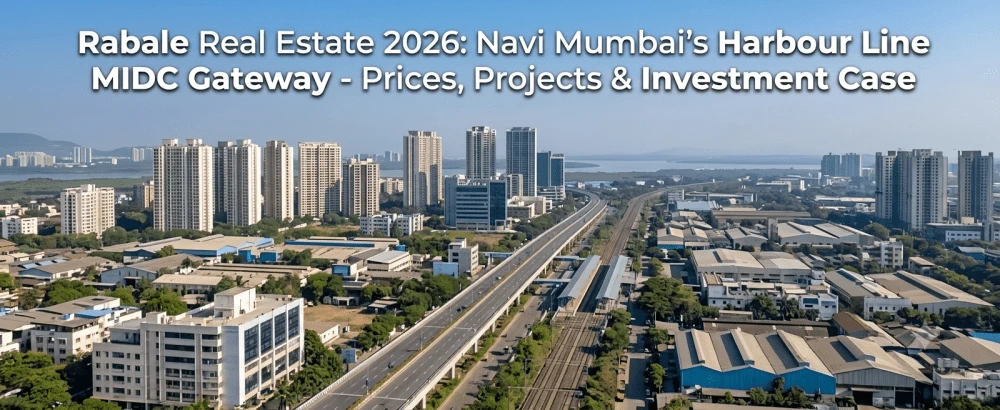
Rabale Real Estate 2026: Navi Mumbai's Harbour Line MIDC Gateway - Prices, Projects & Investment Case

Introduction
Rabale is one of Navi Mumbai's most functionally defined suburbs: a Harbour Line station, a major MIDC zone (Rabale MIDC - the northernmost node of the TTC MIDC industrial belt), and a residential catchment that serves both Airoli's IT-corporate population to the north and the broader Thane-Belapur Road employment corridor to the south.
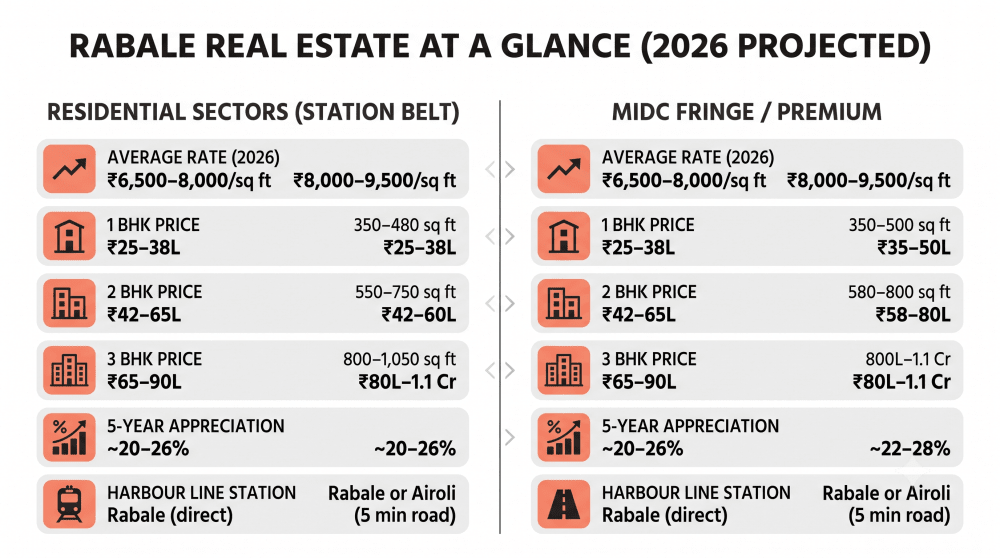
Unlike Turbhe - its neighbour to the south - Rabale's MIDC has gradually evolved from heavy manufacturing toward lighter engineering, electronics, and service industries, making it a cleaner residential proposition for mid-income buyers. Flat prices range from ₹6,500–9,500/sq ft, with 1 BHK configurations available from ₹40–55L and 2 BHKs from ₹65–90L.
Rabale's investment story in 2026 centres on three factors: its position at the junction of the Harbour Line and the Thane-Belapur Road, its proximity to Airoli's expanding corporate employment belt, and its structural land scarcity - most of Rabale's residential grid is built-out, meaning new supply is limited to redevelopment rather than greenfield launches. For buyers targeting affordable Navi Mumbai with Airoli/MIDC access and Harbour Line connectivity, Rabale is an underpriced micro-market.
Rabale at a Glance (2026)
Why Rabale in 2026
Rabale MIDC - Light Industry and Electronics Hub
Rabale MIDC is part of the Trans-Thane Creek (TTC) MIDC belt but has a distinct industrial character from the heavier TTC zones further south. Rabale's MIDC has attracted electronics assembly, precision engineering, pharmaceuticals packaging, and service industry operations over the past two decades - creating a skilled-worker employment base that generates steady demand for affordable residential supply in the 500m–2 km catchment.
The Rabale MIDC's relatively lighter industrial profile (fewer heavy-chemical or high-emission units compared to Turbhe MIDC) makes the residential zones adjacent to the MIDC genuinely liveable, rather than buffer zones between industrial and residential. This is a meaningful distinction for end-user buyers.
Harbour Line - Rabale Station
Rabale station on the Harbour Line connects residents directly to:
- Airoli: 3 min (adjacent corporate IT belt)
- Vashi: 15 min (Navi Mumbai's commercial hub, retail, F&B)
- Ghansoli: 5 min southward (mid-market residential node)
- Belapur CBD: 30 min (Navi Mumbai CBD, government offices)
- CST (Mumbai): 55–60 min
- Panvel: 35 min (Pune expressway access)
The Rabale–Airoli corridor on the Harbour Line is particularly important: Airoli hosts one of Navi Mumbai's fastest-growing IT and corporate employment clusters (Mindspace Airoli, National Insurance Academy, multiple IT parks), and Rabale station at 3 min from Airoli gives Rabale residents near-immediate access to that employment zone by train.
Airoli Corporate Belt - 3 Minutes Away
Mindspace Airoli Business Park - one of Mumbai's major IT and corporate campuses hosting Accenture, EXL Service, and multiple BPO/IT firms - is directly accessible from Rabale via the Harbour Line (one stop) or the Thane-Belapur Road (10 min by road). Rabale residents with Airoli employment essentially live one station away from work, which translates directly into rental demand from IT and BPO professionals who cannot afford or choose not to live in Airoli itself (where prices are 20–30% higher).
Thane-Belapur Road Access
The TB Road passes through Rabale, giving road connectivity northward to Airoli and Thane, and southward through Mahape, Turbhe, Ghansoli, Vashi, and Belapur. All of Navi Mumbai's major employment nodes along this axis are accessible by road from Rabale within 15–35 min, depending on traffic and destination. For buyers who prefer road commuting over rail, Rabale's TB Road access replicates almost all of the Harbour Line's employment reach.
Limited New Supply - Built-Out Residential Grid
Most of Rabale's residential sectors are largely built out on the original CIDCO residential grid. New supply is emerging only through redevelopment of older buildings and the occasional plot near the MIDC fringe. This supply constraint - while making Rabale less exciting for developers - is structurally positive for existing owners and buyers entering now: there is limited risk of a large new supply wave compressing prices.
Micro-Zones in Rabale
- Station Residential Belt: The residential cluster within walking distance of Rabale station - older CIDCO-era buildings from the 1990s and some 2000s-vintage mid-rise societies. ₹6,500–8,000/sq ft. Best affordability entry in Rabale. Harbour Line walking access. 5Y appreciation ~20–26%.
- MIDC Fringe (East of TB Road): The residential pockets adjacent to the eastern side of the TB Road and near the MIDC boundary. ₹8,000–9,500/sq ft for newer construction. Higher quality stock, modern amenities. 5Y appreciation ~22–28%.
- Airoli-Adjacent North Belt: The northern residential edge of Rabale bordering Airoli's residential zone. Commands a slight premium due to Airoli adjacency and corporate access. ₹7,500–9,000/sq ft. Strong rental demand from Airoli IT park workers priced out of Airoli proper.
Active Projects in Rabale on Blox (2026)
Verify current Blox listings and prices at blox.xyz before booking.
Price Appreciation: Rabale vs Navi Mumbai Peers
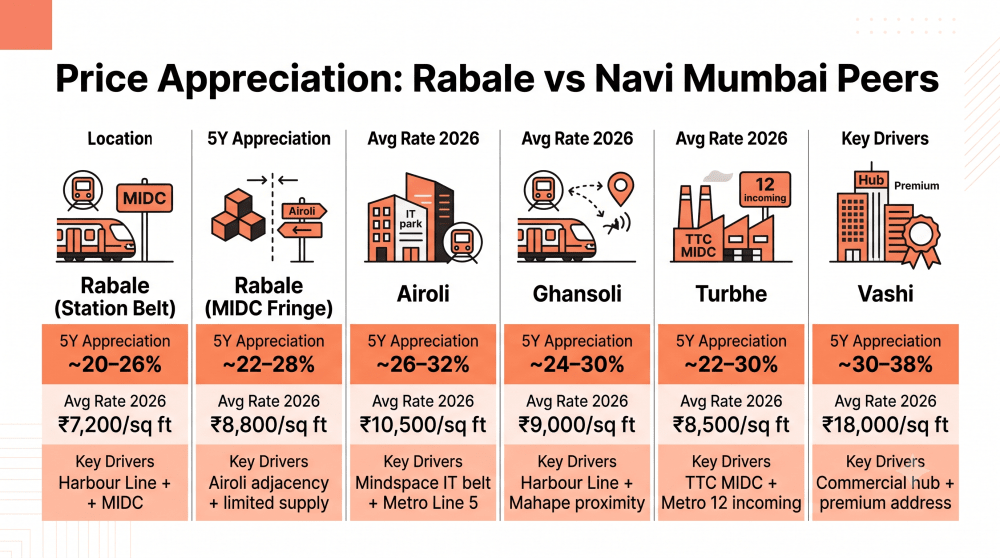
Rabale's appreciation trajectory is the most moderate in its peer group - reflecting its built-out supply dynamics (limited new launches), relatively stable MIDC rather than high-growth IT employment, and lack of a near-term metro catalyst (unlike Turbhe's Metro Line 12). The trade-off: Rabale is among Navi Mumbai's most affordable Harbour Line addresses per sq ft, and the supply ceiling provides a floor on downside.
Rental Yields in Rabale
- 1 BHK (₹40L, Station Belt): Rent ₹11,000–15,000/month → Yield: ~3.3–4.5%
- 2 BHK (₹65L, MIDC Fringe): Rent ₹16,000–22,000/month → Yield: ~3.0–4.1%
- 3 BHK (₹90L): Rent ₹22,000–32,000/month → Yield: ~2.9–4.3%
Rabale's rental yields (3.0–4.5%) are among the strongest in connected Navi Mumbai, driven by MIDC worker and Airoli IT professional demand. Low vacancy periods - typically under 3 weeks between tenancies - reflect the consistent employment demand in the catchment. For investors targeting income over growth, Rabale's yield profile is Navi Mumbai's most compelling under ₹1 Cr.
Social Infrastructure
- Retail: Vashi's commercial district (15 min Harbour Line) - malls, supermarkets, F&B. Airoli's growing retail strip (5 min by rail/road). Local market on TB Road, Rabale.
- Healthcare: Fortis Hospital (Mulund, 20 min via Thane-Belapur Road). MGM Hospital (Vashi, 18 min). Airoli's clinic belt - multiple multi-specialty clinics within 10 min.
- Education: St. Xavier's High School (Airoli, 10 min). Ryan International School (Sanpada, 20 min). CIDCO-belt schools within Rabale's residential sectors.
- Recreation: Parsik Hill (Airoli, 5 min) - natural viewpoint and trekking spot popular with Harbour Line corridor residents. Rabale sector gardens. Vashi's entertainment and dining zone (15 min by train).
MahaRERA Buyer Checklist for Rabale
- CIDCO Lease Verification - Rabale's residential plots are largely on CIDCO-allocated land. Confirm whether the plot is freehold or leasehold, and verify the remaining lease period and renewal terms via the RERA title report.
- MIDC Proximity Disclosure - For projects within 200m of the Rabale MIDC boundary, confirm the developer has disclosed MIDC adjacency impacts (noise, traffic, environmental) in the RERA filing.
- Building Age and Structural Audit - For older CIDCO-era societies (pre-2000 construction) in the station belt, request a structural audit report before purchase - several older Rabale buildings are approaching the threshold where redevelopment timelines become relevant to resale and renovation decisions.
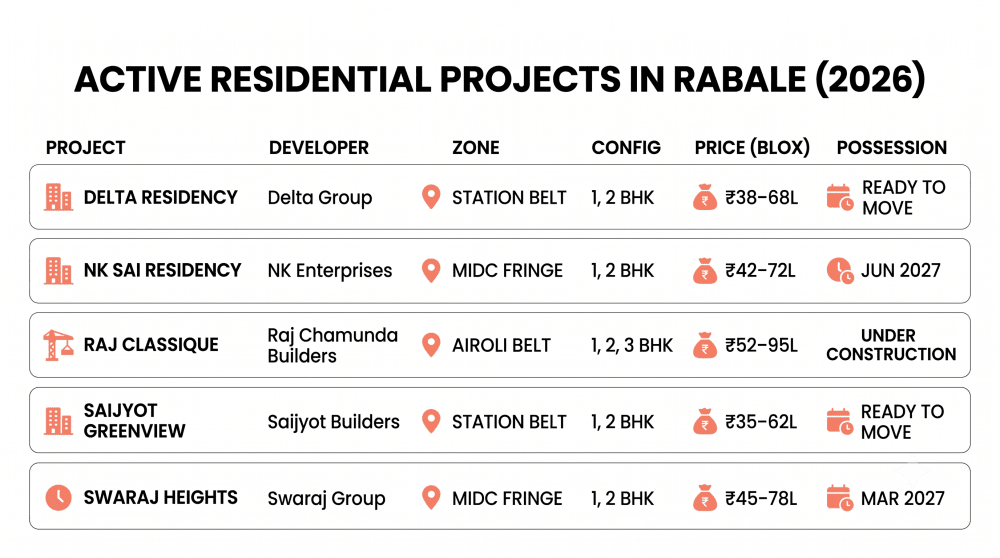
- RERA QPRs for Under-Construction - For NK Sai Residency (Jun 2027), Raj Classique (under construction), and Swaraj Heights (Mar 2027), verify last 4 QPRs showing on-pace construction.
- OC for Ready Units - For Delta Residency and Saijyot Greenview (RTM), confirm Occupancy Certificate, society formation, and maintenance handover are fully complete.
Is Rabale Right for You?
- Buy if: Budget ₹35–90L; you work in Airoli (Mindspace, IT parks), the Rabale/Turbhe MIDC, or any Harbour Line corridor employer; you want the lowest per-sq-ft entry into Navi Mumbai's Airoli employment catchment; or you're an investor targeting 3–4.5% rental yields on affordable sub-₹65L configurations.
- Wait if: You're primarily motivated by capital appreciation - Rabale's moderate 5Y growth trajectory (20–28%) lags peers with stronger infrastructure catalysts (Ulwe, Kharghar, Turbhe for Metro 12). If growth > yield is your priority, the same ₹60–80L budget in Turbhe captures Metro Line 12 upside, or in Panvel captures NMIA upside.
- Rabale is best for: End-users employed within 15 min of Rabale on the Harbour Line; investors who want the highest stable yield in connected Navi Mumbai under ₹65L; and buyers who want Navi Mumbai's MIDC belt lifestyle at the lowest possible per-sq-ft entry.
Final Word
Rabale in 2026 is Navi Mumbai's most affordable Harbour Line address with direct access to the Airoli IT corridor. Its built-out supply base creates a price floor, MIDC employment anchors rental demand, and the Airoli corporate belt's growth is steadily pulling Rabale's northern end upward in both price and tenant quality.
It won't make the fastest appreciation headlines - that distinction belongs to NMIA-adjacent Panvel and Metro-catalyst Turbhe. But for ₹40–90L buyers and investors who want consistent yield, established infrastructure, and a low-risk Navi Mumbai entry, Rabale's fundamentals are better than its press suggests.
Blox is India's largest tech-enabled homebuying platform. Explore verified flat listings in Rabale on Blox.
Frequently Asked Questions
What is the average flat price in Rabale in 2026?

How is Rabale connected to Mumbai and Navi Mumbai?
Is Rabale a good investment in 2026?
What's the difference between Rabale and Airoli?
What rental yields can I expect in Rabale?
What are the top projects in Rabale on Blox?
What MahaRERA checks are specific to Rabale?

Get in Touch
Let our experts help you answer your questions

 +91
+91


Get in Touch
Let our experts help you answer your questions
+91