Most Pune localities in 2026 tell buyers the same story: prices are up, get in before they rise further. Wagholi tells a different one. Flat rates here slipped about 2.4% over the past twelve months, settling near ₹6,550 per sq ft after a 37.9% run across five years. On paper that looks like a market losing steam. In practice it is more interesting - a consolidation phase arriving exactly as the locality's biggest infrastructure upgrade breaks ground.
In January 2026, MahaMetro opened bids on the Ramwadi-Wagholi extension: 11.63 km of elevated corridor, eleven stations, built as a double-decker with a six-lane MSIDC elevated road beneath the Metro viaduct along Ahilyanagar Road. Work began in Q1 2026 against a three-and-a-half-year target. Wagholi also joined Pune Municipal Corporation in the 30 June 2021 merger of 23 villages, shifting it from gram panchayat governance into India's geographically largest municipal corporation.
So the setup is unusual. Wagholi real estate offers the highest rental yields in east Pune at 6–8%, entry prices roughly 40% below neighbouring Kharadi, a metro line under active construction rather than merely announced, and a soft twelve-month print that has thinned out speculative competition. The trade-off is real: civic infrastructure is still catching up, and the metro is three to four years from carrying passengers.
This guide covers Wagholi real estate pocket by pocket - prices, appreciation, connectivity, social infrastructure, employment access, RERA-registered projects, and who this locality genuinely suits.
Why Buy Property in Wagholi
The first reason is arithmetic. Kharadi - the IT hub Wagholi feeds - trades around ₹10,700 to ₹13,067 per sq ft. Wagholi sits six kilometres away at roughly half that. For a buyer whose office is at EON IT Park or the World Trade Center, that gap buys a substantially larger home or a much smaller loan for the same commute. Wagholi real estate has always been priced as Kharadi's overflow, and the discount remains wide.
The second is yield. At 6-8% gross, Wagholi delivers the strongest rental economics in east Pune, well clear of Kharadi's ~4.2% and Hinjewadi's ~5.5%. Rents run roughly ₹10,000 to ₹30,000 a month against acquisition costs starting below ₹55 lakh. Tenant demand arrives from three directions at once - Kharadi and Viman Nagar IT, the Ranjangaon and Shikrapur industrial belt, and students at the engineering colleges inside Wagholi itself.
The third is the metro, specifically its stage of completion. Announced corridors are cheap talk; tendered corridors with contractors mobilised are not. Stations are planned at Wagheshwar Temple, Wagholi, Siddharth Nagar and Bakori Phata - inside the locality, not at its edge. Pune has historically repriced land near confirmed stations by 12-18%, and almost none of that shows in current rates.
Fourth, the PMC merger changed the governance baseline. Approvals, property tax, water supply and drainage now sit with Pune Municipal Corporation rather than a gram panchayat. Service delivery has lagged the paperwork - the honest caveat - but the institutional trajectory is upward.
Location Snapshot
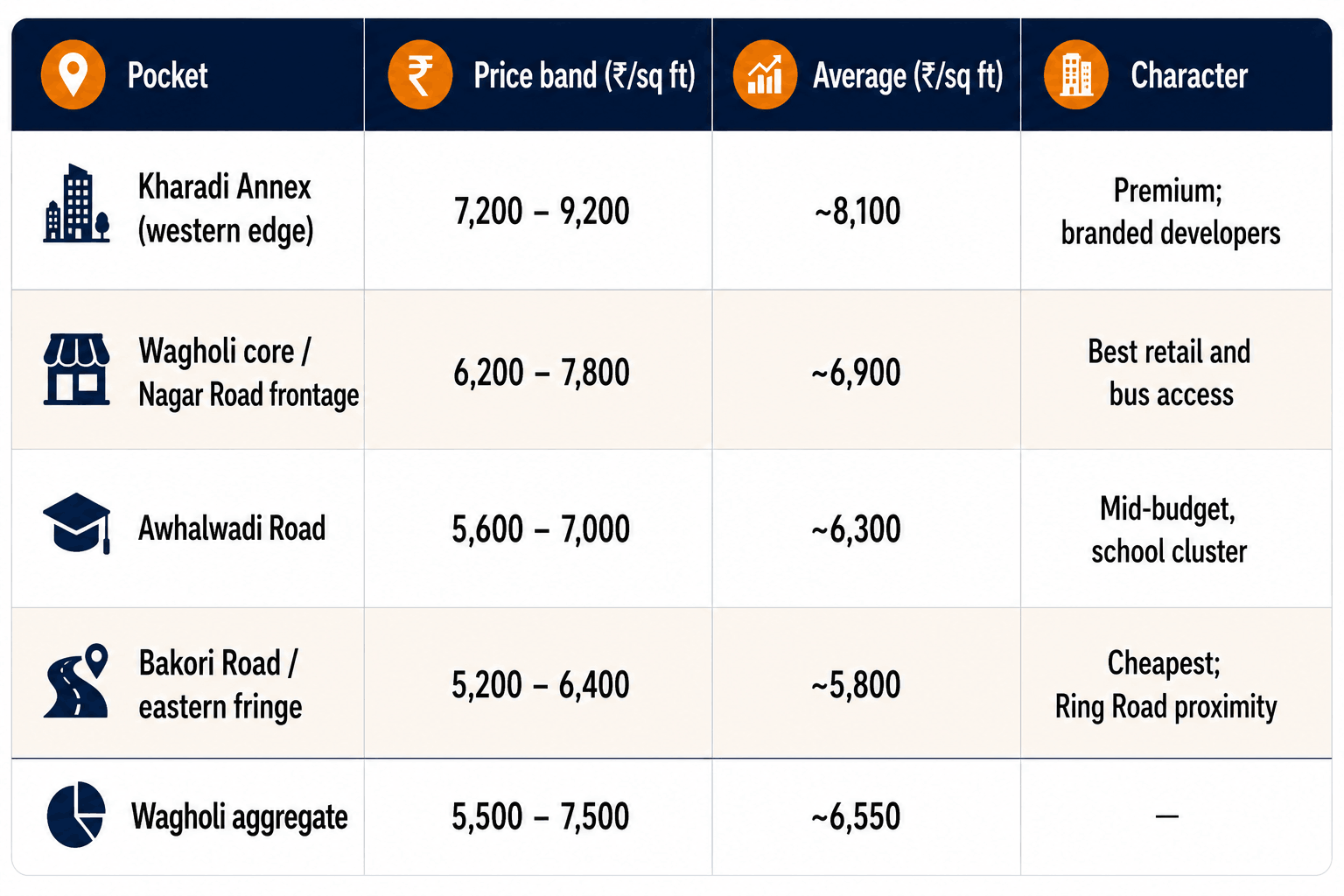
Wagholi sits in east Pune along the Pune–Ahilyanagar (Nagar) Road, PIN 412207, and has been part of Pune Municipal Corporation since 30 June 2021. It splits into five pockets: Kharadi Annex on the western edge, where branded developers cluster; the Wagholi core and Nagar Road frontage, with the best retail and bus access; Awhalwadi Road, home to the school belt; the Bakori Road eastern fringe, cheapest and nearest the Ring Road alignment; and the Lohegaon-facing side toward the airport.
The distances that matter are short. Kharadi and EON IT Park are about 6 km away, Viman Nagar 9 km, Pune Junction 18 km - and Pune International Airport just 11 to 12 km. That airport figure is the quiet advantage in Wagholi real estate: comparable affordable localities in west Pune, Hinjewadi included, sit closer to 30 km from the terminal. Supply skews heavily to 2 BHK and 3 BHK apartments, and the buyer base is dominated by first-time purchasers, rental investors, and the IT and industrial workforce.
Wagholi Property Price Insights 2026
One caveat on data. Some portals publish an average transaction rate above ₹9,000 per sq ft. That figure is skewed by Kharadi Annex launches from Mahindra and Kolte-Patil - Wagholi by postcode, Kharadi by pricing. For mainstream stock, budget from the ₹5,500-₹7,500 band.
Construction status moves the number as much as location does. Ready-to-move flats with an occupancy certificate command ₹6,800–₹8,200 per sq ft, a 9-15% premium buying immediate rental income and no GST. Stock nearing possession within a year sits at ₹6,300-₹7,400 -usually the best risk-adjusted entry. Under-construction inventory runs ₹5,600-₹7,000, and new launches four or more years out go for ₹5,200-₹6,500, a discount carrying real delivery risk.
Appreciation, honestly. Wagholi flat rates fell 2.4% over the last year, rose 16.5% over three years, 37.9% over five and 33.3% over ten. That negative print deserves explanation rather than spin: the locality absorbed enormous supply between 2021 and 2025, and prices paused while inventory clears. Note that the ten-year figure sits below the five-year one - Wagholi was flat or negative in its earlier years too. This is a cyclical market, not a straight line, and the bull case rests on the metro rather than momentum. Analysts project 8–12% annually over three to five years.
What that means in rupees. A 750 sq ft carpet 2 BHK at ₹6,550 per sq ft costs ₹49.1 lakh, or roughly ₹53 lakh all-in with stamp duty and registration. At the 9% mid-point of the forecast that becomes about ₹75.6 lakh by 2031 - a ₹26.5 lakh capital gain - plus roughly ₹14.6 lakh of cumulative rent at ₹22,000 a month with 5% escalation, for an indicative total return near ₹41 lakh. The striking number is the entry cost: ₹53 lakh all-in for a two-bedroom home twelve kilometres from Pune airport.
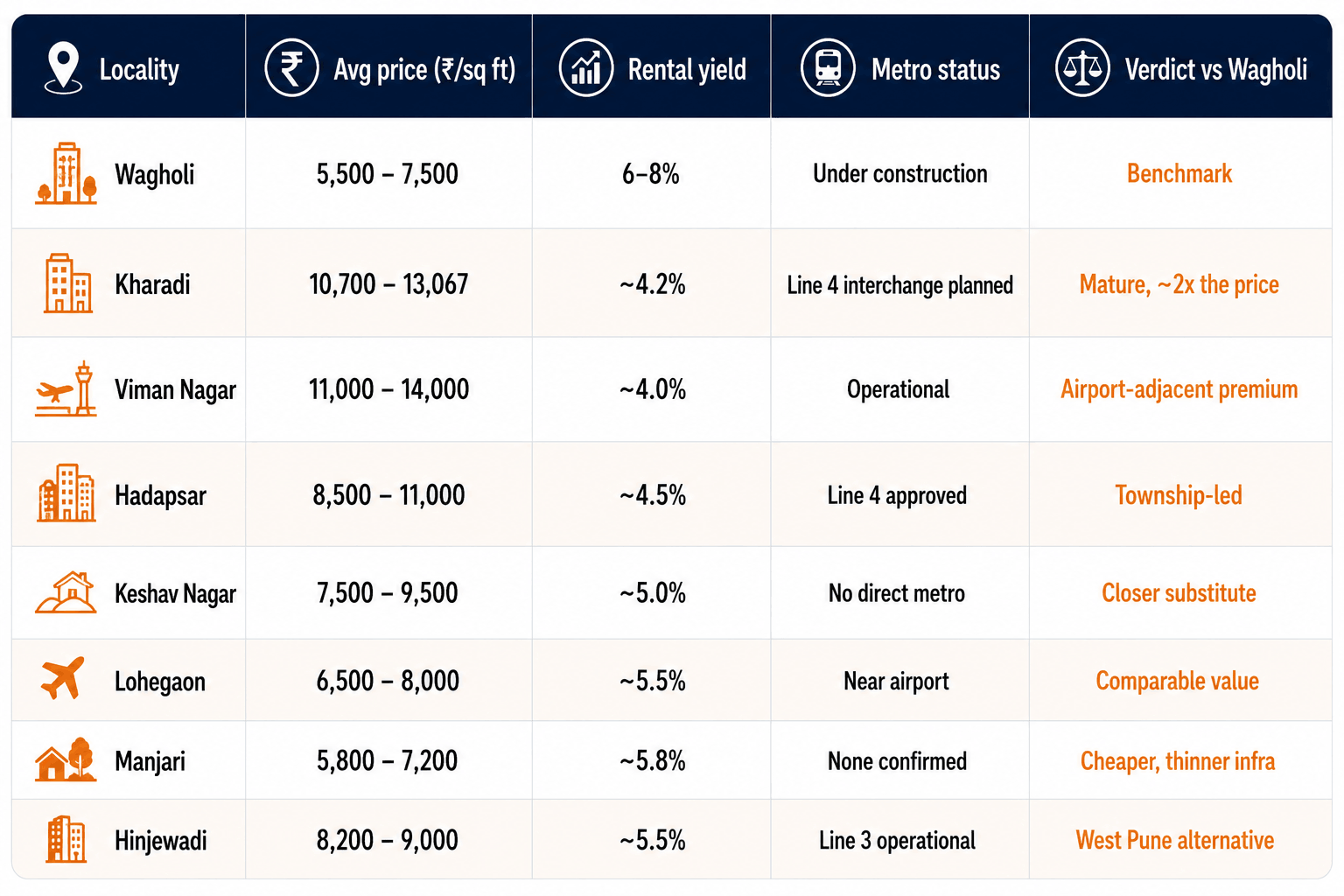
This table is the investment case in one frame. Wagholi is the only locality here combining sub-₹7,500 pricing, 6–8% yield and a metro corridor under construction. Kharadi buyers pay roughly double per sq ft for half the yield - justified by mature infrastructure today, not by growth headroom.
Connectivity
Metro. The Ramwadi–Wagholi extension forms part of Pune Metro Phase II, cabinet-approved at roughly ₹9,800 crore. It runs 11.63 km fully elevated along Ahilyanagar Road with eleven stations - Viman Nagar, Somnath Nagar, Kharadi Bypass, Tuljabhavani Nagar, Ubalenagar, Upper Kharadi Road, Wagheshwar Temple, Wagholi, Siddharth Nagar and Bakori Phata among them - extending the Aqua Line east from Ramwadi. Work began in Q1 2026 in stretches of 4.8 km and 6.8 km against a three-and-a-half-year target. Separately, the approved Line 4 from Kharadi to Khadakwasla will interchange at Kharadi Bypass, giving Wagholi a second network connection.
Road. Pune-Ahilyanagar Road is the spine, carrying traffic toward Kharadi Bypass and the city, and eastward to Shikrapur and Ranjangaon. The six-lane MSIDC elevated road beneath the Metro viaduct is the largest road upgrade Wagholi has received. Bakori Phata connects to the eastern arc of the 128-km Pune Ring Road, due around May 2028.
Rail and air. Pune Junction is roughly 18 km away, with Ghorpadi and Hadapsar halts closer for regional services. Pune International Airport is 11-12 km, typically 25 to 40 minutes - among the best airport access of any affordable Pune locality.
Best Residential Projects in Wagholi (RERA-Registered)
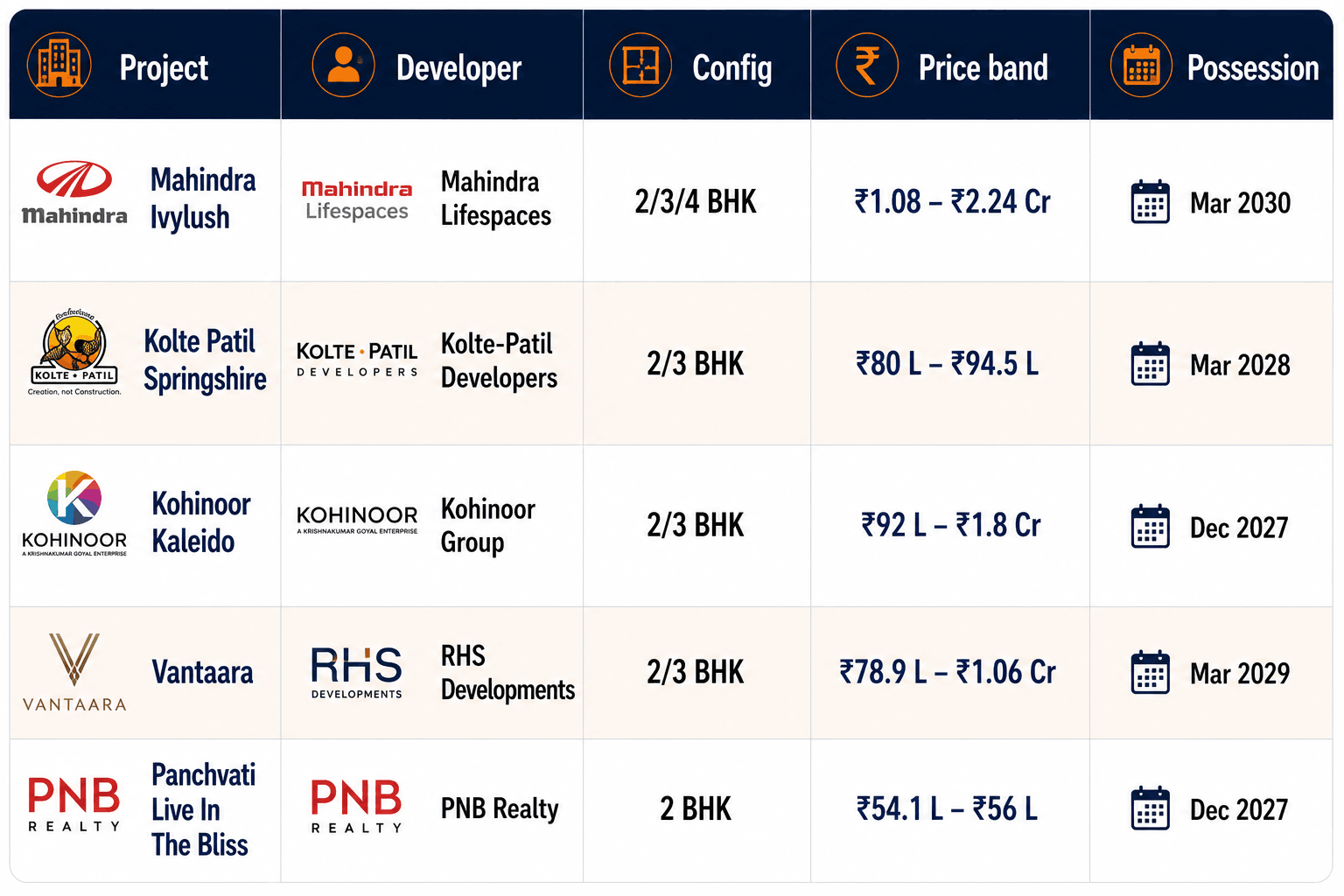
All five are MahaRERA-registered and listed on Blox.xyz with developer-sourced inventory. The spread is instructive: Panchvati at ₹54 lakh and Mahindra Ivylush at ₹2.24 crore are both "Wagholi," but they are different markets - mainstream Wagholi real estate versus Kharadi Annex. Verify each tower's RERA number and the sanctioning authority, since PMC-approved and older gram-panchayat-era layouts coexist here.
Investment Potential
Wagholi real estate is a timing play, and 2026 is an unusually legible entry point. The negative twelve-month print cooled sentiment and cleared out short-term speculators while the metro moved from announcement to active construction. Buying into softness ahead of confirmed infrastructure is the oldest edge in property, and rarely this well documented.
Three catalysts are datable. The Ramwadi-Wagholi corridor targets completion three and a half years from contract award, placing commissioning around 2029–30 alongside the elevated road beneath it. The Ring Road's eastern section is expected around May 2028, opening Bakori Phata toward Chakan and Ranjangaon. And Kharadi's commercial absorption keeps pushing demand eastward - Wagholi is the first affordable stop.
The risks are equally concrete. Pune metro timelines have slipped repeatedly, and a 2029 target could become 2031. Supply remains heavy after four years of launches - the cause of the price pause. Civic infrastructure lags construction, and PMC's record in the merged villages has been mixed. The eastern fringe is genuinely peripheral; buyers there are underwriting a 2030 neighbourhood.
Forecasts of 8-12% annual appreciation look reasonable rather than promotional given the price base and pipeline. Paired with 6-8% yields, Wagholi real estate offers one of the better risk-adjusted return profiles in Pune - for buyers who can wait.
Who Should Buy in Wagholi
Rental investors have the strongest case, and should favour resale over new launches. Older two-bedroom stock bought below ₹40 lakh can yield close to 7% gross, materially better than a ₹95 lakh launch. Prioritise anything within a kilometre of a planned Metro station.
First-time buyers priced out of Kharadi and Viman Nagar will find Wagholi the nearest place a two-bedroom home stays under ₹55 lakh. Choose Wagholi core or Awhalwadi Road over the eastern fringe.
Kharadi and Viman Nagar IT professionals get a 15–25 minute commute at half the price per sq ft, and the Metro will eventually make it predictable rather than traffic-dependent.
NRIs should weigh airport proximity heavily; 11 km beats almost anything comparable in Pune. Stick to institutional developers, verify MahaRERA progress reports online, and appoint a Power of Attorney holder.
Who should look elsewhere: anyone needing mature civic infrastructure from day one, buyers with a two-to-three-year exit horizon, and those wanting premium retail and tertiary hospitals within walking distance.
Final Verdict
Wagholi real estate in 2026 presents something the rest of Pune mostly does not: a soft price print sitting directly on top of hard, funded, under-construction infrastructure. Rates dipped 2.4% while MahaMetro mobilised contractors on an 11.63-km corridor with four stations inside the locality, and MSIDC began a six-lane elevated road beneath the same viaduct. Yields of 6-8% are the best in east Pune, and entry stays under ₹55 lakh for a 2 BHK eleven kilometres from the airport.
What it asks in return is patience. The metro will not carry passengers before roughly 2029, more plausibly 2030. Roads, water and drainage still trail the construction already built. Nagar Road will be a worksite for years. And a decade of data shows this is a cyclical market that has stalled before.
That makes Wagholi a poor fit for anyone needing a finished neighbourhood or a two-year exit - and a strong fit for rental investors who want cash flow while they wait, first-time buyers who refuse to overpay for Kharadi's postcode, and Kharadi-employed professionals who would rather own here than rent nearby.




 +91
+91