1BHK vs 2BHK vs 3BHK: Which Flat Configuration Gives the Best Investment Returns in Mumbai 2026?

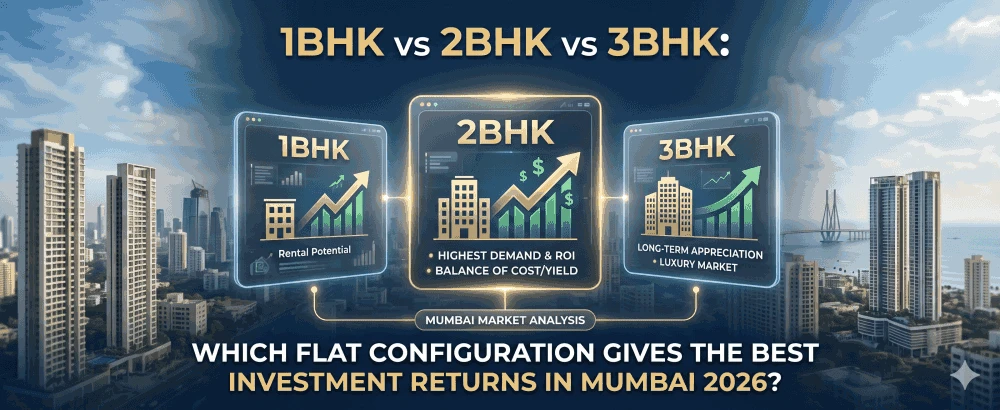
If you are planning to invest in a residential flat in Mumbai, the first major decision you face is configuration. Should you buy a compact 1BHK, the universally popular 2BHK, or a spacious 3BHK that appeals to families and HNI buyers? The answer is not one-size-fits-all — it depends on your investment horizon, budget, risk appetite, and the locality you are targeting.
Mumbai's residential market is showing exceptional strength in 2026. Property registrations in March 2026 hit 15,516 units - the highest in 14 years - while the average price per square foot crossed ₹38,600 in the same month. Against this backdrop of robust demand, choosing the right flat configuration can meaningfully amplify your returns. This guide breaks down the investment case for each configuration with real numbers, so you can make a data-backed decision.
Understanding the Mumbai Flat Investment Framework
Before comparing configurations, it is important to understand how residential flat investment works in Mumbai. Returns come from two sources: capital appreciation (the increase in the flat's resale value over time) and rental yield (rental income as a percentage of the purchase price).
In Mumbai, capital appreciation is typically the primary driver of long-term wealth. The city's 10-year average appreciation rate runs at 7-10% per annum, with pockets like Thane delivering as much as 46% appreciation over just three years (2022-2025). Rental yields, by contrast, are comparatively modest - typically ranging from 2% to 3.5% - making Mumbai a capital appreciation market rather than a yield play.
The configuration of the flat - 1BHK, 2BHK, or 3BHK - significantly influences both of these metrics, as well as a third factor that investors often overlook: liquidity, or how quickly you can sell the flat if you need to exit your position.
1BHK Flats: The Entry-Level Investment Case
Who Buys 1BHKs in Mumbai?
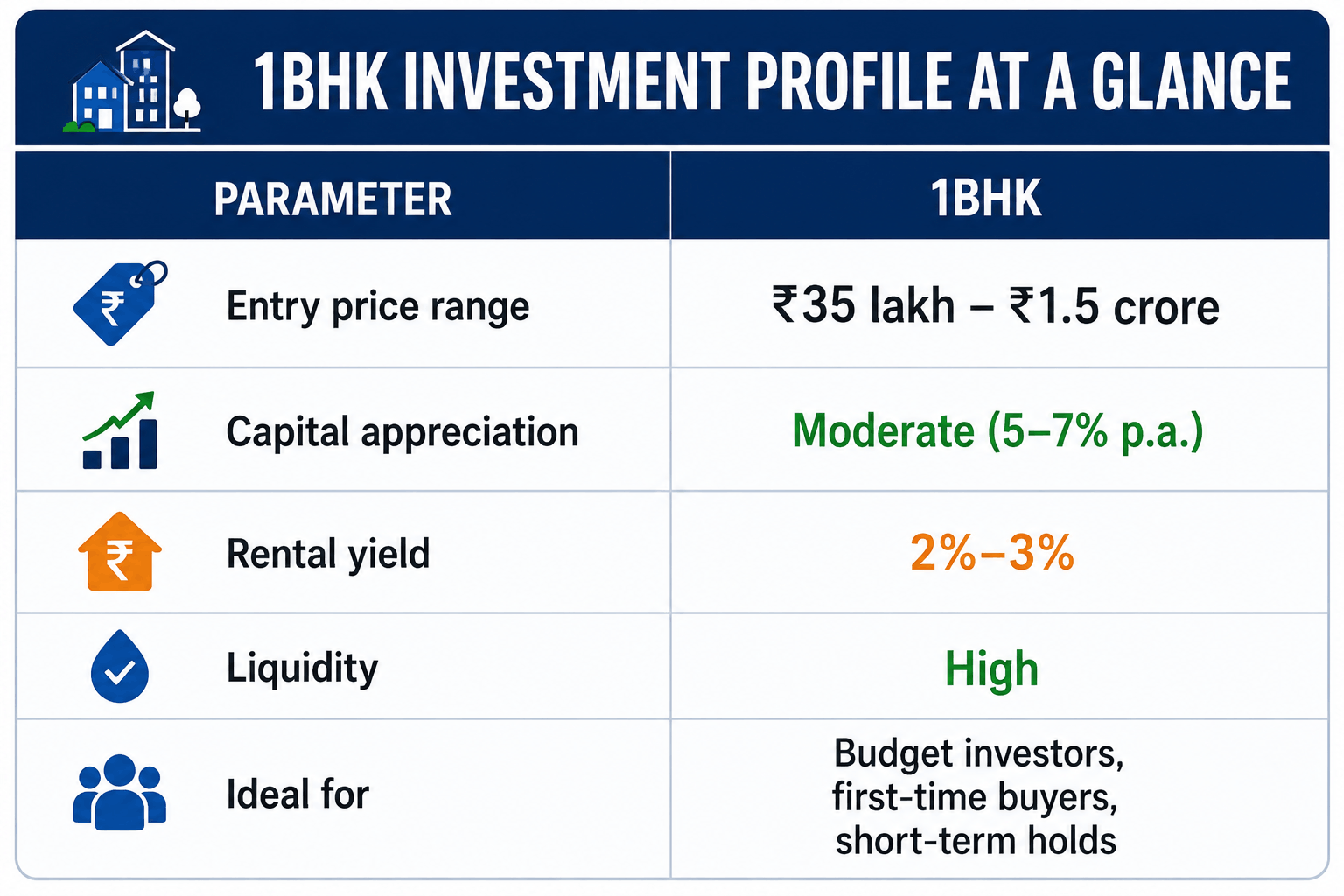
A 1BHK flat in Mumbai is predominantly purchased by young working professionals, single migrants from other cities, millennials making their first asset purchase, and first-time buyers who want to enter the market at the lowest possible ticket size. In extended suburbs like Virar, Vasai, Ambernath, and Badlapur, a 1BHK can be purchased for as little as ₹35–55 lakh, putting homeownership within reach for salaried buyers earning ₹50,000–₹80,000 per month.
Capital Appreciation Performance
Historically, 1BHKs have delivered the lowest capital appreciation among all configurations. This is primarily because the supply of 1BHK units in Mumbai is relatively high - most new projects include a large proportion of compact units to serve the entry-level demand segment - which limits price upside. In premium micro-markets, developers have increasingly moved away from 1BHK formats, further constraining the appreciation story.
That said, in select emerging corridors - particularly along new metro lines in Navi Mumbai and extended western suburbs - 1BHKs have tracked the broader market appreciation of 6-8% annually where infrastructure investment has driven baseline price growth.
Rental Yield
1BHK flats offer yields in the range of 2%-2.5% in most Mumbai micro-markets. In areas with high corporate presence like Powai, Andheri East, and Airoli, yields can push to 2.8%–3% for well-located 1BHK units.
Liquidity
This is where 1BHKs genuinely shine. Because the ticket size is lower, there is a larger pool of potential buyers - both investors and end-users - which means 1BHK flats typically sell faster than larger configurations. In a market downturn, this liquidity advantage becomes critical.
 2BHK Flats: The Sweet Spot for Most Investors
Why 2BHK Dominates Mumbai's Residential Market
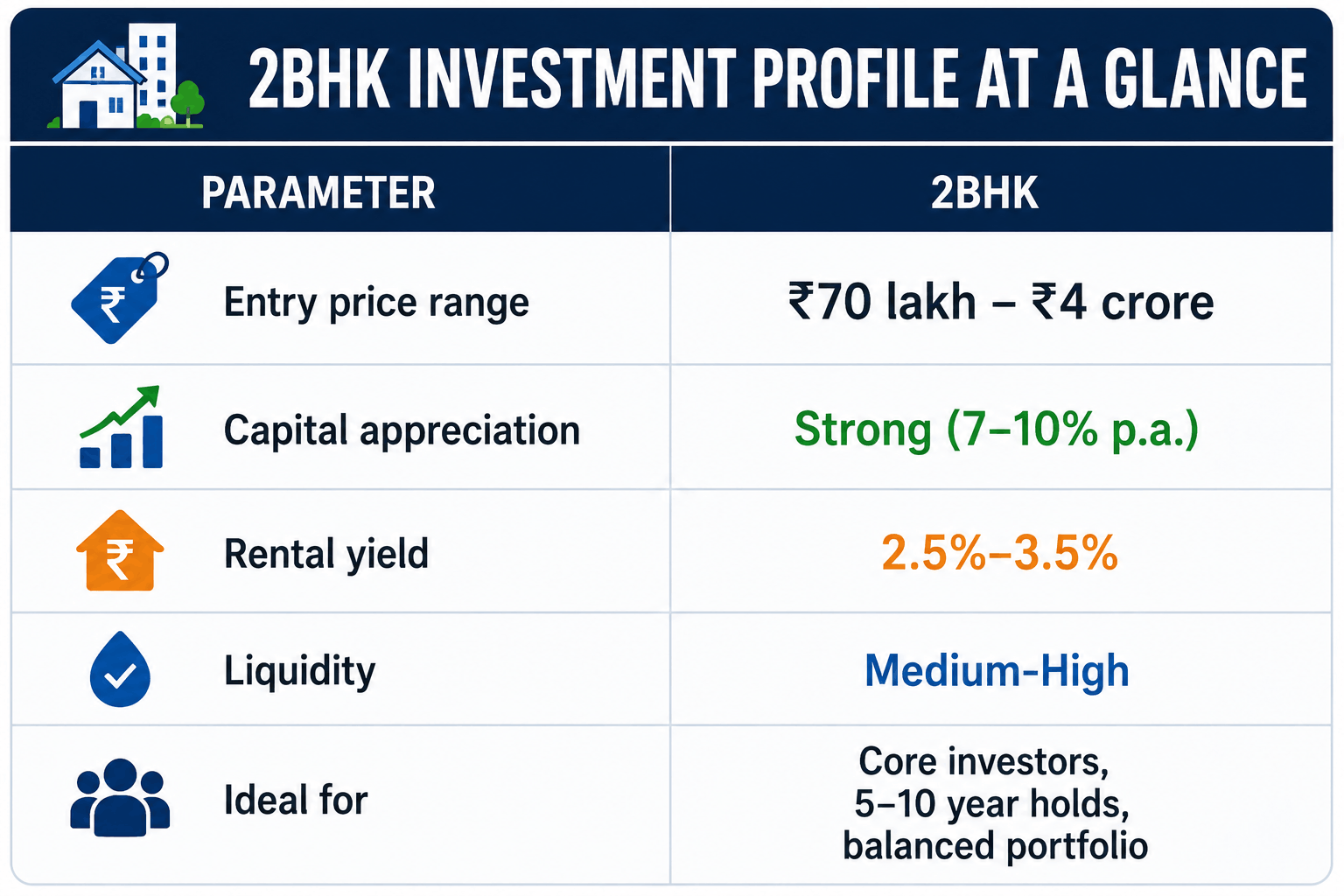
The 2BHK flat is Mumbai's most popular residential configuration by transaction volume, and for good reason. It appeals to the widest possible buyer base: young couples, nuclear families, dual-income households, and investors who want a balance of yield, appreciation, and exit flexibility. Data from Maharashtra's registration department shows that the ₹80 lakh-₹2 crore segment - where most 2BHK transactions in Mumbai's suburbs occur - is driving the highest activity in 2026.
Capital Appreciation Performance
2BHK flats have historically delivered strong capital appreciation in Mumbai, broadly tracking or slightly outperforming the city-wide average of 7-10% per annum. In Central Suburbs like Ghatkopar, Mulund, and Bhandup - where 2BHK units are priced at ₹18,000-28,000 per sq ft - appreciation has been particularly strong due to Metro Line 3 and ongoing infrastructure upgrades.
Some of the standout data points for 2BHK appreciation in 2025-2026:
- Powai: Average price ₹27,000/sq ft, 1-year appreciation ~7-8%, driven by IT corridor demand
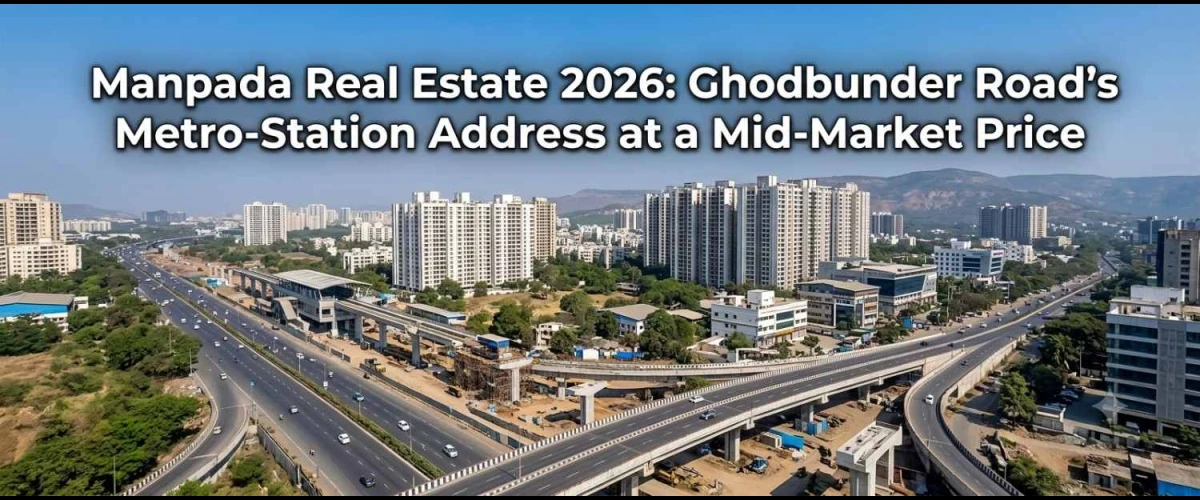
- Thane: 46% appreciation over three years; 2BHKs in Ghodbunder Road and Majiwada are the primary demand driver
- Panvel: Capital values rose 4% in Q2 2025, with NMIA airport development as the long-term appreciation catalyst
- Kharghar: Steady 6-8% annual appreciation; strong end-user and investor demand in the ₹70 lakh–₹1.5 crore range
Rental Yield
2BHK flats deliver 2.5%-3.5% rental yields across most Mumbai submarkets. In corporate-heavy corridors like Powai, Whitefield-adjacent areas of Andheri East, and Airoli (Navi Mumbai's IT hub), demand from working professionals keeps vacancy rates low and yields competitive.
Liquidity
2BHK flats offer good liquidity - not quite as fast-moving as 1BHKs in price-sensitive markets, but consistently in demand from both owner-occupiers and investors. Resale timelines are typically 45–90 days in active markets.
 3BHK Flats: The High-Conviction Play
Who Buys 3BHKs in Mumbai?
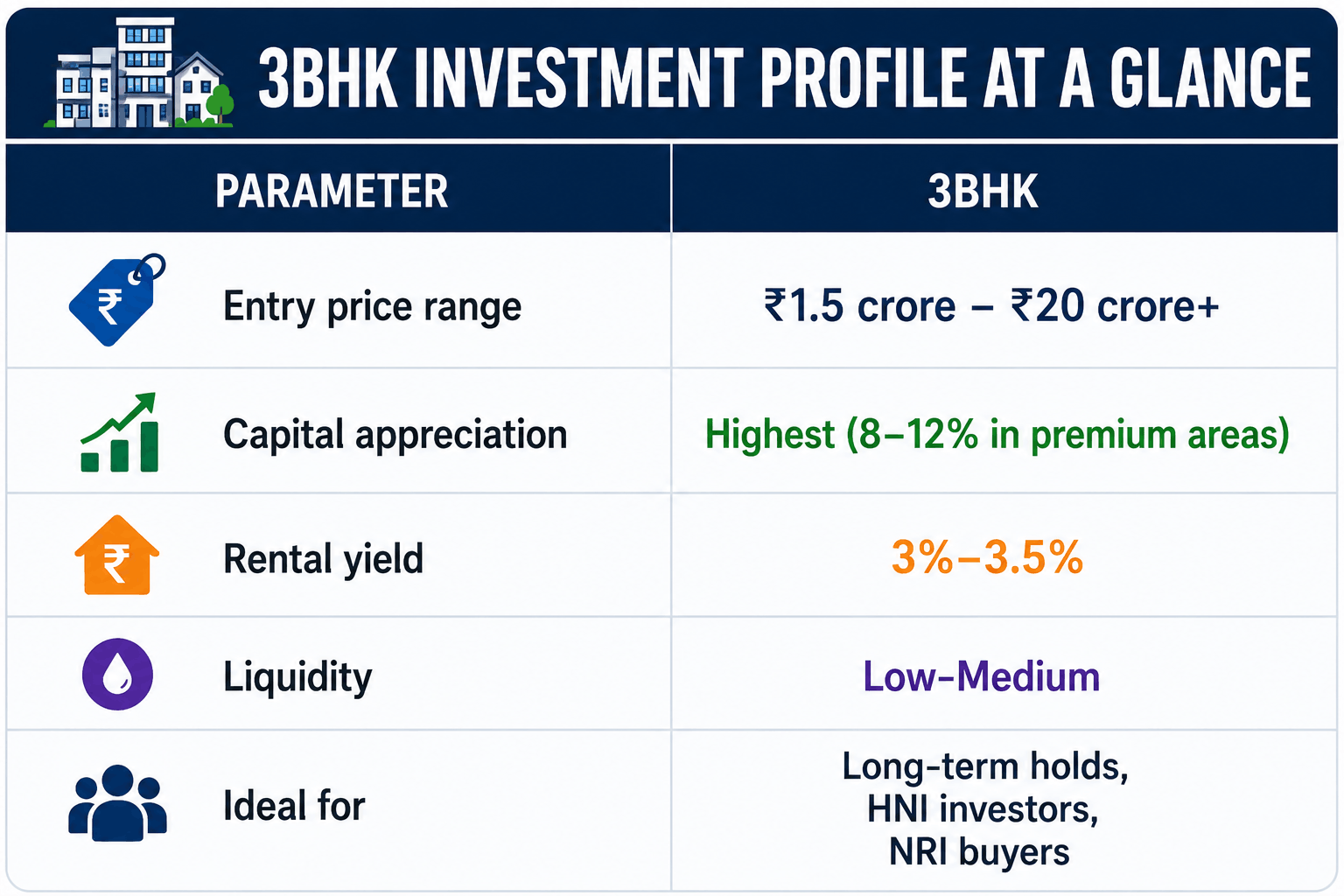
The 3BHK flat in Mumbai is the configuration of choice for established families, HNI buyers, NRIs looking for a family home, and investors targeting capital appreciation over rental income. In 2026, luxury residential registrations (above ₹5 crore) account for 7% of total MMR registrations - a meaningful signal that premium demand is structurally supported.
Capital Appreciation Performance
3BHK flats have delivered the highest capital appreciation in Mumbai's premium micro-markets. In South Mumbai - Malabar Hill, Napean Sea Road, Marine Lines - 3BHKs command ₹55,000-₹90,000 per sq ft, and appreciation has consistently outpaced the city average in bull cycles. Worli has seen 9-12% annual appreciation over the past three years, fuelled by luxury launches and proximity to the Bandra-Worli Sea Link.
In Western Suburbs, Bandra (West) commands ₹48,000 per sq ft, with appreciation tracking at 4-5% in recent years on a very high base. Andheri West and Juhu offer 3BHK units at ₹30,000-₹45,000 per sq ft with appreciation of 6–8%.
In the mid-premium segment - Thane, Mulund, Chembur - 3BHK flats at ₹22,000-₹32,000 per sq ft offer strong appreciation potential with lower entry points. Chembur in particular is emerging as a high-conviction 3BHK investment corridor due to its improved connectivity, Monorail access, and proximity to the Eastern Freeway.
Rental Yield
3BHK flats deliver 3%–3.5% gross rental yields in well-located Mumbai suburbs - marginally higher than 2BHK yields, reflecting strong family-occupancy demand. However, absolute rental amounts are higher, meaning the yield percentage is supported by larger rent cheques.
Liquidity
3BHK flats have the lowest liquidity of all configurations. The higher ticket size narrows the buyer pool, and resale timelines can stretch to 90–180 days in softer market conditions. This is the key risk for investors who may need to exit quickly.
 Best Mumbai Localities by Configuration for 2026 Investment
Best Localities for 1BHK Investment
- Navi Mumbai (Taloja, Dronagiri): Under-construction 1BHKs at ₹35-50 lakh with strong NMIA airport appreciation thesis
- Mira Road: Metro Line 9 connectivity making this a strong budget buy corridor
- Badlapur-Ambernath: The lowest-entry-point 1BHK market in MMR; infrastructure-led upside over 7-10 years
- Airoli: Strong IT corridor rental demand for 1BHKs; yields of 2.8-3%
Best Localities for 2BHK Investment
- Thane (Ghodbunder Road, Majiwada): 46% appreciation over 3 years; strong new supply pipeline
- Kharghar (Navi Mumbai): Metro connectivity, civic infrastructure, 6–8% annual appreciation
- Mulund / Bhandup: Eastern Freeway access, affordable entry point, strong mid-segment demand
- Panvel: NMIA airport play; best 2BHK appreciation thesis in Navi Mumbai through 2030
Best Localities for 3BHK Investment
- Worli / Prabhadevi: 9-12% annual appreciation; luxury demand pipeline robust
- Chembur: Emerging premium suburb; Monorail + Eastern Freeway + BKC adjacency driving 3BHK demand
- Bandra West: High-base market but long-term wealth preservation play for HNI buyers
- Kharghar (Navi Mumbai): Premium towers launching at ₹1.5-2.5 crore; strong appreciation potential
Which Configuration Should You Buy? A Decision Framework
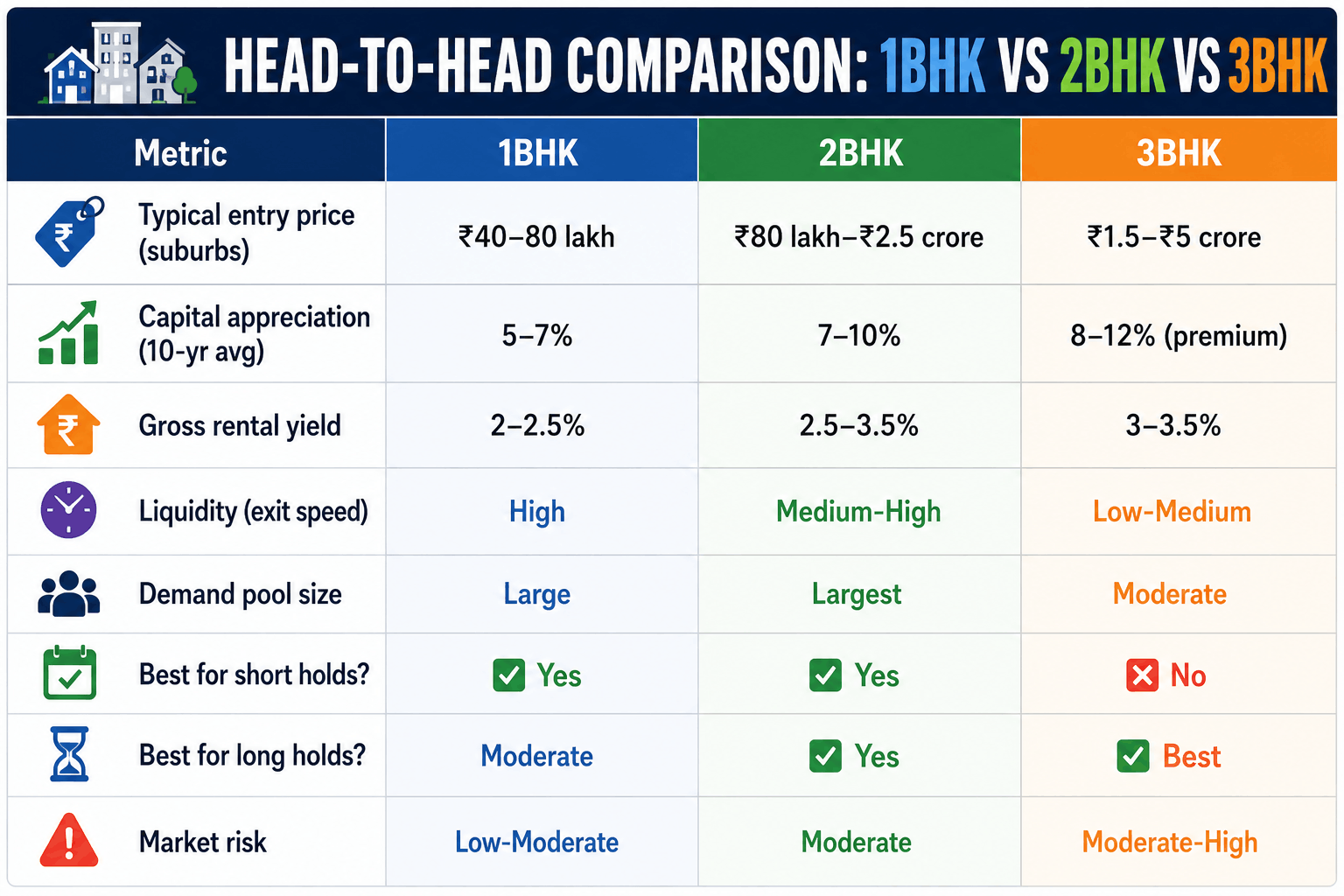
Your ideal flat configuration depends on three variables: budget, investment horizon, and return objective.
If your budget is under ₹80 lakh: A 1BHK in an emerging Navi Mumbai or extended suburb corridor gives you market entry with reasonable appreciation and high liquidity. This is not your highest-return option, but it protects your capital and lets you participate in Mumbai's residential market growth.
If your budget is ₹80 lakh-₹2.5 crore and your horizon is 5-10 years: A 2BHK in Thane, Navi Mumbai (Kharghar, Panvel, Airoli), or the Western Suburbs is the highest-conviction investment in Mumbai today. You get the best combination of capital appreciation, rental yield, demand depth, and liquidity. The ₹80 lakh-₹2 crore segment accounted for 38% of all registrations in 2026, confirming that this is where the market's deepest demand pool sits.
If your budget exceeds ₹2.5 crore and your horizon is 10+ years: A 3BHK in a premium location - Worli, Bandra West, Chembur, or a large-format Navi Mumbai project - offers the highest absolute appreciation in both good and exceptional market conditions. Accept lower liquidity as the trade-off for superior long-term value creation.
For NRI investors: 2BHK and 3BHK configurations in established corridors (Thane, Kharghar, Chembur, Bandra) offer the best risk-adjusted returns. Their higher price points generate meaningful rental income in absolute terms, and they attract stable, long-tenure tenant profiles.
Common Investment Mistakes to Avoid
Chasing 1BHK for yield alone: Mumbai is not a rental yield market. If yield is your primary objective, 2BHK in corporate corridors will outperform 1BHK in most scenarios due to larger absolute rent amounts.
Buying a 3BHK without an exit plan: The liquidity risk of 3BHK units is real. If you cannot hold for 7-10 years, a 2BHK is the more prudent choice.
Ignoring under-construction projects: For budget-constrained investors, buying an under-construction flat from a RERA-registered builder gives you lower entry prices (often 15-20% below ready-to-move rates), allowing you to access better micro-markets than your budget would otherwise permit.
Overlooking maintenance costs: Larger configurations carry higher maintenance charges, property tax, and society fees. Factor these into your net yield calculation before comparing configurations.
Confusing transaction volume with appreciation: Areas with high registration volume are not necessarily high-appreciation markets. Focus on infrastructure-led appreciation catalysts - new metro lines, expressway access, RERA-registered developers - as the primary drivers.
Conclusion
Mumbai's residential flat market in 2026 rewards buyers who make configuration choices aligned with their investment horizon and financial objectives. The 2BHK flat remains the highest-conviction investment across all budget segments in Mumbai - offering the best combination of capital appreciation, rental demand, and exit flexibility. For HNI buyers with long horizons, the 3BHK in premium corridors offers the highest absolute returns. And for first-time investors with budgets under ₹80 lakh, a 1BHK in an emerging Navi Mumbai or extended suburb corridor provides a sensible entry point into one of Asia's most resilient residential markets.
Frequently Asked Questions
Which BHK appreciates the most in Mumbai?

Is 1BHK a good investment in Mumbai in 2026?
What is the average resale ROI on a 2BHK flat in Thane?
Should I buy under-construction or ready-to-move for investment?

Get in Touch
Let our experts help you answer your questions

 +91
+91


Get in Touch
Let our experts help you answer your questions
+91