Kolkata Real Estate 2026: What political shift Means for Buyers, NRIs & Investors


The political scenario has seen a shift after 15 years in the recent elections of the West Bengal Legislative Assembly. For Kolkata's real estate market, the more interesting question is what happens over the next 18 months — and whether buyers who move now will look back on May 2026 as the moment they caught the curve.
This is not a piece about politics. It is a piece about property prices, infrastructure timelines, EMI calculations, and which micro-markets in Kolkata stand to benefit the most from a political realignment that the market has not seen since 2011. The data tells a clear story: Kolkata's fundamentals were already improving before the election result. The BJP win is the sentiment catalyst that many developers, institutional investors, and NRI buyers have been waiting for.
The Story in 60 Seconds
Kolkata's residential market was already outperforming broader India trends in Q1 2026. Sales reached 4,043 units — a 5% year-on-year increase at a time when housing sales across India's top eight cities fell 4%. New launches stood at 3,475 units. The weighted average residential price rose 3% year-on-year to ₹5,937 per sq ft, up from ₹5,748 per sq ft in Q1 2025. Unsold inventory fell 7% to 19,062 units, and the quarters-to-sell ratio improved from 5 to 4.4 — meaning the market is absorbing stock faster.
Against this backdrop, BJP's 206-seat win on May 4 introduces a new variable: political alignment between the state government and the central government. Historically, states where this alignment exists have seen faster clearance of central infrastructure funding, smoother industrial corridor approvals, and improved ease of doing business rankings — all of which drive housing demand. The question is no longer whether Kolkata will catch up with Pune, Hyderabad, and Bengaluru. It is how quickly.
Why Kolkata Has Been Underperforming — and Why That's About to Change
Despite being India's third-largest metropolitan area, Kolkata ranks eighth in builder supply and residential sales — behind several Tier-2 cities. This is not because Kolkata lacks population or purchasing power. It is because the city lacked the economic growth catalysts that drive housing demand: large-scale IT and financial services employment, major industrial investment, and sustained infrastructure buildout.
Pankaj Kapoor, Founder and MD of Liases Foras Real Estate Rating and Research, has been tracking this gap for years. "Unlike Bengaluru, Hyderabad, Pune, or Chennai, Kolkata has not developed a strong services ecosystem — particularly in IT, fintech, and professional services. These sectors are critical drivers of urban housing demand. Kolkata sees limited talent inflow compared to these cities, which directly impacts housing demand and price appreciation," he noted in May 2026.
Three structural changes, however, are now converging:
- First, the RBI's aggressive rate-cutting cycle through 2025 delivered 125 basis points of cuts — from 6.50% to 5.25% — representing the steepest rate reduction India has seen since 2019. For a city where affordability was already Kolkata's key advantage, lower home loan rates extend that advantage significantly.
- Second, central infrastructure investments — the Kolkata Metro's expansion to New Town, the Eastern Peripheral Expressway connectivity improvements, and the Kolkata Airport's capacity expansion — are at various stages of execution. Political alignment accelerates the release of central funds for these projects.
- Third, data centre and back-office IT investment from Southeast Asian and Gulf-region capital is increasingly looking at Kolkata as a cost-competitive alternative to Bengaluru. The New Town/Rajarhat IT corridor already hosts offices of TCS, Wipro, Infosys, and Cognizant. A more business-friendly state government is the signal international investors need to commit to the next phase.
What Buyers Need to Know Right Now
Financial Impact — EMI Math at Today's Rates
The RBI's repo rate stands at 5.25% as of April 2026, following four cuts across 2025. Home loan rates from leading banks now range from 8.25% to 9.10% for salaried buyers with CIBIL scores above 750. Worked example — Sunita, 31, IT professional in Salt Lake City, Kolkata: Sunita is considering a 2BHK flat in New Town (Kolkata's primary IT-corridor suburb) priced at ₹78 lakh. She has a down payment of ₹15.6 lakh (20%) and is financing ₹62.4 lakh.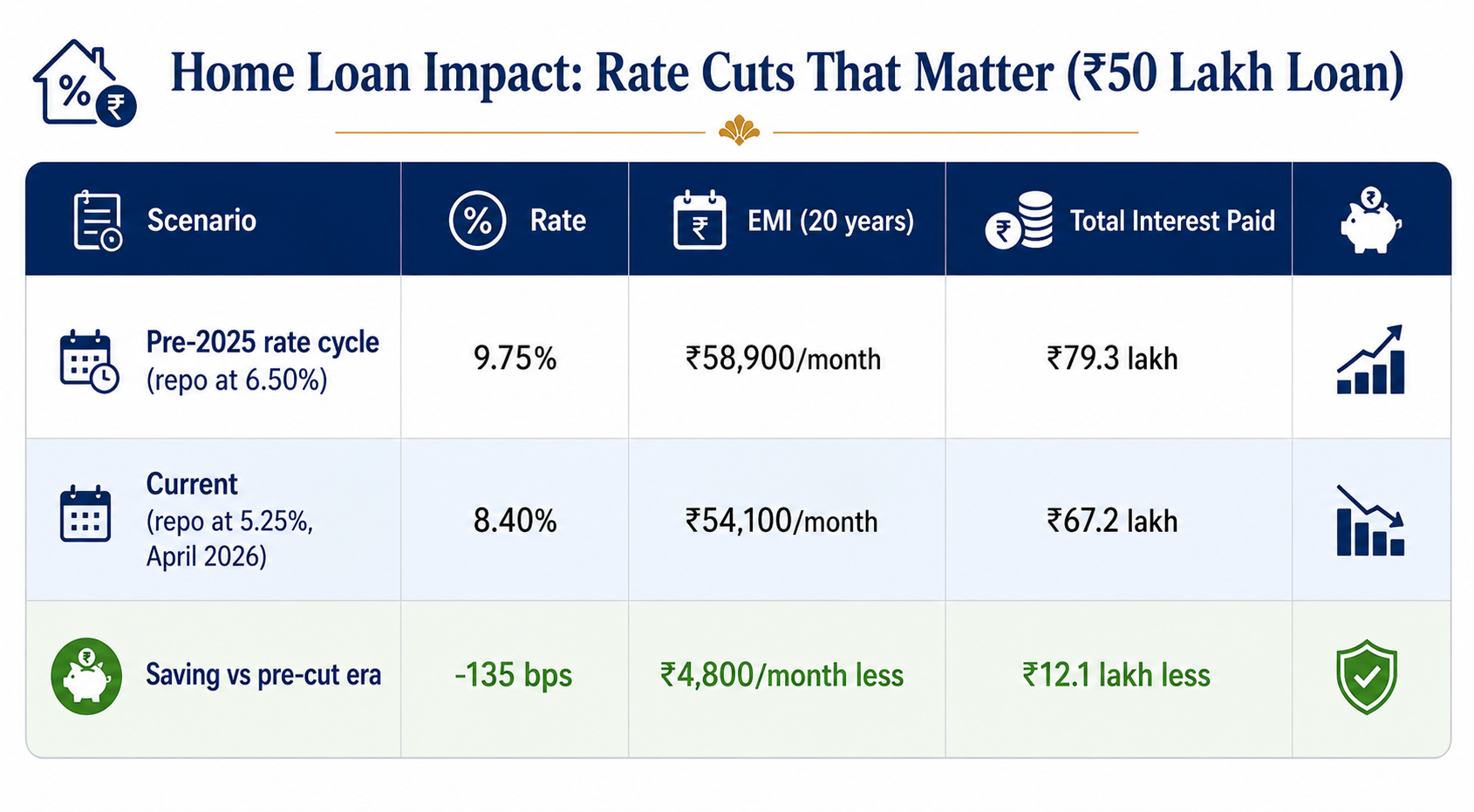
For a city where the average residential price is ₹5,937/sq ft and a quality 900 sq ft 2BHK in New Town comes in at ₹65–80 lakh, this rate environment is transformational. The 125 bps cut cycle has made home ownership accessible to first-time buyers who were priced out 18 months ago.
Legal & Compliance — WBHIRA and What Changes Under New Government West Bengal's real estate regulatory authority, WBHIRA (West Bengal Housing Industry Regulation Act), operates independently of the state government but its budget allocations, staffing, and IT investment are influenced by the state. Under the previous TMC administration, WBHIRA was often criticised for slow complaint resolution and limited digital infrastructure compared to MahaRERA. Under the incoming BJP government, two changes are expected:
- Faster project approvals: BJP governments at the state level have historically prioritised single-window clearance systems and real estate ease-of-doing-business scores. Buyers in under-construction projects may see reduced approval delays, which translates to on-time possession.
- WBHIRA modernisation: Central government's RERA framework review in 2025 recommended all state REAs adopt digital audit trails similar to Maharashtra's MahaCRITI. With political alignment, West Bengal is now more likely to receive central funding and technical assistance for WBHIRA's digital upgrade.
For buyers, the immediate actionable point is this: verify your project's WBHIRA registration on wbhira.in before booking, and confirm quarterly reports are current. The regulatory environment is improving, but the due diligence requirement does not change.
Timeline — When to Buy, When to Wait
The market is in what analysts call the "sentiment lead, fundamental lag" window. Sentiment has improved with the election result, but the fundamental improvements — faster approvals, new infrastructure, IT investment inflows — will take 12–24 months to fully materialise in new supply and price levels.
The case for buying now (Q2–Q3 2026): Prices haven't yet jumped on election optimism. The ₹5,937/sq ft average in Q1 2026 was set before the May 4 result. Developers who have been sitting on land banks, waiting for a more predictable regulatory environment, will now launch new projects in 2026–27. When that supply comes, it will be at higher land-cost pricing. First movers in established micro-markets like New Town Phase 2, EM Bypass, and Tollygunge buy before the curve.
The case for waiting (Q4 2026 onwards): Infrastructure spending materialises slowly. A buyer who wants to be certain of metro connectivity, road quality, and social infrastructure may prefer to wait 12 months and pay a 5–8% premium for certainty. NRI buyers investing from Gulf cities or the UK should factor in FEMA repatriation rules and currency movement over this horizon.
What this means for you: End-user buyers in the ₹50 lakh–₹1.5 crore segment, buying for self-occupation in established corridors, have a compelling case to act in Q2–Q3 2026. Investors purely playing capital appreciation should model both scenarios
The PropTech Angle — Digital Infrastructure Follows Political Reform
Kolkata's PropTech adoption has lagged Mumbai, Bengaluru, and Hyderabad — partly because lower transaction volumes meant fewer platforms chose to invest in the city, and partly because a less business-friendly regulatory environment made data access harder. Both of those factors are now changing.
Several developments are worth tracking for property buyers:
AI-verified listing adoption: Platforms that offer AI-verified listings — cross-referencing WBHIRA registration, builder track record, and neighbourhood data — are expanding in Kolkata as transaction volumes grow. Blox.xyz, which already has an active Kolkata presence, is one such platform. Searching listings in Kolkata on Blox lets buyers filter by WBHIRA-registered projects, reducing the due-diligence burden.
Digital land records: West Bengal's land records system (Banglarbhumi) has seen inconsistent digitization. A central-state aligned government is more likely to fast-track integration with national digital land record standards, which would dramatically reduce title dispute risk — one of Kolkata's most persistent buyer concerns.
PropTech investment in eastern India: The investment data is clear — PropTech investment grew at 42% annualized in AI-driven platforms through 2025. Kolkata's improving transaction volumes will attract platforms offering virtual tours, AI pricing models, and computer-vision construction auditing — tools that the city's buyers have not had access to at scale.
What this means for you: The buyer who waits for "the market to settle" may also be waiting for better digital tools that reduce due-diligence friction. The tools are already available now through platforms like Blox.
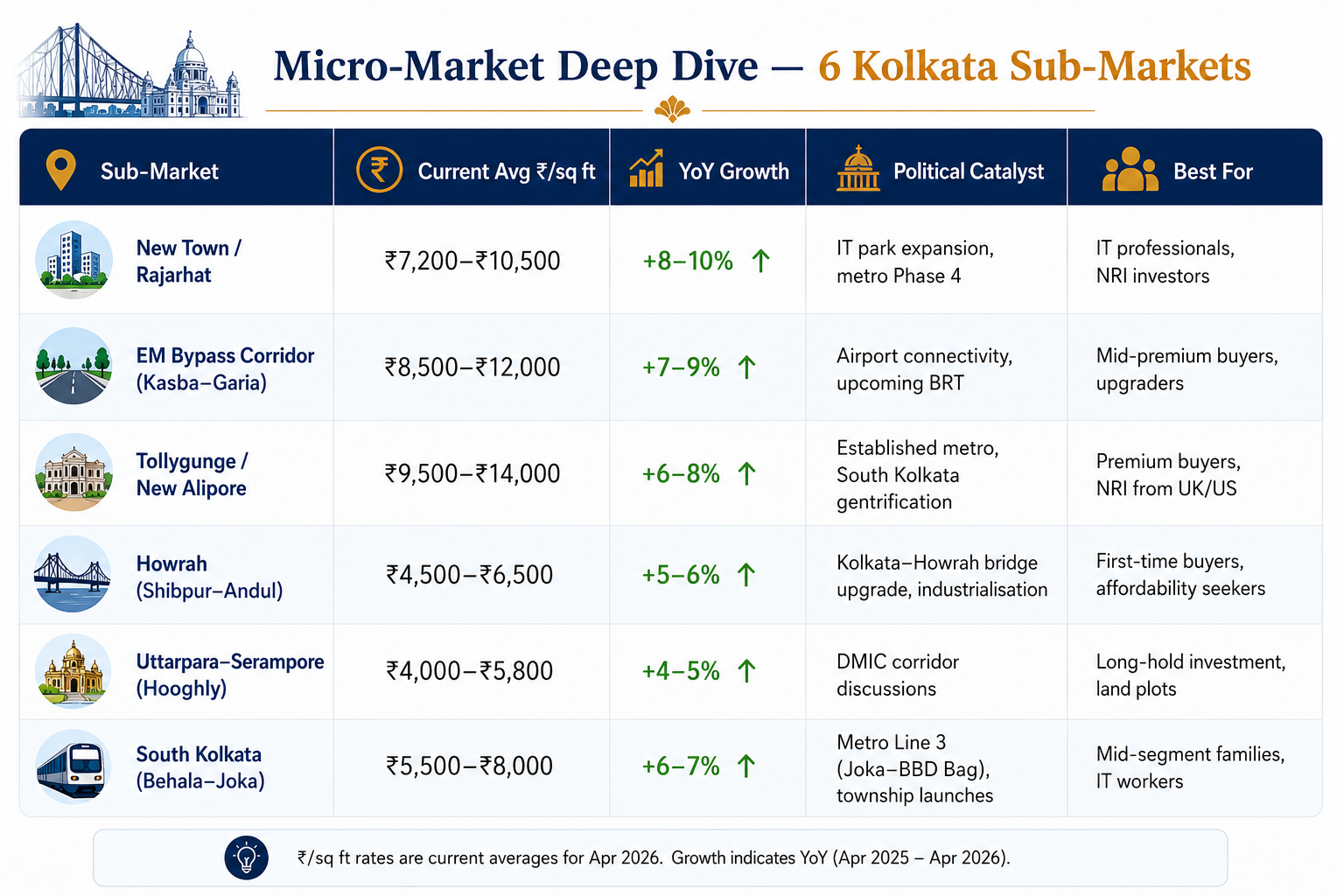
New Town remains the standout sub-market because it uniquely combines existing IT infrastructure, operational metro connectivity, HIDCO-regulated development, and an average entry price that is still ₹4,000–₹5,000/sq ft cheaper than comparable locations in Bengaluru's Whitefield or Hyderabad's Gachibowli.
For NRI buyers specifically: The ₹1 crore–₹2 crore segment in Kolkata grew 50% year-on-year in Q1 2026. For a Bengali NRI in Dubai or London, a ₹1.2 crore New Town apartment converts to approximately AED 530,000 or £105,000 — dramatically cheaper than equivalent-quality apartments in Bengaluru or Mumbai. FEMA permits NRI purchase of residential property (no agricultural/plantation land) with standard repatriation rules. For rental yield, New Town is showing 2.8%–3.5% gross yield — lower than commercial but improving rapidly as the IT workforce expands.
Expert Take
"Real estate is ultimately driven by infrastructure, regulatory clarity, and economic activity. The state-central alignment we see post-May 2026 is a positive signal for Kolkata — but the real test will be what happens in the next budget cycle and whether central infrastructure allocations for metro Phase 4, the Eastern Dedicated Freight Corridor industrial zones, and IT Special Economic Zones actually accelerate," says Sharad Mittal, Founder and CEO of Arnya Real Estate Fund Advisors. "We're watching three specific triggers: single-window project clearance implementation, the speed of WBHIRA's digital upgrade, and any new IT/data-centre SEZ announcements in the Rajarhat-New Town zone."
A senior Blox.xyz Relationship Manager based in Kolkata notes the on-ground shift already: "Since the result came out, we've seen a noticeable uptick in NRI inquiries — particularly from Gulf cities. There's a sense that the window of 'cheap Kolkata real estate with improving fundamentals' won't last. New Town Phase 2 and the Rajarhat extension are getting more calls than we've seen in three years."
For the NRI buyer in UAE: You're watching the rupee, the rental yield, and the repatriation rules. Kolkata's average ₹/sq ft is 40–50% below Mumbai for comparable quality. At current exchange rates (₹91/AED), a ₹80 lakh flat costs approximately AED 355,000 — competitive with mid-tier investment properties in Dubai's secondary market. FEMA permits full repatriation of sale proceeds if the original purchase was made with inward foreign exchange. Rental yield in New Town (2.8–3.5%) is lower than Dubai (5–6%) but the capital appreciation story in an undervalued market is the primary thesis here.
For the first-time buyer under 32: Your sweet spot is Howrah–Shibpur and South Kolkata (Behala–Joka) for entry prices under ₹60 lakh, or Uttarpara–Serampore if you're comfortable with a 30-minute commute. EMI at today's rates on a ₹48 lakh loan (₹60 lakh flat, 20% down) works out to approximately ₹41,800/month at 8.40% over 20 years — manageable on a ₹1.2 lakh monthly take-home for a young IT professional. Metro Line 3 to Joka–BBD Bag means the commute problem is being solved in real time.
For the upgrader or mid-premium buyer: The EM Bypass corridor between Kasba and Garia is your market. Premium 3BHK apartments at ₹1.2–₹2 crore in this zone offer hospital proximity (Fortis, AMRI, Apollo), school access, and airport connectivity that rivals OMR Chennai or Bandra Kurla Complex for lifestyle without the price tag. This is where the 50% jump in the ₹1 Cr–₹2 Cr segment in Q1 2026 is most visible.
Blox in Kolkata Buyer Playbook
Explore verified Kolkata listings on Blox: Visit blox.xyz/kolkata for AI-verified listings across New Town, EM Bypass, Tollygunge, Howrah, and South Kolkata. Every listing is cross-referenced against WBHIRA registration data.
Calculate your exact EMI budget: Use the Blox EMI Calculator with current 8.25%–8.75% home loan rates. Model 15-year vs. 20-year tenures to find your optimal EMI-to-income ratio.
Speak to a Kolkata-based Blox RM: The on-ground intelligence on which micro-markets have the best builder track records, which projects are WBHIRA-compliant, and which areas are seeing the strongest developer activity is available through a dedicated Relationship Manager — at no cost to the buyer.
Do your legal due diligence: Verify WBHIRA registration on wbhira.in. Confirm the builder has no pending complaints under WBHIRA. For under-construction properties, check if quarterly progress reports are current. [link to relevant Blox blog: India home buying guide 2026]
- Watch the next 60 days for policy signals: The new West Bengal cabinet's first 100 days are critical. Single-window clearance announcements, industrial corridor MoUs, and IT SEZ notifications will be the early signals of how fast the fundamental story plays out

Get in Touch
Let our experts help you answer your questions

 +91
+91


Get in Touch
Let our experts help you answer your questions
+91