MahaCRITI Is Now Mumbai's Only RERA Portal: A Buyer's Survival Guide (2026)

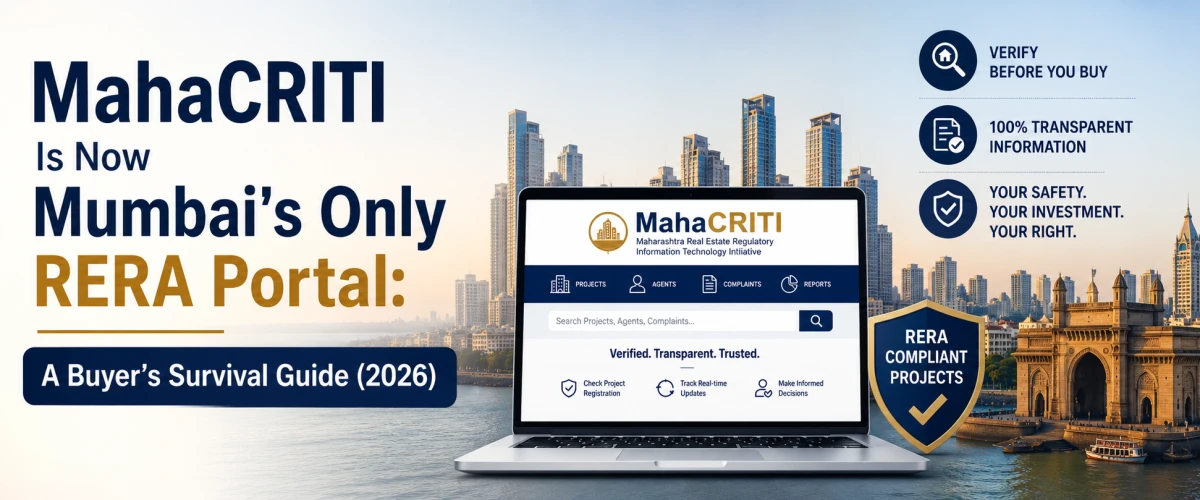
Forty-eight builders who hadn't updated their email IDs received a rude shock on the morning of May 12, 2026: their project registrations had been swept off MahaRERA's old system overnight. If you're currently negotiating to buy a flat in one of Mumbai's thousands of under-construction projects, that sentence should get your attention.
On May 8, 2026, MahaRERA issued Order No. 65A/2026 — a terse, three-page directive that shut down the decade-old MahaRERA 1.0 portal at exactly 11:59 PM on May 10, 2026. From May 11 onwards, every RERA filing in Maharashtra — project registration, project correction, extension requests, quarterly progress reports — happens exclusively on MahaCRITI, an acronym that stands for MahaRERA Complaint and Regulatory Integrated Technology Implementation. If you have never heard of MahaCRITI, that is understandable; if you are buying a flat worth ₹80 lakh or more, you need to know it well.
This guide explains what changed, what it means for your purchase decision right now, and how to use the new system to protect yourself.
What Happened — The 60-Second Briefing
MahaRERA launched MahaCRITI on August 31, 2024, as its next-generation platform. Through 2024 and into 2025, the two portals ran in parallel — the old 1.0 system handling legacy filings, MahaCRITI handling new ones. On May 5, 2025, MahaRERA mandated that all new Project Registration, Project Correction, Project Extension, and Quarterly Reporting applications go exclusively through MahaCRITI.
Maharera Orders and Circular guide
The authority gave builders over a year to clear their pending work on the legacy system. It sent reminder notices on October 15, 2025 and January 2, 2026. Many builders still did not respond. Dozens of communications came back undelivered because developers hadn't updated their registered email IDs. On May 8, 2026, MahaRERA's patience ran out.
What this means for you in plain terms: If your builder had any pending regulatory application sitting on the old portal — an extension request, a correction filing, a pending new registration — that application now stands "administratively closed" on the legacy system. The builder must refile it on MahaCRITI. Until they do, the project's regulatory record is incomplete.
What this means for Mumbai's broader market: With Q1 2026 recording a record 19,775 new residential unit launches across the Mumbai Metropolitan Region — up 25% quarter-on-quarter — a large volume of projects is in various stages of RERA compliance. The portal switch, though administratively necessary, creates a gap window that every buyer must navigate.
Why MahaRERA Killed Its Own Old Portal
Running two IT systems in parallel costs money. More importantly, it creates regulatory arbitrage — builders could exploit inconsistencies between systems, or simply not respond to notices, relying on the legacy system's inertia to delay compliance. The MahaCRITI migration closes that loophole.
MahaCRITI is built on a fundamentally different architecture. The platform integrates Agent Lifecycle Management (tracking registered real estate agents), Complaint Management (buyers can file and track grievances digitally), Conciliation Management (mandated by MahaRERA's August 2025 order requiring digital evidence for conciliation proceedings), and the Project Lifecycle Management Module (launched May 5, 2025). For the first time, every stakeholder — buyer, broker, builder, regulator — sees the same data in real time.
The system also introduces an AI-driven chatbot for real-time guidance, a mobile application, personalised dashboards for project monitoring, and data analytics dashboards for MahaRERA officials. In short, it is not just a new website — it is a fundamentally more transparent regulatory environment.
What this means for you: The new system makes it significantly harder for a builder to quietly miss a quarterly reporting deadline without it being visible to buyers. That is a buyer's best friend.
What This Means for Mumbai Home Buyers Right Now
Projects Whose Builders Didn't Migrate — The Hidden Risk
Order 65A/2026 contains a critical legal nuance that most news coverage has missed. The order states that applications administratively closed on the legacy portal "shall not be construed as an adjudication on the merits" and "shall not amount to any rejection." Builders have the right to refile on MahaCRITI. This is important for buyers because it means the project is not deregistered — it is simply in a compliance limbo until the builder refiles. However, during this limbo period:
The project's extension request (if it had one pending) is unresolved. The builder's revised completion timeline is not officially on record.
If a buyer tries to verify the project on MahaCRITI right now, they may see incomplete or outdated information.
A project correction filing — for example, changing carpet area calculations, or updating the Occupation Certificate timeline — that was pending on the old portal is now void and must be resubmitted.
Decision flowchart for buyers:
Is the project you're looking at registered on MahaCRITI? → If yes, check quarterly report status. → If quarterly reports are current (last report within 90 days), proceed with due diligence.
Are quarterly reports overdue? → Flag to your lawyer. Ask the builder to explain the gap.
Is the project NOT found on MahaCRITI? → Possible legacy portal holdover. Search the old archived MahaRERA database AND MahaCRITI. If absent from both, do NOT book the flat until registration status is confirmed.
Financial Impact: When Project Delays Cost You More Than You Think Consider a worked example. Rohan, 34, IT professional in Powai, agreed to buy a 2BHK flat in Thane for ₹95 lakh in March 2026, with possession promised by December 2027. The builder had a pending project extension request on the legacy MahaRERA portal, which was administratively closed on May 11, 2026. If the builder does not refile the extension on MahaCRITI within 30 days, the project's revised timeline is unregistered. This matters financially in the following ways:
EMI cost of delay: Rohan took a ₹76 lakh home loan (80% LTV) at 8.60% (RBI repo at 5.25% + bank spread 3.35%, post-April 2026 transmission). His EMI is ₹66,800/month. If possession slips by even 6 months past the registered date, he pays ₹4.01 lakh in additional rent (assuming ₹22,000/month in Thane) while also paying home loan EMI. That's ₹4.01 lakh in dead cost.
Stamp duty recalculation risk: If the project's carpet area gets corrected post-portal migration (a common scenario), stamp duty may need to be recalculated at a higher base. Maharashtra stamp duty on residential property is 5% (plus 1% metro cess in Mumbai, Thane, Pune). On a ₹95 lakh flat, a 5% carpet area correction could mean ₹23,750 in additional stamp duty.
- MahaRERA interest liability: Under RERA, a builder who delays possession must pay the buyer interest at MCLR + 2% for the delay period. But this liability is only calculable if the RERA-registered completion date is clearly on record — which requires the extension filing to be properly on MahaCRITI.
Legal Compliance Impact — "Administrative Closure" This distinction matters enormously if you are a buyer who has already paid a booking amount or signed a sale agreement. The builder's project has not been deregistered. MahaRERA has explicitly preserved the builder's right to refile. However:
Your Allotment Letter or Agreement for Sale references a specific MahaRERA registration number. That number remains valid.
If the builder refiles a correction or extension, the new filing will carry updated details. Your lawyer should verify that the refiled application matches the terms in your sale agreement.
If a builder fails to refile within a reasonable time and you suspect they are using the confusion to avoid declaring a delay, you now have grounds for a MahaRERA complaint — filed, naturally, on MahaCRITI's Complaint Management Module.
Verify project registration on MahaCRITI: Go to maharerait.maharashtra.gov.in (the new portal) and search the project by name or RERA number. Confirm the registration is active and the completion date is current.
Check quarterly progress reports: MahaRERA requires builders to file quarterly reports. Look for the last 4 filings. If any quarter is missing, ask the builder to explain.
Review the Occupation Certificate (OC) timeline: Confirm the date on MahaCRITI matches what is in your sale agreement. Any discrepancy is a red flag.
Verify the Escrow Account balance: RERA mandates 70% of collected funds go into a designated escrow account. MahaCRITI now shows this data digitally. A low escrow balance relative to project completion is a warning sign.
- Check agent registration: Your broker must also be registered on MahaCRITI. Dealing with an unregistered agent creates legal liability for you in a dispute. Verify their MahaRERA agent ID on the portal.
The PropTech Angle — Why MahaCRITI Is Actually Good News for Smart Buyers
MahaCRITI is not just a compliance portal — it is a buyer's transparency tool in a way that MahaRERA 1.0 never was. Here is what the new system delivers that changes the home-buying calculus in 2026:
AI-assisted project monitoring: The platform's AI chatbot can answer buyer queries in real time about project status, compliance deadlines, and complaint procedures. This democratises access to regulatory information that previously required a lawyer.
Integrated complaint-to-conciliation workflow: Under MahaRERA's August 2025 Conciliation Forum mandate, digital evidence is now admissible in conciliation proceedings. Every communication on MahaCRITI between buyer, builder, and regulator creates a timestamped digital audit trail. This is a fundamental shift in the power balance: buyers who document their interactions on the portal now have court-ready evidence.
Computer-vision project auditing (emerging): Several RERA-aligned PropTech platforms are piloting AI image analysis of construction-progress photos uploaded to MahaCRITI. Computer vision can flag discrepancies between reported construction percentage and actual site progress — the same technology that is already being used by institutional investors to audit SRA and redevelopment projects in central Mumbai.
Blox.xyz cross-references every listed property against MahaRERA data — now updated to reflect MahaCRITI. Buyers who search property automatically see compliance status without needing to navigate the portal themselves. As the MahaCRITI transition stabilises through June 2026, this integration becomes the most efficient way for a buyer to get a clean compliance signal at the top of the funnel.
What this means for you: The portal migration is a short-term friction event that creates long-term transparency gains. Smart buyers use this moment to raise their due-diligence bar — and platforms like Blox make that easier.
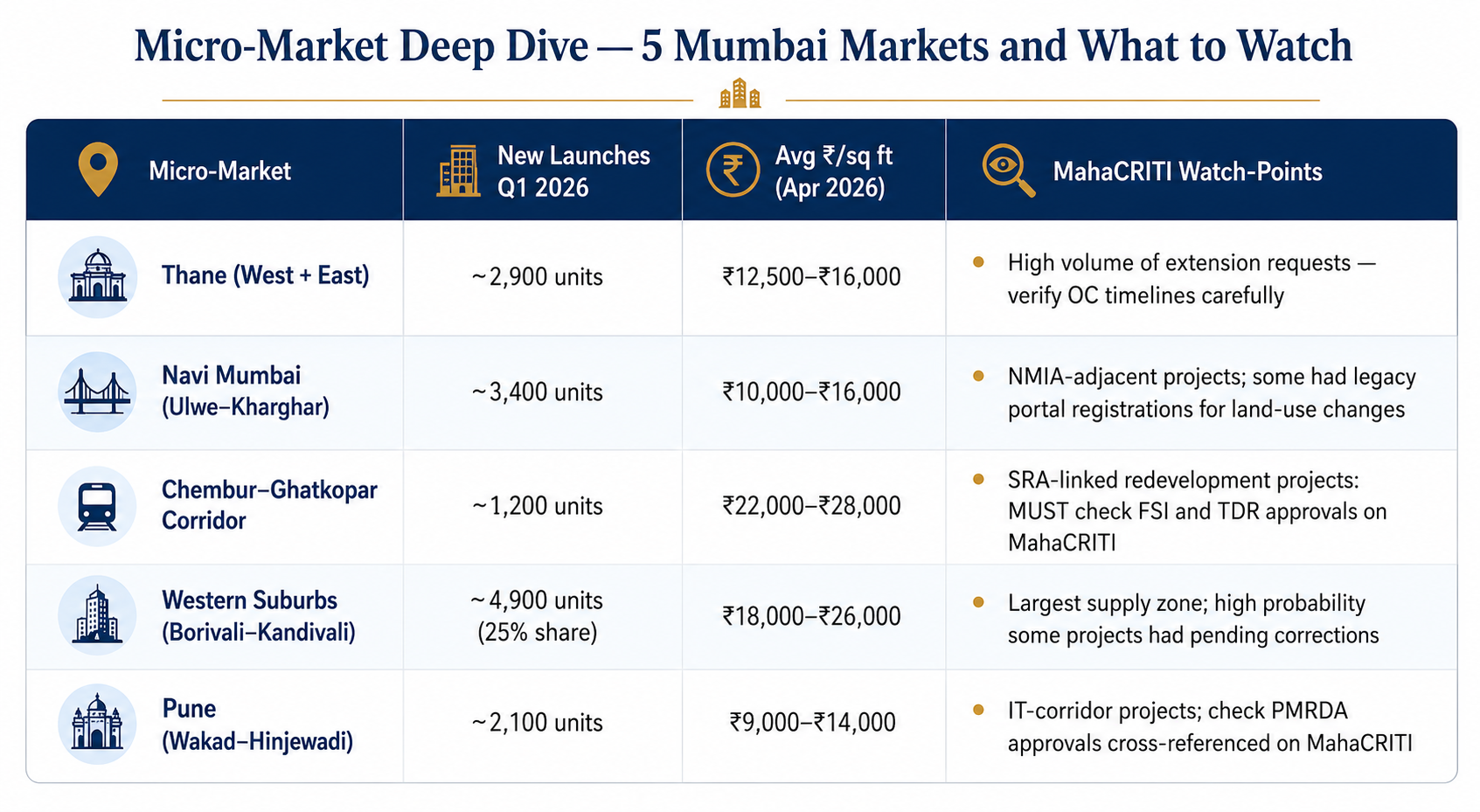
In Kandivali East specifically, average ₹/sq ft moved from approximately ₹19,800 in Q4 2025 to ₹22,400 in Q1 2026 — a 13% appreciation driven by metro Phase 3 connectivity. Any project in this corridor with a legacy portal pending application deserves extra scrutiny given the pricing premium.
"The MahaCRITI migration is the most significant digital infrastructure upgrade Maharashtra's real estate sector has seen since RERA itself was launched in 2017," says Rahul Sundaram, Partner at IndiaLaw LLP, who authored the legal analysis of Order 65A/2026. "The key protection for buyers is the audit trail. On the old system, a builder could miss a quarterly reporting deadline and it would take months before a buyer noticed. On MahaCRITI, the gap is visible to everyone in real time."
A senior Blox.xyz Relationship Manager based in Thane adds: "We've already had buyers come to us confused about why a project they were interested in is showing 'pending' status on the new portal. The answer is almost always that the builder had a minor correction filing on the old system and hasn't refiled yet. We walk them through the MahaCRITI check and, in most cases, the project's fundamentals are fine — the builder just needs to update their filing. But that's exactly the kind of due diligence that catches the rare bad actor too."
Blox.xyz Buyer Playbook
If you are buying an under-construction flat in Mumbai, Thane, Navi Mumbai, or Pune in May–June 2026, follow this sequence:
Start on Blox.xyz: Search Projects — every listing is cross-referenced against MahaRERA / MahaCRITI compliance data. You'll see project registration status at the top of the listing card.
Cross-verify on MahaCRITI: Visit maharerait.maharashtra.gov.in and look up the RERA registration number. Check quarterly reports and escrow balance.
Calculate your EMI and total cost of ownership: Use the Blox EMI Calculator to factor in your home loan at current rates (8.50%–9.25% range post-RBI stabilisation) and model both on-time and delayed possession scenarios.
Speak to a Blox RM: If anything looks off on MahaCRITI — missing reports, unusual corrections, mismatched completion dates — a Blox Relationship Manager can pull the builder's compliance history and flag red flags before you sign.
Review your Agreement for Sale against MahaCRITI data: The date, carpet area, and payment milestones in your Agreement for Sale must match exactly what is on MahaCRITI. Any discrepancy is a negotiation point — or a reason to walk away.

Get in Touch
Let our experts help you answer your questions

 +91
+91


Get in Touch
Let our experts help you answer your questions
+91