Mumbai Coastal Road 2026: Complete Guide to Property Price Impact, Benefiting Areas & Investment Opportunities

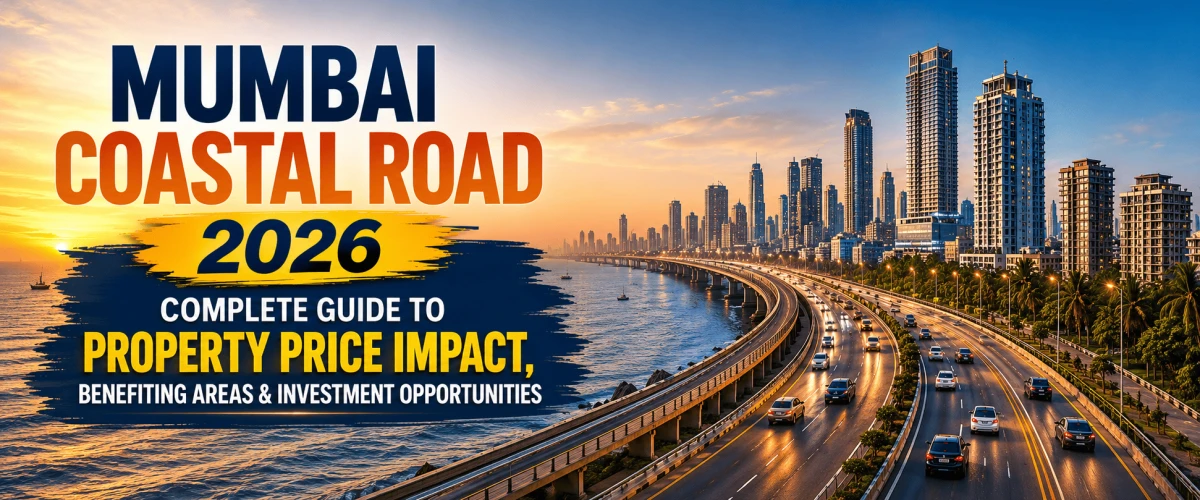
Mumbai's relationship with its coastline has always been complicated — the sea that makes the city iconic also boxed in its road network for decades. The Mumbai Coastal Road project is changing that permanently. Phase 1, a 10.58 km stretch from Princess Street Flyover to the Worli end of the Bandra–Worli Sea Link, opened to the public in March 2024. Phase 2, extending to Bandra and beyond, is advancing through 2026. The result: one of the most significant infrastructure-driven real estate shifts Mumbai has seen in a generation.
This is not just an infrastructure story. For property buyers and investors in 2026, the Coastal Road is a wealth creation engine — and understanding which zones have already captured the gain versus which still have upside is the difference between buying right and overpaying.
What Is the Mumbai Coastal Road? Project Overview & Timeline
The Mumbai Coastal Road (MCR) is a 29.2 km sea-front expressway connecting Marine Lines in South Mumbai to Kandivali in the north. The project is divided into two phases:
Phase 1 - Marine Lines to Worli (Completed)
- Length: 10.58 km
- Key features: 8-lane undivided carriageway, twin tunnels under Priyadarshini Park (2.07 km each — the longest road tunnels in India), reclaimed land, 8 interchanges, a 5.25 km promenade
- Inauguration: March 11, 2024 (traffic launch); promenade inaugurated August 15, 2025
- Current status: Fully operational
- Travel time impact: Nariman Point to Worli — from 45 minutes at peak hours to 10–15 minutes
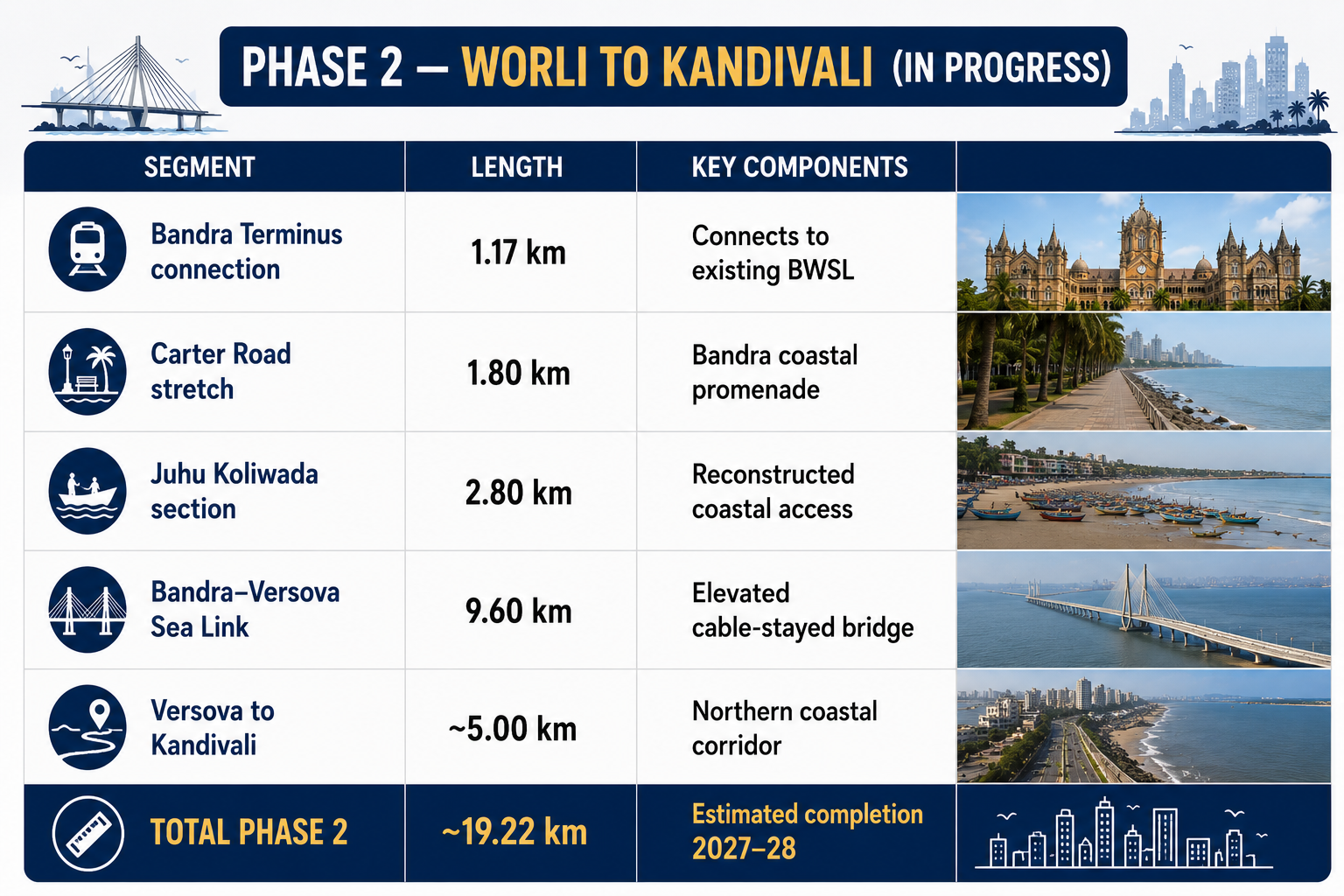
Phase 2 - Integrates with the upcoming Versova–Bandra Sea Link (VBSL), a ₹18,120 crore project that will connect Versova directly to Bandra, creating a seamless western seafront artery for the first time in Mumbai's history.
 Property Price Impact: How Much Have Prices Already Moved?
The Coastal Road has had a measurable, documented impact on real estate values across the western corridor. Here is the area-by-area picture as of May 2026:
Marine Lines & Girgaon (South Mumbai)
Marine Lines was always desirable but historically constrained by traffic. Post-Phase 1, South Mumbai's accessibility has been transformed.
Resale price appreciation: 25–35% since Phase 1 began in 2022
Current average rate: ₹30,000–₹45,000 per sq ft for mid-tier; ₹50,000–₹70,000 per sq ft for premium sea-facing stock
Buyer profile: Institutional investors, HNIs relocating back to South Mumbai, NRI buyers
Worli (The Epicentre)
Worli is the single biggest beneficiary of the Coastal Road — a direct terminus for Phase 1 that has already seen transformative appreciation.
Current average rate: ₹66,400 per sq ft (average); premium sea-facing towers trading at ₹80,000–₹1.2 lakh per sq ft
Price appreciation: 20–30% over the past two years, post-Coastal Road announcement and delivery
Buyer demand: Ultra-HNI, NRI, UHNI — primary residences and trophy assets
Key projects: Multiple luxury tower launches by Godrej, Lodha, Oberoi Realty in the ₹8–50 crore range
Haji Ali & Breach Candy
Located directly on the Phase 1 corridor, these micro-markets have seen:
Resale rates climb 20–25% since 2022
Premium for sea-facing or Coastal Road–view units: 15–25% over non-facing units
Strong demand from end-users who had previously avoided South Mumbai due to commute concerns
Bandra West
Bandra remains Mumbai's aspirational address. The Coastal Road Phase 2 and the VBSL are already inflating property values here:
Current apartment prices: ₹50,000–₹1 lakh per sq ft
Redevelopment surge: Several old buildings in Bandra West are being redeveloped with developers offering 100–150% additional area to existing owners, anticipating premium post-infrastructure valuations
Price trajectory: Values have been rising steadily and are expected to hold premium as connectivity improves further
Juhu
Juhu benefits from the northern sections of Phase 2 and the Bandra–Versova connectivity:
Prices moved from ₹58,950 per sq ft in September 2025 to ₹61,000 per sq ft in March 2026 — a 3.5% move in just 6 months
Primary sales in Juhu rose from 12 units in 2020 to 157 units in 2025 — a 1,200% surge in five years
Versova
Versova is arguably the most interesting value play in Mumbai real estate in 2026. It is the only major western suburb coastal pocket where infrastructure gains are partially priced in but not fully delivered.
2024 average price: ₹40,831 per sq ft
2025 average price: ₹49,458 per sq ft
Early 2026 average price: ₹55,727 per sq ft
Two-year appreciation: ~36.5%
Despite this appreciation, Versova still trades at a significant discount to Juhu (₹61,000) and Bandra (₹75,000+), suggesting further upside as the VBSL and Phase 2 segments deliver.
The Connectivity Revolution: Why Travel Time Drives Property Value
In Mumbai real estate, time is the most valuable commodity. Property prices are not primarily a function of the physical space you get — they are a function of how efficiently that space connects you to where you work, school your children, and spend your leisure time.
The Coastal Road rewrites this equation for the western corridor:
Journey | Before Coastal Road | After Coastal Road | Time Saved |
Nariman Point → Worli | 45 min (peak) | 10–15 min | 30–35 min |
Marine Lines → Bandra | 60–75 min | 20–25 min | 40–50 min |
South Mumbai → Juhu | 90–120 min | 35–40 min | 50–80 min |
BKC → Marine Lines | 50–60 min | 20 min | 30–40 min |
For a professional who commutes daily, saving 45–60 minutes per trip translates into roughly 200–250 hours per year. The willingness of buyers and tenants to pay a premium for this time saving is precisely what drives Coastal Road corridor property values higher.
Investment Analysis: Where Is the Real Opportunity in 2026?
Zone A — Already Priced In (Worli, Marine Lines, Haji Ali)
These zones have captured most of the Phase 1 upside. Prices are at historic highs. Buyers here are paying for:
Certainty of infrastructure delivery
Status and trophy value
Strong rental demand from expats, senior executives, and HNIs
Investment verdict: Good for capital preservation and rental income. Limited capital appreciation upside. Best suited for long-horizon hold (5+ years) or end-use.
Zone B — Partially Priced In (Bandra West, Bandra East)
Bandra has priced in the Coastal Road premium but continues to benefit from broader demand drivers — aspirational buyer demand, limited new supply, and proximity to BKC, one of Mumbai's prime commercial districts.
Investment verdict: Strong for rental yield (3.5–4.5% gross). Capital appreciation more moderate than Zone C but lower risk. Best for investors seeking rental income.
Zone C — Best Upside Remaining (Versova, Juhu Koliwada, Oshiwara)
These areas are in the Phase 2 corridor but infrastructure is not yet fully delivered. The runway for appreciation is real:
VBSL expected completion: 2027–28
Versova still at ₹55,727 vs Juhu's ₹61,000+ — a 9% discount that will narrow
CRZ relaxations enabling redevelopment of old coastal buildings in this belt
Investment verdict: Best risk-adjusted upside in the Coastal Road theme. Ideal horizon: 3–5 years. Caveat: Phase 2 completion timelines have shifted before; buy for medium-term hold, not quick flip.
Zone D — Infrastructure Adjacency (Andheri West, Lokhandwala, DN Nagar)
These areas do not sit on the Coastal Road alignment but are within 1–2 km of the corridor's northern sections. They benefit from decongestion effects as Coastal Road draws traffic away from SV Road and Link Road.
Investment verdict: Secondary beneficiaries. Appreciation will be moderate but consistent. Better value per square foot relative to Zone B/C.
Infrastructure Synergies: Coastal Road + Metro Network
The Coastal Road's impact is amplified by the simultaneous expansion of Mumbai's metro network. By 2026, the following synergies are creating multi-modal corridors:
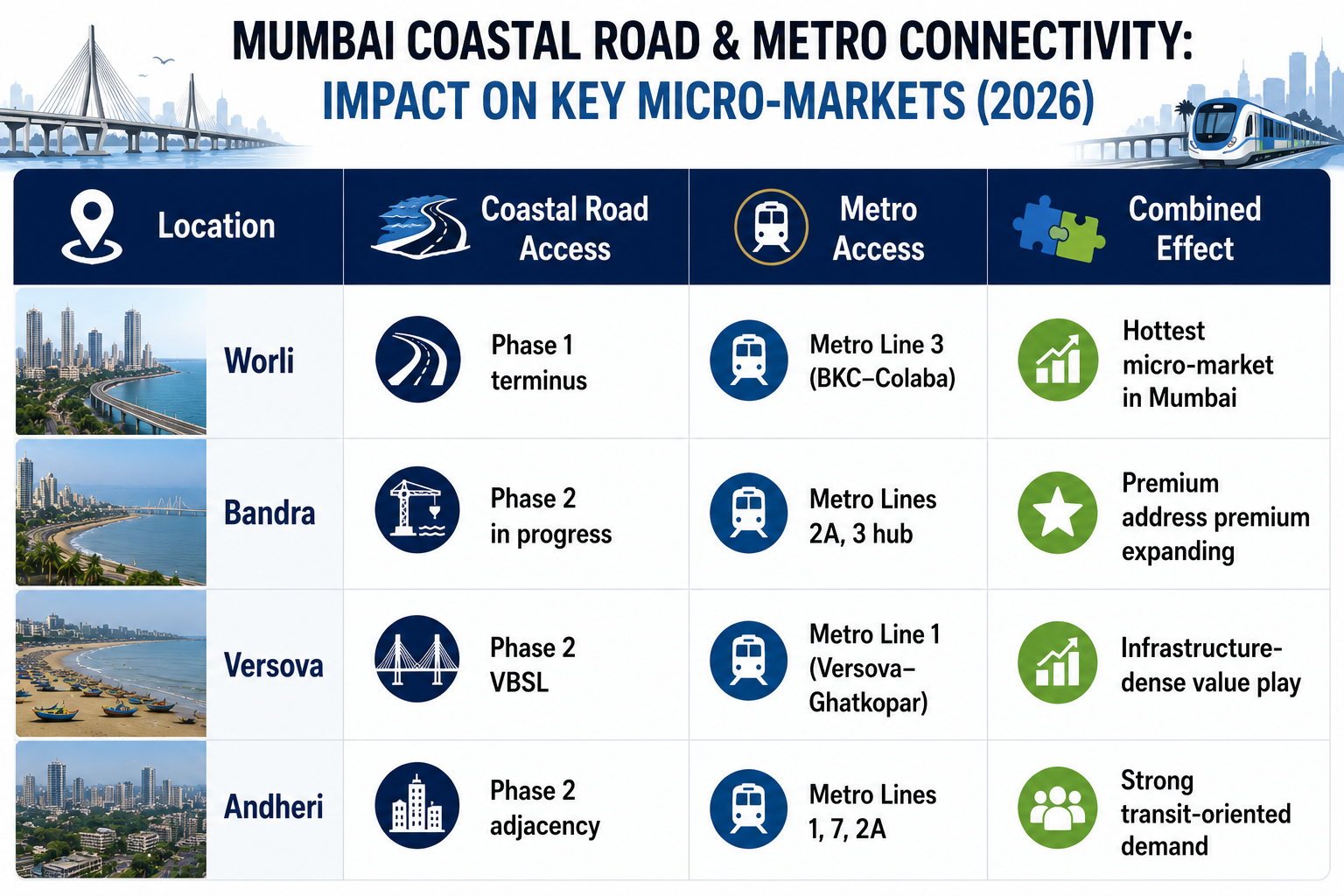
The intersection of the Coastal Road and metro network in a single locality — particularly Worli and Bandra — is what justifies premium pricing and makes these zones structurally different from other Mumbai localities.

Get in Touch
Let our experts help you answer your questions

 +91
+91


Get in Touch
Let our experts help you answer your questions
+91