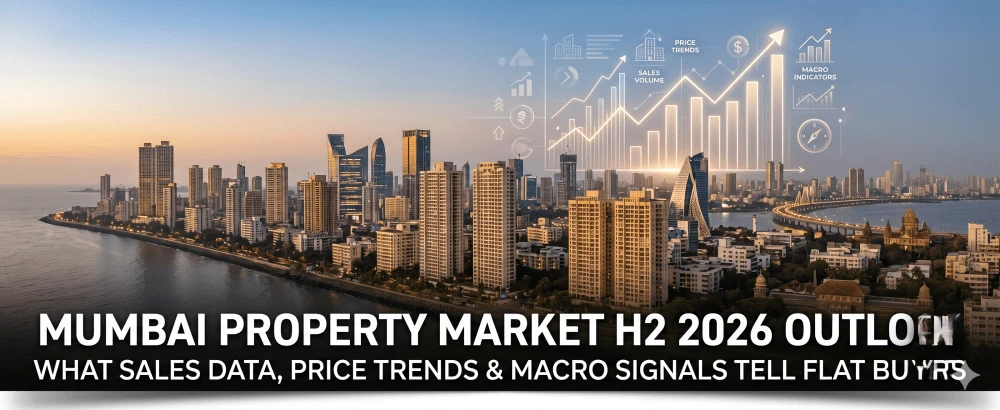
Mumbai Property Market H2 2026 Outlook: What Sales Data, Price Trends & Macro Signals Tell Flat Buyers

Introduction
Mumbai's residential property market has been consistently surprising analysts in 2026. Against a backdrop of steady interest rates, an infrastructure buildout that is the most ambitious since the 1990s, and end-user demand that refuses to cool, the city's flat market has delivered record-breaking registration numbers month after month. As we cross the mid-year point, buyers and investors are asking the same question: what does the second half of 2026 hold?
This guide compiles the latest sales data, price trend analysis, segment-level insights, and infrastructure signals to help flat buyers and investors make informed decisions in H2 2026. If you are weighing a purchase or waiting for the right moment to enter the market, the evidence laid out here should sharpen your thinking.
H1 2026 in Numbers: Mumbai's Strongest Start in 14 Years
The headline story of H1 2026 is registration volume. Mumbai's Department of Registrations and Stamps has produced extraordinary month-on-month data that signals deep, fundamental demand rather than speculative activity.

Source: Knight Frank India; Maharashtra Department of Registrations and Stamps.
The March 2026 figure of 15,516 units is the highest monthly registration tally in the past 14 years. April and May confirmed this was not a seasonal spike - both months set their own 14-year records. The consistent volume above 12,000 units per month demonstrates that Mumbai's residential demand is structural, driven by owner-occupiers upgrading from rentals, and genuine family-formation buyers - not speculative momentum.
In May 2026, the Maharashtra state exchequer collected ₹1,051 crore in stamp duty revenue, reflecting both volume and a rising average transaction value.
What's Driving the Numbers: The Demand Composition
Understanding who is buying is as important as knowing how many are buying. The 2026 demand profile has several distinctive characteristics that will shape H2 2026 dynamics.
Mid-Segment Dominates
The ₹80 lakh–₹2 crore price band now accounts for the largest share of Mumbai's residential transactions. The ₹1–2 crore segment specifically has grown to 38% of all registrations in H1 2026, up from 32% twelve months ago. This reflects two structural shifts: first, rising aspirations among salaried buyers who want quality mid-size apartments rather than compact starter homes; second, new project launches by reputed developers targeting this exact price band in growing suburbs like Thane, Kharghar, Panvel, and the Western Suburbs.
Luxury Sustains
At the other end, luxury registrations (above ₹5 crore) now account for 7% of total MMR registrations. This is a meaningful and sustained share that reflects demand from HNI buyers, returning NRIs, and tech-sector wealth. The luxury segment is concentrated in South Mumbai, Worli, Bandra West, and Juhu, where average prices run ₹35,000–₹90,000 per sq ft.
Affordable Segment Faces Headwinds
The sub-₹50 lakh market is shrinking as a share of overall registrations, as pricing in extended suburbs rises with infrastructure investment. Buyers in this segment are increasingly moving to fringe markets - Dronagiri, Taloja, Ulwe in Navi Mumbai, and Virar-Vasai in the north - where 1BHK and small 2BHK units still trade at accessible price points.
Price Trends: Where Mumbai Stands in June 2026
The average property price across Mumbai touched ₹38,600 per sq ft in March 2026, up from approximately ₹37,850 per sq ft in June 2025 - an annualised appreciation of roughly 5–6%.
This city-wide average masks significant micro-market variation:

The most striking data point is Thane's 46% appreciation over three years - driven by the Metro extension, the Trans Harbour Link improving connectivity to Navi Mumbai, and a massive pipeline of new residential launches from tier-1 developers. For flat buyers who entered Thane in 2022–2023, the returns have been exceptional.
A Reuters analyst poll conducted in early 2026 projects 5–7% annual price appreciation for Mumbai residential over the next three years. This forecast aligns with Mumbai's structural fundamentals: supply constraints in prime locations, sustained end-user demand, and infrastructure investment that keeps unlocking new demand corridors.
Infrastructure: The H2 2026 Appreciation Catalysts
Infrastructure developments are the single most reliable predictor of flat price appreciation in Mumbai. Buyers who identify areas benefiting from infrastructure in the next 12–24 months tend to capture the strongest returns.
Metro Line 3 (Aqua Line) - Impact Deepening
Mumbai's Metro Line 3, the 33.5 km underground corridor connecting Cuffe Parade to SEEPZ, became fully operational in 2024. Its impact on property prices along the corridor - particularly in Dadar, Shivaji Park, BKC, and Aarey - is still playing out in 2026. Flats within 500m of Metro Line 3 stations have seen 10–15% premium pricing versus the surrounding micro-market average.
Navi Mumbai International Airport (NMIA)
The NMIA at Dronagiri-Ulwe is the biggest long-term appreciation catalyst in the Mumbai Metropolitan Region. As the airport moves closer to commercial operation, the areas of Dronagiri, Ulwe, Panvel, and New Navi Mumbai are seeing accelerated price discovery. Buyers who enter now are positioning ahead of an airport-driven demand wave that infrastructure analysts project will mirror the Hyderabad-RGIA pattern (where areas near Shamshabad airport tripled in value over 10 years post-opening).
Trans Harbour Link
The Atal Setu (Trans Harbour Link), now operational, has meaningfully compressed travel time between Mumbai and Navi Mumbai. This has catalysed demand for flats in Kharghar, Vashi, Kopar Khairane, and Airoli from buyers who work in Mumbai but want Navi Mumbai's better affordability and quality of living. Expect this corridor to continue outperforming in H2 2026.
Coastal Road Phase 2 and Metro Lines 2A and 7
The full operational impact of Coastal Road and the Metro 2A/7 network on Western Suburb property prices is still unfolding. Areas along Dahisar-Andheri (Metro 7) and Andheri-Bandra-Dahanu Road (Metro 2A) corridors are seeing steady appreciation as commute times reduce and developer interest intensifies.
H2 2026 Outlook: What to Expect from July to December
Based on the H1 data, analyst forecasts, and infrastructure signals, here is what buyers and investors should anticipate in the second half of 2026.
Price Trajectory
Expect continued moderate appreciation of 4–7% on an annualised basis across most Mumbai micro-markets in H2 2026. The dramatic double-digit price spikes of 2021–2022 are behind us; what we are now seeing is a more sustainable, fundamentals-driven appreciation cycle. This is actually healthy - it means price growth is anchored to income growth and real demand rather than speculative buying.
Premium micro-markets like Worli, Bandra, and South Mumbai may outperform the city average if luxury demand remains robust. NMIA-adjacent areas (Dronagiri, Ulwe, Panvel) could see disproportionate appreciation as airport milestones progress.
Volume Outlook
Registration volume is expected to remain robust but will likely moderate from the exceptional H1 highs. The festive season (September–November) typically sees a 15–20% uptick in registrations as developers launch new projects and offer pre-festive pricing benefits. Buyers planning to enter the market have historically captured good deals and new inventory in the August–September window, just before festive demand pushes prices upward.
Interest Rate Environment
The Reserve Bank of India has maintained a broadly accommodative stance in H1 2026. Home loan interest rates remain in the 8.5%–9.5% range across major lenders, having softened slightly from their 2023 peaks. Any further RBI rate reduction in H2 2026 would provide additional EMI relief for buyers and stimulate demand in the ₹50 lakh–₹1.5 crore segment.
New Supply Pipeline
Developer activity in H1 2026 has been strong, with new launches concentrated in Thane, Navi Mumbai, and Western Suburbs. A robust new supply pipeline maintains buyer choice but also creates competitive pressure on developers to offer incentives - particularly for under-construction projects where buyers can negotiate payment plan flexibility and early-booking discounts.
Segment-Specific H2 2026 Outlook
Affordable Flat Buyers (Budget: Under ₹70 lakh)
The extended suburbs of Navi Mumbai (Dronagiri, Taloja), Virar-Vasai, Badlapur, and Mira Road remain the go-to destinations. PMAY 2.0 subsidies (₹2.5 lakh for eligible buyers) can meaningfully reduce the effective acquisition cost. Buyers in this segment should move before festive season demand compresses the available stock.
Mid-Segment Buyers (Budget: ₹70 lakh–₹2 crore)
This is where H2 2026 presents the best opportunities. Thane, Kharghar, Airoli, and Kopar Khairane offer a combination of quality product, infrastructure upside, and reasonable price points. The ₹80 lakh–₹1.5 crore range is where the deepest buyer pool sits, ensuring resale liquidity is healthy.
Premium and Luxury Buyers (Budget: ₹2 crore+)
Chembur and Powai (Central Suburbs) are the two markets offering the best value in the premium segment in H2 2026. Chembur, in particular, benefits from its proximity to BKC and the Eastern Freeway, with 2BHK and 3BHK apartments in the ₹2–4 crore range still offering meaningful upside in appreciation relative to South Mumbai's fully priced market.
NRI Buyers
The rupee's relative stability and Mumbai's strong appreciation track record make 2026 a compelling entry year for NRI buyers. 3BHK flats in established corridors - Bandra, Chembur, Kharghar - generate meaningful rental income in absolute terms and offer family-use flexibility. See [NRI Buying Property in Mumbai 2026](/blog/nri-buying-property-mumbai-2026) for the full legal and financial framework.
The Buyer's Action Guide for H2 2026
- If you are considering a flat purchase between July and December 2026, here is a practical framework for maximising your outcome.
- August–September (Pre-Festive Window): This is historically the best window to begin your property search. Developer inventory is freshest, and you have time to negotiate before the festive rush. Pre-launch bookings from reputed developers also open up in this window, offering 10–15% below expected launch pricing.
- October–November (Festive Season): Developers offer sweeteners - waived stamp duty, free parking, flexible payment plans - but underlying demand also rises sharply, compressing your negotiating room. If you find the right property in this window, buy; but do not overpay chasing a festive offer.
- December (Year-End): A secondary negotiation window opens as developers push to close their year-end numbers. Buyers who have done their research in August–September can often close at favourable terms in December.
Due Diligence Essentials: Before any purchase, verify the project's RERA registration on MahaRERA's website, check the builder's delivery track record, review the approved layout plan, and ensure the title is clear. For under-construction purchases, insist on a registered agreement and link disbursements to construction milestones.
Risk Factors to Monitor
While H2 2026's outlook is positive, buyers should be aware of the following risk factors.
- Global interest rate headwinds If global inflation re-accelerates and the RBI is forced to raise rates, home loan EMIs will rise, moderating demand in the ₹50 lakh–₹1.5 crore segment.
- New supply volume in specific corridors: Thane and Navi Mumbai have a very active new launch pipeline. While this is healthy for buyers (it maintains competitive pricing), a sudden excess of supply in specific micro-markets could temporarily dampen price growth.
- Execution risk on infrastructure projects: Airport and metro timelines in India are subject to delays. Buyers entering purely on an infrastructure appreciation thesis should have a 7–10 year investment horizon to allow for project execution variability.
## Conclusion
Mumbai's property market is entering H2 2026 with significant momentum behind it. Fourteen-year registration highs, a mid-segment demand surge, robust infrastructure development, and a moderate appreciation trajectory all point to a market that rewards thoughtful buyers. Whether you are a first-time flat buyer, an investor building a portfolio, or an NRI looking to enter the Mumbai market, H2 2026 presents genuine opportunities - particularly in growth corridors like Thane, Navi Mumbai, and Chembur.
The key to capturing these opportunities is preparation: define your budget and investment horizon, shortlist 3–4 micro-markets aligned with infrastructure catalysts, and identify RERA-registered projects from reputed developers. Once you have that framework in place, the current market has plenty to offer.
Start your Mumbai flat search on blox.xyz - where thousands of verified listings across Mumbai, Thane, and Navi Mumbai are updated daily. Your next investment opportunity is a search away.
Frequently Asked Questions
Is H2 2026 a good time to buy a flat in Mumbai?

Which areas in Mumbai will see the highest appreciation in H2 2026?
Will property prices fall in Mumbai in H2 2026?
What is the stamp duty in Maharashtra in 2026?

Get in Touch
Let our experts help you answer your questions

 +91
+91


Get in Touch
Let our experts help you answer your questions
+91