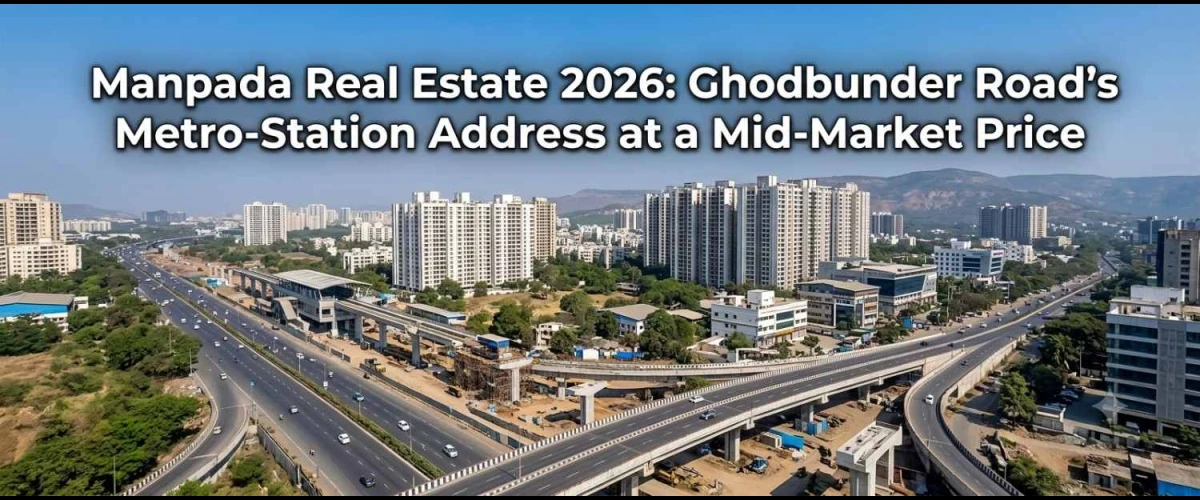
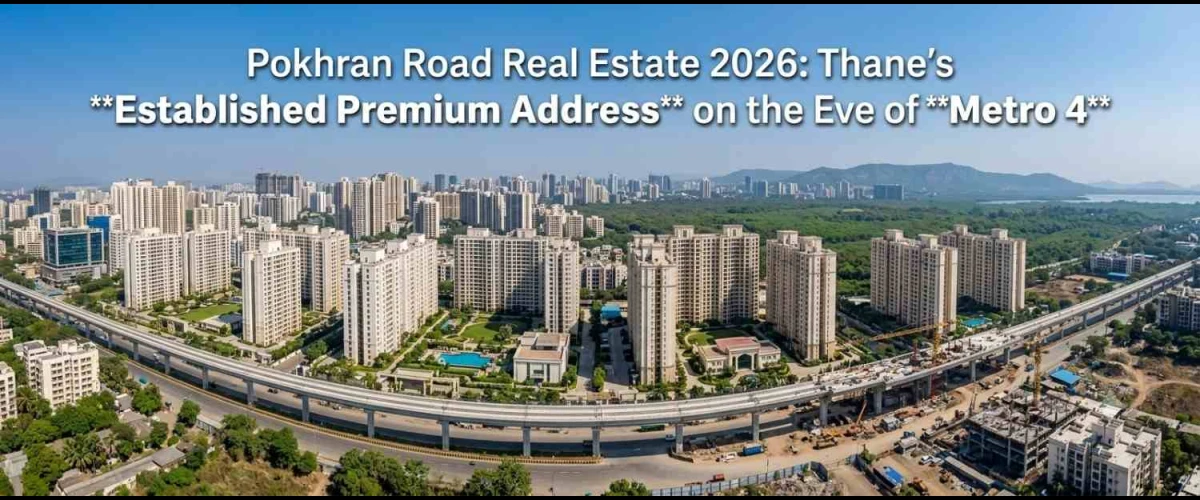
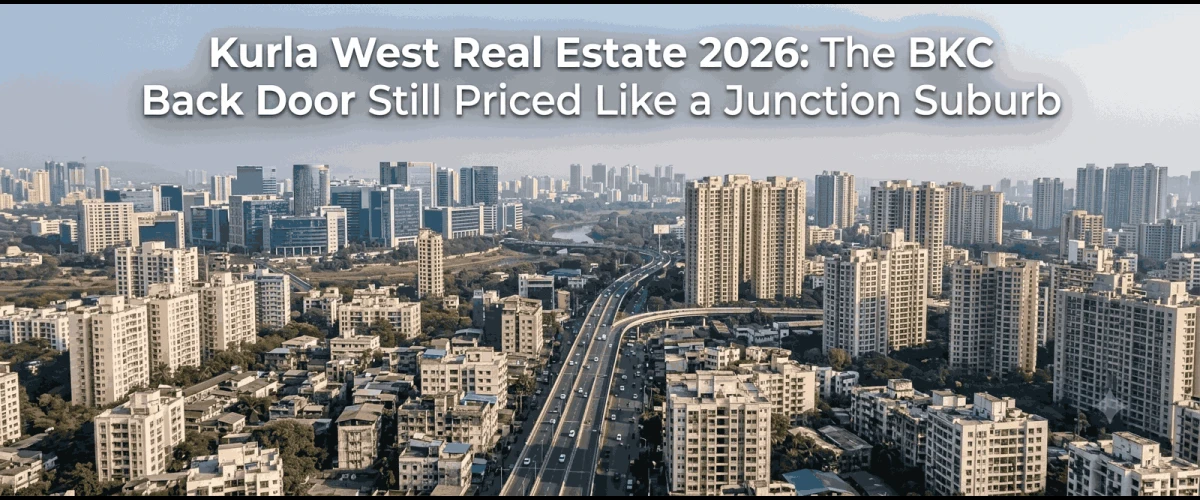
Mumbai Real Estate Mid-Year Market Report 2026: Sales Data, Price Trends, Infrastructure Drivers & H2 Outlook


Halfway through 2026, Mumbai's real estate market has delivered something analysts rarely see: a sustained confluence of positive fundamentals across sales volumes, pricing, new launches, and infrastructure delivery — all at the same time.
May 2026 set a 14-year record for property registrations with 12,315 transactions. Capital values across the Mumbai Metropolitan Region have surged to ₹27,009 per sq ft on average — up 32% year-on-year and 10% quarter-on-quarter. Q1 2026 produced a record 19,775 new residential unit launches. And the repo rate, now at 5.25%, has significantly reduced EMI burdens for mid-income buyers, bringing a wave of first-time purchasers into the market.
This mid-year report pulls together the critical data, analyses the key drivers, identifies which segments and micro-markets are outperforming, and offers a data-grounded outlook for the second half of 2026. Whether you are a buyer deciding when to transact, an investor assessing where to allocate capital, or a market observer tracking one of Asia's most important property markets — this is your definitive mid-point review.
Part 1: Sales and Registration Data — The Numbers That Define 2026
May 2026: A 14-Year Record Month
Mumbai city recorded 12,315 property registrations in May 2026, marking:
7% growth year-on-year over May 2025
The highest May registration figure in 14 years
Stamp duty revenue of ₹1,051 crore — a significant contributor to state exchequer
The achievement is particularly notable given that May is typically a softer month, wedged between Q1's seasonal peak and the festival season acceleration of Q3. The fact that end-user demand sustained record levels through a "shoulder month" signals structural depth in Mumbai's housing market rather than cyclical spike.
April 2026: The Stronger Month
April 2026 had delivered 13,864 registrations — the highest April figure in 14 years. The month-on-month decline from April to May (14% drop in registrations, 9% in stamp duty revenue) is normal seasonal variation, not a demand signal. The year-on-year growth in both months is what matters.
Q1 2026 Snapshot
The January–March 2026 quarter produced:
40,231 total registrations across the quarter
Record 14-year high in March 2026 for single-month registrations
19,775 new residential unit launches — 25% quarter-on-quarter growth, 7% year-on-year
New launches skewed towards mid-segment (48% of supply), followed by high-end and luxury (27%), and affordable housing (25%)
Rolling 12-Month Aggregate
The 12-month window from June 2025 to May 2026 produced:
87,282 total registrations
Total transaction value of ₹1,36,336 crore
Average transaction value: ₹15.62 lakh per registration (calculated average)
Part 2: Price Trends — Where Values Stand at Mid-Year
Headline Capital Value
Mumbai MMR capital values have reached ₹27,009 per sq ft on average — a figure that represents:
+10% quarter-on-quarter appreciation (Q4 2025 to Q1 2026)
+32% year-on-year appreciation (Q1 2025 to Q1 2026)
This is extraordinary by any historical measure. Mumbai's long-term average annual appreciation is typically cited at 7–10%, meaning the 32% year-on-year gain reflects either significant catch-up after post-pandemic suppression, structural demand-supply imbalance, or a combination of both.
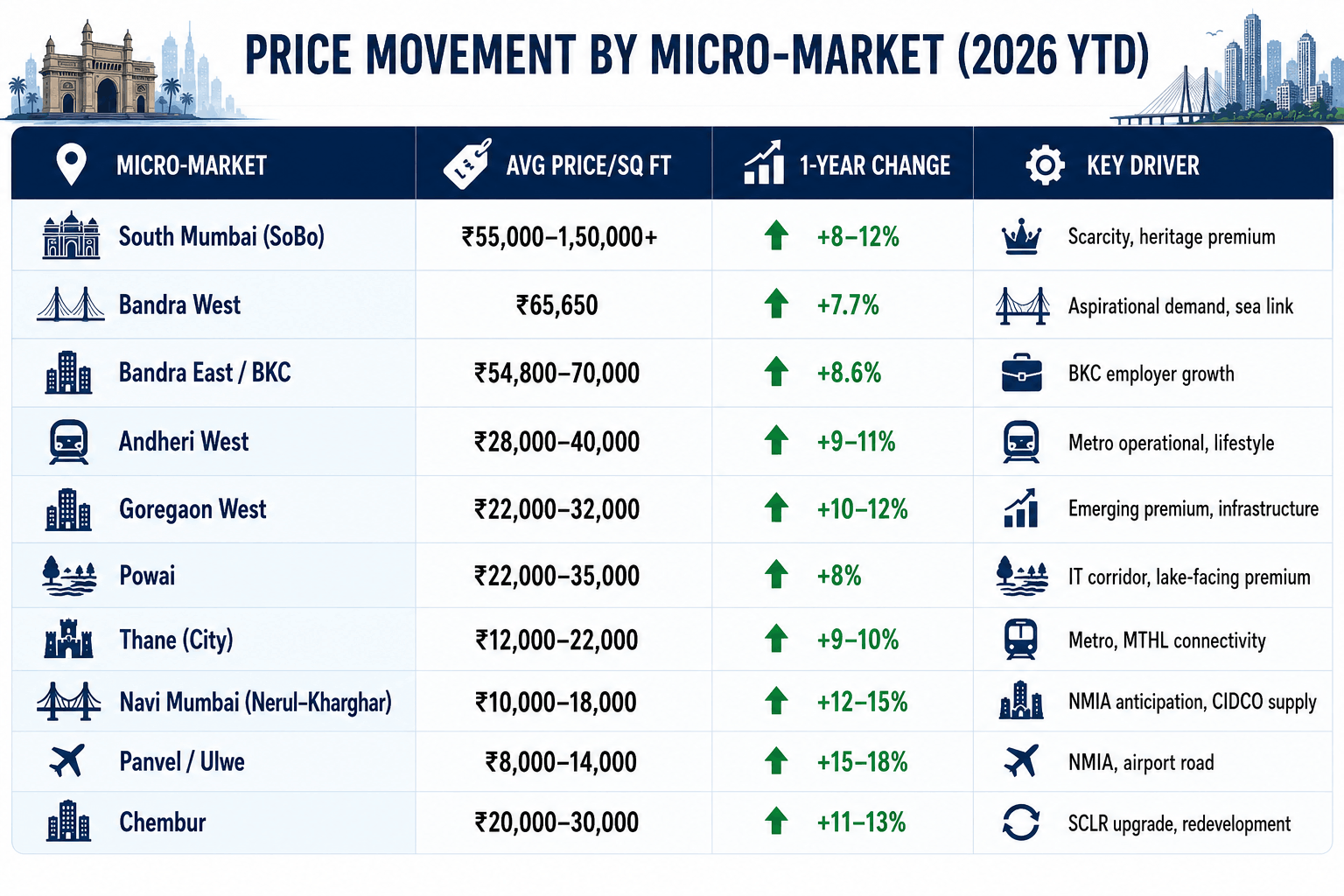
Key Observation: The highest percentage appreciation is occurring in Navi Mumbai micro-markets — particularly Panvel and Ulwe — driven by the anticipated operationalisation of the Navi Mumbai International Airport (NMIA) in late 2026. These markets are seeing 15–18% year-on-year price growth from a lower base, making them the highest-velocity appreciation stories in MMR today.
Segment-Level Pricing: Where Buyers Are Transacting
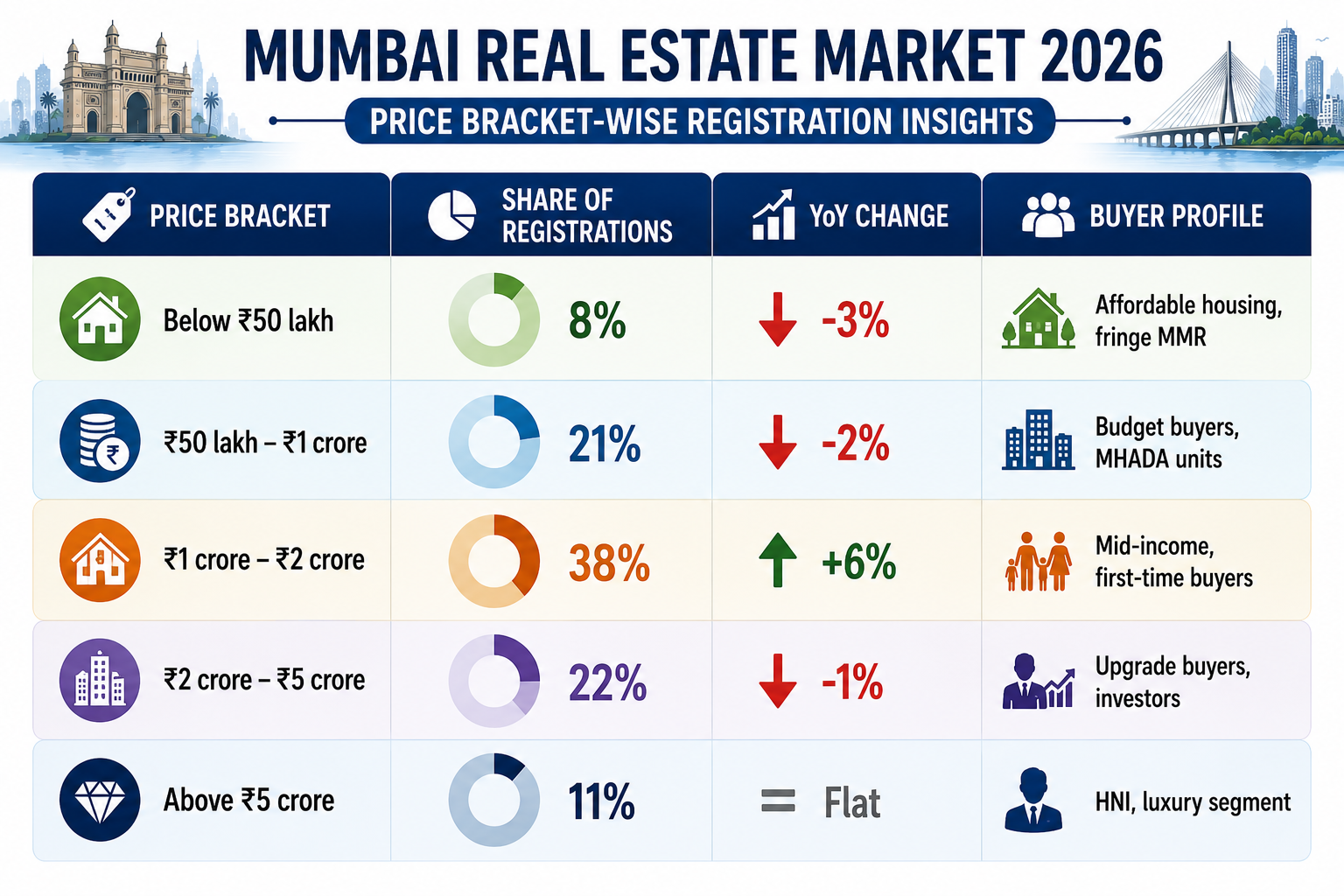
The ₹1–2 crore ticket size now accounts for 38% of all registrations in 2026 — up from 32% a year ago. This bracket is dominated by end-users, PMAY beneficiaries, and first-time buyers priced out of the western suburbs.
Part 3: Infrastructure Milestones Driving the Market in 2026
Infrastructure has always been Mumbai's property-price engine. Projects that cut commute time by 20 minutes translate directly into 10–20% price premiums in the benefiting micro-markets. Here is where the most significant infrastructure activity stands at mid-2026:
Metro Network: Operational and Pipeline
Operational Lines:
Metro Line 2A (Dahisar to DN Nagar): Fully operational, driving property appreciation in Borivali, Kandivali, and Malad West corridors
Metro Line 7 (Dahisar East to Andheri East): Connecting eastern suburbs to the western rail corridor
Metro Line 1 (Versova-Andheri-Ghatkopar): The OG metro line, now supplemented by other lines
Under Construction (Expected 2026–2028):
Metro Line 3 (Aarey to Cuffe Parade): The underground line connecting BKC to south Mumbai — once fully operational, it will transform BKC-to-Nariman Point commute times from 60+ minutes to under 20 minutes. Properties along its corridor (Bandra East, Dharavi station, CSMT, BKC stations) are already pricing in anticipated operational impact.
Metro Line 2B Extension through Bandra
Metro Line 4 (Wadala to Kasarvadavali)
Metro Line 6 (Swami Samarth Nagar to Vikhroli)
The metro network's expansion is systematically repricing Mumbai's transit-adjacent micro-markets. Areas within 500 metres of operational or confirmed metro stations have historically outperformed the broader MMR market by 8–12% annually.
Navi Mumbai International Airport (NMIA)
NMIA remains the single most powerful medium-term demand driver for Navi Mumbai real estate. Expected to begin initial operations in late 2026, the airport will:
Create direct employment for 30,000+ people in Phase 1 operations
Stimulate ancillary employment (hospitality, logistics, retail) in the Panvel-Ulwe-Dronagiri-Uran corridor
Significantly reduce south Mumbai's congestion premium over north-eastern corridors
Transform Panvel from a "far out" dormitory town to an airport-adjacent commercial hub
Property prices in the NMIA impact zone (Ulwe, Dronagiri, Panvel, Taloja) have already seen 15–18% year-on-year appreciation — and analysts expect further acceleration as the airport moves from construction to operational phase.
Mumbai Coastal Road
The Bandra-to-Worli and Worli-to-Marine Lines stretches of the Mumbai Coastal Road are progressing, with significant sections now operational. The coastal road is expected to:
Cut travel time between Bandra and Marine Lines from 60+ minutes to under 20 minutes
Reduce traffic pressure on the Bandra-Worli Sea Link
Catalyse further appreciation in the western coastline corridor: Worli, Dadar, Mahim, Bandra
Properties along the western coast have seen a 10–12% appreciation premium attributable specifically to coastal road completion expectations.
Eastern Freeway and MTHL Impact
The Mumbai Trans Harbour Link (MTHL / Atal Setu), now fully operational, has cut the Sewri-to-Chirle (Navi Mumbai) drive from 60 minutes to under 20 minutes. Its impact is particularly visible in:
Chembur: Now firmly established as a premium eastern suburb with strong appreciation
Ulwe and Belapur: Direct beneficiaries of reduced travel time to south Mumbai jobs
Panvel: Now reachable from Fort/Nariman Point in under 30 minutes
Part 4: Demand Drivers — What Is Propelling the Market
RBI Repo Rate: At 5.25%, Lowest in the Cycle
The Reserve Bank of India's repo rate stands at 5.25% — a level that has significantly reduced home loan EMI burdens. Compared to the peak of 6.5% in 2023, a borrower on a ₹1 crore home loan (20-year tenure) has seen their monthly EMI reduce by approximately ₹8,000–₹10,000. This material reduction in affordability barrier has directly expanded the first-time buyer market — visible in the ₹1–2 crore segment's surge from 32% to 38% of all registrations.
The RBI is widely expected to hold rates at current levels through 2026, providing a stable low-rate environment for home purchase decisions.
End-User Dominance: Structural Not Cyclical
A key characteristic of the 2026 market — distinguishing it from pre-2008 speculative cycles — is the overwhelming dominance of end-user buyers. Analysts estimate that 70–75% of residential transactions in MMR in 2026 are for self-occupation. This structural end-user base provides price floor support and reduces crash risk if investor sentiment were to soften.
Premium Demand: Supply Constraint Meets Aspiration
Mumbai's island city geography means land supply is essentially fixed. Combined with rising incomes among Mumbai's expanding BFSI, tech, and professional class, this has created a structural premium market where supply cannot keep pace with demand. The luxury and ultra-premium segment (above ₹5 crore) has maintained its 11% share of registrations despite extraordinary price appreciation — confirming inelastic demand from high-net-worth buyers.
Redevelopment Pipeline: Mumbai's Future Housing Supply
With no greenfield land available in the island city or inner suburbs, Mumbai's new residential supply is increasingly coming from redevelopment — older buildings being demolished and rebuilt under new FSI norms. The city's 3.0 FSI for certain zones allows developers to significantly increase floor area, making previously unviable redevelopments financially attractive. Suburbs like Kurla, Chembur, Dharavi (the massive slum redevelopment project), and Bandra are seeing heavy redevelopment activity that will add premium supply in locations with historically tight inventory.
Part 5: Risk Factors and Market Cautions
No market analysis would be complete without addressing downside risks. Mumbai's 2026 market has multiple positives but is not without vulnerability.
Global Economic Uncertainty
The month-on-month decline in May registrations (14% drop from April) was partly attributed to global economic caution — elevated tariff environments, geopolitical uncertainty, and slower global trade growth. While India's domestic consumption story insulates housing to a degree, a significant global downturn would affect Mumbai's BFSI employment base and dampen luxury demand.
Affordability Ceiling in Premium Markets
At ₹65,000/sq ft in Bandra West and ₹27,009/sq ft MMR average, Mumbai is approaching affordability ceilings for broad mid-income segments. The 32% year-on-year appreciation in capital values, if sustained, mathematically outpaces income growth in any realistic scenario. Some cooling from the current pace of appreciation is both likely and healthy.
NMIA Delay Risk
Navi Mumbai property prices have substantially priced in NMIA operationalisation in late 2026. Any further delay to airport opening could dampen near-term sentiment in the Panvel-Ulwe corridor, creating a temporary price consolidation phase.
Developer Execution Risk
The record Q1 2026 new launch volumes (19,775 units) need to be converted into actual completions on time. Delays in under-construction projects — a perennial risk in Indian real estate — can hurt buyer confidence and create inventory overhang in specific micro-markets.
Part 6: H2 2026 Outlook — What to Expect
Festival Season (September–November): Expected Demand Acceleration
The Q3 festival season — Navratri, Dussehra, Diwali — historically produces Mumbai's strongest quarterly registration numbers. Developers typically time launches and offers to coincide with this period. Expect record or near-record festival season registrations in 2026, supported by low repo rates, NMIA anticipation, and continued end-user demand.
Price Trajectory: 5–7% Annual Appreciation Forecast
Analysts across Cushman & Wakefield, Knight Frank India, and ANAROCK forecast 5–7% annual price appreciation through 2026–2028. This is measured appreciation rather than the extraordinary 32% year-on-year that Q1 2026 produced — suggesting some normalisation ahead, but no correction.
Catalyst Watch: NMIA First Flight
NMIA's first commercial flight will be a watershed moment for Navi Mumbai real estate sentiment. Once operationalised, expect a short-term price surge in Panvel-Ulwe-Dronagiri followed by a consolidation as the initial FOMO rush subsides and long-term fundamentals take over.
Budget 2026–27 Expectations
The real estate industry is lobbying for:
Increased tax deduction limit on home loan interest (currently ₹2 lakh — seeking ₹5 lakh)
Rationalisation of long-term capital gains tax on property
Extension of PMAY-Urban 2.0 benefits to higher income groups
Any positive policy announcement in the upcoming Union Budget would be a market catalyst.
Buyer and Investor Action Guide for Mid-2026
If You Are an End-User Buyer
The current environment — stable low interest rates, post-correction base prices in outer suburbs, strong legal protections under RERA — is favourable for purchase. Do not wait for a price correction; 5–7% annual appreciation means each year of delay increases your acquisition cost. Focus on RERA-registered projects with credible developers and verifiable delivery timelines.
If You Are a Rental Investor
Target Navi Mumbai micro-markets (Kharghar, Panvel, Nerul) for the best combination of price, yield (4–6%), and appreciation potential. Bandra East's 5% yield is exceptional for an inner suburb. Avoid Bandra West and south Mumbai if rental income is your primary goal.
If You Are an Appreciation Investor
NMIA impact zone properties (Panvel, Ulwe, Dronagiri) offer the highest near-term velocity. For a 5–10 year horizon, Thane and Navi Mumbai's CIDCO-developed sectors offer the best risk-adjusted appreciation given ongoing infrastructure delivery.
If You Are an NRI Buyer
The RBI has maintained a stable FEMA framework for NRI property purchases, and the Rupee's relative stability has improved the USD/GBP/EUR effective price for foreign-currency earners. Focus on high-liquidity markets (Bandra, BKC fringe, Powai, Hiranandani) for ease of resale when you need to repatriate capital.

Get in Touch
Let our experts help you answer your questions

 +91
+91


Get in Touch
Let our experts help you answer your questions
+91