Property Title Verification Mumbai 2026: How to Check Documents, Avoid Fraud & Ensure a Clear Title Before You Buy

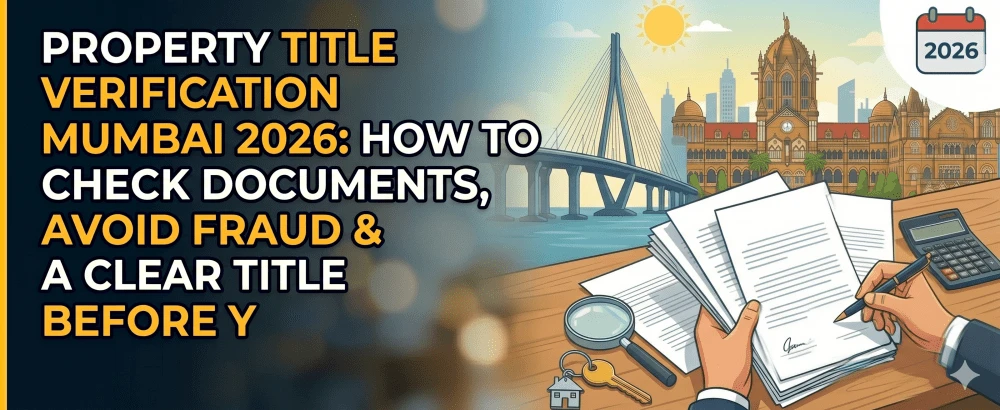
Buying property in Mumbai is one of the largest financial commitments most people will ever make. And yet, a significant number of buyers — particularly first-time purchasers — skip or rush through the one step that protects everything else: verifying that the property they are buying has a legally clear title.
Property title fraud is not a theoretical risk in Mumbai. Disputed ownership, concealed mortgages, forged sale deeds, encroachments on government land, and unresolved inheritance claims are all documented and recurring problems across the Mumbai Metropolitan Region. A buyer who does not verify the title before registering may discover — sometimes years later and after the property has been paid for in full — that their ownership is legally challenged or void.
This guide provides a complete, actionable property title verification framework for Mumbai in 2026: the documents you must check, the government portals you must use, the red flags that should stop a transaction in its tracks, and the professional costs involved.
What Is Property Title Verification?
A property title is the legal right to own and use a specific piece of real estate. Title verification is the process of confirming that:
- The seller is the rightful owner of the property
- The ownership chain from the first recorded owner to the current seller is unbroken, documented, and legally valid
- No outstanding loans, mortgages, or litigation are attached to the property
- The property's physical boundaries match what is recorded in government land records
- The property has obtained all necessary approvals and is not subject to government acquisition
In Mumbai, title verification typically requires tracing ownership documentation back at least 30 years. This 30-year period is not arbitrary — it reflects the statute of limitations on most property-related legal claims. Any "break" in the chain within this period must be explained and resolved before proceeding.
Why Title Verification Is Non-Negotiable in Mumbai
Mumbai's property market has several features that make title verification especially important:
Complex tenancy and slum heritage. Large parts of Mumbai — particularly in the western and central suburbs — were developed on land that was previously occupied by tenants, Gaothan (village) plots, or SRA (Slum Rehabilitation Authority) resettlement. These properties often carry legacy occupancy rights or government restrictions that are not always disclosed upfront.
Redevelopment transactions. Mumbai is a redevelopment-intensive city. When an old society is demolished and a new building constructed, the ownership chain goes through a developer agreement, allotment, and new sale deed. Each of these transitions must be verified. Fraudulent redevelopment agreements — where a developer takes possession but fails to complete the project or register flats — are a real and documented risk.
Power of Attorney (PoA) transactions. A significant portion of Mumbai property transactions, particularly resales, are conducted through a General Power of Attorney (GPA) rather than a direct registered sale deed. GPA transactions carry higher risk because the PoA can be challenged, revoked, or discovered to have been executed under duress. Always insist on a registered sale deed from the original owner; accept GPA-based transactions only after thorough legal review.
Encroachment on government/forest land. Some properties in peripheral zones — Aarey Colony boundaries, Borivali national park periphery, coastal regulation zone (CRZ) areas — are built on government or forest land. These properties may be legally unauthorized even if they carry a sale deed and index.
Step-by-Step Property Title Verification in Mumbai
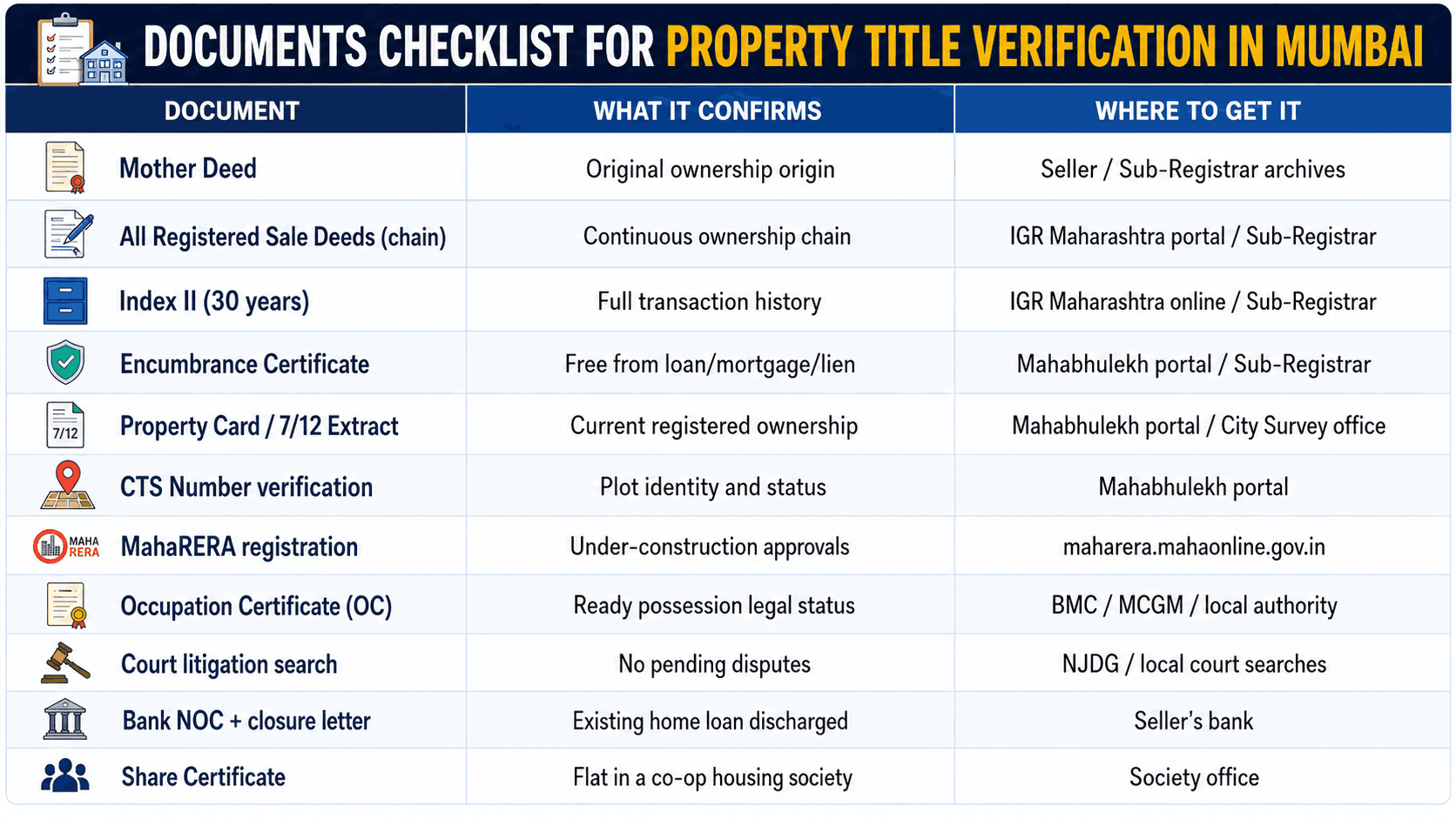
Step 1: Obtain and Verify the Mother Deed
The Mother Deed is the root document - the earliest recorded document establishing the origin of ownership for the land or property. In Mumbai, this is typically:
- A government grant or lease document
- A conveyance deed from MHADA, BMC, or a government authority
- A sale deed tracing back to the original owner
Ask the seller for the Mother Deed and trace all subsequent transactions from that origin to the present seller. Every transfer - sale, gift, inheritance, court decree - must be documented with a registered deed.
Step 2: Check Index II for All Transactions
Index II is a government-maintained summary record of every registered transaction involving a property. It is maintained at the Sub-Registrar's Office of the district and contains the names of buyer, seller, document type, date, and consideration amount for each registration.
In 2026, Index II can be accessed online through the IGR Maharashtra (Inspector General of Registration) portal at igrmaharashtra.gov.in. Search by CTS number or property address to retrieve the full transaction history.
Critical point: If a seller is reluctant to share the Index II, or if the Index II shows transactions that the seller did not disclose - treat this as an immediate red flag. A clean Index II with no hidden mortgages or transfers is non-negotiable before proceeding.
Step 3: Obtain the Encumbrance Certificate (EC)
The Encumbrance Certificate is a legal document certifying that the property is free from any financial or legal liabilities - mortgage, loan, lien, or court attachment - for the specified period.
How to obtain it in 2026:
- Visit the Sub-Registrar's Office of the district where the property is located
- OR apply online via the Mahabhulekh portal at mahabhulekh.maharashtra.gov.in
- Request EC for the previous 30 years - this is the minimum recommended period
- Cost: approximately ₹200 for a 30-year EC at government rates
An EC showing all registered transactions - including any bank loans taken against the property - is the primary document confirming that the property has not been pledged as collateral for an outstanding loan. If the property has an existing home loan registered against it, the seller must provide a bank No Objection Certificate (NOC) and closure letter confirming full repayment before the sale proceeds.
Step 4: Verify the Property Card and 7/12 Extract
For land and plotted properties in Mumbai, the Property Card (also called Form 1 or City Survey Record) is the key ownership document maintained by the City Survey Office. For agricultural land at the MMR periphery, the 7/12 Extract (Saat Baara Utara) from the Tahsildar's office performs a similar function.
Both can be verified online:
- Mahabhulekh portal (mahabhulekh.maharashtra.gov.in) for 7/12 extracts
- City Survey records through the Mumbai Metropolitan Region Development Authority (MMRDA) portal or Sub-Registrar office
Confirm that:
- The CTS (City Survey) number matches the property's physical location
- The owner's name on the property card matches the seller's identity documents
- There are no Mutation Entries (changes in ownership records) that are unexplained
Step 5: Conduct a Mahabhulekh and CTS Number Verification
Every plot in Mumbai has a CTS number - essentially an "Aadhaar for land" that uniquely identifies each plot in the urban land records system. In 2026, you can verify the CTS number on the Mahabhulekh portal, which gives you:
- The current registered owner's name
- Plot area
- Any government reservations or acquisition notices on the land
- Links to the property's land record history
If the CTS number on the seller's documents does not match the Mahabhulekh database, or if the database shows the land reserved for public use (road, garden, school, etc.), stop immediately and consult a property lawyer.
Step 6: Verify RERA Registration (For Under-Construction Properties)
If you are buying an under-construction flat, the project must be registered on MahaRERA (maharera.mahaonline.gov.in). RERA registration confirms:
- The developer has obtained all required approvals - IOD (Intimation of Disapproval), CC (Commencement Certificate), and layout approvals
- The project timeline and delivery date are officially registered
- Allottee funds are held in an escrow account and cannot be diverted
- The developer's history of project completions is publicly viewable
For under-construction projects, MahaRERA verification is in addition to - not instead of - the title verification steps above. Even a RERA-registered project must have a clean land title.
Step 7: Check for Pending Litigation
Search the National Court Record System (NJDG - National Judicial Data Grid) at njdg.ecourts.gov.in using the seller's name and property address to check if any civil, criminal, or family court proceedings relate to the property. Also ask your lawyer to search in:
- City Civil Court, Mumbai
- High Court of Bombay
- Consumer Courts (for builder disputes)
Properties under active litigation - particularly those in inheritance disputes, partition suits, or attachment orders - carry the risk of transaction reversal by court order even after registration.
Step 8: Publish a Legal Notice
Your property lawyer should publish a public notice in one English and one Marathi newspaper in the area where the property is located, announcing the proposed purchase and inviting any claims, objections, or mortgages to be declared within 14 days.
While this step cannot guarantee that all claims are surfaced - particularly undocumented private loans - it significantly protects the buyer's legal standing. A buyer who published notice and received no objections has a materially stronger position than one who did not.
 Red Flags: When to Stop a Transaction
Experienced Mumbai property lawyers identify the following as non-negotiable stop signals:
1. Missing original sale deeds. If the seller cannot produce original registered sale deeds - only photocopies - stop immediately. Original documents are legally necessary and their absence often signals that the property has been pledged to a moneylender or bank.
2. Undisclosed transactions in Index II. If Index II shows a mortgage, a sale deed, or a gift deed that the seller has not disclosed, assume the worst. This may be an attempt to sell a property already encumbered.
3. Power of Attorney as the primary ownership document. A GPA does not transfer ownership; it only authorizes an agent to act on behalf of the owner. Buying on the basis of a GPA without confirming the principal is alive, competent, and not having revoked the PoA is extremely high risk.
4. CTS number mismatch. If the CTS number on the seller's documents does not match the Mahabhulekh database, or if the plot area differs significantly, the property boundaries or ownership records are in dispute.
5. Pending litigation in court records. Any active property-related litigation - even if the seller asserts it will be resolved - makes the property ineligible for safe purchase until the case is disposed.
6. Government reservation on the plot. If Mahabhulekh shows the plot reserved for a road, school, garden, or public utility, the BMC or government has the right to acquire it at any time for the reserved use. Property value and usability are materially affected.
7. Missing Occupation Certificate. An OC confirms the building was constructed as per approved plans and is legally fit for habitation. Without OC, the property cannot be sold with a clear legal status, and home loans are generally not available.
What Does Title Verification Cost in Mumbai?
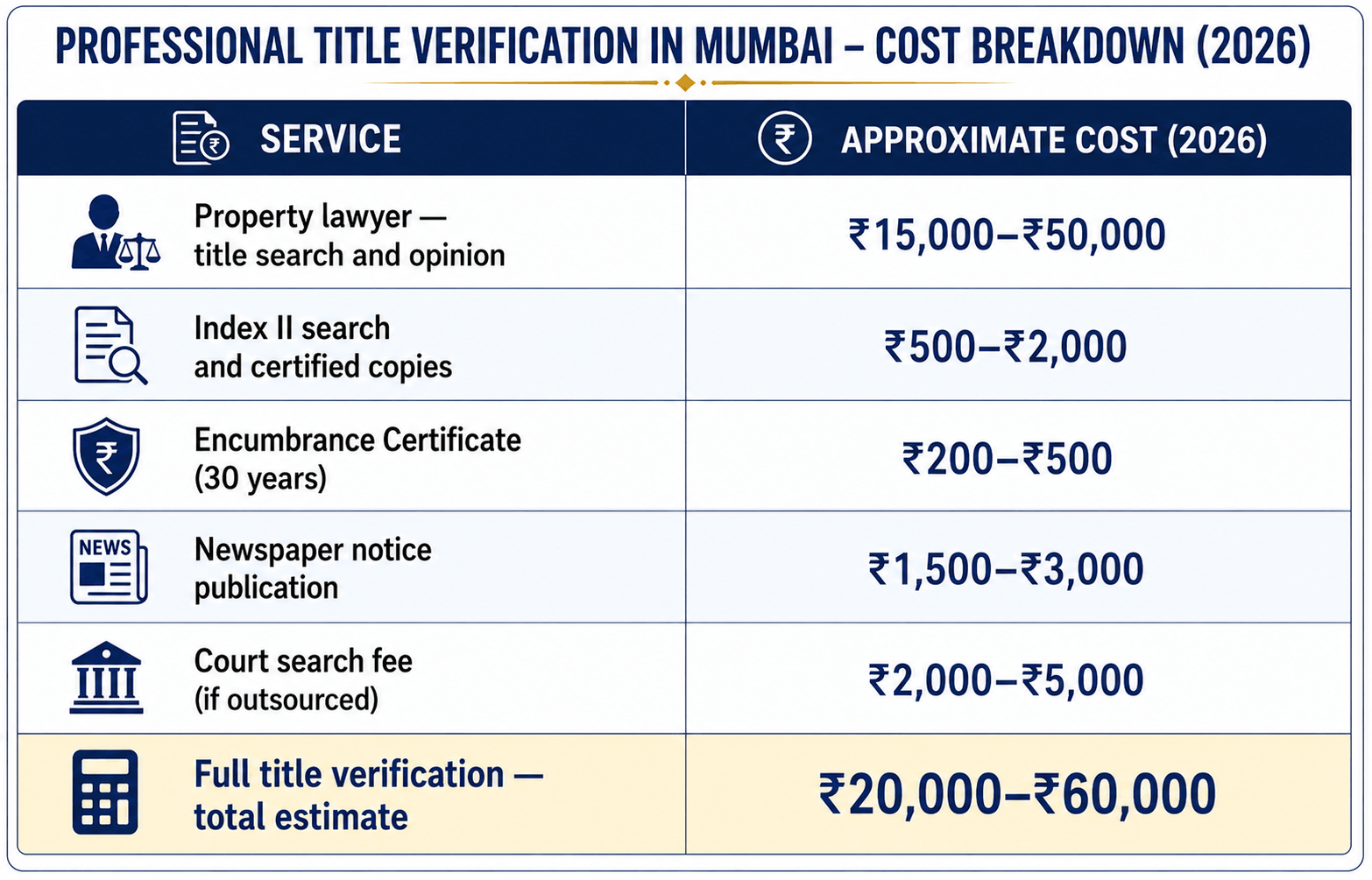
This cost is typically 0.1–0.3% of the property value - arguably the best-spent money in the entire transaction. Skipping this step to save ₹25,000 on a ₹1.5 Crore purchase is a risk-reward calculation that no rational buyer should accept.
How Long Does Title Verification Take?
A standard property title verification in Mumbai takes 2-4 weeks when handled by an experienced property lawyer. This includes:
- Document collection from seller: 3-5 days
- Index II and EC retrieval: 3-7 days
- CTS / Mahabhulekh verification: 1-2 days
- Court search: 3-5 days
- Legal notice publication and 14-day waiting period: 14 days (can run concurrently)
- Final title opinion: 2-3 days
For under-construction projects with a pending RERA check, add 3–5 days for MahaRERA document review.
Frequently Asked Questions
Can I do property title verification myself without a lawyer?

Is RERA registration enough to confirm a clean title?
What is the difference between Index II and an Encumbrance Certificate?
What happens if I skip title verification and a problem surfaces later?
Are properties purchased on Power of Attorney safe in Mumbai?

Get in Touch
Let our experts help you answer your questions

 +91
+91


Get in Touch
Let our experts help you answer your questions
+91