Pune Real Estate 2026: Complete Guide to Property Prices, Top Localities & Flat Investment Outlook

Introduction:
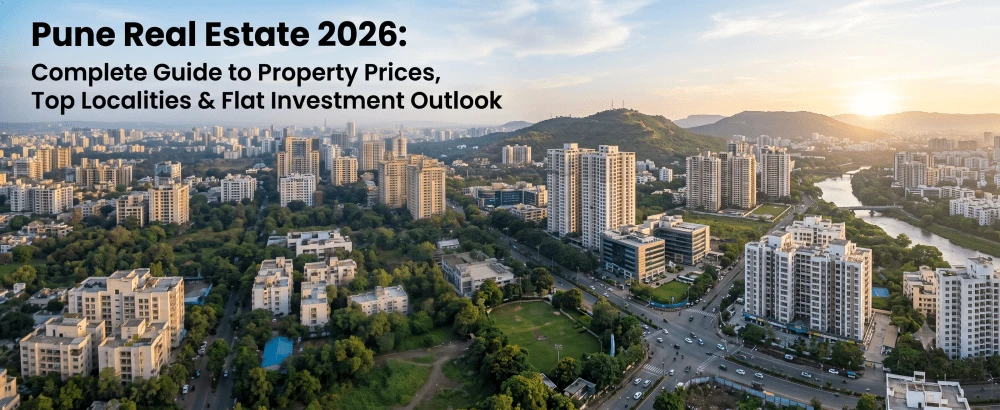
Pune has done something remarkable over the past decade. It absorbed India's largest IT expansion outside Bengaluru, built a metro system that is now partially operational, and still managed to keep flat prices meaningfully below Mumbai - while delivering appreciation rates that have outpaced most comparable Indian cities.
In 2026, Pune registers over 42,000 property transactions in a single financial year. The city's average flat price has crossed ₹12,950 per sq ft - a figure that would have seemed ambitious as recently as 2022. And yet, for buyers priced out of Mumbai and Navi Mumbai, Pune continues to represent one of the most credible value propositions in Indian real estate: a large, growing, multi-employer city with a functioning social infrastructure, improving connectivity, and a housing market that has shown consistent upward momentum without the volatility of speculative markets.
This guide covers everything a prospective flat buyer needs to know about Pune real estate in 2026: price bands by locality, the infrastructure projects shaping appreciation, which areas offer the best risk-reward balance, how RERA protects buyers in Maharashtra, and the questions you should be asking before signing anything.
Pune Real Estate by the Numbers: 2026 Data Snapshot
The scale of Pune's housing market is often underappreciated. Consider these 2026 figures:
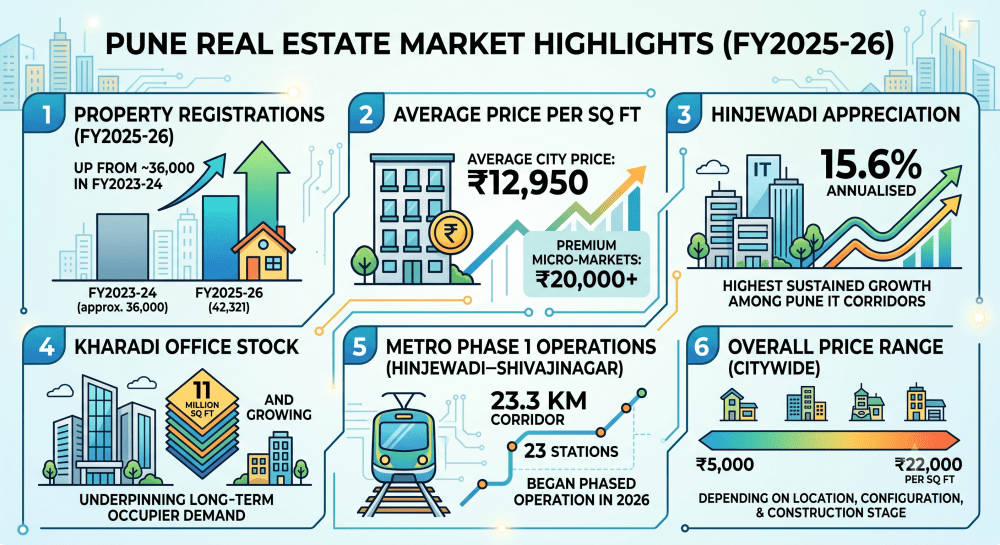
These numbers confirm Pune's status as India's second-largest organised real estate market after Mumbai-MMR - and a credible long-term investment destination in its own right.
Pune's Flat Price Map: Locality-by-Locality Breakdown
One of Pune's defining characteristics is its geographic diversity. The city spans several distinct corridors - the eastern IT belt, the western premium residential ring, the northern affordable suburbs, and the southern expansion areas - each with its own demand drivers and price dynamics.
Eastern IT Corridor: Kharadi, Viman Nagar, Kalyani Nagar
- Kharadi is Pune's most active real estate micro-market in 2026. The area sits at the intersection of two demand drivers: IT employment (the EON IT Park and World Trade Centre account for over 11 million sq ft of office space) and airport proximity (approximately 8 km to Pune Airport). Flat prices currently range from ₹8,500 to ₹14,500 per sq ft, with premium projects in the ₹9,500–₹12,000 band achieving 8–10% annual appreciation. The upcoming Mula-Mutha river flyover (due late 2026) will ease traffic connectivity to Hadapsar and the southern bypass, adding another infrastructure catalyst.
- Viman Nagar commands a premium over Kharadi by virtue of its established residential character and walkability. Average prices run from ₹10,500 to ₹15,000 per sq ft. The locality appeals particularly to working professionals who prioritise lifestyle amenities - the Phoenix Marketcity mall, multiple hospitals, and direct access to the airport bypass road. Supply is limited relative to demand, which has kept appreciation robust.
- Kalyani Nagar is Pune's aspirational mid-luxury address on the eastern bank of the Mula-Mutha river. Prices start at ₹11,000 per sq ft and extend well beyond ₹18,000 for riverside-facing premium inventory. The locality benefits from both IT employment proximity and strong social infrastructure - making it a preferred choice for senior executives and returning NRIs buying in Pune for the first time.
Western IT Corridor: Hinjewadi, Baner, Wakad
- Hinjewadi is the story of Pune's real estate decade. What was a periurban area with poor connectivity a decade ago is now a 15+ million sq ft IT campus - home to Infosys, Wipro, TCS, and dozens of mid-size technology companies. Current flat prices average ₹8,800 per sq ft with 15.6% annual growth, and inventory ranges from ₹45 lakh (1 BHK) to over ₹2.5 crore (4 BHK premium). The metro station at Hinjewadi Phase 1, now operational, is transforming the area's connectivity credentials - direct metro access to Shivajinagar reduces what was a 60–90 minute peak-hour commute by road to under 40 minutes.
- Baner sits between Hinjewadi and Pune's prime residential centre, offering a blend of IT proximity and established neighbourhood amenities. Prices range from ₹9,000 to ₹13,000 per sq ft. Baner's main appreciation driver is its position as the last relatively affordable premium micro-market before Aundh and Pashan - areas where prices have already crossed ₹15,000. Buyers who missed the Hinjewadi entry point at ₹6,000–₹7,000 three years ago are finding Baner a credible alternative.
- Wakad has matured from a budget extension of Hinjewadi into a legitimate mid-tier residential locality. Average prices are ₹7,500–₹10,000 per sq ft, offering buyers a more affordable Hinjewadi-adjacent option. Metro connectivity via the Hinjewadi Phase 1 corridor serves Wakad residents as well, and the Wakad-Bhosari road upgrade has improved north-south connectivity considerably.
Central Pune: Aundh, Pashan, Kothrud
These localities represent Pune's established residential spine - well-connected, socially mature, and priced to reflect their scarcity. Average flat prices run from ₹12,000 to ₹18,000 per sq ft in Aundh and Pashan, with larger 3 and 4 BHK configurations in heritage buildings occasionally exceeding ₹22,000. These are primarily end-user markets with limited new supply - buyers here are typically paying for address and amenity rather than appreciation upside.
Kothrud has long been Pune's most sought-after residential locality for local families - established Maharashtrian community, proximity to educational institutions, and a reputation for civic infrastructure that few Pune localities can match. Prices average ₹12,000–₹16,000 per sq ft. The metro connectivity through Kothrud on the Hinjewadi–Shivajinagar corridor has added a fresh appreciation catalyst.
Affordable Horizons: Hadapsar, Pimpri Chinchwad, Undri
- Hadapsar offers one of Pune's most compelling value stories in 2026. The township corridor of Magarpatta and Amanora - self-contained planned communities with internal roads, retail, schools and hospitals - has demonstrated how planned micro-markets can command premiums over surrounding areas while still remaining meaningfully below city average prices. Prices in the Hadapsar area range from ₹6,500 to ₹10,500 per sq ft depending on project quality and township affiliation.
- Pimpri Chinchwad is the city's industrial backbone and its most affordable organised housing market. Average prices run from ₹5,500 to ₹8,500 per sq ft. The upcoming Metro Phase 3 extension linking Pimpri Chinchwad to the Hinjewadi corridor will be a material appreciation catalyst - buyers who entered between 2023 and 2025 are likely to see meaningful gains as connectivity improves.
- Undri and Pisoli on the southern periphery offer sub-₹6,000 per sq ft entry points - the most affordable flat prices within Pune's municipal limits. These areas appeal primarily to budget-conscious first-time buyers and to investors taking a 5–7 year view on southern Pune expansion.
The Infrastructure Catalysts Shaping Prices in 2026
Every significant real estate market appreciates unevenly - and Pune's current pricing map closely tracks the infrastructure calendar. Here are the projects creating the sharpest price gradients:
Hinjewadi–Shivajinagar Metro (Pune Metro Line 3)
The 23.3 km elevated metro corridor connecting Hinjewadi IT Park to Shivajinagar (23 stations) is the most consequential infrastructure project in Pune real estate since the Outer Ring Road. Phase 1 operations began in 2026. The beneficiary localities are Hinjewadi, Wakad, Baner, Balewadi, and Shivajinagar - a stretch that was previously accessible only by road, with severe peak-hour congestion. Analysts are attributing a 12–18% price premium in corridors within 500 metres of confirmed metro stations, relative to comparable localities without metro access.
Pune Ring Road (PRR)
The 128-km Pune Ring Road, when complete, will connect the city's periphery and create entirely new residential growth corridors - similar to what the Navi Mumbai periphery experienced as CIDCO infrastructure matured. Current construction is ongoing on key stretches, with partial sections due by 2027-28. Localities like Undri, Wagholi, and Talegaon on the ring road alignment are attracting early-stage investor interest.
Pune Airport Expansion
Lohegaon International Airport's runway extension and terminal capacity upgrade are expected to increase Pune's air connectivity significantly through 2026-27. For residential real estate, airport expansion most directly benefits Viman Nagar, Kharadi, and Nagar Road localities - which are already premium, and which the airport proximity reinforces as executive residential destinations.
Hinjewadi–Maan Road Widening
Addressing the most persistent criticism of Pune's western IT corridor (the daily traffic gridlock on the Hinjewadi–Baner stretch), the road widening project and junction improvements have made measurable progress in 2026. While not as dramatic as the metro, the reduced commute friction is already reflected in faster inventory absorption in the Wakad-Hinjewadi belt.
MahaRERA and Buyer Protection in Pune
Maharashtra's RERA implementation - administered by MahaRERA - applies fully to Pune and gives buyers a robust legal framework when purchasing under-construction flats.
What MahaRERA guarantees:
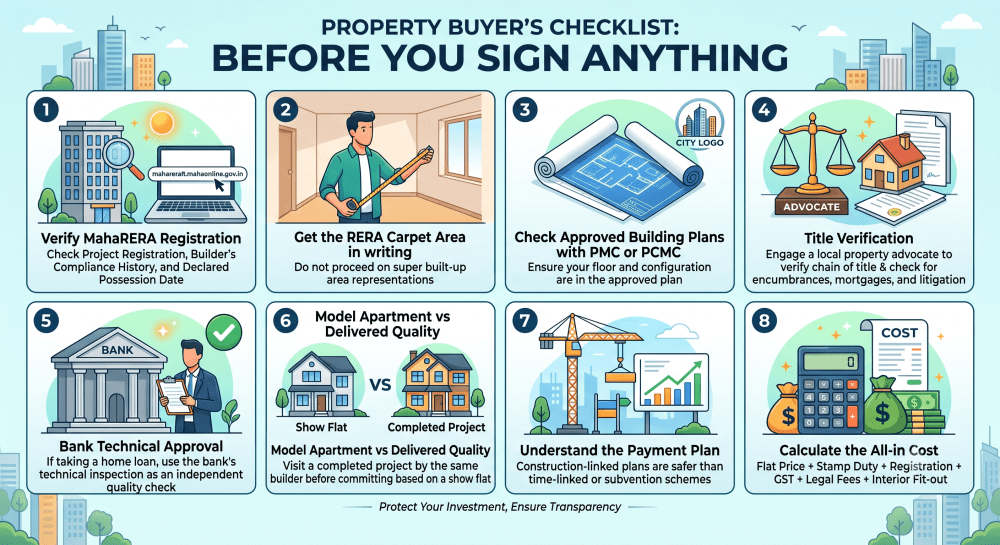
- Mandatory registration: Every under-construction project in Pune must be registered with MahaRERA before marketing. Verify the RERA registration number at maharerait.mahaonline.gov.in before engaging with any builder.
- Carpet area pricing: Builders must quote prices based on carpet area, not super built-up area. This prevents the kind of area inflation that was common before 2017.
- Escrow protection: 70% of all buyer funds must be held in a dedicated escrow account and can only be released against construction milestones. This protects buyers from diversion.
- Delivery timelines: The registered RERA documents commit the builder to a specific possession date. Delays entitle buyers to interest compensation at the SBI MCLR + 2% rate.
- Complaints: If a builder violates RERA commitments, buyers can file complaints directly via the MahaRERA portal - and the process is online, relatively fast, and has a track record of resolving complaints within 90-120 days.
For Pune-specific buyers, two additional checks matter:
- Pune Municipal Corporation (PMC) / PCMC approvals: Ensure the project has valid Commencement Certificate and that the building plans are approved by the relevant municipal body (PMC for Pune city, PCMC for Pimpri Chinchwad, and Pune Metropolitan Region Development Authority for peripheral areas).
- NA and zone clearances: Several projects on Pune's periphery are on land that was recently converted from agricultural (NA conversion). Verify the non-agricultural use certificate is valid and that the zone designation is residential, not agricultural or industrial.
Stamp Duty and Registration in Pune (2026 Rates)
Buying a flat in Pune involves the same stamp duty structure that applies across Maharashtra:
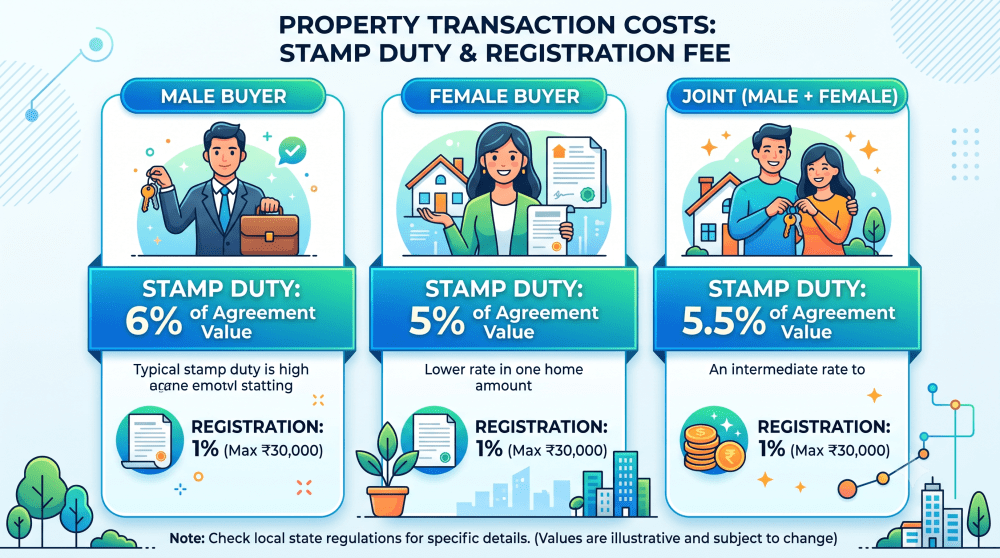
In addition to these, buyers should account for:
- Local body tax / municipality cess: 1% in Pune metropolitan area
- Advocate fees and notary charges: ₹10,000–₹25,000 depending on complexity
- GST (under-construction only): 5% of agreement value for projects without affordable housing status; 1% for affordable housing
- Total transaction cost estimate: Budget 8–10% of the flat's agreement value for stamp duty, registration, GST, and professional fees combined.
Home Loans for Pune Flat Buyers: 2026 Landscape
Pune's working population - heavily skewed towards IT and manufacturing - is among India's most bankable borrower segments, and lenders know it. Current home loan rates in 2026:
- SBI: 8.50%–9.25% p.a. (floating, linked to MCLR)
- HDFC Bank: 8.70%–9.40% p.a.
- ICICI Bank: 8.75%–9.45% p.a.
- LIC Housing Finance: 8.50%–9.10% p.a.
- Eligibility benchmark: For a ₹80 lakh loan (typical for a 2 BHK in Hinjewadi or Wakad), the minimum net monthly income required is approximately ₹85,000–₹90,000 assuming a 20% down payment. Existing EMIs reduce eligibility proportionally.
- First-Time Buyer Tip: If your household income falls within PMAY 2.0 limits (annual income up to ₹12 lakh for EWS/LIG), you may be eligible for the credit-linked subsidy of up to ₹2.67 lakh on your home loan interest. Check with your lender before disbursement, as the benefit must be claimed upfront.
Which Configuration Gives the Best Returns in Pune?
The 2026 data from Pune's more active micro-markets offers a clear directional answer:
- 2 BHK flats remain the market's workhorse - highest liquidity, broadest buyer pool, and the most consistent appreciation track record across Hinjewadi, Kharadi, Viman Nagar and Wakad. A 2 BHK in a RERA-compliant project with metro adjacency in these micro-markets is as close to a market-consensus quality asset as Pune real estate offers.
- 3 BHK flats have outperformed in premium localities (Kalyani Nagar, Kothrud, Baner) where the buyer demographic skews senior and lifestyle-oriented. The absolute appreciation in rupee terms on 3 BHK units has been strong, though the percentage return is comparable to 2 BHK.
- 1 BHK flats offer the best rental yield (typically 5.5–7.5% gross in Hinjewadi and Kharadi, driven by single IT professional demand) but may face liquidity challenges at resale since the buyer pool narrows. Strong for investors oriented towards rental income; less ideal for pure appreciation plays.
Who Is Buying in Pune in 2026?
Understanding the demand composition helps buyers assess their competitive position in any given micro-market:
- IT professionals (30–40%): The largest segment, concentrated in Hinjewadi, Kharadi, and Viman Nagar. These buyers typically have high borrowing capacity, prefer ready-to-move or near-completion inventory, and make decisions relatively quickly once their locality preference is fixed.
- NRI buyers (15–20%): Pune has a disproportionately large NRI buying segment relative to its size - driven by the city's established diaspora in the US, UK, and Gulf. NRIs tend to favour premium mid-luxury projects in Kalyani Nagar, Baner, and Viman Nagar. MahaRERA transparency and FEMA compliance are especially valued by this segment.
- Local end-users (30–40%): Pune-based businesspeople, established professionals, and families upgrading from rental accommodation. These buyers are concentrated in Kothrud, Aundh, and Hadapsar.
- Pure investors (10–15%): Buyers who are not Pune residents and who are purchasing primarily for capital appreciation. Most active in Pimpri Chinchwad, Undri, and the Hinjewadi periphery - areas where entry prices remain low enough to yield meaningful returns at a reasonable risk level.
Common Mistakes Pune Flat Buyers Make in 2026
After advising hundreds of buyers, the patterns are consistent:
- Not verifying MahaRERA registration first. Some builders market unregistered projects (especially plotted and commercial developments that are positioned as "residential-like"). Always start at maharerait.mahaonline.gov.in.
- Comparing carpet area and super built-up area prices. Post-RERA, carpet area is the standard - but some builder marketing materials still quote super built-up. A 1,200 sq ft super built-up flat may have only 780–850 sq ft of actual carpet area. Always ask for the RERA carpet area figure.
- Ignoring infrastructure completion timelines. Multiple buyers have purchased "metro-adjacent" flats in Pune only to discover that the relevant metro station is 3–5 years from completion. Verify the precise station location and confirmed opening date independently.
- Underestimating transaction costs. First-time buyers routinely underestimate the combined impact of stamp duty (5–6%), registration (1%), GST (5%), and moving/fit-out costs. Budget an additional 10% of the agreement value over and above your flat cost.
- Over-leveraging on under-construction projects. The allure of lower launch prices is real, but construction delays in Pune (as across India) are common. Never stretch your borrowing capacity to the maximum on an under-construction project - keep a buffer for EMI servicing during the construction period.
Pune Real Estate Outlook: What to Expect Through 2027
The structural drivers of Pune's property market are healthy:
- Employment: Pune's IT sector continues expanding - Microsoft, Cognizant, Accenture, and IBM have all confirmed capacity expansions in the 2025-26 period. Manufacturing (auto, defence, pharma) remains a stable demand anchor.
- Supply: New launches have been disciplined - developers calibrated supply carefully post-pandemic, and inventory overhang that characterised Pune's 2015-19 slowdown has been largely absorbed. Unsold inventory as a percentage of total supply is at a decade low.
- Metro: The operational Hinjewadi–Shivajinagar line will take 18–24 months to fully influence prices along its corridor. The full impact on Hinjewadi, Wakad, and Baner valuations has not yet been priced in.
- Risks: The primary risk to Pune's real estate market is interest rate sensitivity - a portion of the 2024-25 buyer cohort stretched EMI-to-income ratios in a lower-rate environment. If rates rise materially from current levels, some forced selling could pressure prices in the ₹1–₹1.5 crore segment.
- Consensus analyst forecast for 2026-27: 7–12% price appreciation in the established IT corridor localities (Hinjewadi, Kharadi, Viman Nagar), with peripheral and budget localities (Pimpri Chinchwad, Undri) likely to see sharper gains as metro connectivity matures.
Action Checklist: Buying a Flat in Pune in 2026
Final Word: Is Pune a Good Real Estate Market in 2026?
For most categories of buyer - first-time purchaser, IT professional looking for an owner-occupied flat, or NRI seeking a quality residential investment in a credible Indian city - Pune's 2026 market offers a compelling combination of market depth, price diversity, regulatory protection (MahaRERA), and employment demand that most Tier 2 cities cannot match.
The city is not without risks: some peripheral micro-markets have limited liquidity, construction delays remain a reality despite RERA, and the premium corridors are no longer cheap by any objective measure. But for buyers with a 5–7 year horizon, Pune's real estate fundamentals - employment diversification, metro expansion, disciplined supply - make a strong case.
The opportunity window that existed in Hinjewadi at ₹5,000–₹6,000 per sq ft has closed. The window in Wakad and Pimpri Chinchwad, however, remains open - and metro connectivity will not leave it open indefinitely.
Looking to find RERA-verified flats in Pune? Blox.xyz lists only builder-direct flats with complete documentation and zero brokerage. Explore verified Pune listings on Blox.
Disclaimer: All price data is based on publicly available market reports and builder disclosures current as of mid-2026. Property markets fluctuate - consult a qualified real estate advisor and conduct independent due diligence before any purchase decision.

Get in Touch
Let our experts help you answer your questions

 +91
+91


Get in Touch
Let our experts help you answer your questions
+91