Taloja Real Estate 2026: Affordable Flats, & Why Navi Mumbai's Most Budget-Friendly Locality Is Now the Smartest Buy

Taloja is where Navi Mumbai's affordability story reaches its logical conclusion. With 1BHK flats starting at ₹31 lakh and CIDCO schemes available from ₹22.6 lakh, this locality in the southern stretch of Navi Mumbai offers the lowest entry price of any area within the Mumbai Metropolitan Region that still has credible infrastructure investment behind it.
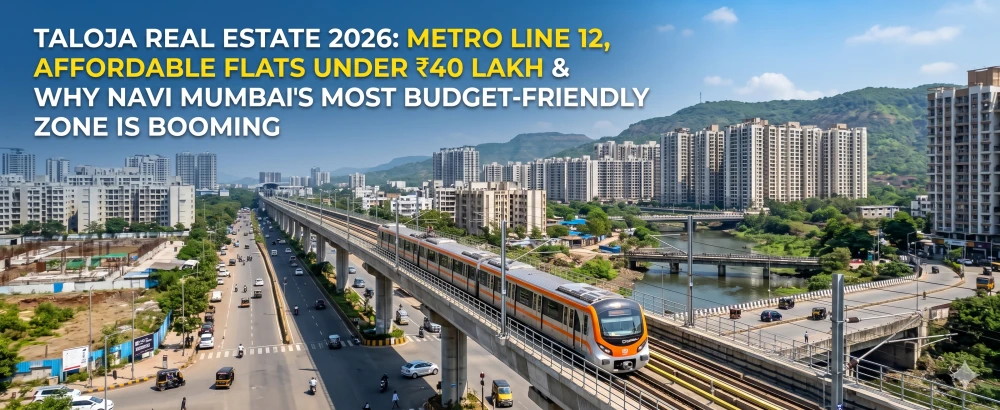
That infrastructure is arriving fast. Metro Line 1 (Belapur-Pendhar) has been running since September 2025, with a station at Pendhar that serves Phase 2 Taloja residents in under 5 minutes. Metro Line 12 (Kalyan-Taloja), spanning 23.756 kilometres, is on track for completion in December 2027. And the newly approved Metro Line 12A, an 18.4-kilometre extension at ₹84.14 billion, extends the metro network further into Taloja's growth corridors.
Add in the Navi Mumbai International Airport (NMIA) that became operational in December 2025, sitting less than 15 kilometres from Taloja, and what you have is an affordable flat market with airport city upside — a combination that buyers in 2026 can still access at entry-level prices.
This guide covers Taloja's flat prices, top projects, CIDCO affordable schemes, metro connectivity, and who should be buying here in 2026.
Taloja in Context: Planning, Location, and Growth Phases
Taloja is a CIDCO-planned node in the Raigad district, falling under the Panvel Municipal Corporation. It sits south-east of Navi Mumbai's established commercial core — approximately 15 kilometres from CBD Belapur and 18 kilometres from Vashi.
The locality is divided into two distinct phases:
Phase 1 (Sectors 1–18): The established section of Taloja, where the original CIDCO residential development is complete. Infrastructure is mature — roads are laid, water supply is functional, and the social ecosystem (schools, hospitals, markets) is reasonably developed. Properties here are primarily secondary market resales from early CIDCO allottees.
Phase 2 (Sectors 19+): The growth zone. This is where new launches are happening, CIDCO is releasing fresh inventory, and the price differential versus Phase 1 creates a compelling opportunity for investors who are comfortable with a 3–5 year horizon. Phase 2 is also where Metro Line 12 will have its primary impact.
Both phases are served by a MIDC industrial belt that provides employment — the Taloja MIDC is one of the largest industrial estates in the Mumbai Metropolitan Region, with pharma, manufacturing, and logistics companies anchoring a substantial permanent workforce.
Taloja Flat Prices in 2026: What You Can Buy at Every Budget
Taloja is Navi Mumbai's most affordable residential market. The data below reflects current market rates:
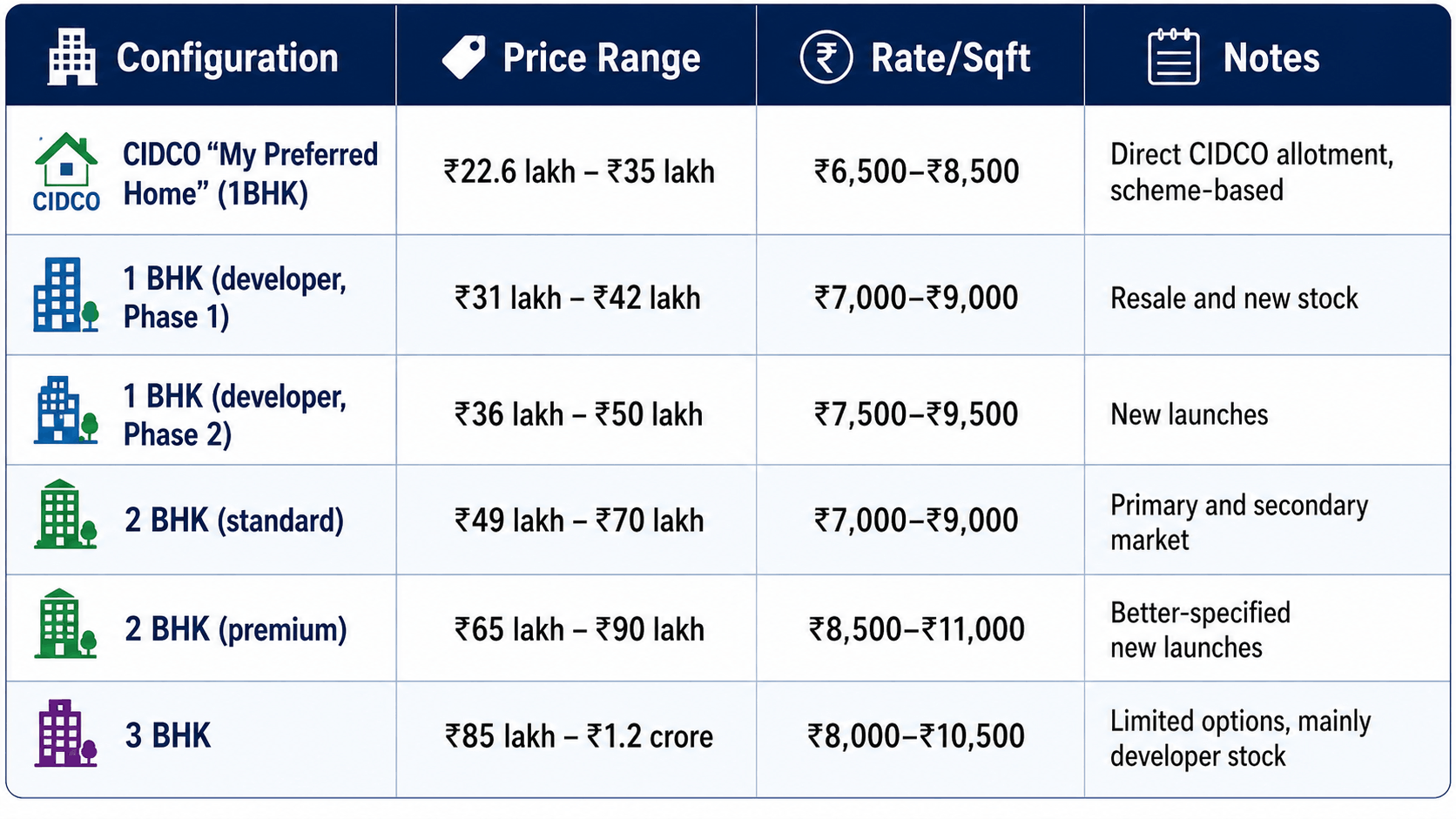
Average rate across Taloja: approximately ₹8,700/sqft.
Price Appreciation:
- 1-year appreciation: 12.8% — significantly above the Navi Mumbai average
- This 1-year number reflects both post-NMIA re-rating and genuine demand absorption from MIDC employment
For context, Taloja's 1-year appreciation of 12.8% is higher than many established Navi Mumbai localities including Vashi (7–9%) and Nerul (6–8%). The market is catching up from a low base.
CIDCO "My Preferred CIDCO Home" Scheme: Affordable Flats from ₹22.6 Lakh
The most significant affordability lever in Taloja is CIDCO's mass housing programme — the "My Preferred CIDCO Home" scheme, which provides subsidised flats across multiple phases and sectors in Taloja at prices well below market.
Key details:
- Entry price: from ₹22.6 lakh for a 1BHK unit
- Target beneficiaries: Economically Weaker Section (EWS), Low Income Group (LIG), and Middle Income Group (MIG) categories
- Total inventory: approximately 85,000 units across multiple phases in Taloja (Phase 1 and Phase 2 sectors)
- Process: Demand survey → application → lottery-based allotment for oversubscribed units → possession
- The scheme supplements but does not replace the open market — private developer launches run in parallel
CIDCO has been the primary developer of Taloja's residential stock, which means a significant portion of the existing housing was originally allotted through these schemes and has since traded on the secondary market. Understanding whether a secondary market resale was originally a CIDCO allotment matters for title verification - CIDCO allotment conditions and transfer rules apply until the flat is fully converted to freehold.
PMAY Integration: CIDCO scheme buyers who qualify under PMAY 2.0 income criteria (annual household income under ₹18 lakh) can additionally claim the Credit Linked Subsidy Scheme (CLSS) benefit — reducing effective home loan interest to 6.5% on the eligible loan portion. This combination of CIDCO pricing and PMAY subsidy makes Taloja the most affordable home-ownership option in Navi Mumbai.
Metro Connectivity: The Infrastructure Case for Taloja in 2026
Taloja's infrastructure upgrade story is primarily a metro story, and it is unfolding across three overlapping lines.
Metro Line 1 (Belapur-Pendhar): Operational since September 2025 This is the game-changer that is already live. Metro Line 1 runs from CBD Belapur through Khandeshwar and terminates at Pendhar, with an elevated stretch along the Belapur-Kharghar-Khandeshwar-Pendhar corridor. Pendhar station is approximately 5 minutes from Phase 2 Taloja by auto-rickshaw or feeder bus.
What this means practically: Taloja residents can now reach CBD Belapur (Navi Mumbai's central business district) in approximately 25 minutes via Metro Line 1 + connecting transport. Pre-metro, this journey could take 45–60 minutes by road. The time savings are already being priced into Phase 2 properties.
Metro Line 12 (Kalyan-Taloja): Under construction, December 2027 The headline infrastructure project for Taloja itself. Metro Line 12 is a 23.756-kilometre elevated metro corridor connecting Taloja to Kalyan in one direction and integrating with the broader Navi Mumbai network in the other. It has dedicated Taloja stations — meaning Phase 1 and Phase 2 residents will have direct metro access, not just feeder-dependent access.
A December 2027 completion places buyers who enter in 2026 ahead of the delivery — the classic "buy before the metro opens" opportunity that has delivered consistent 15–25% appreciation in other Mumbai metro corridors (Andheri, Ghatkopar, BKC).
Metro Line 12A (18.4 km, ₹84.14 billion): Newly approved The recently approved Metro Line 12A extends the metro network further into Taloja's growth sectors. This approval signals both state government commitment to the corridor and the long-term planning horizon for Taloja's infrastructure. The approval was issued in 2026; construction timeline and completion are expected post-2028.
NMIA Impact: How the New Airport Is Reshaping Taloja's Property Story
The Navi Mumbai International Airport (NMIA), which became operational in December 2025, sits approximately 12–15 kilometres from Taloja by road. This proximity has two distinct effects on Taloja's property market:
Airport Economy Employment NMIA created direct employment in aviation, cargo handling, retail, hospitality, and ancillary services. Taloja, as one of the closest affordable residential areas to NMIA, has naturally absorbed a portion of the workforce seeking proximity to the airport at budget prices. This has added a new buyer/renter profile — airport economy workers — to the existing MIDC industrial workforce.
Cargo and Logistics Multiplier Taloja MIDC and the broader Raigad district are positioning as the logistics hinterland for NMIA. Warehousing, cold chain, and last-mile distribution facilities are expanding along the Taloja-Panvel belt. Logistics workers and managerial staff from these facilities add further depth to Taloja's rental demand.
Price Trajectory Signal NMIA's operational status validates the "airport city" narrative that has been driving speculation about the Panvel-Taloja-Ulwe-Dronagiri corridor. Taloja is the affordable residential anchor of this corridor — positioned to benefit from the airport economy without carrying the premium pricing of Ulwe or Dronagiri.
Top Residential Projects in Taloja 2026
Arihant Superstructures (multiple projects) Arihant is the dominant developer in Taloja's Phase 2, with multiple ongoing and recently delivered projects. Their Phase 2 launches are targeted at the ₹35–55 lakh bracket for 1BHK and ₹55–80 lakh for 2BHK. Arihant's Taloja projects have strong track records for RERA-compliant delivery.
Vascon Engineers A listed developer with projects in Taloja targeting the mid-budget segment. Vascon's brand provides a degree of quality assurance that smaller local builders do not.
Ornate Universal Active in the Phase 2 market with 1 and 2 BHK launches. Ornate has been a consistent player in the Navi Mumbai affordable segment.
CIDCO Direct Allotments For buyers willing to go through the demand survey and allotment process, CIDCO direct allotments in Taloja remain the single cheapest option — starting from ₹22.6 lakh. The application process requires registration on the CIDCO portal during demand survey windows.
Reputed smaller developers A number of smaller Navi Mumbai developers have active projects in Taloja Phases 1 and 2. For these, buyers must perform additional due diligence — check MahaRERA registration, verify OC status for ready units, and review the developer's project completion history.
Taloja vs Comparable Affordable Localities: A Comparison
Buyers considering Taloja typically compare it against Kamothe, Kharghar, and Dronagiri. Here is a structured comparison:
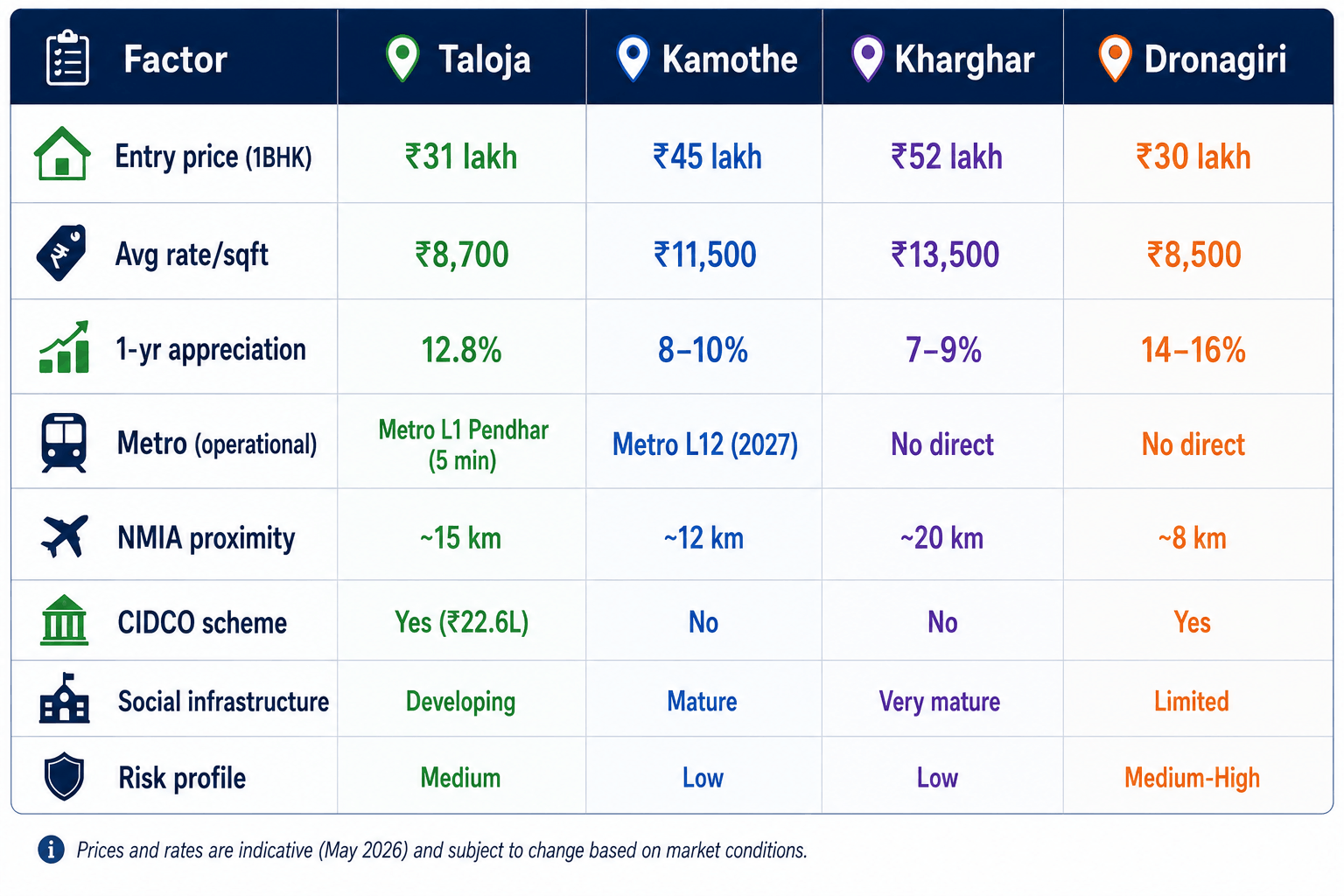
Taloja's advantage is clear on price. Where it concedes is social infrastructure maturity — schools, hospitals, and daily retail in Taloja are present but not as developed as Kharghar or Kamothe. For families with school-age children, this is a real consideration. For young professionals, MIDC workers, and long-term investors, the price-to-infrastructure ratio is compelling.
Taloja MIDC: The Employment Backbone
Taloja MIDC is the industrial estate that underpins the entire Taloja residential market. It is one of the oldest and largest MIDC estates in the Mumbai Metropolitan Region, spanning hundreds of hectares along the Taloja industrial belt.
Key sectors in Taloja MIDC include pharmaceuticals (several large API manufacturers), chemicals, engineering, and increasingly, warehousing and logistics. The estate employs tens of thousands of workers across all skill levels — from factory-floor workers to scientists and engineers in the pharma companies.
This workforce creates two types of residential demand:
Workforce Housing Demand: Workers and supervisors from MIDC estates seek affordable 1BHK accommodation within commuting distance. Taloja's prices make ownership feasible on MIDC salaries — a meaningful driver of primary market absorption.
Mid-Management Upgrade Demand: Engineers, managers, and senior professionals at MIDC companies — many of whom previously rented in Belapur or Kharghar — are increasingly buying 2BHK and 3BHK flats in Phase 2 Taloja, where their budget stretches further than in more established localities.
Who Should Buy a Flat in Taloja in 2026?
Profile 1: The First-Time Buyer Priced Out Elsewhere A professional household with a combined income of ₹10–15 lakh/year who cannot qualify for a mortgage sufficient to buy in Kharghar or Vashi. Taloja's ₹35–55 lakh 1BHK range translates to an EMI of ₹28,000–₹44,000/month at 8.75% on a 20-year loan — achievable on a dual income in the MIDC corridor.
Profile 2: The MIDC/Airport Economy Employee Someone who works in Taloja MIDC, the Panvel logistics belt, or at NMIA and wants to eliminate a long commute. For this buyer, Taloja is not just affordable — it is functionally convenient.
Profile 3: The CIDCO Scheme Applicant A buyer who is eligible for EWS, LIG, or MIG category and wants the cheapest legitimate path to flat ownership in Navi Mumbai. CIDCO allotment + PMAY subsidy makes this category the most powerful home-ownership story in the MMR.
Profile 4: The Yield-Focused Investor An investor looking for rental income from a low-capital-deployment flat. A ₹40 lakh 1BHK in Taloja yielding ₹10,000–₹14,000/month in rent generates a gross yield of 3–4.2% — comparable to or better than yields available in higher-priced localities. The appreciation kicker from Metro Line 12 (December 2027) adds upside.
Profile 5: The Pre-Metro Appreciation Play A buyer or investor who has studied the pattern of how metro opening events affect property prices across Mumbai (Ghatkopar +18%, Andheri West +15%, BKC +22% in the 2-year window around metro delivery). Metro Line 12's December 2027 delivery creates a defined catalytic window that buyers entering in 2026 are ahead of.
Due Diligence Checklist for Taloja Flat Buyers
CIDCO Title Clarity Confirm whether the property is on freehold land or CIDCO-allotted land still under lease. CIDCO allotments carry transfer conditions until premium conversion. Verify the title chain with a qualified property lawyer.
MahaRERA Verification All new projects in Taloja must be registered on MahaRERA. Check the project's registration number, completion date, and any deposited complaints. For CIDCO direct schemes, RERA applicability rules differ — verify with CIDCO directly.
Builder Background Check Taloja has many smaller developers. For any project where the developer is not nationally known, independently verify: how many projects have they completed, did those projects receive OC on time, and are there any MahaRERA complaints against them.
Infrastructure Connection Status Verify that the project has NMMC-compliant water supply, sewage, and electricity connections — not just temporary provisions. Some Phase 2 projects had delays in permanent utility connections.
Occupancy Certificate For ready-to-move properties, the OC is non-negotiable. Without an OC, the building is technically unauthorized, and banks will not provide mortgage finance.
Frequently Asked Questions
Is Taloja a good place to invest in 2026?

What is Taloja's connectivity like currently?
Are CIDCO flats in Taloja a good investment?
How far is Taloja from Mumbai CST?

Get in Touch
Let our experts help you answer your questions

 +91
+91


Get in Touch
Let our experts help you answer your questions
+91