Ulwe Real Estate 2026: Property Prices by Sector, NMIA Impact & Why It's Navi Mumbai's Smartest Investment

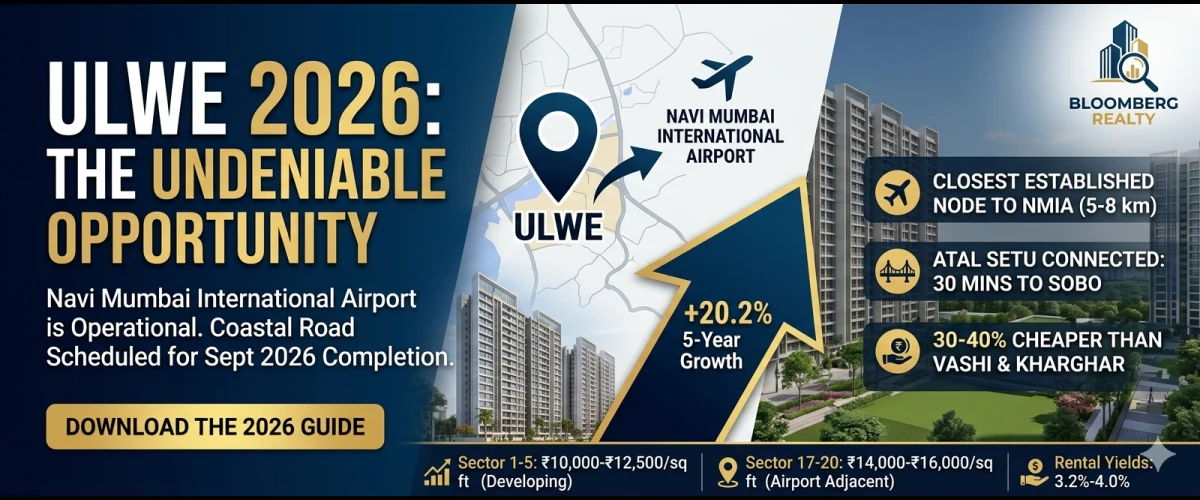
Among all the nodes in Navi Mumbai, Ulwe has had the most dramatic transformation of the past five years — and 2026 may be the year its potential becomes undeniable. A decade ago, Ulwe was a name that drew blank stares. Today, it is among the most-searched real estate destinations in the entire Mumbai Metropolitan Region. The reason is straightforward: Ulwe is the closest established residential node to the Navi Mumbai International Airport (NMIA), and with the airport now operationally live and the Ulwe Coastal Road scheduled for completion by September 2026, every infrastructure piece that sceptics once called "just plans" is now becoming reality. Property prices in Ulwe range from ₹10,000 to ₹16,000 per sq ft, making it 20–30% cheaper than neighbouring Kharghar and 30–40% cheaper than Vashi. If the infrastructure trajectory continues — and all current indicators suggest it will — that discount window is closing. This guide is for buyers who want to understand Ulwe in full: the sectors, the prices, the infrastructure catalysts, the rental income potential, the risks, and a clear action plan for investing in 2026. Why Ulwe Is Navi Mumbai's Most-Watched Node in 2026 The NMIA Catalyst The single biggest driver of Ulwe's real estate story is the Navi Mumbai International Airport. NMIA first welcomed a scheduled commercial flight on December 25, 2025 (IndiGo), and has been scaling up operations through Q1 and Q2 2026. By the end of 2026, it is expected to be handling significant domestic and short-haul international traffic, with full international operations following as terminal infrastructure matures. Ulwe's geography makes it uniquely positioned. The airport lies barely 5–8 km from Ulwe's residential sectors, making it the closest dense residential node to the new terminal. Historically, areas within a 10 km radius of a new international airport see 40–60% property appreciation over the first 5–7 years post-operationalisation — a pattern seen in Hyderabad's Gachibowli-Kokapet corridor after RGIA, Bengaluru's Whitefield after KIAL, and Pune's Wagholi after the Pune Airport expansion. The Infrastructure Cluster NMIA is the headline, but Ulwe benefits from a cluster of infrastructure projects that collectively transform its connectivity profile:
- Ulwe Coastal Road: A 5.8 km six-lane arterial road linking Belapur to the Mumbai Trans Harbour Link (MTHL) at Shivaji Nagar. The project, costing ₹1,591 crore, has an elevated airport link of 0.903 km and has reached 60% physical completion as of May 2026. CIDCO targets completion by September 2026.
- Mumbai Trans Harbour Link (Atal Setu): Already fully operational, the 21.8 km sea bridge connects Sewri (South Mumbai) to Chirle in Navi Mumbai. It has cut travel time from Ulwe to South Mumbai from 90 minutes to under 30 minutes — a transformation equivalent to adding a new suburb to the city's commuter map.
- Navi Mumbai Metro Line 1 Extension (Airport Corridor): The metro extension toward the airport is under construction with expected completion by 2027–28. A metro station near the airport will transform Ulwe's last-mile connectivity and trigger another round of appreciation in sectors along the metro corridor.
- Harbour Line Extension to Ulwe: CIDCO has been planning the Belapur-Ulwe-NMIA rail extension, which will directly connect Ulwe to CST via the Harbour Line. This is a longer-horizon project (estimated 2028–30), but its announcement has already influenced land pricing in the affected sectors.
- Taloja-Khandeshwar Metro Line 2: An additional metro line will further enhance connectivity in the wider Navi Mumbai region, providing Ulwe residents with multiple public transit options over the next three years.
Affordability in a Supply-Constrained Market Mumbai's property market in 2026 is characterised by shrinking affordable options. In Western suburbs, the average 2 BHK starts at ₹1.2–₹1.8 crore even in peripheral locations. In Thane, decent 2 BHK inventory sits at ₹80–₹1.2 crore. Ulwe still offers 2 BHK apartments in the ₹45–₹75 lakh range (in entry-level sectors), making it one of the last large-scale affordable residential markets within 35 km of the Mumbai CBD. Ulwe Property Prices by Sector (2026)
Sector Range | Price (per sq ft) | Dev. Status | Airport Proximity | Key Features |
|---|---|---|---|---|
Sectors 1–5 | ₹10,000–₹12,500 | Established | Moderate (10–12 km) | Most affordable; good for end-users |
Sectors 6–10 | ₹11,500–₹13,500 | Well-developed | Good (8–10 km) | Mix of ready and under-construction |
Sectors 11–16 | ₹12,500–₹14,500 | Developing | Very good (6–8 km) | High appreciation potential |
Sectors 17–20 | ₹14,000–₹16,000 | Premium emerging | Excellent (4–6 km) | Highest premium; airport-adjacent |
Sectors 21–23 | ₹13,500–₹15,500 | Active development | Good (6–8 km) | Coastal road impact zone |
Key Price Data Points (May 2026)
- Average listed rate across Ulwe: ₹14,850/sq ft
- Average transacted rate (negotiated): ₹10,500–₹12,500/sq ft (15–25% below listed)
- Sector 5 average: ₹16,600/sq ft (above-average for developed mid-Ulwe)
- Sector 21 average: ₹14,600/sq ft
- 1 BHK price range: ₹45 lakh – ₹65 lakh
- 2 BHK price range: ₹65 lakh – ₹1.2 crore (sector-dependent)
- 3 BHK price range: ₹1.1 crore – ₹1.8 crore
Negotiation note: A significant gap exists between listed prices (asking ₹14,500+) and closed deal prices (₹10,500–₹12,500). Buyers who engage with sellers directly or through a good broker consistently achieve 15–25% below the asking price in Ulwe. This is a distinguishing feature of a still-developing market and represents an opportunity for savvy buyers.
Price Appreciation History
Period | Appreciation |
|---|---|
Last 1 year | +5.3% |
Last 3 years | +12.5% |
Last 5 years | +20.2% |
Last 8 years | 200–300% |
The 8-year figure is striking: Ulwe has delivered 200–300% total returns since 2018, when the airport project was confirmed but still years from completion. The 5-year appreciation of 20.2% annualises to approximately 3.7% per year — modest in isolation, but remember that this was the patient accumulation phase before infrastructure delivery. The acceleration phase is what analysts expect now. Investment Thesis: Why 2026 Is the Entry Window for Ulwe Infrastructure Delivery = Price Inflection Point Every major infrastructure-linked real estate market follows a similar arc:
- Phase 1 (Announcement):** Early informed buyers enter. Prices rise modestly.
- Phase 2 (Construction):** Gradual price rise. Broad market begins to recognise potential.
- Phase 3 (Delivery):** Infrastructure becomes operational. Sharp price rise as demand floods in.
- Phase 4 (Maturity):** Prices stabilise at a new, higher base.
Ulwe in May 2026 sits at the Phase 2 / Phase 3 transition — the inflection point historically associated with the strongest short-to-medium-term returns. NMIA is operational. Atal Setu is operational. The Coastal Road is 60% complete and due by September 2026. Phase 3 demand has not yet been fully priced in.
The comparable case of Panvel — where prices jumped 35–40% in the 18 months following NMIA's first flights — is instructive. Ulwe, being even closer to the airport, is expected to track a similar trajectory, but its larger residential inventory means the appreciation may be more gradual and sustained rather than spike-and-plateau.
The Discount Will Close
Currently, Ulwe trades at a **20–30% discount to Kharghar** and a **30–40% discount to Vashi.** Both of those markets have matured and are constrained by lack of developable land. Ulwe still has active CIDCO-released plots and developer activity, but the pace of new supply is being absorbed faster than it is being created. The discount to Kharghar specifically is expected to compress to 10–15% by 2028–2030 as infrastructure fully matures, implying a 15–20 percentage point uplift from convergence alone.
Rental Yield: Earning While You Wait
For investors who want income rather than pure capital appreciation, Ulwe's rental market is developing alongside its residential base:
Unit Type Monthly Rent (2026) Annual Yield 1 BHK ₹12,000–₹18,000 3.0%–3.8% 2 BHK (Sectors 9–17) ₹18,000–₹28,000 3.2%–4.0% 3 BHK (premium sectors) ₹28,000–₹40,000 3.0%–3.5%Rental Yields by Unit Type
- Infrastructure Delays Infrastructure timelines in India have historically slipped. The Harbour Line extension to Ulwe, for example, has been in planning for years. Buyers should base their investment case on confirmed/partially-completed projects (NMIA, Atal Setu, Coastal Road) rather than announced-but-not-started ones.
- Developer Risk in Under-Construction Projects Some smaller developers active in Ulwe have weaker balance sheets than established players. Always buy from RERA-registered projects. Check the builder's track record on delivery timelines using the MahaRERA portal before committing to an under-construction purchase.
- Civic Infrastructure Gaps Some sectors still lack reliable water supply, sewage, and road connectivity. Before finalising a property, visit the site during a weekday, verify water pressure and supply hours, and check CIDCO's published infrastructure rollout timeline for that sector.
- Price Negotiation Gap The 15–25% gap between listed and transacted prices means that buyers who don't negotiate effectively could overpay significantly. Work with a buyer-side broker who has access to recent transacted data (not just listing portals).
- Rental Void Risk The tenant base in Ulwe is still building. New investors should budget for 1–2 months of rental void per year while the rental market matures, particularly in sectors where the working population is not yet fully established.
Ulwe vs. Other Navi Mumbai Nodes
Key insight: Panvel has already captured much of the NMIA-led appreciation spike. Ulwe offers a similar fundamental thesis at a slightly earlier stage of the appreciation curve, with better infrastructure connectivity (especially via Atal Setu to Mumbai proper) than Panvel. Common Mistakes Buyers Make in Ulwe
Parameter
Ulwe
Kharghar
Panvel
Taloja
Price (per sq ft)
₹10K–₹16K
₹14K–₹22K
₹8K–₹14K
₹6K–₹10K
Airport proximity
Excellent
Moderate
Very Good
Poor
1-year appreciation
5.3%
8–10%
12–15%
6–8%
Rental yield
3.0–4.0%
2.8–3.5%
3.5–4.2%
2.5–3.0%
- Choosing the Wrong Sector for Their Objective An investor buying for capital appreciation should target Sectors 17–20, not Sectors 1–5. An end-user who needs to move in immediately should buy in well-developed Sectors 1–8, not an under-construction Sector 17–20 project with a 2027 possession.
- Not Verifying RERA Registration Always check the MahaRERA portal before paying any booking amount. Verify that the RERA registration number is valid, the project is not on the defaulter list, and the promised completion date is credible.
- Buying Based on Listing Prices Alone Ulwe's significant gap between listed (₹14,500+) and transacted (₹10,500–₹12,500) prices means that relying solely on listing portals for pricing data will give an inflated picture. Work with a local broker who can share recent sale registrations (available at the Sub-Registrar office).
- Underestimating Infrastructure Timelines The metro and Harbour Line to Ulwe are likely 3–5 years away from completion. Buyers who plan to exit within 2 years should base their thesis on already-operational infrastructure (NMIA, Atal Setu, Coastal Road), not future projects.
- Ignoring Builder Credentials Ulwe has a mix of established developers (Neelkanth Group, Cidco projects, established builders) and smaller regional developers. Smaller developers may offer lower prices but carry higher delivery risk. Verify the developer's last 2–3 completed projects before booking.
Buyer's Action Plan: How to Buy in Ulwe in 2026 Step 1: Define your objective (end-use, investment, rental income) and set a clear budget including stamp duty (5%), registration (₹30,000), GST (5% for under-construction), and broker fee (1–2%). Step 2: Select your target sector based on the objectives framework above (Sectors 1–8 for end-users; 17–20 for investors; 11–14 for value investors). Step 3: Shortlist 3–5 projects — check MahaRERA registration, possession date, and builder track record for each. Step 4: Visit the site — assess proximity to schools, hospitals, local markets, and water supply. Also check road conditions (unpaved roads in developing sectors add maintenance costs and commute friction). Step 5: Get transacted comps — ask your broker to share the last 5–10 sale registrations in the building or sector. Use this to anchor your negotiation 15–25% below the asking price. Step 6: Legal due diligence — engage a property lawyer to verify title, clear encumbrance, and ensure the sale agreement is RERA-compliant. Step 7: Register the property — pay stamp duty at the Sub-Registrar's office. Ensure the registered agreement matches the agreed price and all included amenities. Conclusion: Is Ulwe Worth Buying in 2026? The honest answer is: for the right buyer, Ulwe in 2026 is among the most compelling real estate investments available in the Mumbai Metropolitan Region. It has everything an infrastructure-led investment thesis needs: a major airport now operational and scaling, a sea bridge (Atal Setu) that has already transformed Mumbai connectivity, a coastal road on track for 2026 completion, and an affordable price point (₹10,000–₹16,000/sq ft) that leaves significant headroom for appreciation before Ulwe reaches parity with Kharghar or Panvel. The risks are real — infrastructure delays, developer quality variation, and the negotiation gap. But for buyers who do their homework, choose the right sector and developer, and hold for a 5–7 year horizon, Ulwe is the kind of investment opportunity that is discussed with regret by those who wait too long. Ready to explore verified Ulwe properties? Blox.xyz for curated listings, sector-wise price comparisons, and expert guidance on buying in Navi Mumbai's most dynamic market.

Get in Touch
Let our experts help you answer your questions

 +91
+91


Get in Touch
Let our experts help you answer your questions
+91