Dronagiri Real Estate 2026: NMIA Airport Impact, Property Prices & Why It's Navi Mumbai's Best-Kept Investment Secret

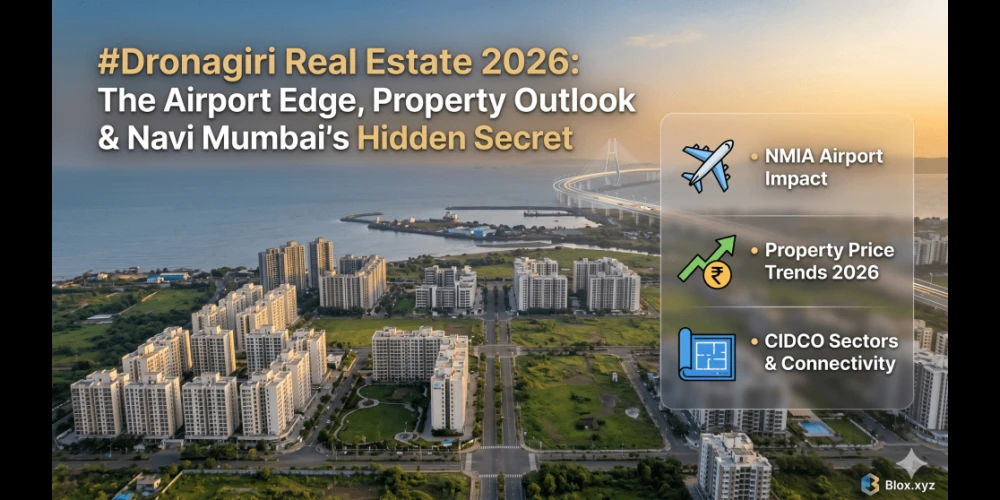
Navi Mumbai has quietly been building its reputation as one of the most compelling real estate destinations in the Mumbai Metropolitan Region (MMR). While Kharghar, Panvel, and Ulwe have attracted most of the attention, a smaller, lesser-known node has been steadily rising in the background - Dronagiri.
Tucked into the southern tip of Navi Mumbai, Dronagiri is a CIDCO-planned township that sits at the intersection of industrial momentum, airport proximity, and serious long-term infrastructure development. In 2026, it is no longer just a sleepy port-adjacent suburb. It has emerged as one of the most strategically located micro-markets in all of MMR - and one of the most underpriced given everything that's happening around it.
This guide covers everything you need to know about Dronagiri real estate in 2026: current property prices, CIDCO sectors, connectivity improvements, the transformative impact of Navi Mumbai International Airport (NMIA), and a clear-eyed investment assessment to help you decide if Dronagiri belongs in your portfolio.
What Is Dronagiri? An Overview of This Navi Mumbai Node
Dronagiri is one of Navi Mumbai's southernmost CIDCO nodes, located in the Raigad district of Maharashtra. It is bounded by Uran to the east, the Arabian Sea to the west, and is closely linked to the Jawaharlal Nehru Port Trust (JNPT) - one of India's busiest container ports — making it a centre of logistics and port-related economic activity.
The township is part of what urban planners increasingly call the "Airport Influence Zone" - a corridor of nodes that includes Ulwe, Dronagiri, Chirle, and Uran, all of which fall within a 15–20 minute drive of the new Navi Mumbai International Airport at Panvel-Ulwe.
CIDCO has divided Dronagiri into numbered sectors (Sector 1 through Sector 25+), each designated for specific land uses ranging from residential to commercial and logistics. The township infrastructure includes wide internal roads, parks, schools, and civic amenities - hallmarks of CIDCO's planned development model that makes it distinct from the organic, chaotic growth common to older Mumbai suburbs.
Key facts at a glance:
- Location: Raigad District, Navi Mumbai
- Development authority: CIDCO (City and Industrial Development Corporation of Maharashtra)
- Nearest port: Jawaharlal Nehru Port Trust (JNPT)
- Nearest airport: Navi Mumbai International Airport (NMIA) - approximately 15 km
- Major road: Uran–Panvel Road, JNPT Road
- Rail connectivity: Nerul–Uran railway line
Dronagiri Property Prices in 2026: What Are Flats Costing?
The most striking feature of Dronagiri's real estate market in 2026 is the disconnect between its strategic value and its current price point. This gap is precisely what makes it an exciting proposition for long-horizon investors.
Current Average Property Rates
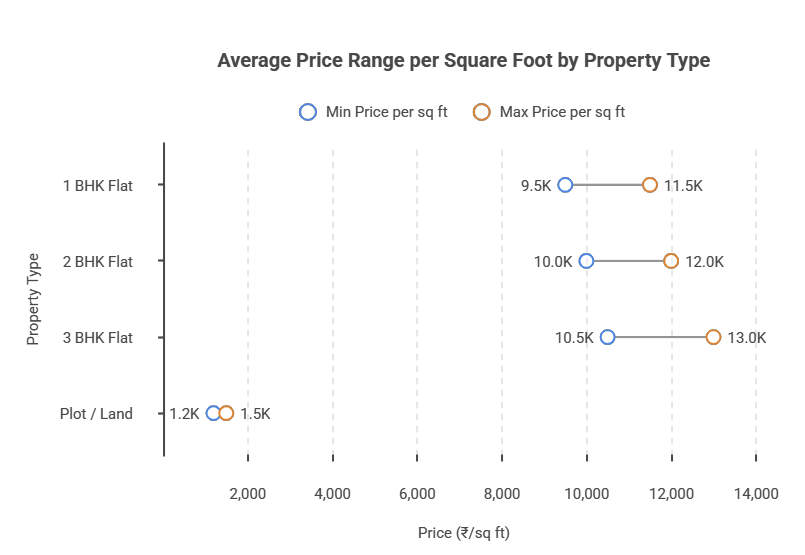
The overall average flat rate in Dronagiri is approximately ₹10,700 per sq ft — a figure that has risen roughly 3.9% in the past year and 4.9% over three years. These are still very affordable numbers by Navi Mumbai standards, where mature markets like Kharghar and Vashi command ₹14,000–₹20,000 per sq ft.
Historical Price Journey
A useful benchmark for understanding where Dronagiri is on its price curve: 1 BHK flats that originally sold for ₹20–22 lakh are now changing hands in the resale market at ₹45–50 lakh. That's a doubling in value over roughly 7–8 years, driven by the slow but steady improvement in infrastructure and the announcement of the NMIA project.
The next phase of appreciation, however, is expected to be sharper and faster — driven by actual operational milestones rather than just announcements.
The NMIA Effect: How the New Airport Is Reshaping Dronagiri's Trajectory
If there is one factor that will define Dronagiri's property story over the next five to ten years, it is the Navi Mumbai International Airport (NMIA).
The airport, situated near the Ulwe-Panvel corridor, is one of the largest greenfield airport projects in India. Once operational, it will serve as a second gateway to Mumbai, relieving pressure from the congested Chhatrapati Shivaji Maharaj International Airport (CSMIA) at Andheri.
Why Dronagiri Specifically Benefits
Dronagiri's benefits from NMIA stem from three specific factors:
- Physical Proximity: Dronagiri lies approximately 15 km from the airport site. For airport-related workers — pilots, cabin crew, ground staff, cargo handlers, maintenance engineers — affordable housing close to the airport will be in high demand. Dronagiri's price point makes it the natural answer.
- Airport Influence Zone Designation: CIDCO has proactively designated several plots in Dronagiri as part of the Airport Influence Zone (AIZ), reserving land for commercial, hospitality, and logistics uses that will support airport operations. This commercial activity creates a secondary halo effect on nearby residential areas.
- Cargo and Logistics Growth: Dronagiri's existing proximity to JNPT means it already hosts logistics-related employment. NMIA will layer on air cargo handling, creating additional employment catchment in the immediate area.
Market experts report that property prices in key NMIA-proximate localities have already increased by 30% to 50% in the last three years — though Dronagiri's own appreciation has been more modest (owing to its slightly longer drive distance from the airport site), leaving room for further catch-up.
What the Airport Timeline Means for Buyers
For buyers entering Dronagiri in 2026, the airport opening represents a binary inflection point. Historically, real estate near large infrastructure projects follows a three-phase pattern:
- Phase 1 (Pre-announcement): Prices flat or slowly rising
- Phase 2 (Announced, under construction): Prices begin appreciating as early investors enter
- Phase 3 (Operational): Sharp appreciation as real demand kicks in
Dronagiri is currently in Phase 2, which historically offers the best risk-reward balance for investors willing to hold for 4–8 years.
CIDCO Sectors in Dronagiri: What You Need to Know
Dronagiri's internal geography is defined by its CIDCO sectors, each with a specific character and price band. Understanding which sectors suit which type of buyer is essential before making a purchase.
Residential Sectors: The primary residential sectors in Dronagiri (Sectors 5, 7, 9, 12, 15) offer a mix of CIDCO-built tenement housing and private developer projects. CIDCO Sector 12 is one of the most active, with budget-friendly projects well-connected via the Uran–Panvel Road and JNPT Road.
Key amenities across residential sectors include:
- CIDCO-maintained parks and gardens
- Government schools and private educational institutions
- Primary health centres and private clinics
- Local market clusters
Industrial and Port-Adjacent Sectors
Sectors closer to the JNPT waterfront are zoned for industrial, warehousing, and logistics activity. These are not suitable for residential investment but create the employment base that sustains residential demand in the township.
CIDCO Auction Plots
In a significant move in early 2026, CIDCO announced the auction of 30 premium plots near the Navi Mumbai International Airport, including plots in the Dronagiri and Ulwe corridors, designated for bungalows and commercial development. This auction signalled CIDCO's intent to accelerate high-value development in the Airport Influence Zone and is expected to set new price benchmarks for the area.
Connectivity: Getting To and From Dronagiri
One of Dronagiri's historical limitations has been connectivity — it sits at the edge of the Navi Mumbai network, connected to the mainland via a limited road and rail network. In 2026, this is changing rapidly.
Rail: Nerul–Uran Line
The Nerul–Uran railway line — part of the Harbour Line extension — provides rail connectivity from Dronagiri/Belapur stations all the way to Chhatrapati Shivaji Maharaj Terminus (CSMT) via Nerul and Vashi. While travel time is still significant (roughly 60–75 minutes to CSMT), the rail link makes Dronagiri viable for Mumbai-based workers and gives it far better connectivity than pure road-reliant nodes.
Future extensions of this rail corridor toward NMIA are under planning, which would dramatically cut travel times.
Road: JNPT Road and Uran–Panvel Road
The primary road spine connecting Dronagiri to the wider Navi Mumbai network runs through the Uran–Panvel Road and the JNPT Road network. While these roads can get congested near the port, the overall road quality is reasonable and CIDCO has been widening key arteries.
Mumbai Trans Harbour Link (MTHL) — A Game-Changer
The Mumbai Trans Harbour Link (MTHL) — also known as the Sewri–Nhava Sheva Sea Link — is the most important infrastructure upgrade for Dronagiri and the entire Navi Mumbai coastal belt. This 21.8 km sea bridge connects Sewri in Mumbai to Nhava Sheva in Navi Mumbai, dramatically reducing travel time between South Mumbai and the Navi Mumbai coastal nodes.
From Dronagiri, the MTHL cuts the journey to South Mumbai to under 30 minutes — a distance that would take 90+ minutes via the Sion-Panvel Highway. This has fundamentally altered Dronagiri's commuter viability, opening it up to a much larger pool of potential residents who work in South Mumbai or BKC.
Who Should Buy in Dronagiri in 2026?
Dronagiri's profile as a real estate destination is distinct. It is not for everyone, but for the right buyer, it represents an exceptional opportunity.
Ideal Buyer Profiles
- Long-horizon investors (5–10 years): The combination of NMIA, MTHL, port expansion, and CIDCO's active plot auctions creates a powerful multi-driver appreciation thesis. Investors willing to be patient stand to benefit from a convergence of catalysts.
- Budget buyers from Greater Mumbai: With prices starting under ₹40 lakh for a 1 BHK, Dronagiri is one of the few places within the Mumbai Metropolitan Region where first-time buyers with a combined household income of ₹60,000–₹80,000/month can realistically aspire to homeownership.
- Airport-economy workers: Pilots, cabin crew, airport operations staff, cargo handlers, and ground service professionals who will work at NMIA will need affordable, well-connected housing. Dronagiri fits this profile.
- Port and logistics sector professionals: JNPT employs thousands directly and indirectly. Workers and mid-level professionals in this sector often prefer Dronagiri's proximity and affordability.
Who Should Probably Wait
- Short-term investors (< 3 years): Dronagiri is not a quick-flip market. Appreciation is meaningful but gradual, and liquidity is lower than in more established nodes like Kharghar or Vashi.
- Buyers needing immediate lifestyle amenities: The node's retail, dining, and entertainment infrastructure is still maturing. Buyers accustomed to the amenity density of Kharghar or Powai may find Dronagiri austere.
Dronagiri vs. Comparable Navi Mumbai Investment Options
How does Dronagiri stack up against the other Navi Mumbai investment destinations featured in the Blox cluster?
|
Parameter |
Dronagiri |
Panvel |
Ulwe |
Kharghar |
|
Avg Rate
(₹/sq ft) |
₹10,700 |
₹7,500–₹11,000 |
₹8,000–₹12,000 |
₹10,000–₹16,000 |
|
NMIA Distance |
~15 km |
~10 km |
~8 km |
~20 km |
|
Rental Yield |
3.5–4.5% |
3–4.5% |
3–4% |
3–4% |
|
Investment
Horizon |
5–10 years |
3–8 years |
3–7 years |
2–5 years |
Dronagiri occupies a unique niche: the lowest entry price among NMIA-proximate nodes, with one of the strongest employment-driven demand bases (port activity + future airport). The trade-off is lower current liquidity and longer appreciation timelines.
Rental Market in Dronagiri: Yields and Tenant Profile
For buy-to-let investors, Dronagiri offers a functional if not spectacular rental market in 2026.
Current Rental Rates
| Flat Type | Monthly Rent Range |
| 1 BHK | ₹7,000 – ₹12,000 |
| 2 BHK | ₹12,000 – ₹20,000 |
| 3 BHK | ₹20,000 – ₹30,000 |
Gross rental yields in Dronagiri currently range from 3.5% to 4.5% — decent for a suburban node of this stage of development, and higher than the Mumbai city average of 2.5–3%.
Tenant demand is primarily driven by:
- Port and shipping industry workers (stable, long-tenure tenants)
- Workers from MSME and logistics units in nearby Taloja MIDC
- Young families relocating from Uran and surrounding areas seeking better civic infrastructure
As NMIA comes online, a new cohort of airport workers will add significant rental demand pressure to the Dronagiri market.
Common Buyer Mistakes to Avoid in Dronagiri
Given that Dronagiri is an early-stage market with limited transaction history compared to mature Navi Mumbai nodes, buyers need to be especially vigilant.
- Skipping MahaRERA verification: Always verify that any project you're buying into is registered with MahaRERA. Dronagiri has had some smaller developers operating in grey zones; insist on a valid RERA registration number before signing any agreement.
- Ignoring floor plans relative to sector zoning: In industrial-adjacent sectors, noise and truck traffic can be a real quality-of-life issue. Ensure your residential unit is in a clearly residential sector and check the local zoning map.
- Buying primarily for short-term appreciation: Dronagiri will reward patience. Buyers expecting 20–30% gains in 1–2 years are likely to be disappointed. Build a 5–8 year horizon into your financial plan.
- Overlooking home loan options: Several national banks and HFCs now have dedicated products for CIDCO-area properties. Compare loan offers from SBI, HDFC, and Kotak before choosing. NRI buyers should review FEMA guidelines before purchasing. (See our NRI Buyers Guide for details.)
- Not factoring in stamp duty and registration costs: Maharashtra charges stamp duty at 6% (5% stamp duty + 1% metro cess) for properties above ₹30 lakh. On a ₹65 lakh flat, this adds approximately ₹3.9 lakh to your total cost — budget accordingly.
Infrastructure Projects That Will Further Boost Dronagiri in 2026–2030
Beyond NMIA and MTHL, several other infrastructure developments are set to reinforce Dronagiri's long-term value:
- Navi Mumbai Metro Line Extension: CIDCO's metro network expansion includes a planned corridor that will improve connectivity between Dronagiri/Belapur and the core Navi Mumbai nodes. Exact timelines are still being firmed up but clearances are advancing.
- JNPT Port Expansion (Phase 4): JNPT's ongoing expansion — targeting capacity of 10 million TEUs — will drive further job creation in logistics, warehousing, and port services, directly benefiting Dronagiri's residential demand.
- Chirle and Third Mumbai Corridor: CIDCO's "Third Mumbai" master plan encompasses the Chirle–Dronagiri corridor as part of a new urban development zone. This long-term plan envisions significant commercial and residential development in the southern Navi Mumbai belt.
- Smart City Components: Dronagiri has been incorporated into CIDCO's smart city framework, with investments in underground utilities, smart surveillance, solar-powered street lighting, and digital civic services infrastructure — all of which enhance livability and long-term value.
Investor Action Plan: How to Buy Property in Dronagiri in 2026
If you're convinced that Dronagiri fits your investment thesis, here's a practical step-by-step guide:
- Step 1: Define your budget and timeline clearly. Given Dronagiri's appreciation profile, have at minimum a 5-year hold horizon and ensure the purchase doesn't compromise your liquidity.
- Step 2: Shortlist RERA-registered projects in residential sectors.** Focus on Sectors 5, 9, 12, and 15 for maximum residential amenity and future resale appeal. Verify each project on the MahaRERA portal.
- Step 3: Assess connectivity from the specific sector. Proximity to the Nerul–Uran railway station is a significant value driver for rental tenants and future resale buyers. Prioritise projects within 1–2 km of station access.
- Step 4: Evaluate developer credibility. In a market of this maturity, developer track record matters enormously. Prefer developers with at least 3–5 delivered projects in Navi Mumbai.
- Step 5: Get pre-approved for a home loan. Banks including SBI, HDFC, and LIC Housing Finance offer loans for CIDCO properties. Compare interest rates (currently 8.5%–9.5% for floating rate home loans) and processing fees.
- Step 6: Use Blox.xyz to search verified listings. Blox.xyz aggregates verified listings across Navi Mumbai's emerging nodes, including Dronagiri. You can filter by RERA status, developer, and budget range.
Conclusion and CTA
Dronagiri in 2026 is the kind of real estate story that is easy to dismiss too early and regret missing too late. The combination of CIDCO-planned infrastructure, JNPT employment base, MTHL connectivity, NMIA proximity, and a sub-₹11,000-per-sq-ft price point is not a coincidence — it is the definition of an early-stage opportunity in a fundamentally sound, development-backed market.
The investors who entered Kharghar a decade ago at similar price points have since seen their investments multiply multiple times over. Dronagiri's journey is earlier and the time horizon is longer — but the structural drivers are at least as compelling.
If you're ready to explore Dronagiri property options or want to speak with a verified advisor, visit blox.xyz today. Blox.xyz connects Mumbai home buyers with RERA-verified projects and experienced real estate professionals who know Navi Mumbai's emerging markets intimately.

Get in Touch
Let our experts help you answer your questions

 +91
+91


Get in Touch
Let our experts help you answer your questions
+91